Seeing Jesus in One Another, One Person at a Time

Today is the last Sunday in Ordinary Time. Next Sunday will begin the new year in the Church calendar as we begin Advent. In today’s Gospel from Matthew, Jesus offers a parable about the Judgment of the Nations that addresses the key criterion for judgment. Jesus eloquently clarifies what will determine eternal punishment and what will determine eternal life. It comes down to how we treat one another. Are we indifferent, blind to another’s suffering, or are we willing to bother, to get involved, to be, as Fr. James Keenan, S.J. wrote, “willing to enter the chaos of another.”
The gift of our faith is that Christianity is personal. We serve Jesus in being aware of and encountering one another. We are not to be about bringing world peace, ending hunger, providing homes for all. We are instead to be about treating each person we meet with dignity, we are to feed someone hungry, and to provide clothes and shelter for someone who has none. We are to see Jesus in our midst: “For I was hungry and you gave me food, I was thirsty and you gave me drink, a stranger and you welcomed me, naked and you clothed me, ill and you cared for me, in prison and you visited me.” (Mt 25:35-37). Jesus commands us to be aware, to accompany, and to make a difference, one life at a time.
We may feel there is so much need and that one can easily get overwhelmed with it all. We can easily slip into the belief that there is so much that needs to be done that no one person can even make a difference. How do we even begin? One place to begin could be to pay attention to our interests and emotions. What do you find you spend your time doing already? When you read or hear a news report, what gets under your skin? This could be God speaking to you, moving you to help. The key is to resist looking out too broadly when we are willing to see. Instead, it is more helpful to begin by making a commitment to making a difference one person at a time. Visit one person in a nursing home, bring communion to a neighbor, or be a big brother or big sister to a child. By starting small there is more of a chance that we will begin to move.
We begin each day with ourselves, adjusting our attitude outward, while at the same time making a commitment to serve Jesus in one another. God is guiding us already, we just need to have eyes to see, ears to hear, and a willingness to reach out to another. A positive step would be to take this week to look back at the year, or month and evaluate how we have done in being aware of where we were willing to enter the chaos of another and where we weren’t. Then for assistance on how we can do better, may we spend some time reading and meditating on the Beatitudes and chapter 25 of Matthew. As Pope Francis said in his 2014 homily these are:
“Few words, simple words, but practical for all. Because Christianity is a practical religion: it is not just to be imagined, it is to be practiced. If you have some time at home today, take the Gospel, Matthew’s Gospel, chapter five. In the beginning, there are the Beatitudes; in chapter 25 the rest. And it will do you good to read them once, twice, three times. Read this programme for holiness. May the Lord give us the grace to understand his message.”

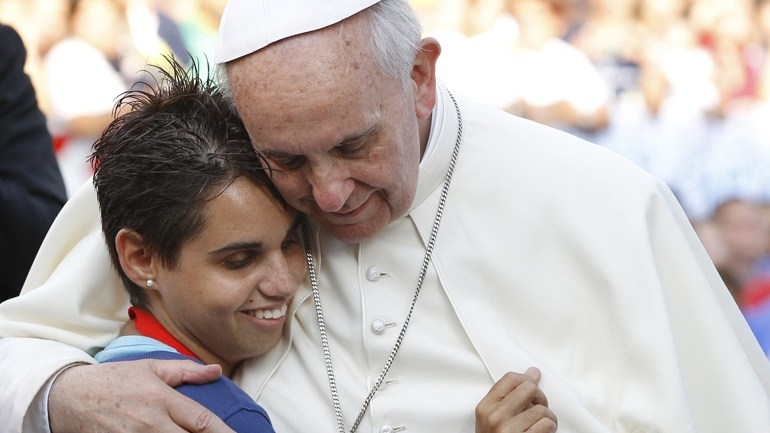
Pope Francis photo credit: Paul Haring, CNS

Fr James Keenan article on Mercy:

http://www.thinkingfaith.org/articles/scandal-mercy-excludes-no-one

Pope Francis homily, 6 September 2014:

http://en.radiovaticana.va/news/2014/06/09/pope_the_beatitudes,_a_practical_programme_for_holiness/1101553

Experience the Foretaste of Heaven

The Sadducees present an absurd scenario for Jesus to respond to: a woman’s spouse died leaving her childless and then successively married her husband’s six brothers who all died, also leaving her childless. The question from the Sadducees was, whose wife of the seven brothers would she be when the woman died? What the Sadducees were really getting at was to have Jesus weigh in on his views about whether there was or was not a resurrection of the dead.
The Sadducees did not believe in a resurrection of the dead because they only believed in the Torah, the law or the teachings, what we as Christians today recognize as the first five books of the Old Testament. In the Torah, there is no overt reference to the resurrection. The Pharisees, having an oral Torah, oral tradition beyond and oral interpretation of the Torah, did recognize the resurrection of the dead. Jesus deftly answered the question by keying in on the Sadducees foundational claim that the Torah does not address the resurrection when he stated: “That the dead will rise even Moses made known in the passage about the bush, when he called ‘Lord’ the God of Abraham, the God of Isaac, and the God of Jacob; and he is not God of the dead, but of the living, for to him all are alive”  (Lk 20:37-38). Jesus clearly pointed out that God was not a God of the dead but of the living.
The deeper reason for the question was ultimately, and is the question that also arises today, “What goes on in heaven? What do we do all day?” Jesus’ response to the Sadducees then and us today is: “The children of this age marry and remarry; but those who are deemed worthy to attain to the coming age and to the resurrection of the dead neither marry nor are given in marriage. They can no longer die, for they are like angels; and they are the children of God because they are the ones who will rise” (Lk 20:34-36). What Jesus means is that heaven is a different reality than we experience now. Heaven is a different dimension of existence. We will no longer marry because we will be living eternally, there will be no death, no more need to procreate.
Also, heaven is not so much a geographical place as it is a relationship and experience of a deeper communion with God. We want to know what we are going to do there, because we are attached to what we have and what we do here. In heaven, we will experience the fulfillment of that which we have been created for, that which we truly crave and hunger for, that which will fulfill our deepest longing, which is to look upon God face to face, what theologians call the beatific vision. Many would scoff and say, “That’s it?” I am sure there is more, but if that was all, there would be more joy, more acceptance, more totality of being, than we could ever imagine or embrace in just a second of that eternal gaze. As the psalmist wrote: “Better one day in your courts than a thousand elsewhere” (Psalm 84:11).
Definitively speaking, heaven is a mystery to us. Again, the Mystery of God is not a problem to be solved but a relationship to experience and develop. This is why prayer, worship, encounter, relationships, and experiencing God’s creation are so important because each are encounters with the living God, each are a foretaste of heaven. If we are only tied to the material, the finite, our self apart from others, we will succumb to attachments and addictions that will create walls of division and separation such that we cannot even begin to conceive of the eternal or spiritual ground and foundation of our existence.
May we be more mindful today to make some time for prayer, rereading some of today’s reading and pondering it, wondering about the gift of an eternal communion with God and what that would be like to see God face to face. Head to worship with a community of faith this weekend, and actually sing during the service. God does not implore that we sing well, but only that we make a joyful noise unto the Lord (cf Psalms 98, 100). During the Mass,  heaven and earth become one through the presence of Jesus in his people gathered, his word proclaimed, and his real presence in the Eucharist.  In our homes and in our everyday experiences, may we really experience, accompany, and be with the people around us, talking and listening to one another. May we seek a ministry of service that we can participate in regularly or invite someone to join us if we are already active. May we spend some time immersed in God’s creation, whether taking a walk, taking long deep breathes while looking at the starry night, or just sitting and watching all the gifts of life pass by, birds, otters, bobcats, or whatever may cross our path. Each of these are opportunities to encounter the God of all creation and to experience the foretaste of heaven!

Photo: Family of bobcats that were playing in our backyard a few months back.
Link for today’s Mass readings:
http://www.usccb.org/bible/readings/112517.cfm


Jesus Cast Out From Us All that would Defile Us.

Jesus entered the temple area and proceeded to drive out those who were selling things, saying to them, “It is written, My house shall be a house of prayer, but you have made it a den of thieves” (Lk 19:45-46).
Luke’s account of Jesus casting out the money changers is the most succinct of all four Gospels. I have reduced it yet further to the two verses above. Luke uses the Greek term for “drive or cast out” – ekballō, eight other times. Each time he used it, Luke was making reference to exorcising demons and unclean spirits. The profanation of the body through possession of evil is equivalentl to the desecration of the Temple precincts.
Jesus himself would justify his actions by saying: “Destroy this temple, and in three days I will raise it up” (Jn 2:19). Jesus shows the dignity of our humanity, in that as the Son of God he entered our humanity. He entered into the chaos of our lives, our faults, and foibles, or sin, while remaining sinless himself, and showed that even though we have turned away from God, we are not destroyed. He reminds us that what God has created is good and that includes us. Though we constantly turn away, he infinitely reaches out to us in love, and calls us home.
One of the wonderful features of holidays, is that families that are apart seek to come together. They return home. Some are not able to and reconnect by phone, email, or the other avenues of social media available to us now. But we also need to realize or maybe even experience this ourselves, that there are also those family members that are estranged, or who no longer have family. There are those suffering today that are homeless, displaced, refugees and immigrants, or living in fear of deportation. May we pray for them and be avenues of reconciliation where we can.
No matter who or where we are, Jesus is present. He became one with us to restore our communion with God and one another. He provides the living water that quenches the thirst of our deepest longings. That which will not be satisfied by even the greatest of deals available today on Black Friday.
Our temple today is not the Malls, even though the masses may be flocking there. Jesus, our temple, our new covenant, the dwelling place of God as was the temple in Jerusalem before its destruction, is alive and present to each of us in every condition, situation, and place we find ourselves. And through his resurrection and ascension he has made us temples of the indwelling of God the Holy Spirit. Through our baptism, we are incorporated into his mystical Body. All we need to do is say yes to his invitation.
May we call on Jesus to identify within us, our temple, those attachments, conditions of hardness of heart, and selfish desires that keep us apart from our communion with him and his Father. May he cast out, as he did in the temple precincts, all from our being that would defile us and keep us bound in sin. May the Holy Spirit reign in our hearts that we may embody and bear his love to all we meet today. If you are braving the masses of those going to the stores today, or if you are already there, I invite you to be a bearer of Christ’s light. Be patient, kind, and loving with those you are rubbing elbows with. You are braver than I. I will be digging in to correct my student’s essays and taking some quiet time to enjoy praying and looking out at our Maple Tree!

Link for today’s Mass readings:
http://www.usccb.org/bible/readings/112417.cfm

Happy Thanksgiving!

I am thankful and grateful for all of you who have signed up to receive the email of my daily postings, taken time to read, post likes, and/or share comments whether it be directly through my blog site, Instagram, Facebook, Twitter or Linkedin. Life is busy and I appreciate your taking the time to walk with me along these spiritual stepping stones as we journey through the Gospel readings of the day this year. God is with us in his Word, through the gift of his Son and the Love of the Holy Spirit, as well a through us being there for one another! If you ever have questions, specific prayer requests or intentions, or care to make comments, don’t hesitate to do so. May we continue to pray for one another. May God bless and keep you and all you hold in your heart in his care.
Happy Thanksgiving!
Deacon Serge and JoAnn

May We Be Thankful

As they were going they were cleansed. And one of them, realizing he had been healed,
returned, glorifying God in a loud voice; and he fell at the feet of Jesus and thanked him (Lk 17:14-15). Ten were healed from their leprosy and only one, a Samaritan, after realizing he was healed, returned to thank Jesus.

It is a good practice to spend some time each day to reflect on what we are thankful for. To see where God has entered our lives and provided assistance. At times when we feel a bit down and out, or in a bit of a funk, often the reason may be that we are focusing, on what we do not have instead of on what we do have. There is a quote, I am not sure of the source, that goes: “I cried because I had no shoes, and then I came upon a man with no feet.” We can be so bombarded by the mass appeal to the material, that we forget the truly important realities of this life that we have been given. What are you doing this Friday?

Times of family coming together can get a bit messy. There is all the cleaning, setting up and the prep for the big dinner, the travel, the unresolved issues of life, and there are the wonderful gifts of diverse personalities and points of view. If we can periodically stop, take a breath and be thankful for the fact that we have families and friends to be messy and grumble with, we might appreciate each other a bit more.

As Jesus reminds us, we do not know the time or the hour. Life is fragile in the best case scenarios, life is also finite. We will not be here forever. November is a time in the Church when we remember those who have joined the communion of saints. I know too many families that have lost family members unexpectedly. My thoughts and prayers are with you this Thanksgiving Day. May we be open to experience our loved ones again, who are home with God, and also remember them in their pictures and our stories shared. May we also feel the warm embracing arms of our loving God and Father reminding us that we are never alone and that he cares for our loved ones who have gone before us. Life is also a gift, let us be thankful for our life and for those who share it with us. May we also remember and pray for those who may be alone, struggling, or without food and home this day.


Photo: Thanksgiving toast with my maternal grandparents Helen and Bernard Morcus. They are toasting now, where we will one day be!

Link for today’s Mass readings:

http://www.usccb.org/bible/readings/112317-thanksgiving.cfm

Building Bridges of “Solidarity and Fraternity”

Today we have available to us the same parable as we heard or read from this past Sunday, though with a twist. The Parable of the Talents on Sunday was from Matthew 25:14-30 and today’s Parable of the Ten Gold Coins is from Luke 19:11-28. A key difference is that in Matthew’s account, we do not know why or where the master goes after entrusting three of his servants with talents; five, two, and one respectively. In Luke’s account the man is a noble and he “went off to a distant country to obtain the kingship for himself and then to return” (Lk 19:12). He called ten servants to invest a gold coin he gave each of them. The theme is the similar in both accounts in that when the man returns, two of the servants have invested well and brought about a greater return on their investment for their master, and one hid what he was given out of fear.
Another added feature in the Lukan account was that there were fellow citizens of the nobleman that did not want the man to be king and openly opposed him. The nobleman after attaining his kingship and returning successfully, dealt harshly, to say the least with his opposers, having them slain. Those listening to the parable would understand this outcome, as it was not uncommon in the ancient Near East for a ruler to slay those who would oppose his rise.
The readings over this week continue in this vein of eschatological talk, references to the second coming of Jesus because we are in the final two weeks of the liturgical year. Each of the readings present us with the reality that there will be a judgment by God, but what Jesus makes clear is that we are not the judge and jury, though many appropriate that role for themselves. We are only accountable to the talent or gold coin we have been entrusted with. As I mentioned on Sunday, we’ve got talent. But we can’t just sit on it.
There is much we are called by the Lord to do in helping to be a part of building up the kingdom of God in our midst. Doubts, fears, and anxieties will arise in our hearts and minds. We may say to ourselves, “I don’t even know where to begin.” One place to begin is in prayer with the one who calls us to this work of encounter, solidarity, and accompaniment. How we respond will be different for each one of us. We have been given unique gifts. May we ask God for his guidance regarding how best we can serve him, and may we seek the love of the Holy Spirit this day, that in the words of Pope Francis we may: “Have the courage to go against the tide of this culture of efficiency, this culture of waste. Encountering and welcoming everyone, [building] solidarity – a word that is being hidden by this culture, as if it were a bad word – solidarity and fraternity: these are what make our society truly human(Pope Francis 2014, 61). Italics and bold mine.

Photo: Pond at St Vincent de Paul Regional Seminary
Francis, Pope. The Church of Mercy: A Vision For the Church. Chicago: Loyola Press, 2014.
Link for today’s Mass readings:
http://www.usccb.org/bible/readings/112217.cfm

Let’s Stop Grumbling and Start Healing

Again, the crowd gets in the way of someone seeking access to Jesus. The wall of people does not appear to be overtly keeping Zacchaeus from seeing Jesus, as they may be so focused on seeing him themselves that they are not aware another cannot see. There is also the possibility that the people were aware, they knew Zacchaeus, and many judged him to be the sinner of sinners, as he was the chief tax collector of the area. Each time Zacchaeus nudged by to get through a gap to get a better look, the individuals may have time and again closed the gap such that Zacchaeus could not get through.
Zacchaeus though would not be thwarted in his effort to see Jesus. He would climb a sycamore tree. From his perch he was not only able to see Jesus, Jesus saw him and said, “Zacchaeus, come down quickly, for today I must stay at your house.” Jesus did not see a tax collector or a sinner, he saw a seeker. As with yesterday’s reading, the crowd only saw a blind beggar, and today they tried not to see the tax collector, Jesus saw Bartimaeus yesterday and today he saw Zacchaeus. He saw his brothers.
Jesus did not see the 99% and he did not see the 1%, Jesus saw people who were in need of compassion and mercy. Jesus did not meet Zacchaeus with judgment, but with love and acceptance as he was, and that made all the difference for conversion to happen. Zacchaeus responded to Jesus’ invitation with the words: “Behold, half of my possessions, Lord, I shall give to the poor, and if I have extorted anything from anyone I shall repay it four times over.”  Jesus does not judge Zacchaeus, he sees his open heart of faith. Zacchaeus is moved by Jesus’ acceptance of him as he is, as a person with dignity, and he repents as a response to the love he has received.
We need to follow the lead of Jesus and start seeing each other as human beings. One way to do so is to resist the temptation to “grumble”, to gossip, to pre-judge, to dehumanize one another, and to see beyond the exterior of the person to the heart and character of the person. To do that, we need to be willing to encounter one another, to walk with one another, to accompany and spend time with one another.
May we move from a people who seek to define and limit ourselves by our identity, and instead seek to open ourselves up to being people of integrity. This means resisting the temptation of building walls that protect ourselves from others and instead building bridges of dialogue and embracing the gift of diversity. Integrity means that we will be aware, we will stand with and stand up for someone who is ignored, belittled, dehumanized, harassed, discriminated against, ridiculed, abused, objectified, persecuted, segregated, and prevented access no matter their gender, sexual orientation, race, ethnicity, income level, class, political party, religion or none. Life is hard enough, so let’s stop grumbling and start healing, let’s stop preventing access and start opening opportunities, and let’s stop closing ourselves within and begin to open our arms wide to embrace and accompany one another as we journey with Jesus.

Photo: Entrance to Our Lady of Florida Spiritual Center

Link for today’s Mass readings:

http://www.usccb.org/bible/readings/112117.cfm

The Face of God’s Mercy

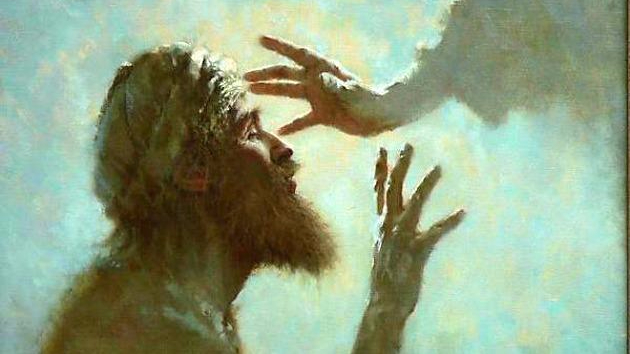
He shouted, “Jesus, Son of David, have pity on me!” The people walking in front rebuked him, telling him to be silent, but he kept calling out all the more,”Son of David, have pity on me” (Lk 18:38-39)!
The difference between the blind man who shouted to Jesus and the people walking in front of Jesus was that the man knew he was blind. Those preventing access to Jesus were not aware of their spiritual blindness. Luke does not say why the people were preventing access to Jesus, just as Jesus in his parable of the Good Samaritan did not say why the priest or the Levite did not help the man dying on the road to Jericho.
Why would the people prevent the man from having access to Jesus? Especially since he was asking for pity, or mercy. One practical reason could be time. They were on the way to Jericho, their mind was set to get there, and stay on schedule they would. Another could be that the man was a beggar. He was not seen to have dignity and worth, so they attempted to quiet him and he could go back to being invisible. The Jericho road was a dangerous road, maybe this was just a set up, a way to lure Jesus into an ambush.
Ultimately, we do not know why they prevented the man access. The more important question is how often do we prevent others from accessing Jesus for similar reasons? We do not have the time, they are other than us, so we too may not see their dignity and worth as human beings, and/or we are afraid of difference so we keep others at arm’s length.
Jesus responded differently to the call of the beggar. He stopped and had the blind man brought to him. He made the time, saw him as a fellow brother with dignity and worth, and he took the risk to reach out to someone in need and healed him. As Pope Francis has said, “[Jesus] understands human sufferings, he has shown the face of God’s mercy, and he has bent down to heal body and soul. This is Jesus. This is his heart” (The Church of Mercy, opening page).
This is to be our response as well. Even if we do not understand the suffering of another, Jesus does. We are invited to stop, to be present, to enter the chaos of another, and trust that Jesus will be present through us to provide mercy to another. We are to resist indifference and fear and to see each person we encounter, not as other, but as a fellow human being with dignity and worth. We show this best by making the time for others. May Jesus heal our blindness that we may see the dignity and worth of each person that we meet today, so that those we encounter see in us the face of God’s mercy.

Link for today’s Mass readings:
http://www.usccb.org/bible/readings/112017.cfm

We’ve Got Talent!

Today’s reading for Sunday returns to the Gospel of Matthew and the well-known Parable of the Talents. The master is about to embark on a journey and while he is away he entrusts his servants with talents; the first with five talents, the second with two, and the third one talent. Scripture scholars debate on the exact amount of a talent and any definitive number is lost to us today. The point is that it was a significantly large sum.
Even deeper than the amount, God has given each of us unique gifts and has charged us to invest in making the kingdom of God present and relevant to others. Fear and anxiety, as they did with the third servant, are temptations that arise in all of us. I have felt both throughout my life since my early youth. Fortunately, God has given me the courage to rise above those temptations, such as speaking in public. Had I given in, I would not be a teacher, nor a deacon today. Anxieties and fears still arise for me, as recently as this past summer during my once a week homily sharings at our parish 8:00 am Masses. Time and again, I have turned to the Holy Spirit and he has walked with me through these trials.
As I have embarked on this new evangelization of sharing the Gospel through social media, I was not sure how it would be received or if it would be received. Yet, again I trusted that it was God inspiring me to step out in faith, and he has given me the words to type each day; even on those days in which I sit and stare at a blank white screen when nothing seems to come, the Holy Spirit (I pray) has continued to be present to guide me to offer something coherent and relevant to help others in their faith journey.
We’ve got talent! God has something for all of us to share in our own unique way. If you are reading these words, I encourage you to trust in those intuitions that God is inspiring you with. May we say yes to sharing the unique gifts we have been given to help to bring light and healing to a tired and weary world. If we cling to them they will wither and fade, if we share them they will multiply. The best way is to start small, take baby steps. Each time we step out of our comfort zone we take a risk. True enough, but God will provide the means and he will send others to support and help us to fulfill what he calls each of us to accomplish. Another point that may help ease the anxiety when it arises, is to realize that it is God’s work and not our own. We are inspired to express not impress through our words, actions, and/or faces. My prayers are with you as we journey together to bring about the joy, mercy, love, and glory of God to others!

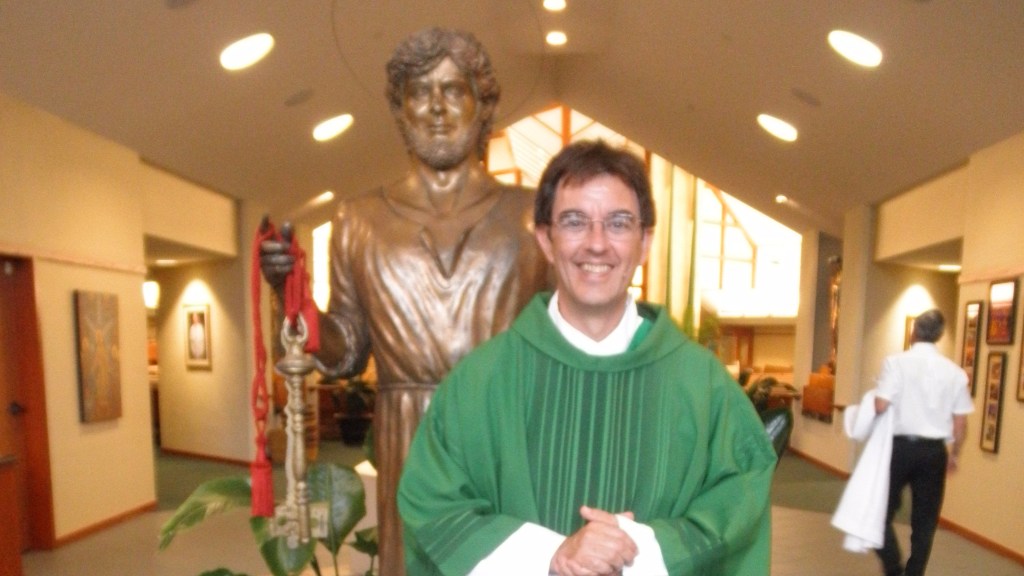
Photo from my first Mass after being ordained. St Peter pray for us!
Link for today’s Mass readings:
http://www.usccb.org/bible/readings/111917.cfm

Persistence in Prayer is a Plus

Today’s Parable of the Persistent Widow piggybacks off of Jesus guiding the Pharisees, and indirectly his disciples, away from being so concerned with the time or the hour of the end times, and instead being patient and trusting in God’s timing and plan. What was more important was to recognize the kingdom of God in their midst and freeing oneself from the attachments to the finite and material pleasures of this world. Along with this patience, Jesus affirms the attribute of persistence that was shown by the widow going to the unjust judge.

Persistence in prayer is not changing God. We are not wearing him down like the woman did with the judge. God does not need us, we need him. Our persistence changes us, helps us to develop our relationship by interacting with him more consistently. Things happening in our lives help us to see that we are fragile and vulnerable and in need of help. Our persistence in prayer, especially when we are in need, helps us to become more patient and to become more aware that, sometimes, what we believe is a crisis is not that much of one when some time passes. In fact, the practice of stopping everything and praying for five minutes when a crisis arises, often helps us to resist slipping into a fight or flight mode, helps us to resist reacting, and some breathing, while praying helps us to act more wisely than impulsively. We may also come to see that what we thought was a crisis, was more of a problem to be solved than something catastrophic. Our instant reactions to perceived crisis, can often escalate an issue rather than de-escalate one.

In the greater scope of things, God does answer all prayers of petition or intercession by saying yes, no, or not yet! Most seem to fall in the not yet category, which opens our hearts and minds to his will and conforming our will to his. Our time of unanswered prayers helps us to move our mindset away from seeking instant gratification, to one where we trust in God’s timing. Sometimes we become grateful for what appears to be unanswered prayers because what we thought was for our highest hope and good, with time, hindsight, some distance, we find the original request was more an apparent than an actual good. As the line in the Garth Brooks song goes, “Sometimes I thank God for unanswered prayers.”

Persistence in prayer is also a discipline that deepens the roots of our relationship with God. Many of our neighbors have water systems for their lawns. The roots of their grass pretty much grow horizontally, seeking the ready access to water, while our roots grow deeper seeking the water that is not as readily available. When the drought season comes our grass is heartier and withstands until the rains return. Ready access through our modern technology, higher internet speeds, one click access, overnight shipping can offer plusses, but we have to be careful that this mindset does not also form our mental, psychological, and spiritual growth. We will not instantly be physically fit, wise, or enlightened. Development of our personhood takes time, experience, discipline, prayer, and trust in God’s plan for our lives.

Patience, persistence in prayer, freeing ourselves from attachment, developing an authentic relationship with God and one another are all worth the time and effort. May we take some time to breathe deeply, slow down our pace, discipline ourselves to resist even small acts of instant gratification today. Let us look back with hindsight upon those experiences in which what we initially sought from God in prayer actually changed over time to something better than our initial request, and be grateful for trusting in his guiding hand instead of our impulsiveness. May we also see those experiences in which we felt we should change course or give up but instead were persistent in prayer which brought about fruitful results! Let us be faithful and consistent in prayer, assured that our loving God and Father is with us, he has our back, he will guide us through any trial or tribulation we are going through, and that he is our unlimited source for all that is Good, Beautiful, and True in our life!


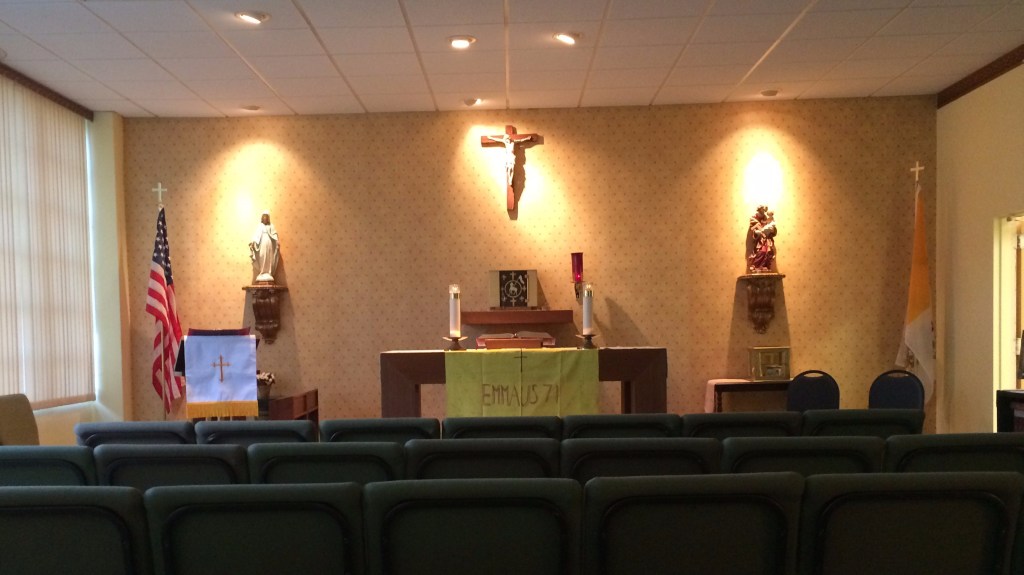
Photo: Cardinal Newman Chapel

Link for today’s Mass readings:

http://www.usccb.org/bible/luke/18:1