Repay to Caesar What Belongs to Caesar and to God What Belongs to God.

The Pharisees and Herodians had hatched a clever plot to trap Jesus. The Pharisees pretty much went along with paying the Roman taxes, which is equivalent to approximately a laborer’s wage for the day, to keep the peace with Rome. The Herodians showed public support for the paying of the tax because they supported the house of Herod and his dynasty. Herod Antipas, the tetrarch or prince of Judea and son of the deceased Herod the Great, would only stay in power as long as he abided by the authority of Rome. Which meant making sure his subjects paid the tax and he kept the peace. The Jews that identified themselves as nationalists or zealots were more openly opposed to the Roman tax, as they were opposed to the oppression by Rome, the presence of Roman leadership, and the military in their land.

If Jesus sided with paying the tax to Rome he would upset the nationalist zealots, and if he sided with not paying the taxes he would upset the Herodians. The disciples of the Pharisees were sent with Herodian representatives to ensnare Jesus and so begin to divide and conquer his support base. The only problem was that they were used to playing two-dimensional chess and they were on their way to meet a master at three-dimensional chess. Jesus immediately saw through their flattery and called them out for what they were – hypocrites! Jesus then deftly answered their challenge with, “repay to Caesar what belongs to Caesar and to God what belongs to God” (Mt 22:21).

The coin used to pay the tax was a denarius, and it bore the inscription of the Roman emperor, Tiberius, on it. In point of fact, the coin did belong to Tiberius. Jesus not only evaded their verbal trap but also utilized the situation as a teaching moment for those present with him and for us today. We are citizens of states and countries, while at the same time citizens of heaven. We are to give to the government that which is for the greater good of the society to provide for appropriate services and protect its citizens, especially in being sure to take care of the poorest and most vulnerable among us. We are also to pay to God that which belongs to God, our very life.

Jesus presented a consistent message that God is to be first in all things, that he is to be the priority over everything. Also, God wants all of us, not just that we worship one day a week. We are to align ourselves with his will and have the courage to follow him. Jesus was no hypocrite. What he required from his followers, he did himself. Jesus showed this in his encounter with Pontius Pilate. Jesus did not call down the angelic host to wipe out the soldiers that came to apprehend him at Gethsemane, nor did he do so with Pilate and his army in the Praetorium. Instead, Jesus said: “You would have no power over me if it had not been given to you from above” (Jn 19:11). God allowed the judgment of Pilate to stand, the death of an innocent man, and Jesus followed his Father’s will to his death, and death on a cross, to bring about a greater good, the salvation of the world. Jesus rendered to Caesar what belonged to Caesar and to God what belonged to God.

May we pray daily for the discernment to know and the courage to follow the will of God as did Jesus and the saints, such that we too can be engaged citizens in our society while remaining faithful to our God.

———-——————————————

Link for today’s Mass readings:

http://www.usccb.org/bible/readings/102217.cfm

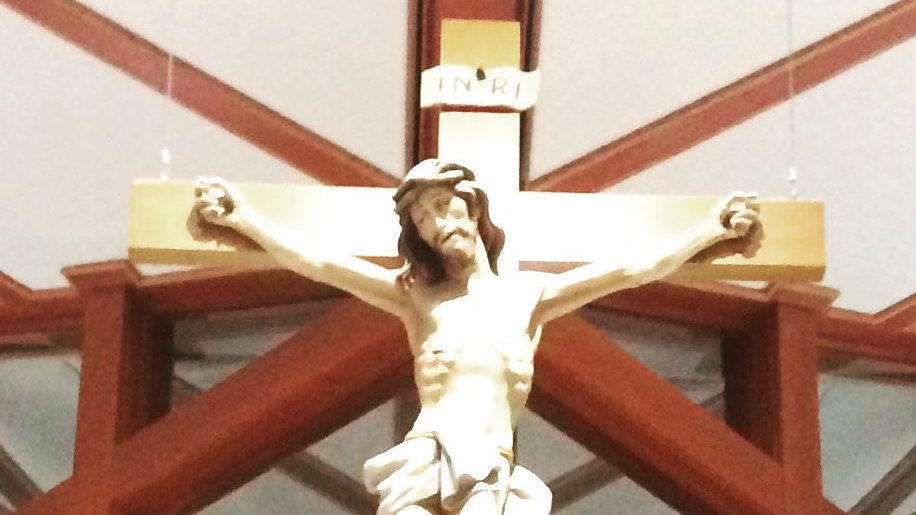
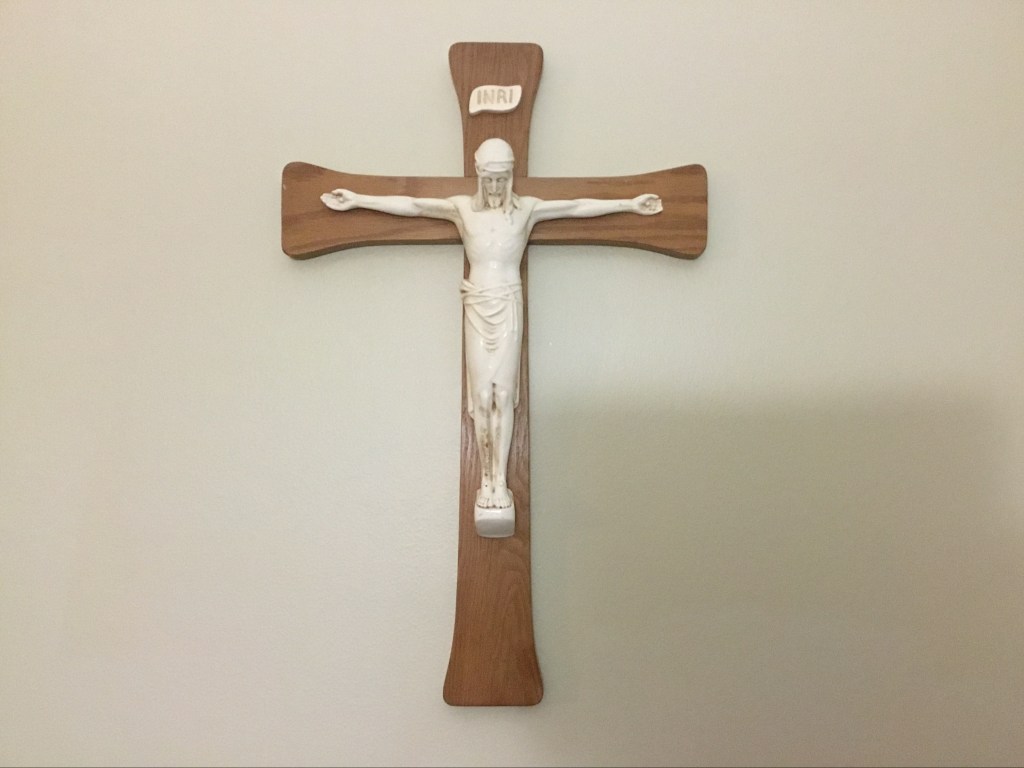
Crucifix in my room at Our Lady of Florida Spiritual Center. Looking for a place to get away, renew, and reflect: check out https://ourladyofflorida.org
 

Let Us Say Yes to God’s Invitation

“Everyone who speaks a word against the Son of Man will be forgiven, but the one who blasphemes against the Holy Spirit will not be forgiven” (Luke 12:10).

This verse is often referred to as the unforgivable sin and it can be difficult to understand. What is Luke saying here? Also, if you have been reading this blog regularly you may have read more than once that God forgives us more than we can ever mess up, so you may be thinking, “What’s the deal? Why can’t we be forgiven for blaspheming the Holy Spirit?”

One way to approach the understanding of this verse is to refer to my reflection from yesterday, but then turn it on it’s head. I shared an example from my late teens in which I followed the leading of the Holy Spirit, not so much aware I was doing so at the time. I followed my curiosity imparted on me by my teacher which led me to purchase a Bible, then I was led to leave a party and when I got home I had the urge to open my newly purchased Bible and did so. Because of each successive yes to the invitation and guidance of the Holy Spirit, I placed myself in a better position each time to hear the word of God.

Now, that experience could have taken a different turn. I could have resisted the initial curiosity that welled up within me from my teacher’s discussion and instead of going out to purchase a Bible, I could have stayed home that day and opened up my copy of The Stand and given it a second read. If then, each time I had the urge to purchase a Bible, I denied it, I would not have had a Bible when I went to that party. Instead of leaving the party I might have stayed. I would not have had the experience of reading the Bible that night, nor hearing God’s voice. Say each step did happen up to and including hearing God’s voice, but then I denied that I heard God, instead attributing the experience to some bad pepperoni pizza from the party. Each are examples of how I could have closed myself off to God’s communications.

God reaches out to us in many ways and just as we can open ourselves up to God,  we can also close ourselves off to those potential opportunities of hearing him as well as dismissing examples of his communications as mere “coincidences.” With each denial, we further limit ourselves to the possibility of acknowledging an encounter with God and or even begin to doubt that he even exists. We could then develop “a mentality which obstinately sets the mind against the Spirit of God, and as long as that obstinate mindset perdures, God’s forgiveness cannot be accorded to such a person” (Fitzmeyer 1985, 964).

Yes, God loves us more than we can ever mess up, so much so that he gives us the freedom to reject him. He does not impose his will on his, but invites us. John the Baptist and Jesus got this, and this is why their emphasis on repentance was so preeminent in their preaching. If we turn to God with humility and contrition, true sorrow for our sins, he will forgive us. The danger of a consistent obstinate disposition, is that like a muscle that is not used, it will atrophy, so will our ability to see God working in our lives. We will become less and less able to see, we will become blind, our heart will become hardened. Now that does not mean God stops communicating, he does, but when we harden our heart, when we close ourselves off from him, and dismiss each invitation and attempt at communication, we are less and less able to receive the forgiveness he so thirsts to give us.

Let us continue to seek ways to experience God and share our experiences with others, though as invitations not as impositions. We need to remember to meet people where they are and as they are, accepting them and their dignity to say no to the invitation. Jesus gave us the gift of to be able to participate with the Holy Spirit, who is the Love that is shared between the Father and the Son. The more we say yes to his guidance and leading, the more we will see him in our everyday experiences, and the more we will experience and participate in his love. In this way, our life may be more attractive and inviting to others such that we may be the only Bible someone else ever gets the chance to read, and maybe, just maybe, they may hear God speaking to them through us.

_________________________

Link for today’s Mass readings:

http://www.usccb.org/bible/readings/102117.cfm

Fitzmeyer, Joseph A. The Gospel According to Luke X-XXIV in the Anchor Bible. NY: Double Day, 1985.

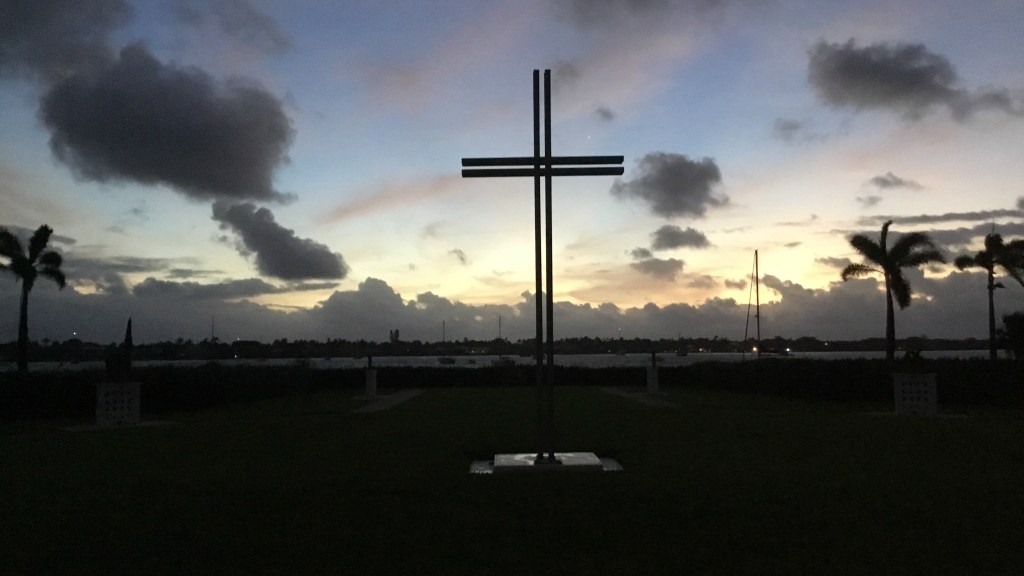
Photo: Our Lady of Florida Spiritual Center, great place to slow down and encounter God!

The Sparrows, nor We Escape the Notice of God

“Are not five sparrows sold for two small coins? Yet not one of them has escaped the notice of God. Even the hairs of your head have all been counted. Do not be afraid. You are worth more than many sparrows” (Lk 12:6-7).

About thirty-five years ago I was in high school and either in my junior or senior sociology or psychology class my teacher mentioned that if we thought Stephen King told amazing tales, we should definitely read the Bible, especially regarding the imagery found in the Book of Revelation. My teacher’s comment piqued my interest because at the time I enjoyed reading Stephen King, though I had not spent any time reading the Bible. My teacher’s words stayed with me beyond that class period.

A few weeks or months later I remember going to Waldens, a book store, at the Enfield Mall in the next town over from where I grew up in East Windsor, Connecticut. I purchased a King James Bible. I don’t remember reading it right away, but shortly some time after, I do remember leaving a party with some classmates. I don’t remember anything about the party or why I left, but when I arrived home, I went up to my room and for some reason grasped my new Bible. I then just opened it at random and began reading. The verse above was what I read, and it was the first time I can remember experiencing God speaking to me.

It was not the booming voice I imagined emanating from the burning bush that was directed to Moses, the room didn’t shake, nor did the lights flicker. In the quiet and still moment though, I heard in my mind something along the lines of, “You will not ever win the lottery, but like the sparrows, I will take care of you. I will always give you the ability and means to work.” God has proven true to his word. There have been some tight financial times through the years, but each time God has provided through the kindness of friends, families, as well as some amazing assistance out of the norm.

My students ask me from time to time if God still speaks to us as he spoke to the people in the Bible. I share, “Absolutely!” Then offer the example I shared above as well as move on to the wide range of ways God communicates and reaches out to us. He does speak to us directly, he also speaks to us through his Word in our personal reading, in our time of communal worship, he speaks to us through music, through the preaching we hear, he speaks to us through others, through our serving each other, through his creation, and a myriad of other infinite possibilities.

The question is not so much, does he still speak to us? The question is how do we open ourselves up to the reality that we can hear his words or his silence? The first way is to ask God to help us to recognize his voice, just as the sheep that come to learn the shepherd’s voice. Another way is to come to a stillness that provides the opportunity for reflection and ask God to reveal times in the past where he has spoken and we were not aware. See what comes up. Not only do we need to make a consistent time each day to pray, but stay long enough to listen! One of the biggest reasons many of us do not hear God is because we are not listening. There are other ways to put ourselves in a position to hear God’s voice, these are a few to start. The main point is being willing to be open and believe that God speaks, and then look for God in all the aspects of our life, he really is present in the midst of our everyday experiences.

Fr Jim Martin, S.J. has expressed the search for finding God in this way: “God is always inviting us to encounter the transcendent in the everyday, the key is noticing” (Martin 2010, 86). May we take time to notice God. Let us ask him as we begin to help us to be aware of him and how he is inviting us to encounter him, and that he may help us to notice him, to recognize his voice. May we also ask God to help us to be aware of one sin today that may be blocking us from hearing him, a way in which we have said no to his invitation. Let us be a little more aware today than we were yesterday. Happy seeking!

Oh, and by the way, yesterday morning about 6:30 am at Cardinal Newman where I teach, as I was walking up to one of the side doors, I saw sitting in front of it a small sparrow sized bird. The sparrows do not escape the notice of God and neither do we. We can trust and believe that God loves us, he cares for us, and he provides for us.


Link for today’s Mass readings:

http://www.usccb.org/bible/readings/102017.cfm

Martin, S.J., James. The Jesuit Guide to Almost Everything: A Spirituality for Real Life. NY: Harper Collins, 2010.

Building Bridges of Encounter

Woe to you, scholars of the law! You have taken away the key of knowledge. You yourselves did not enter and you stopped those trying to enter” (Lk 11:52).

I have quoted my friend, mentor, and brother, Dr. Sixto Garcia, before, and it is worth quoting him again: “We are a living, craving, hunger and desire to be one with God and one another. This is true for the atheist and believer alike.” At the very root, in the very bowels of our being, we yearn for God. The psalmist echoes this point as well: “As the deer longs for streams of water, so my soul longs for you, O God” (Psalm 42:2). Whether we know it or not, believe it or not, we yearn for God, he is the only one who can fulfill what our deepest longing is, because as St Augustine also wrote in his Confessions, he “has made us for himself and we are restless until we rest in thee”.

To prevent access, to those who seek, as did those for whom Jesus points out today, is an egregious offense. Especially in the way that Jesus describes. They themselves have the key to enter, do not avail themselves of the gift they have received, and worse, prevent others from going in! I remember a time in eighth grade where I had wanted to ask a girl I liked out to the school dance. I confided with someone my desire, but of course the word got out. A few days later in math class, the teacher laughed aloud and announced to the whole class that I was the first one he had ever heard of being rejected before I could even ask someone out. I wanted to melt into the floor.

Now, this may not be the most direct example of what Jesus was talking about, but there is a parallel. Teachers, like religious leaders, are entrusted with the care of those they have been entrusted to teach, and when they betray that trust and belittle those they are charged to empower, they slam doors in the faces of those who seek to actualize their potential. We are all caretakers of each other. We need to resist any temptation to belittle, to dehumanize, or crush the spirit of another who seeks.

St Paul in his most theologically mature letter wrote: “We who are strong ought to put up with the failings of the weak and not to please ourselves” (Romans 15:1). People are hungry for God. We must resist building walls or refuse to open doors to those who seek. We need to build bridges of encounter and accompaniment. Even when the seeker does not recognize they are seeking, and express their thirst to us in not the most pleasant of ways. Here it is even more important that we resist reacting, and slipping into a defensive posture, but instead risk to be open, to be understanding, to listen with our spirit instead of our ego for what the need truly may be. As Pope Francis wrote: “Each one of us is called to be an artisan of peace, by uniting and not dividing, by extinguishing hatred and not holding on to it, by opening paths to dialogue and not by constructing new walls! Let us dialogue and meet one another in order to establish a culture of dialogue in the world, a culture of encounter” (Pope Francis, 128).


Link for today’s Mass readings:

http://www.usccb.org/bible/readings/101917.cfm

Pope Francis. The Church of Mercy: A Vision for the Church. Chicago: Loyola Press, 2014.

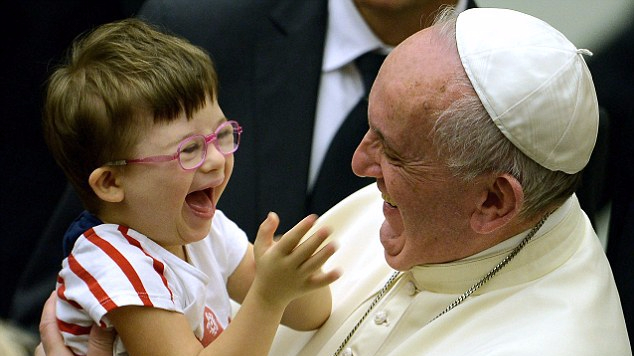
Photo of Pope Francis and friend: © AFP/Getty Image

The Way of the Cross

The Lord Jesus appointed seventy-two disciples whom he sent ahead of him in pairs to every town and place he intended to visit (Lk 10:1).

Jesus sent out disciples ahead of him. He sends us out as well. Just as Mary conceived Jesus through the overshadowing of the Holy Spirit, she went in haste to assist Elizabeth who also was to give birth. What happened when Mary came upon Elizabeth? No sooner had Mary’s greeting reached Elizabeth John leapt in her womb with gladness. This is the model of evangelization. Sharing the joy of Christ that we experience with others.

Christianity is a religion of encounter, yes we are a people of the book like our Jewish and Muslim brothers and sisters, but we are primarily a people of encounter with Jesus the Christ. We encounter Jesus through a regular practice and discipline of prayer, worship, study, fellowship, and service. Our pastor Fr. Don has shared with us a wonderful image to represent the path of discipleship and that is the image of the cross. The vertical part of the cross represents how we develop our personal relationship with Jesus, the horizontal represents our bearing Jesus to and with others. If we only have the vertical, the one on one relationship with Jesus, we just have a stick. If we just serve others without encountering Jesus, we just have a stick.

Christianity is the way of the cross, not the way of the stick. We are to be contemplatives in action. We are about building relationships between ourselves and Jesus and others. When we experience the joy of encounter with Jesus, as did Mary, as did his apostles, as did his disciples, we are to then go out to share the good news of that unique encounter. Not necessarily to some far away land, but primarily into our everyday experiences. We are to love others as Jesus loves us, we are to share the inexpressible joy of that love, and that love we share is to be unconditional, agape in the Greek. “[T]he surrender of life for the sake of others” (Lohfink, 73).

The Christian commission is to build Christian communities one smile at a time, one person at a time, one encounter at a time, one relationship at a time. I agree with Gerhard Lohfink in his piece, “What Does the Love Commandment Mean?” that love is not a pious universal that we love all humanity in some vague removed or remote way, no: this love is something tangible, corporal, it’s hands on: “This love constantly breaks out of the individual communities to embrace non-Christians, guests, strangers, the suffering (obviously including those in other countries) but it is always tied to the concrete experience of common life in the individual community” (72).

May we pray for and experience the gift of joy this morning and share that experience with those we meet today. With each encounter let us reach out beyond our self to engage others with hospitality, respect, and joy. Each pair of eyeballs that you engage, smile and say hello. Just that simple, genuine expression acknowledges to the other that they matter to you. If someone asks you how you are, instead of saying, “Fine.” Say instead, “Better since you asked.” There are many ways to reach out and give of ourselves to others in love. Be open, surrender to Jesus, let us rise up, and be on our way to bear Christ to those we encounter today!


Link to today’s Mass readings:

http://www.usccb.org/bible/readings/101817.cfm

Lohfink, Gerhard. “What Does the Love Commandment Mean?” In No Irrelevant Jesus:      On Jesus and the Church Today, translated by Linda M. Maloney, 64-74. Collegeville, MN: Liturgical Press, 2014.


Resist Hypocrisy, Embrace Hospitality

The Lord said to him, “Although you cleanse the outside of the cup and the dish, inside you are filled with plunder and evil. You fools” (Lk 11:39).

Jesus’ harshest convictions were for acts of hypocrisy. He did so to show in no uncertain terms how dangerous this was for religious leaders. Those entrusted with the care of God’s people who observed the proper rituals, spoke and dressed to match their role, which all meant nothing when their hearts were hard, closed to the will of God, but most of all, they themselves were obstacles, stumbling blocks to those who sought God. Jesus calling them fools meant that they were bereft of the wisdom of God they projected to have.

A recent Pew study tracing religious affiliation from 2007 to 2014 found that approximately 56 million Americans identify themselves as following no religious affiliation. Some have labeled this group as the “nones”. I am sure the context and nuance of why this trend is on the rise has many components, but I believe one ingredient is that many feel they have witnessed unacceptable levels of hypocrisy that have turned them off to organized faith traditions.

In the depths of our very being we seek and yearn for the transcendent, the infinite, we are spiritual seekers, because this is how we have been created. Yet, time and again, we experience suffering, injustice, and hypocrisy at the hands of the very ones who are our leaders in both the religious and political sphere. Jesus got this, and this is why he convicted those who abused their positions, because he knew the significant damage that could be inflicted on the believer.

We as people of faith must first and foremost recognize that we live in a fallen world. No one is perfect, even and especially our leaders. We all fall short of the perfection we seek and aspire to. If we put anyone up on a pedestal they, sooner or later, are going to fall, and the higher up they go, the greater the fall. Our actions must follow Jesus’ lead of resisting the urge to project all is well and good, that we are fine, when we are not, and none of us are all of the time.

Jesus is inviting us to transformation. To experience this gift we need to seek help and assistance when needed. We must be people of courage allowing the light of Jesus to shine upon those dark places of sin within our souls, and be willing to see that which needs healing so as to release our own “plunder and evil”, which we harbor within. Jesus’ light shines brightest and most often through others. We need to trust one another with our weaknesses, faults, and shortcomings, not hide them or pretend they are not there, if we are ever going to be able to overcome them. Allowing the gifts of others not present within us to come to the fore affirms their unique gifts and provides healing for us. At the same time we need to offer what we uniquely can give, not judging another who has fallen, but providing empathy, support, and encouragement so they too can heal. When we are transparent with our sin, and empower and accompany one another, we as Church can resist the temptation of hypocrisy and instead embrace the gift of hospitality.


Link for today’s Mass readings:

http://www.usccb.org/bible/readings/101717.cfm

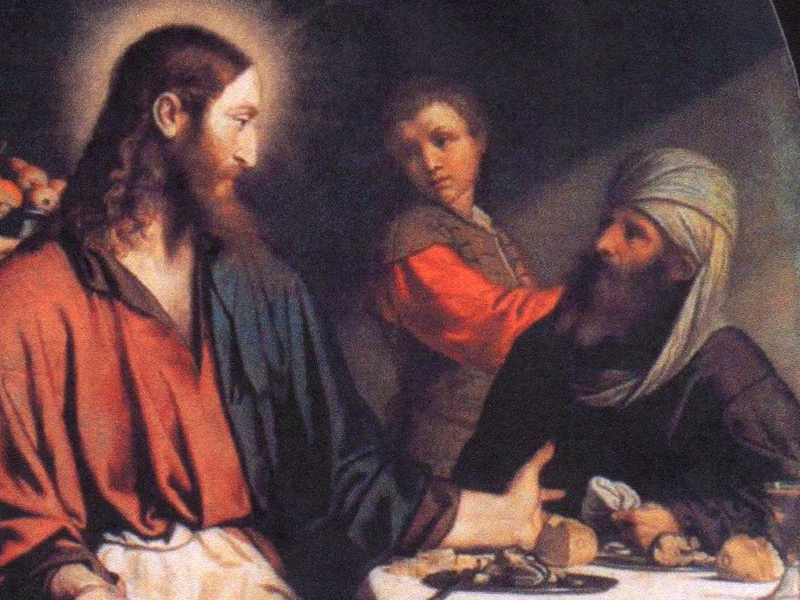
Painting: Supper In the House of Simon, by Italian artist Moretto da Brescia (1150-1554)


Repent and Believe in the Gospel

While still more people gathered in the crowd, Jesus said to them, “This generation is an evil generation; it seeks a sign, but no sign will be given it, except the sign of Jonah” (Lk 11:29).

To understand what Jesus means we need to understand the sign of Jonah. Jonah was sent by God to go to Nineveh, the capital city of Assyria, to call them to repent from their wicked ways. The Jews not only considered Nineveh to be a place of decadence, wickedness and godlessness, the military of Assyria had invaded Israel and eventually conquered the northern kingdom around 721 BC. We can understand Jonah’s initial refusal follow God’s lead. Not only did he not want to go to Nineveh, Jonah wanted God to punish and destroy them. Those who have read the tale, know that Jonah acquiesced and within hours of his proclamation to the citizens, including the king, they repented and God showed them mercy.

Jesus is drawing a parallel between the people of Nineveh and his listeners. The people of Nineveh listened and repented to a reluctant messenger. The Ninevites, Gentiles, the sworn enemies of Israel, received God’s mercy when they repented. Now, in their midst was one greater than Jonah, the Son of God, and they were demanding of him a sign. The sign of Jonah was repentance. Jesus, from the beginning of his public ministry preached the same: “This is the time of fulfillment. The kingdom of God is at hand. Repent, and believe in the Gospel” (Mk 1:15).

We would do well to listen to Jesus’ message. Repentance is a key spiritual discipline. We are called to consistently examine our conscience. We need to come to accept that we live in a fallen world. This is not a pessimistic view. This is an awareness of the reality of our present condition. Jesus warned about the cult of personality, the messiah complex. Jesus himself is the sign, he is the Way, the Truth, and the Life.

Through accepting that we live in a fallen world, by recognizing we need a savior, we can make the next step to recognize that we need to repent and turn back to him who can save us, for apart from him, we can do nothing. If we believe we can solve our problems on our own, we will consistently fall short. Julian the Apostate, Roman emperor from 361-363 AD attempted to adopt and mimic Christian charitable works, which he saw value in but he sought to do so through the state by enacting policies without practicing Christianity. In essence, doing good on his own without Jesus. This did not work.

St Mother Teresa recognized the need for Jesus and stressed this when she taught her novices that she was not interested in numbers, she was not interested in having a branch of social workers. She and those who followed Jesus were to be missionaries of God’s charity. They were to serve Jesus in the distressing disguise of the poor. To do so they participated in daily Mass for an hour and adoration for an hour. Empowered by Jesus, blessed by his mercy and love they could serve Jesus in those they met in harshest of conditions.

May we not so much seek signs, but seek Jesus. Let us begin this morning by turning away from our own selfish pursuits and pray today that Jesus may be the center of our lives, the very source of our thoughts and actions. For it is, “Through him we have received the grace of apostleship, to bring about the obedience of faith, for the sake of his name” (Romans 1:5). Let us trust that God is at work within us. We are called to follow his lead, to do what he asks of us today. Let us rise and be on our way to go and announce the Gospel of the Lord in word and deed.


Link for today’s readings:

http://www.usccb.org/bible/readings/101617.cfm

We Are Invited to the Feast

The Parable of the Wedding Feast (Mt 22:1-14) continues with a similar tone to The Parable of the Tenants presented last Sunday (Mt 21:33-43).  There is invitation, rejection, death, and harsh judgment. We need to remember that these are parables, not specific historical accounts, in which Jesus is seeking to reveal something significant. Jesus would have also shaped this parable, as well as others, depending on the audience he was speaking to, a common practice in oral tradition. This can be a possible reason for the similarity and differences in the account of the same parable given in Luke (14:15-21).

Jesus often shared table fellowship with many, we see consistent evidence of this. Jesus also “used meal imagery to depict the eschatological banquet or final salvation” (Meier, 271). The imagery of the great wedding feast in this parable conveys to the listeners then and us reading today, that all are invited to participate in the kingdom of heaven. Jesus first sought to gather the scattered people, once united under King David as the twelve tribes Israel, yet there were those who rejected his invitation. They, as the chosen people of God, were to be a holy people, a faithful witness to the one God. Jesus sought to reignite their original purpose, yet there were those who refused and so he shared in this parable that others would be invited. Jesus’ invitation as a universal message echoes that of Isaiah: “On this mountain the LORD of hosts will provide for all peoples a feast of rich food and choice wines, juicy, rich food and pure, choice wines” (Isaiah 25:6).

As with the Parable of the Tenants, Matthew emphasizes not only the rejection of the invitation, but includes the violent images of the abuse and death of the servants sent by the king, and the king’s punishment, by putting them to death and burning of their city. Some biblical scholars see this as a possible allusion to the destruction of the Temple in 70 AD. Luke does not include the abuse of the messengers or the king’s punitive justice. Matthew was emphasizing that there will be accountability to the way in which one responds to the invitation. We do not know the time or the hour, so we must not delay in our decision. “In the concrete context of his ministry, at any given time Jesus would have spoken this parable to this or that group of his fellow Jews as a salutary warning not to ignore his urgent final message, lest they suffer the consequences on the last day… Decide now, or soon it will be too late and your place will be taken by another” (Meier, 272). This message was directed to all who heard it. Each person then and now needs to make a decision.

Jesus, the Son of God, in the humanity he has assumed, in his willingness to give his life for us, opened up heaven for us. This act of love and grace is a free gift and we are invited to receive or reject. Many of those who have said yes, have followed the same path to martyrdom by sharing the message they have received and losing their life, but now wear the white robes at the great wedding feast in heaven. The invitation has been given to us today. Will we make excuses or say yes to this invitation? The writer of the second letter to Timothy gives us this encouragement, that we can depend on this, that we are to remember that Jesus Christ, who was raised from the dead assures us that, “If we have died with him, we shall also live with him; if we persevere, we shall also reign with him” (2 Timothy 2:11-12).


Link for the Mass readings for today:

http://www.usccb.org/bible/readings/101517.cfm

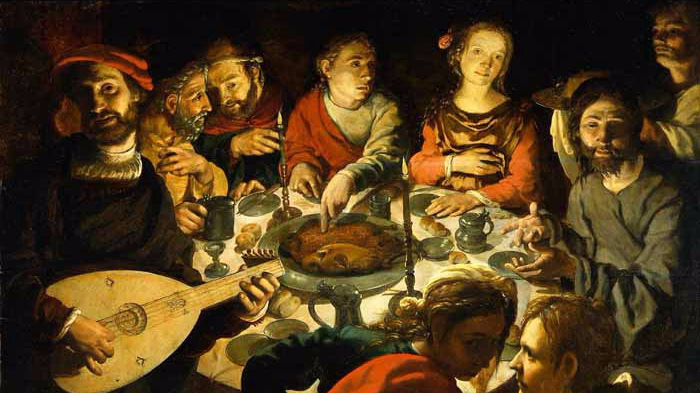
Painting: The wedding at Cana, Jan Cornelisz Vermeyen, c. 1530

Meier, John P. A Marginal Jew, vol 5, Probing the Authenticity of the Parables. New Haven: Yale University Press, 2016.


Radiating Christ

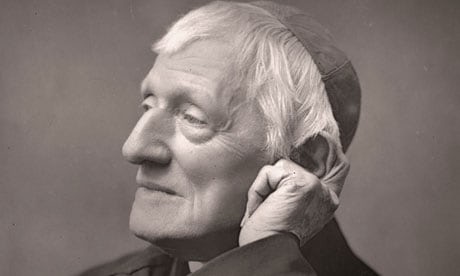
The Prayer of John Cardinal Newman
Radiating Christ
Dear Lord, help me to spread Thy fragrance everywhere I go. Flood my soul with Thy spirit and life. Penetrate and possess my whole being so utterly that all my life may only be a radiance of Thine.
Shine through me and be so in me that every soul I come in contact with may feel Thy presence in my soul. Let them look up and see no longer me but only Thee, O Lord!
Stay with me, and then I shall begin to shine as thou shinest; so to shine as to be a light to others. The Light O Lord will be all from Thee; none of it will be mine; It will be Thou, shining on others through me.
Let me thus praise Thee in the way Thou dost love best, by shining on those around me. Let me preach thee without preaching, not by words but by example, by the catching force, the sympathetic influence of what I do, the evident fullness of the love my heart bears to thee!

Mary, Model Disciple

While Jesus was speaking, a woman from the crowd called out and said to him, “Blessed is the womb that carried you and the breasts at which you nursed.” He replied, “Rather, blessed are those who hear the word of God and observe it” (Lk 11:27-28).

The woman’s comment directed to Jesus in today’s reading is certainly better than the charge leveled against him yesterday that he was healing by the power of Beelzebul, yet even this complement is still off the mark. What made Mary truly blessed was her fiat, her yes, to being willing to participate in the incarnation, conceiving, carrying to term, and giving birth to the Son of God. Then continuing to hear the word of God and observing it through the rest of her life. Mary is the model disciple.

Jesus is, in correcting the woman who called out, also helping her, those present, and us to keep proper perspective regarding living under the kingdom or reign of God. God is to be sovereign, primary, first and foremost. We need to be careful not to put any “thing” or any “one” before God. Even today we need to be careful not to make Mary into a goddess. We honor Mary and the saints, we invoke their intercession for assistance as we do family and friends with us now. We do not adore them, as we do with God. Mary points us to her Son, not to herself. She is like the moon that radiates the light of the sun. This is the point of discipleship.

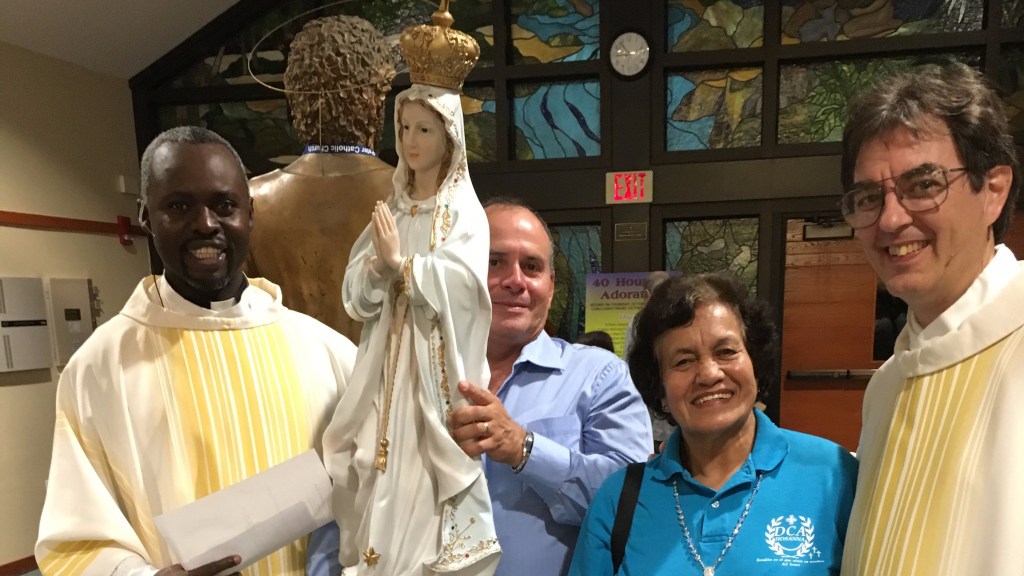
Last night we experienced a beautiful Mass commemorating the 100th anniversary of Mary’s appearance to the three shepherd children at Fatima, Portugal. Did we process in with a statue of Our Lady of Fatima, yes, and was the statue given a place of honor yes. But the focal point, the ultimate procession was of those coming toward the altar, affirming their commitment to serving Jesus, by receiving him in his Real Presence in the Eucharist. Mary brought us out on a Friday night, away from our tv’s, cell phones, iPads, restaurants, and also from our trials, challenges, and weariness, to celebrate a bilingual Mass, the rich diversity of our parish, the coming together as a community for the sole purpose of worshipping her Son. Nourished then by Jesus through his presence in our communal gathering, his Word, and his Body and Blood, we were then sent forth to be his disciples and radiate his light to those we meet.

As blessed John Henry Cardinal Newman articulates so well in his prayer, the goal of the disciple of Jesus is to come to that point where others may look up at us and “see no longer me, but only Thee O Lord!” How do we do that? We place ourselves in a posture of humility, of prayer, willing to hear the word of God, observe it, and then serve him in one another, to act upon it in our lives. This means we need to slow down, resist the urge to accomplish and just get something done. Sometimes when I am reading the Office, I will catch myself just reading the psalms, the readings, and the prayers, to get them done, instead of letting the words pierce my heart, convict me, call me to conform my life to Jesus. Prayer then becomes a function instead of an encounter with the living God. I will stop myself and begin again.

To hear God’s word, as we do with any person, we must stop and listen. This can happen in the events of our daily lives as well if we are attentive. It is resisting the temptation to walk around or away from someone who is homeless, and instead share a few moments, a few dollars, to ask their name. Is this uncomfortable, yes, challenging, yes. But the Word of God calls us out beyond ourselves to be there for others. The image of fire used for the Holy Spirit is appropriate in this regard, because whatever fire touches it transforms. When we are touched by the Love of the Holy Spirit we need to share that same love with others. When we experience the love of God, as did Mary, and say yes to his invitation we will never be the same again. We will continue to experience suffering and pain because we live in a fallen world.

Again think of Mary who from the beginning experienced suffering with Jesus. She conceived Jesus through the power of the Holy Spirit, what a gift, but what a trial, how to explain this to Joseph, her betrothed! Simeon’s prophecy at Jesus’ dedication in the temple ending with the words to Mary, “and you yourself a sword will pierce” (cf Luke 2:25-35). We can trace Mary’s sorrows, and continued faithfulness as “she pondered these things in her heart” (cf Luke 2:19) throughout her life raising Jesus and then escalating as she was also present during his public ministry where she saw him rejected in their hometown of Nazareth, the questions and accusations hurled at him, his arrest, scourging, and crucifixion.

Yet, if we keep our eyes on Jesus, turn to him in our trials, challenges, experiences of injustice, we draw upon an infinite source, as did Mary, and experience a joy, a peace that surpasses all understanding, a fulfillment that is beyond comprehension because of the blessing and love we receive from her Son. Through these experiences of Jesus present to us in our time of need, sorrow, and pain, we are given his grace. We then need to ask for courage to reach out to provide aid and comfort to those he sends us to, instead of turning within because of our fears, prejudices, and pride. This is how we observe his words, by loving, willing the good of others as he has loved us. In hearing and observing the words of Jesus, we cannot help to be transformed. May we say yes, as did Mary, and so to radiate Christ to others from the very depths of our soul.


Photo: Mass celebrating 100th anniversary of visitation of Our Lady of Fatima with St Peter family

Link for today’s Reading:

http://www.usccb.org/bible/readings/101417.cfm

The prayer, Radiating Christ, by John Henry Cardinal Newman you may find posted on my blog