Reflections on the Gospel Reading for the Day


To what or whom do we place our ultimate trust?
“No servant can serve two masters. He will either hate one and love the other, or be devoted to one and despise the other. You cannot serve God and mammon” (Lk 16:13).
Jesus consistently emphasizes the priority of making God primary in our lives. Anything that moves into the slot of preeminence before God is idolatrous. Anything, even family, as we heard a few days ago. We cannot have two firsts, because either we will “hate the one and love the other, or be devoted to one and despise the other.” This balancing act is not an easy discipline.
It becomes especially challenging when we look at mammon, money, or material wealth. Many of us seek our security in having a home, insurance policies, savings, retirement plans, market investments. Setting up this security is often considered prudent. The problem is when material security becomes the foundation of our life, our fulfillment, our god.
This has certainly influenced the Church at times with movements governed by a prosperity gospel. The approach to a faith life that is not so much building up a relationship with our loving God and Father, but one of seeking God as a holy investor. There is a perspective offered on verses such as the Parable of the Sower (cf. Mark 4, Matthew 13, and Luke 8) in which the primary intent in giving is to reap a financial return of ten, twenty, or a hundredfold. God certainly wants us to be good stewards, and he will indeed bless us and wants us to be generous and cheerful with our giving, but again, if in our giving the primary intent is to receive more of our treasure, we are serving Mammon and not God.
Following are two scriptural verses and two Church Father quotes that may help us to see that in giving away and not accumulating the material, thus trusting in God for our security is the prudent path:
“If one of your kinsmen in any community is in need in the land which the Lord, your God, is giving you, you shall not harden your heart nor close your hand to him in his need. Instead, you shall open your hand to him and freely lend him enough to meet his need” (Deuteronomy 15:7-8).
“For I was hungry and you gave me food, I was thirsty and you gave me drink, a stranger and you welcomed me, naked and you clothed me, ill and you cared for me, in prison and you visited me” (Matthew 25:35).
“When giving to the poor, you are not giving him what is yours; rather, you are paying him back what is his” (St Ambrose of Milan, 340-339).
“If each one of us took only what is necessary for his sustenance, leaving what is superfluous for the indigent, there would be no distinction of rich and poor” (St Basil of Caesarea, 330-379).
Our reactions to the above can be a barometer as to whether we are putting gold first or God first. God is to be our source and our fundamental option. The blessing we receive, the hundredfold we seek, is to be measured in love, mercy, and generosity received and given. Pope Francis, in a 2013 address, expressed his concern “that some homeless people die of cold on the streets [and this] is not news. In contrast, a ten-point drop in the stock markets of some cities is a tragedy. A person dying is not news, but if the stock markets drop ten points it is a tragedy! Thus people are disposed of as if they were trash. Consumerism has led us to become used to an excess and daily waste of food, to which, at times, we are no longer able to give a just value, which goes well beyond mere economic parameters” (Vatican Insider).
Do we place our trust, faith, and security in Mammon, or God? Do we build up treasure for ourselves at the expense of or indifference toward others or build up our treasure in heaven, aware of and reaching out to those who are in need? Were someone to observe us objectively, and closely would they say about us, “There goes someone that lives their life believing: In Gold we Trust.” Or would they say, “There goes someone that lives their life believing: In God we Trust?”
Photo: pexels.com by Quang Nguyen Vinh
Link for the Mass readings for Saturday, November 6, 2021
May we have the prudence and courage of the saints to say yes to God’s invitation to serve.
In the Parable of the Dishonest Steward, the steward who is on the block to lose his job for squandering his lord’s property comes up with a plan to settle his lord’s accounts. He lessened the amount owed with the intent to gain some support from those indebted to his master. Most likely he was giving up his own profits in settling these debts, much like a real estate agent or car salesman today would forego their commission to make a sale.
The prudence or cleverness of the steward is commended by the lord because the dishonest steward had utilized foresight, which was a better quality to develop than the original squandering that landed him in this predicament in the first place.
Jesus commenting on this parable also acknowledged those who were clever in worldly ways, thinking and acting with prudence. Being shrewd and having the foresight to navigate potential conflicts to acquire the desired goal is admirable. Jesus then shared the insight that we as “children of the light” ought to act with prudence as well. The difference being, the application is not for personal gain but applying cleverness in evangelization. As we spread the Gospel, we do so, not in a one size fits all approach. We are to be present and adjust to each person’s uniqueness.
Many in the Church have gone before us aware of the needs of those people in their midst and coming up with creative ways to minister to them. Often they too, utilized the model of the steward’s prudence in today’s Gospel, giving up their opportunity for immediate gain to provide for the needs of others.
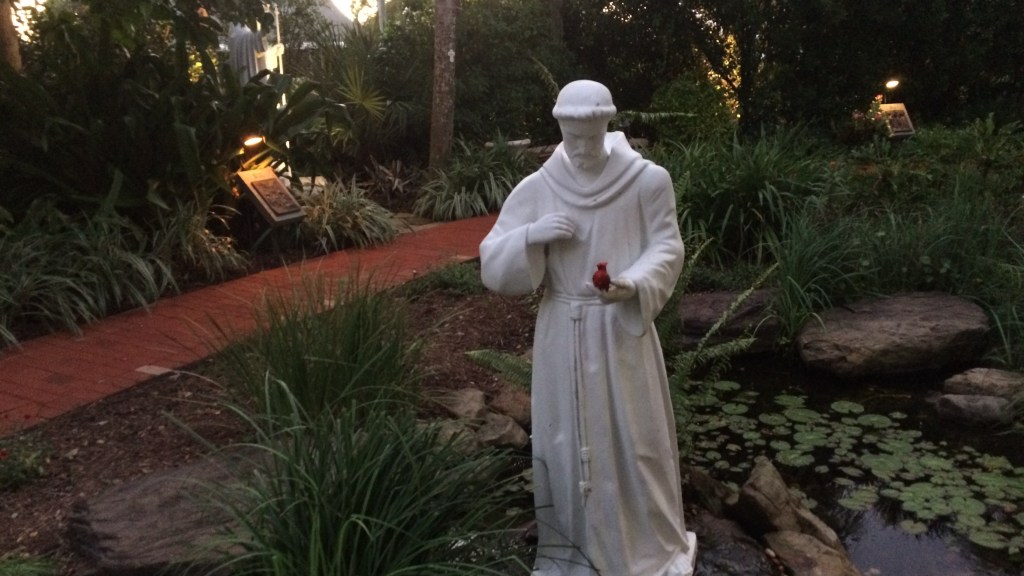
St. Francis of Assisi, lived his youth, not as a faithful steward, but as a pampered troubadour, part of the social elite. Then as his transformation began to take hold, he began to sell off his father’s cloth and gave it to the poor. He would ultimately renounce his family name as well as all material possessions, and give all to follow Jesus.
St. Mother Teresa, left her home at eighteen, never to see her family again to become a missionary in India with the Loretto Sisters. She became a school teacher in Calcutta, by no means squandering what the Lord gave her, but she too was called to go deeper. She left the convent to serve the poorest of the poor in the streets, those in the most deplorable of conditions.
Jesus has a unique call for each of us. We too are called to be faithful stewards, to be holy, and to be saints. What needs do we see in our midst? In what ways can we be more prudent? Each of us is invited into a deeper embrace of the Gospel. “We experience faith and encounter God in our own particular time in history, and faith lights up our journey through time. Faith must be passed on in every age” (Pope Francis, 20). Jesus, please deepen our faith and help us to put it into practice in the unique way you call us to serve.
Photo: Statue of St. Francis in our rosary garden at St Peter Catholic Church in Jupiter, FL.
Walking With Pope Francis: Thirty Days with the Encyclical The Light of Faith. New London, CT., Twenty Third Publications, 2013.
Link for the Mass readings for Friday, November 5, 2021
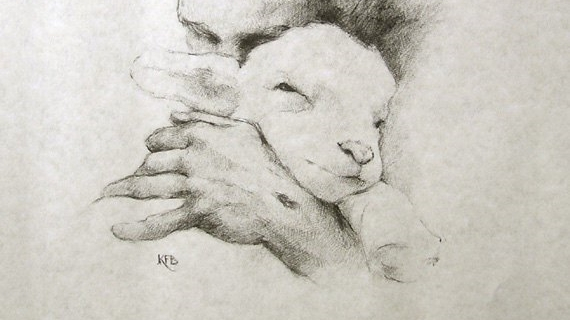
The Shepherd cares for each one of us.
In our Gospel account today, Luke records that Jesus is critiqued for eating with tax collectors and sinners. Jesus responds to the criticism of the Pharisees and the scribes by sharing three parables, two of which we read today, and the third, the Prodigal Son, is often reserved for reading on Sunday during this liturgical cycle of readings.
The two parables we are given today display the love that God the Father has for his children. Though we may not find being compared to a sheep or a coin endearing, the imagery of the shepherd going to find the one lost sheep and the woman searching all over her house for the one lost coin is a message well worth meditating on.
Someone hearing this parable might say, “Why bother looking for the one sheep when you have ninety-nine other sheep or why bother looking for one insignificant coin when you have nine other ones?” But if we reflect upon this parable for a bit we might recall a time or feel right now that we may be lost or insignificant. What Jesus is telling us is that we matter, that God loves us more than we can ever imagine, and he is constantly seeking us out. God is the creator of the vast expanse of the cosmos yet he cares for each and every one of us individually. He cares for you as if you were the only person in the world.
We do not need to look for God so much as we need to just stop, be still, and notice he is already waiting for us. If we feel a bit worn, misunderstood, lost, lonely or underappreciated, rest assured that we are not alone. God cares and he is present, yes, even in the midst of any conflicts, trials and/or tribulations that we may be going through. Even if we have separated ourselves from him through our sin, God loves us more than we can ever mess up and he is the shepherd that watches over us and seeks us out even when we walk away from him. Return to him and feel the healing balm of his forgiveness.
I have experienced his forgiveness, mercy, and love when I participate in the Sacrament of Reconciliation and I invite you to do the same when you can. In the meantime, allow yourself to let go in the loving embrace of Jesus today. Breathe slowly, rest, cry, or vent. Receive the gift of his love so as to share it with someone today who also needs to know they matter, that they have dignity, that they are not alone, and that they are loved.
Photo: One of my favorite pencil drawings by Kathryn J. Brown, 1982
Link for the Mass readings for Thursday, November 4, 2021
Want to be truly free?
I can visualize the opening scene of today’s Gospel in my mind’s eye. Jesus striding along with a gathering of people walking, talking, and moving about, and then he just stops and turns. Those closest to Jesus pull up to a stop with him, others continue right past, while at the same time others bump into and trip over those who had stopped before them. The subtle hum of random conversation then slowly comes to a halt, a stillness ripples through the crowd, and then there is silence. The dust begins to settle. Those closest have their eyes locked on his, while those further back are craning their necks, moving left and right to get a better look, others are cupping their ears to catch the sound of Jesus’ voice.
These crowds most likely consisted of some disciples, while the greater majority were those on the periphery gathering because of curiosity, intrigue, and maybe even wonder. Jesus then begins to speak, “If anyone comes to me without hating his father and mother, wife or children, brothers and sisters, and even his own life, he cannot be my disciple” and then finishes with “In the same way, everyone of you who does not renounce all his possessions cannot be my disciple” (cf. Lk 14:25-33).
Those who may be hearing these words second hand, as they were further away from the point of direct hearing, may not believe that the message was transmitted to them correctly. These words cut to the quick, just as surely as when Jesus shared about eating his flesh and drinking his blood, and when he told another follower, who wanted to bury his father to let the dead bury their dead. Luke does not say, but I am sure that many of those gathered around him were just as shocked and began to walk away.
The familial bond for ancient peoples was strong. Though the invitation of salvation that Jesus offers is for all to be saved, he is not going to dumb down or sugar coat his message just to get numbers. Jesus presents, time and again, that the way to live a life of fullness and wholeness, to restore that which has been lost, is to put God first in our lives. God must be the primary focus, the primary relationship in our life, nothing else can have priority of place before him. When we do so, all other things will fall into their proper place.
We need to ask ourselves if we want to be an onlooker, just someone looking at Jesus from a distance, or a disciple, willing to be his servant sent forth to share the Gospel and invite others into relationship with him? Are we attached to any possessions, false substitutes, even members of our family, such that we place them before our relationship with God? Idols are anything that we put before God and will distract us from the very flow of his life force that fuels our existence. If we are willing to walk the path of discipleship, we must be willing to surrender our will to God, place him first in our lives, and be open to being transformed by his love.
Jesus is to be the interpretive key that opens our understanding to all else. All that which is material and finite in our lives find meaning in relation to him. Only when we are able to let go of the attachments to the things of this world will we then truly begin to be free, to be other-centered, to be more patient, understanding, and willing to love and be more present to our father and mother, husband, wife or children, brother and sister, and even our very self and our neighbor.
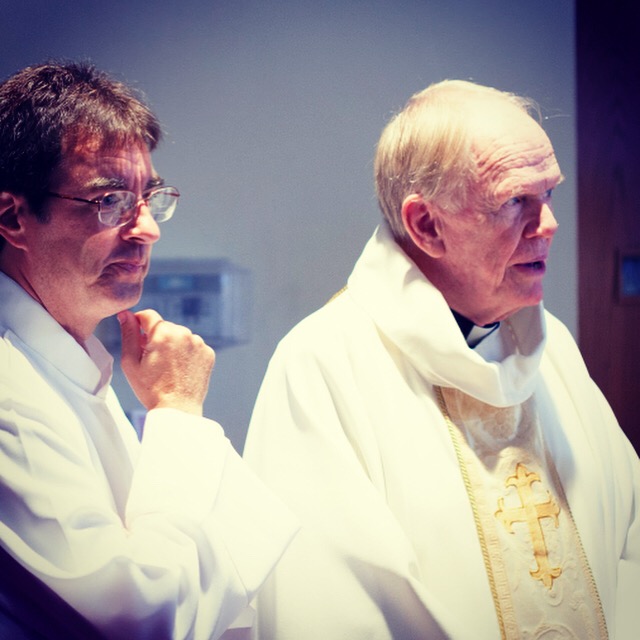
Photo: In the chapel at St Ignatius Cathedral, just prior to my ordination Mass, September 2013. To my left, long-time friend Fr. Ed O’Brien, a true disciple! Photo Credit: Deacon Michael Miller
Link for the Mass readings for Wednesday, November 3, 2021
All Souls Day is why we are an alleluia people.
“For this is the will of my Father, that everyone who sees the Son and believes in him may have eternal life, and I shall raise him on the last day” (Jn 6:40).
This is our hope and what we believe, that we who encounter Jesus and believe in him shall have eternal life. God’s will, what he created us for, is to be in communion with him and one another in this life and the next. A word of assurance that I often lean on is from the book of Wisdom from our first reading today, “The souls of the just are in the hand of God, and no torment shall touch them. They seemed, in the view of the foolish, to be dead; and their passing away was thought an affliction and their going forth from us utter destruction. But they are in peace” (Wisdom 3:1-3).
The miracle of Jesus raising the daughter of the Roman official, Jairus, embodies these verses from Wisdom. As Jesus entered the home of the official many were “making a commotion” and Jesus dismissed them stating: “Go away! the girl is not dead but sleeping.” He was ridiculed by the crowd but paid them no heed. He went to the girl, took her hand, “and the little girl arose” (cf. Mt 9:18-26).
Jesus assured his followers as he assures us today that the will of his Father is that all will be saved. Experiences like the raising of Jairus’ daughter, the son of the widow from Nain, and Lazarus, were not only seeds of hope planting the promise of his resurrection to come but a foretaste of the raising of humanity on the last day. His disciples witnessed Jesus’ actions and words, and not only kept these experiences in their hearts but shared them. Through the Gospels we are able to enter into and experience these same encounters with Jesus again and again. We also experience Jesus each time we pray, participate in the sacraments, communal worship, and are willing to serve one another. In each of these moments of encounter, we are conformed and shaped into who we have been created and called by God to be in this life and the next.
This All Souls Day we celebrate the gift that Jesus was victorious over sin and death, not only for himself but for all of us. Let us lift up those we hold close to our heart, as well as those aborted and miscarried, those immigrants who have died seeking a better life, those who have died from COVID, those who have suffered tragic, unjust, violent deaths, and those who have died alone.
“Merciful Father, hear our prayers and console us. As we renew our faith in your Son, whom you raised from the dead, strengthen our hope that all our departed brothers and sisters will share in his resurrection, who lives and reigns with you and the Holy Spirit, one God, forever and ever” (Prayer for All Souls, Liturgy of the Hours).
Photo: Remembering JoAnn, my heart and my love, this All Souls Day. Picture from her birthday 2015.
How are we who mourn blessed?
“Blessed are they who mourn, for they will be comforted” (Mt 5:4).
So many have died over the past year and a half from Covid, too many from violence, so many from unexpected diagnosis of cancer and health incidents and vehicular accidents. Another word for blessed is happy. How do the families and friends of those who have died feel blessed when they learn of the death of a loved one? From a theological reference, one response can be that Jesus shared these words from the perspective of the eschatological event, his second coming at the end of time and that we can rely on the hope that Jesus died for us all and we will rise with him on the last day.
This is our hope and this is true, but I also believe that Jesus was also speaking about our day to day experiences as well. Jesus said, as is recorded in Mark 1:15, “This is the time of fulfillment. The kingdom of God is at hand.” Jesus, is the kingdom at hand, just an outstretched arm away. Those of us who mourn will be blessed, will find comfort when we resist running away, or denying the agony and pain that threatens to overwhelm us and instead allow ourselves to experience the grief and the suffering of our loss. It is in the very embracing of our pain and suffering that we come to encounter Jesus with his arms wide open.
By experiencing the depth of our sorrow and allowing ourselves to grieve and mourn in the loving embrace of Jesus, we can release this unbearable weight and begin to heal. If we ask God or anyone near us why someone dies we may not receive a sufficient answer. His Son though, who suffered the agony, loss, pain, and hurt as we do, understands what we are feeling. His presence and closeness will be the strength we need to guide us through the many ups and downs, fits and starts, of our emotional roller coaster. Just like having a surgical amputation, our life will never be the same, but we will heal and be able to live again.
Today, we celebrate the gift of the Communion of Saints on this All Saints Day. The saints understood and lived the message and truth of the Gospel that Jesus has risen. They have lived their life to the full and have gone before us to the true land of promise, our heavenly home, and from there they cheer us on, encourage us, and intercede for us.
Jesus suffered and persevered through the cross, then into and conquered death. We need not fear death because through our life in Jesus, death no longer has any power over us. Yes, we mourn the loss of those no longer with us in this reality, yet we also rejoice in their new life in Christ. St Paul of the Cross, taught: “The world lives unmindful of the sufferings of Jesus which are the miracle of miracles of the love of God. We must arouse the world from its slumber.” Let us then not run from but enter into our pain and mourn so that we may experience God’s comfort, peace, healing, and yes, even blessing and happiness.
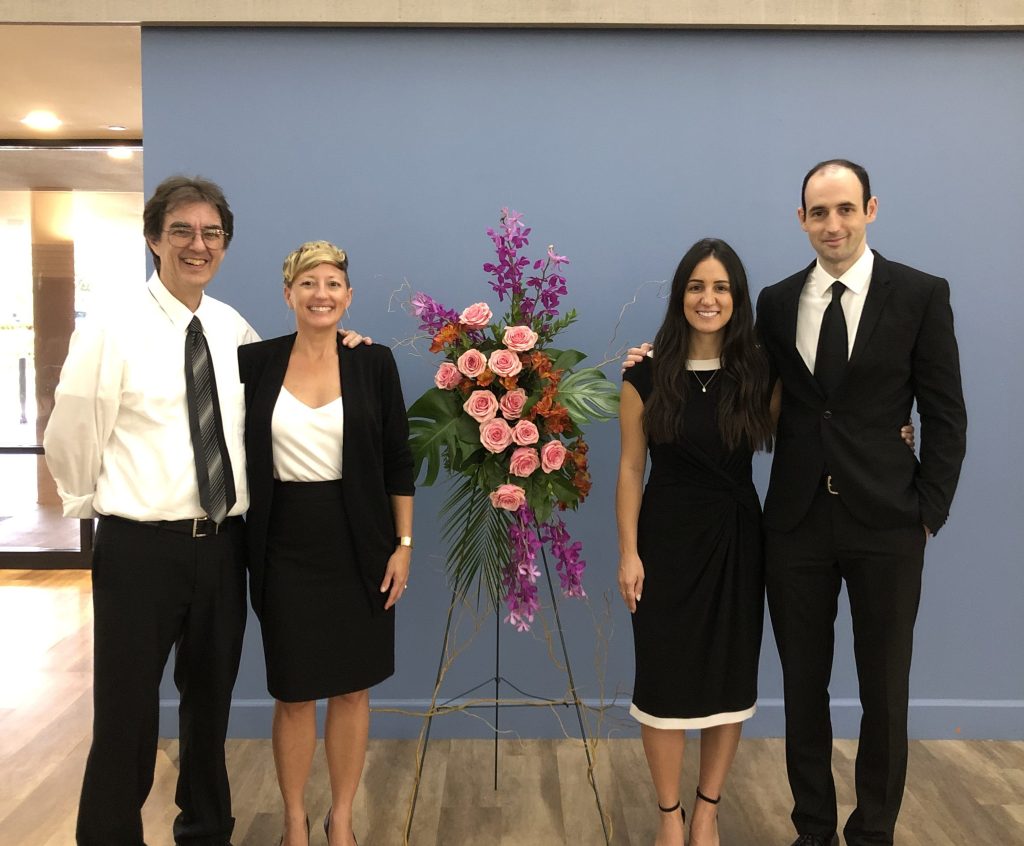
I felt JoAnn share with me, just hours after her death, that she would be closest to me and our kids when we were doing those things that made us happy. Jesus, the saints, and JoAnn remind us that we are not alone in our suffering.
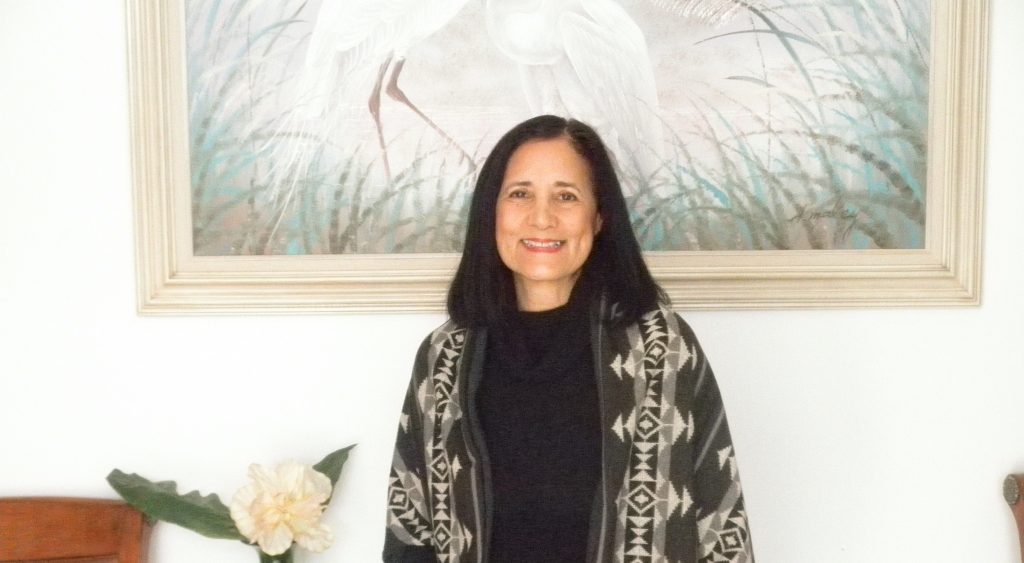
Photo: Celebrating JoAnn’s life at the reception after her funeral Mass.
The source for the quote is from St Paul of the Cross: https://passionist.org/st-paul-of-the-cross-passionist-founder/
Link for the Mass readings for Monday, November 1, 2021
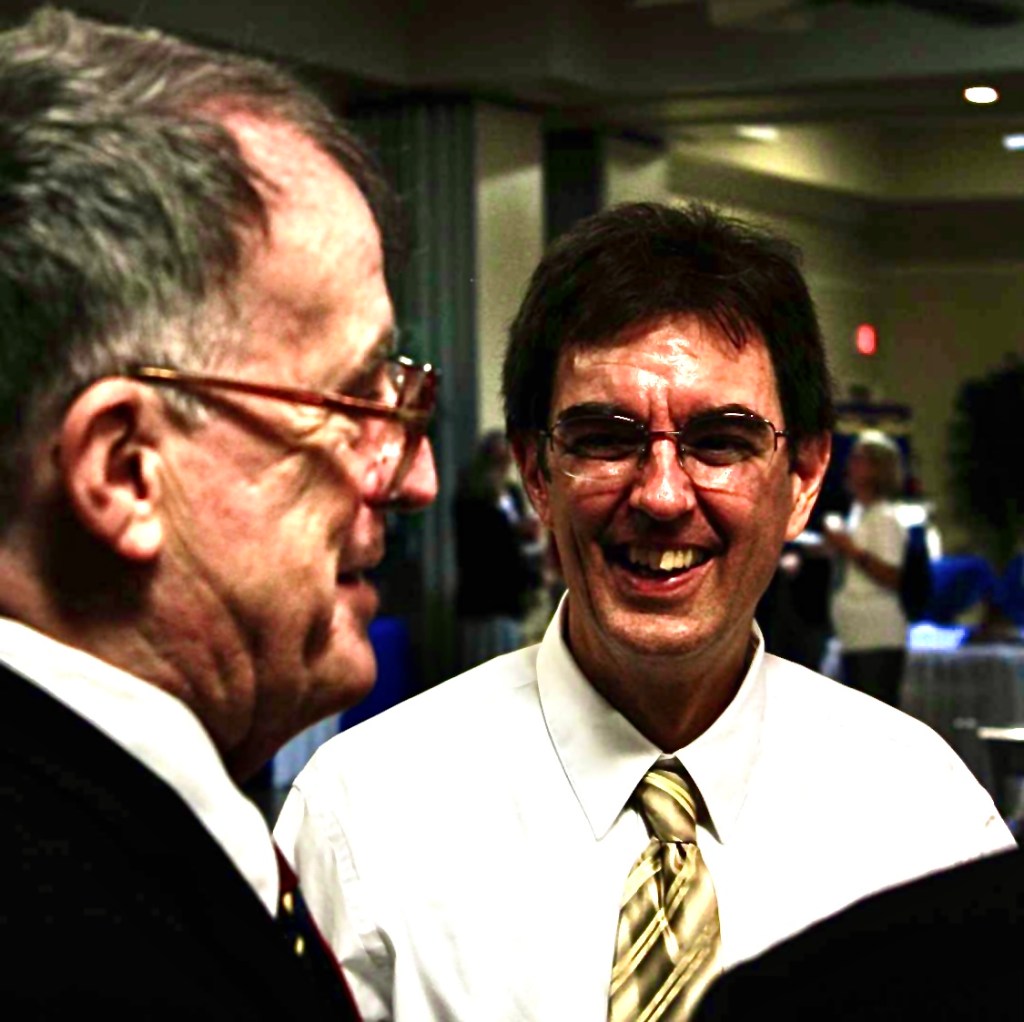
We begin to love by smiling and welcoming one another.
“Hear, O Israel! The Lord our God is Lord alone! You shall love the Lord your God with all your heart, with all your soul, with all your mind, and with all your strength. The second is this: You shall love your neighbor as yourself” (Mk 12:29-31).
How do we actually live out this great commandment given to us by Jesus? How do we love God that we cannot see?
Our first step is to understand better the love that Jesus is talking about. St Thomas Aquinas teaches us that to love, is to will the good of the other. This is more than an emotion or a feeling. To love means to accompany, encourage, and be present to one another. The love that God offers us is unconditional, it is about service and sacrifice.
Jesus doesn’t just want us to maintain the Church, our family, our friends, or our ourselves, he has always called us to be a missionary Church, to go out from ourselves and love others as he loves us.
Many inside and outside of the Church have been wounded, yet her heartbeat is strong, because the lifeblood that flows through her veins comes from her Son, Jesus the Christ. So many of our brothers and sisters are walking away from the Church, but her children still hunger to be loved and to love, they still hunger to belong, to be a part of who God has created them to be. They have a curiosity and desire to learn and they want to know, to have their questions answered, and to find meaning and fulfillment.
If we are to be of help to others, we start by saying yes to the invitation of Jesus to receive the love of his Father. We are to kneel in his presence, sit at his feet, and allow the transforming love of the Holy Spirit to conform and shape us, to sculpt us in love. At the same time, we are called to learn and know our faith, recognizing that our belief is grounded in both faith and reason, so that we can share who we are as a child of God, and what we have learned with others with love, with joy, even in the midst of scandal and crisis. This is not a time to run away, but to stand up for what we believe in, to show, through our own life and commitment, that Jesus is the way, the truth and the life.
Jesus Christ is the center of the Church. He is present in the Word proclaimed, in his Body and his Blood that we receive, in the Sacraments, and he is present in each and every one of us. If we are struggling to see or experience God, the best way to begin is to reach out toward another in loving service.
We are brothers and sisters in Jesus. We hunger and crave to belong to God and one another, whether we are aware of this hunger and thirst consciously or unconsciously, and this is true for the atheist as well as the mystic alike. Jesus invites us to be his disciples and we do so by loving God with all our heart, with all our soul, with all our mind, and with all our strength, and by loving our neighbor as ourself.
Being a disciple of Jesus is about surrendering ourselves to the love of God, embracing and being conformed by his loving hands. We are then to share his love and joy with others through invitation, hospitality, welcoming, and meeting our brothers and sisters where they are, as they are, and accompanying, convicting not condemning, empowering, loving and protecting one another.
Even people who don’t practice a faith or have lost their faith, still feel the need to connect with God and find purpose to their lives. I invite you to receive and meditate on this message I now share with you today. Then share it with someone:
God loves you more than you can ever mess up. God helps you to see and know that you are not defined by your worst choices or mistakes. God loves you more than you can ever imagine. Then share a smile, even while wearing a mask because the eyes smile. In that very simple act of a smile, we are saying you matter to me, you have dignity, you are important, have value, and I love you.
Photo: Share a smile today – photo credit: Jack McKee
Link for the Mass readings for Sunday, October 31, 2021
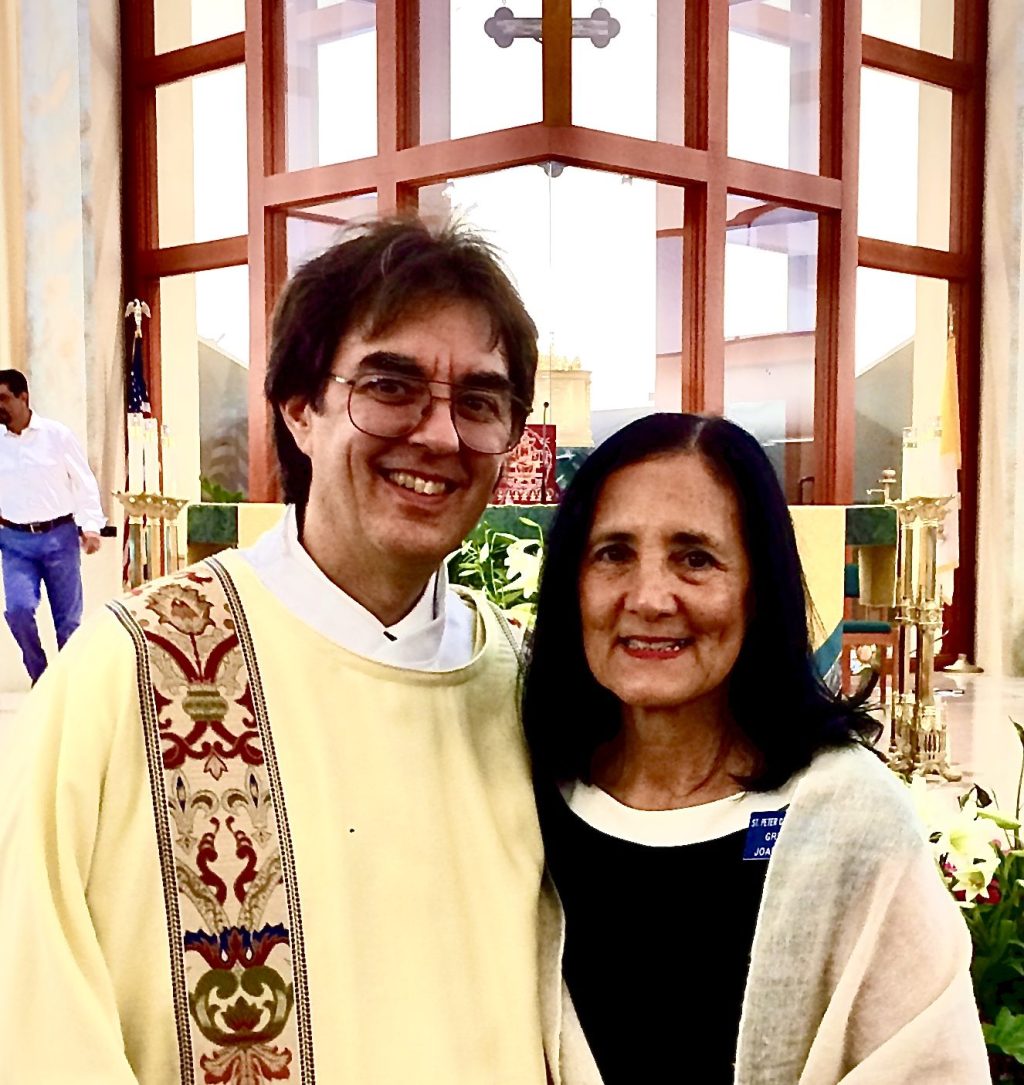
Jesus has died for us, may we live for him.
“For everyone who exalts himself will be humbled, but the one who humbles himself will be exalted” (Lk 14:11).
With these words, Jesus ends his parable about people jockeying for seats of honor, when in fact it is the prerogative of the host to determine the seating. Jesus also addressed this same issue with the Apostles when James and John requested to sit, one on his right and the other on his left when he would come in his glory (cf. Mark 10:35-45). True humility is submitting ourselves to the will of God and acting as he directs such that he is given the primacy of place, not us.
A memory of mine from third grade sticks with me and that is the feeling one day of someone watching me in the classroom. The feeling was not my classmates or the teacher. I do not believe I was paranoid, nor do I now. What I think the experience was about was me starting to be aware of me from the outside of myself, kind of looking in at myself as I perceived others as seeing me.
Maybe this was the awakening of my ego. I am no psychiatrist, this is all speculation on my part, but I feel as if that memory and today’s Gospel reading has converged. Too often throughout my life I have made decisions seeking others’ approval and just as often, I have chosen my actions regarding perceived opinions, not actual decisions requested of me directly. These perceived opinions were much more subtle in nature, but also could multiply so to be debilitating at times when I sought to make a decision.
What I am coming to realize, is that it is more important to align myself with God’s will for my life. This does not mean that I am turning my back on family, friends, and colleagues, but in point of fact, by coming to a better understanding of God’s will, I am more authentic in my interactions with others instead of operating from a posture of appeasement, which is more disingenuous. In so doing, I am better able to be present to others for their needs and not my own.
What may have been going on with those at dinner seeking the closer seats to the host, what impelled James and John to want to sit at Jesus’ right and left when he came into his glory, was that they were seeking honor, prestige, glory, acceptance to feed their egos, their false senses of self. Jesus is teaching us to instead align our energy and seek God’s will and we will find the fulfillment and joy that we seek. This is the transformation we saw happen in Peter. He protected himself at the cost of denying Jesus three times but forgiven by the mercy of Jesus he gave himself in love to serve him and his Church unto his death.
May we seek freedom from indecision, mental distractions, and temptations that we entertain to protect our own ego. Let us pray instead for a clearer mind, heart, and spirit that can discern clearly the will of God, and the courage and confidence to act upon his leading without hesitation. May we surrender our ego to God, and as Mother Teresa is known for saying, become a simple pencil in God’s hand. Instead of seeking honor, recognition, and praise, let our intention rather be to follow God’s leading and to serve others unconditionally, willing their good. In dying to our ego-self, may we go forward today living for Jesus. In our baptism we have been crucified with Christ, so it is no longer we who live, but Christ who lives in us (cf. Galatians 2:20).
Photo: Easter 2017
Link to the Mass readings for Saturday, October 30, 2021
 Spiritual Stepping Stones