Reflections on the Gospel Reading for the Day


Today we can begin again to allow ourselves to be loved by God and to serve as Jesus serves us.
For the Son of Man did not come to be served but to serve and to give his life as a ransom for many (Mk 10:45).
As fully God and fully man, Jesus taught and modeled for his disciples a contrarian view of how to live in our world. He rejected the pursuit of worldly honor, power, pleasure, and wealth during the time of his earthly ministry. Jesus redirected any attention drawn himself to his Father. He epitomized the exact opposite of the cult of personality by emphasizing what is most important is developing a relationship with God and following his will by serving the needs of others, even to the point of suffering and dying to open up access to heaven for us.
On our own, we cannot achieve this freedom of service. James and John showed that they did not understand Jesus’ call to service. Instead, they were looking for seats of honor and power. Though they had experienced, studied, and were mentored by Jesus, it was not until experiencing his crucifixion, resurrection, and ascension, and in remaining true and faithful despite their own failures, that they came to a place of transformation through their openness to the indwelling of the Holy Spirit. They came to understand that Jesus called them to serve and not be served. They then fulfilled what Jesus first saw when he called them to leave their boats and follow him.
This is true for us as well. Jesus sees not just our impulsiveness, pride, and selfishness, our woundedness, and our sins, but our potential yet to be actualized. Jesus calls us to a way of life that embraces serving as he served, yet in the unique way and charism that our loving God and Father has planted in us. He has sent the Holy Spirit to meet us in our present condition, to guide and empower us with his love, so as to draw us deeper into the Mystery of God.
May we allow ourselves to receive and experience the love of God so as to resist the temptation of building our own cult of personality and self aggrandizement by supporting our ego. As Fr. Gabriel Ghanoum shared with us on our retreat this weekend, the E.G.O stands for edging God out. Instead, by inviting God in, we will better be able to love and take care of ourselves. By entertaining healthier thoughts, making time for meditation, prayer, worship, study, healthier eating, exercising, and engaging in virtuous activities and by being loved by God and loving him in return, we will properly love ourselves, so as to better serve Jesus as we are present to and serve one another.
——
Photo: A new day for us to love God, love ourselves, and love others. Sunrise Saturday morning at Our Lady of Florida Spiritual Center. Come for retreat: https://www.ourladyofflorida.org/
Link for the Mass readings for Sunday, October 17, 2021
Be open to the Holy Spirit and you will experience God-incidences.
“Everyone who speaks a word against the Son of Man will be forgiven, but the one who blasphemes against the Holy Spirit will not be forgiven” (Luke 12:10).
This verse is often referred to as the “unforgivable sin” and it can be difficult to understand. Also, if you have been reading this blog regularly you may have read more than once my writing that God forgives us more than we can ever mess up, so, how is it that we can’t we be forgiven for blaspheming the Holy Spirit?
A story that I shared in yesterday’s reflection may help (If you read the story yesterday, you can skip this and the next paragraph). When I was a junior or senior in high school, one of my teachers commented that if we thought Stephen King wrote amazing tales, then we might find reading the book of Revelation from the Bible interesting. This was a public school mind you. As a big fan of Stephen King, that phrase stayed with me, and a few weeks later, I purchased a King James Bible from our local bookstore, Waldens, which I am not sure exists anymore. I don’t remember if I read it at all, I must have thumbed through it a time or two, but then placed in on a shelf, presumably with my a copy of The Stand.
A month or two passed and I remember being at a party and not having much fun, so I left. When I arrived home I had the urge to open my newly purchased Bible and when I did my eyes found not the words from the author of Revelation but Luke. He shared: “Do not be afraid. You are worth more than many sparrows” (Lk 12:7). After reading the section leading up to this verse, I felt God saying to me that I would not ever win the lottery, but like the sparrows, he would take care of me providing me with the opportunity and the ability to work. He has continued to be true to his word through all the ups and downs of my fifty-six years so far. These beginning stepping stones have led to others that would ultimately pave the way to me typing these words to you today. Because of each successive yes to the invitation and guidance of the Holy Spirit, and confessing those times that I did not, I placed myself in a better position each time to recognize and hear the word of God.
Now, that experience could have taken a different turn. I could have resisted the initial curiosity that welled up within me from my teacher’s discussion and instead of going out to purchase a Bible, I could have stayed home that day and opened up my copy of The Stand and given it a second read. Thus denying that invitation of the Holy Spirit, I would not have had a Bible when I went to that party. I could have followed through on the first urging to purchase a Bible but then resisted the second urge to leave the party. Choosing to ignore either or both promptings would have led to a higher probability of my not hearing God’s voice that night. Say each step did happen up to and including hearing God’s voice but then I denied that I heard God, instead attributing the experience to some bad pepperoni pizza from the party. Each one is an example of how I could have closed myself off to God’s communications.
God invites us to share in his life in a myriad of ways. With each invitation, no matter how small, we can say yes, or we can dismiss these “encounters” as mere “coincidences.” With each denial, we further limit ourselves to the possibility of acknowledging an encounter with God, even begin to doubt and/or come to a place of denying that he even exists. We could then develop “a mentality which obstinately sets the mind against the Spirit of God, and as long as that obstinate mindset perdures, God’s forgiveness cannot be accorded to such a person” (Fitzmeyer 1985, 964).
God loves us more than we can ever mess up, so much so, that he gives us the freedom to reject him. He does not impose his will upon us. John the Baptist and Jesus got this, and this is why their emphasis on repentance was so preeminent in their preaching. If we turn to God with humility and contrition, true sorrow for our sins, God will forgive us and we will receive his healing touch.
The danger of a consistent and obstinate disposition is that like a muscle that is not used, it will atrophy, and so will our ability to see God working in our lives. We will become less and less able to notice his gentle stirrings and invitations. We will become spiritually blind and our hearts will become hardened. Now that does not mean God stops communicating. He continues to reach out to us in an infinite number of ways, but we are less and less able to receive the forgiveness he so thirsts to give us when we close off ourselves to even the mere possibility of him doing so.
Jesus, in becoming one with us so that we can become one with him, opened up the opportunity for us to experience the Holy Spirit, who is the Love that is shared between himself and God. The more we say yes to his guidance and leading, the more we will experience him, the more we will begin to recognize his voice, and the more we will participate in his forgiveness and love. I don’t believe in coincidences, but God-incidences!
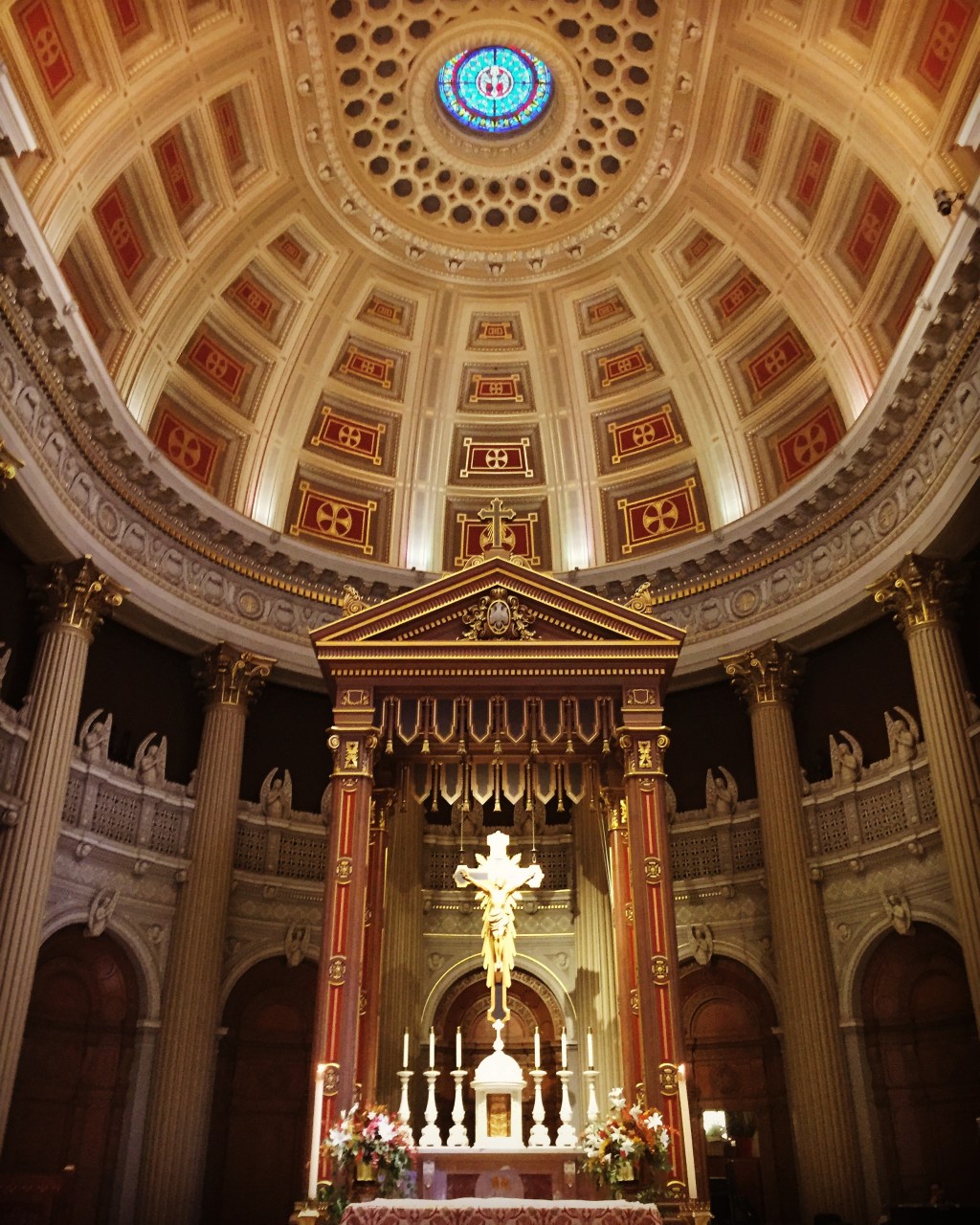
Photo: Holy Spirit stained glass in the dome in the apse of St Ignatius Church in San Francisco. “Come Holy Spirit, fill the hearts of the faithful and kindle in them the fire of your love. Send forth your Spirit and they shall be created. And you shall renew the face of the earth.”
Fitzmeyer, Joseph A. The Gospel According to Luke X-XXIV in the Anchor Bible. NY: Double Day, 1985.
Link for the Mass readings for Saturday, October 16, 2021

God provides for the sparrows and us, are we aware?
“Are not five sparrows sold for two small coins? Yet not one of them has escaped the notice of God. Even the hairs of your head have all been counted. Do not be afraid. You are worth more than many sparrows” (Lk 12:6-7).
Some thirty-five plus years ago I was in high school and either in my junior or senior sociology or psychology class, my teacher mentioned that if we thought Stephen King told amazing tales, we should definitely read the Bible. He keyed in especially on the imagery expressed in the Book of Revelation. My teacher’s comment piqued my interest because at the time I enjoyed reading Stephen King, though I had not spent any time reading the Bible.
My teacher’s words stayed with me beyond that class period. A few weeks or months later I remember going to Waldens, a bookstore, at the Enfield Mall in the next town over from where I grew up in East Windsor, Connecticut. I purchased a King James Bible. I don’t remember reading it right away, but shortly sometime after, I do remember leaving a party. I don’t remember anything about the party or why I left, but when I arrived home, I remember going up to my room and for some reason grasping my new Bible. I then opened it at random and began reading. The verse above was what I read, and it was the first time I can remember experiencing God speaking to me.
It was not a booming voice emanating from the burning bush that was directed to Moses, the room didn’t shake, nor did the lights flicker. Yet, in that quiet and still moment, I heard in my mind, “You will not ever win the lottery, but like the sparrows, I will take care of you. I will always give you the ability and means to work.” God has proven true to his word. I have not won the mega millions, but God has provided me with the opportunity to have regular, gainful employment and even though experiencing some tight financial times through the years, God has provided beyond work through the kindness of friends, families, as well as some amazing assistance outside of the norm at times.
Does God still speak to us as he spoke to the people in the Bible? Absolutely! God does speak to us directly, he also speaks to us through his written word in our personal reading, in our time of communal worship, and through preaching. He also speaks to us through the sacraments, music, art, movies, through others, through our serving each other, through his creation, and a myriad of other infinite possibilities.
The question is not so much, does God still speak to us? The question is why do we not hear and how do we open ourselves up to his words or his silence? One way is to ask God to help us to recognize his voice. So we can be like the sheep that come to learn the shepherd’s voice. Another way is to stop and be still. Doing so gives us the opportunity for reflection, to ask God to reveal times in the past where he has spoken and we were not aware. When we examine and reflect on our day, with God’s help we can see where God has been with us and reaching out to us.
Not only do we need to make a consistent time each day to pray but we need to stay long enough to listen! One of the biggest reasons many of us do not hear God is because we are not listening or we don’t make the time to stop. God’s silence is also a profound answer. There are many people that may want to give us advice, to offer solutions to fix our problems, when sometimes, we just need to stop, slow down, and be still. Are we willing to be open and believe that God speaks to us, and guides us? Fr. Jim Martin, S.J., has expressed the search for finding God in this way: “God is always inviting us to encounter the transcendent in the everyday, the key is noticing” (Martin 2010, 86).
God knows us better than we know ourselves and he loves us more than we can ever imagine. Let us be a little more aware today than we were yesterday, and may we have eyes, ears, and minds open to notice God present in our lives. Our Loving God and Father cares for and provides for us as he does the sparrows. Are we willing to answer his invitation to spend time with him and to listen for his word or his silence?
Photo by Tejas Prajapati from Pexels
Martin, S.J., James. The Jesuit Guide to Almost Everything: A Spirituality for Real Life. NY: Harper Collins, 2010.
Mass readings for Friday, October 15, 2021

Let us share the keys to open more doors so that more people may have access.
Woe to you, scholars of the law! You have taken away the key of knowledge. You yourselves did not enter and you stopped those trying to enter” (Lk 11:52).
I have quoted my friend, mentor, and brother, Dr. Sixto Garcia often, and it is worth quoting him again: “We are a living, craving, hunger, and desire to be one with God and one another. This is true for the atheist and believer alike.” At our root, in the very bowels of our being, we yearn for God. The psalmist echoes this point as well: “As the deer longs for streams of water, so my soul longs for you, O God” (Psalm 42:2). Whether we know it or not, believe it or not, we yearn for God. He is the only one who can fulfill what our deepest longing is because as St Augustine wrote in his Confessions, he “has made us for himself and we are restless until we rest in thee”.
To prevent access, to those who seek, as did those for whom Jesus points to in today’s Gospel, is an egregious offense. Especially in the way that Jesus describes. They themselves have the key to enter, do not avail themselves of the gift they have received, and worse, prevent others from going in! I remember a time in eighth grade where I had wanted to ask a girl I liked out to the school dance. I confided this hope with someone but of course, the word got out. A few days later in math class, the teacher laughed aloud and announced to the whole class that I was the first one he had ever heard of being rejected before I could even ask someone out. I wanted to melt into the floor.
Now, this may not be the most direct example of what Jesus was talking about, but there is a parallel. Teachers, like religious leaders, are to open up greater access and care for those that have been placed in their trust. When they do the opposite by denying access, betraying that trust, belittle, or worse abuse those they are charged to empower, they slam doors in the faces of those who seek the fulfillment of their being. We are all caretakers of each other. We need to resist any temptation to demean, dehumanize, or crush the spirit of anyone.
St Paul in his most theologically mature letter wrote: “We who are strong ought to put up with the failings of the weak and not to please ourselves” (Romans 15:1). People are hungry for God. We must resist building walls or refusing to open doors to those who seek. We need to build bridges of encounter and accompaniment, even when the seeker does not recognize they are seeking, and when they express their thirst in not the most pleasant of ways. Here it is even more important that we resist reacting and slipping into a defensive posture but instead be open, understanding, willing to listen with our spirit instead of our ego for what their need truly may be.
As Pope Francis wrote: “Each one of us is called to be an artisan of peace, by uniting and not dividing, by extinguishing hatred and not holding on to it, by opening paths to dialogue and not by constructing new walls! Let us dialogue and meet one another in order to establish a culture of dialogue in the world, a culture of encounter” (Pope Francis, 128).
Photo: My first year teaching, 1997, hoping to share some keys, open some doors, and plant seeds of peace.
Mass reading for Thursday, October 14, 2021

Jesus invites us to come from the shadows into his light.
After Jesus continues to call out those Pharisees who follow their own will and put themselves in the place of honor instead of God, one of the scholars of the law said to him in reply, “Teacher, by saying this you are insulting us too.”
Jesus does not miss and beat and convicts the scholar as well when he said, “Woe also to you scholars of the law! You impose on people burdens hard to carry, but you yourselves do not lift one finger to touch them” (Lk 11;45-46).
Jesus is clear about his mission, about what the kingdom of God is not and what it is. Jesus is shining a light on the practices of the Pharisees and the scholars of the law in the hope that they can see the darkness that is blinding them. Unfortunately, unlike Bartimaeus (see Mk 10:46-52) who knew he was blind and wanted to see, this is not true for these men who Jesus confronts in today’s Gospel.
How about us? As Jesus shines his light and love in our direction, do we cover our eyes because the light is too bright and withdraw further into the shadows or do we remain still and allow our eyes time to adjust so that the brightness of the Mystery of God will reveal to us that which has kept us bound? Will we justify, or rationalize our behavior or that of others that we know are sinful, or will we be transparent and walk further into the light and the embrace of Jesus, so to repent and believe in the Gospel?
We need to resist the path of those Pharisees and scholars of the Law who imposed heavy burdens on those seeking a relationship with the living God and instead be willing to follow Jesus and meet others where they are in the moment, so to accompany, encourage, and support each other in living the Gospel in our everyday lives. Hiding in the darkness, enslaved by our fears and prejudices, is no longer an option. Jesus beckons us to come out from the shadows and into the radiance of his light. As we experience his love and mercy, he encourages us to continue to move out of our comfort zones and complacency so that we may encounter others with the same love and mercy we have received.
In actuality, the prescriptions that Jesus places on us as his disciples are more challenging than those of the Pharisees and scribes. The difference is that what Jesus invites us to do, he will accompany us and give us the divine assistance to accomplish. What we need to remember is that it is Jesus working through us, not us doing it on our own. Apart from Jesus, we are nothing, but with Jesus all things are possible.
Photo from remehernandez from Cathopic.com
Mass readings for Wednesday, October 13, 2021

Accountability and humility will help us to resist hypocrisy.
The Lord said to him, “Although you cleanse the outside of the cup and the dish, inside you are filled with plunder and evil. You fools” (Lk 11:39).
Jesus’ harshest critiques were for acts of hypocrisy. He did so to show, in no uncertain terms, how dangerous this was, especially for religious leaders. These men were entrusted with the care of God’s people. They may have observed the proper rituals, spoke, and dressed to match the part but this all meant nothing if their hearts were hardened and they were closed to the will of God. Most of all, the danger was when they themselves became obstacles, stumbling blocks to those who sought God. Jesus indicting them as fools meant that they were bereft of the wisdom of God they projected to have.
A recent Pew study tracing religious affiliation from 2007 to 2014 found that approximately 56 million Americans identify themselves as following no religious affiliation. Some have labeled this group as the “Nones”. The context and nuance of why this trend is on the rise has many components. One ingredient is the unacceptable levels of hypocrisy which has turned many off to organized faith traditions. The most recent report from France reminds us of the present crisis regarding the abuse of minors and the indigenous children recently found in unmarked graves throughout Canada boarding schools support this trend in horrific and unconsionable ways.
In the depths of our very being, we seek and yearn for the transcendent, the infinite. We are spiritual seekers, yet, time and again, we experience suffering, injustice, and hypocrisy at the hands of the very ones who are our leaders in both the religious and political sphere. This is why Jesus convicted those who abused their positions because he knew the significant damage that they could inflict.
No one is perfect, our leaders nor ourselves. We all fall short of the perfection of Christ, even those of us who seek and aspire to live by the Gospel. If we put anyone up on a pedestal they, sooner or later, are going to fall, and the higher up they go, the greater the fall. God is to hold priority of place. One way we can sidestep the trap of hubris is by resisting the urge to project all is well and good, that we are fine when we are not. None of us are super men or women. If we think we can go it alone, we will fall sooner or later.
When we turn to Jesus to reveal our weakness and our sin, we can experience his transformative and healing power in our lives. To be vulnerable, to allow Jesus to shine his light into our inner darkness takes courage, but when we open all of our lives to him we will identify and be able to release our own “plunder and evil”. The Holy Spirit can also help us to trust one another with our weaknesses, faults, and shortcomings.
In assuming a posture of humility and openness, in reaching out for help, in entrusting ourselves to a core group of people will allow the unique gifts of others to come to the fore so we can empower one another while holding each other accountable at the same time. When we are transparent with our weaknesses and willing to accompany one another, we as Church can resist the temptation of hypocrisy and instead of driving people to the nearest exit, we can welcome people home.
Painting: Supper In the House of Simon, by Italian artist Moretto da Brescia (1150-1554)

Someone greater than Jonah is among us.
While still more people gathered in the crowd, Jesus said to them, “This generation is an evil generation; it seeks a sign, but no sign will be given it, except the sign of Jonah” (Lk 11:29).
To understand what Jesus means we need to understand the sign of Jonah. Jonah was sent by God to go to Nineveh, the capital city of Assyria, to call them to repent from their wicked ways. The Jews not only considered Nineveh to be a place of decadence, wickedness, and godlessness, but the military of Assyria had invaded Israel and eventually conquered the northern kingdom around 721 BC. We can understand Jonah’s initial refusal to follow God’s lead. Not only did he not want to go to Nineveh, but Jonah also did not want them to receive mercy. He wanted God to punish and destroy them. Those who have read the Book of Jonah, know that Jonah finally acquiesced, and within hours of his proclamation to the citizens, including the king, they repented and God showed them mercy.
Jesus draws a parallel between the people of Nineveh and his listeners. The people of Nineveh heard and repented to a reluctant messenger. The Ninevites, Gentiles, the sworn enemies of Israel, received God’s mercy when they repented. Now, in their midst was one greater than Jonah, the Son of God, and they were demanding of him a sign. The sign of Jonah was repentance. Jesus, from the beginning of his public ministry, preached the same: “This is the time of fulfillment. The kingdom of God is at hand. Repent, and believe in the Gospel” (Mk 1:15).
We would do well to listen to Jesus’ message. Repentance is a foundational spiritual discipline. We are called to consistently examine our conscience and to come to accept that we live in a fallen world. This is not a pessimistic view. This is an awareness of the reality of our present condition.
By accepting that we live in a fallen world, that there is only so much that we can do by ourselves, we will begin to recognize that we do need a savior. The next step that we can make is to acknowledge that we need to repent and turn back to him who can save us. For apart from him, we can do nothing, yet with God, all things are possible.
St Mother Teresa recognized the need for Jesus and stressed this when she taught her novices that she was not interested in numbers and she was not interested in having a branch of social workers. She and those who followed Jesus were to be missionaries of God’s charity. They were to serve Jesus in the distressing disguise of the poor. To do so they participated in daily Mass for an hour so they could bring Jesus to those they encountered that day. After returning from their time of service they participated in adoration for an hour. Empowered and renewed by Jesus, blessed by his mercy and love, they could serve Jesus in those they met in the harshest of conditions.
The Gospel message today is clear. We are not so much to seek signs but to seek Jesus. By emptying ourselves of our preconceived notions and opening our hearts and minds to follow his lead and being conformed to his life, we can be about doing God’s work. As long as we stay connected to him, he will guide and give us the means to accomplish that which he sends us to do.
We empty ourselves by repenting from our own selfish pursuits and accepting the invitation of Jesus to be the center of our lives, the very source of our thoughts, words, and actions. “For you were called for freedom, brothers. But do not use this freedom as an opportunity for the flesh; rather serve one another through love” (Galatians 5:13 ).
Photo: Cardinal Newman Chapel where I like to begin each day, looking at Jesus while he looks at me.
Mass readings for Monday, October 11, 2021

“You are lacking one thing…”
A man approached Jesus seeking to know what he must, “do to inherit eternal life” (Mk 10:17). Jesus shared that following the commandments, such as: do not kill, commit adultery, steal or bear false witness; do not defraud, but do honor his father and mother (cf. Mk 10:19), would be a good place to start. The man affirmed that he had followed them all. I can see the eyebrows of Jesus raise and his mouth curl into a smile as he realizes the sincerity of the man kneeling before him. The disciples recognized that look and held their breath.
Jesus, looking at him, loved him and said, “You are lacking one thing. Go, sell what you have, and give to [the] poor and you will have treasure in heaven; then come and follow me” (Mk 10:21).
Jesus was not admonishing or condemning the man, he was loving him, and inviting him to take the next step to fulfill the deepest desire we all have, which is to be one with God and one another. Yet, instead of embracing the invitation, the man was crestfallen. He had followed the prescriptions of Torah all his life, he felt he was blessed by God with the gift of having many material goods, but in the end it was those possessions that had enslaved him. He genuinely came seeking eternal life, and Jesus outlined what he could do to receive what he sought, and even more by giving him the opportunity to be one of his disciples, but he could not give up the one thing he was lacking.
The heart of the commandments is to help us to be freed from that which enslaves us, so that we can put God and each other first and foremost in our lives. This is what we all have been created for, as St. Augustine himself realized when he wrote, “You have made us for yourself, O Lord, and our hearts are restless until they rest in you” (St Augustine, Confessions).
I invite you to return to this scene from Mark 10:17-31 today, and recall the image of the disciples and Jesus watching the rich man walk away sad. Slowly, observe that they turn their eyes of invitation toward you. A bit hesitant, maybe, ask Jesus, “What must I do to inherit eternal life?” Jesus holds your gaze in his and loves you and says, “You are lacking one thing…” What does he say next? What is your response?
————————————
Painting – Chinese depiction of Jesus and the rich young man – 1879 – accessed from Wikipedia
Link for the Mass readings for Sunday, October 10, 2021

 Spiritual Stepping Stones