Reflections on the Gospel Reading for the Day
Trust where God is leading
“Jesus summoned the Twelve and gave them power and authority” (Lk 9:1).
Jesus summons us as he did the Twelve and empowers us for ministry in his name. The expression of our service is unique to each of us. Many resist exploring or entering into a deeper commitment to their faith because they are anxious or afraid that God may call them to something that they would never want to do, or that they couldn’t conceive they were capable of. Initially, there may be some trepidation even when we are clear of the direction God wants us to move in, but that may come more from our hesitancy to change and move out from our comfort zone. Ultimately, God wants for us what we want for ourselves; to live a life of fulfillment, joy, and meaning.
God knows what and with whom we will experience fulfillment. The challenge for us is to come to know this for ourselves as well. The work of discipleship begins by accepting the invitation of God to walk with him and trust that he knows what he is doing and where he is leading us! No matter what our age, we are never too young or too old to begin or recommit to the journey along the path of discipleship. One good practice is to reflect on our dreams and desires, bring them to God in prayer, and imagine ourselves embracing what we desire.
When I first joined the Franciscans to study for the priesthood in the early ’90s, I would imagine from time to time my ordination day, especially in our second year as we were thinking about taking temporary vows. When I did so, a puzzling result consistently arose. I did not imagine feeling any excitement or joy. So, a year and a half into formation, I decided to take a leave of absence. I had asked to take off a year, but the minimum time for a leave of absence was two.
Though I balked at first about the two-year time frame required, I came to respect the wisdom of my formation director. It was in my second year away, that I realized that my vocational path was leading me to the Sacrament of Matrimony and not Holy Orders. About eighteen months after I made that decision I met JoAnn. As our relationship grew and we began to talk about marriage, whenever I envisioned our wedding day I felt excitement and joy. Each year together has been better than the one before. Though JoAnn left this life far too soon, knowing what I know now after twenty-three years of marriage, I would ask her to marry me all over again!
God has a plan for each and every one of us, he knows what will fulfill us, and he loves us more than we can ever imagine. When we ponder our dreams and desires, and as we investigate, research, explore potential outcomes and continue to pray and discern each step, we will come to see that as we align ourselves with God’s will that makes all the difference. We are not alone in this process and we have a God who can see the full picture, where we see only a small part.
There will be fits and starts, missteps and slips, doubts as well as confirmations, and desolations as well as consolations. The key through it all, is to remain faithful, to continue to trust in Jesus who called us. He will continue to accompany us along the way, he will give us the resources and strength we need, and he will send the Holy Spirit to empower and transform our lives. We need to remember that this process is not just for ourselves alone. We are transformed by the gift of God’s love to go out and share the invitation we said yes to with others.
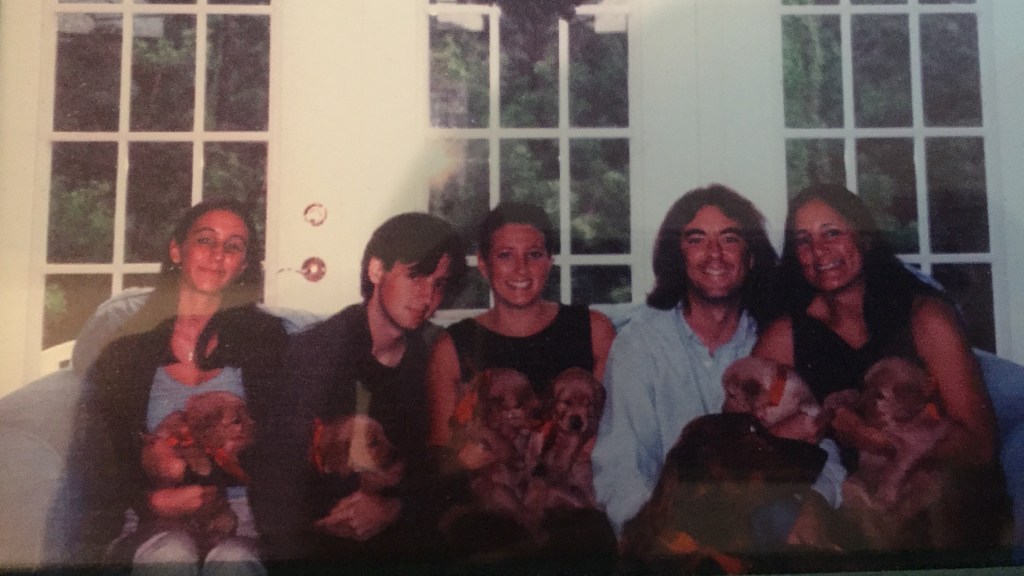
Photo: Following God’s discernment led me to JoAnn, family, and puppies! Picture from Christmas about 2002.
Link for the Mass readings for Wednesday, September 23, 2020
Do we hear the word of God and act upon it?
He said to them in reply, “My mother and my brothers are those who hear the word of God and act on it” (Luke 8:21).
There are many popular genetic testing kits that are advertised on TV and through the internet. People have asked me is it possible to be a blood relation to Jesus. Jesus’ reply today can help you to save some money. Asking if we are a blood relation with Jesus is missing the point of Jesus’ ministry. What is important are “those who hear the word of God and act upon it.” God is to be first, even before family. We may experience a subtle shudder from this statement but to those of Jesus’ time, it would have been apoplectic. Family meant everything in the Ancient Near East.
Jesus is not making the point that we disregard family, he is instead teaching us that if we are to be authentically present to our family this will come about best by following the will of God. As we deepen our relationship with Jesus and put his teachings into action, we begin to bear the relational fruits of the Spirit. Would not our familial relationships be much better if we were more loving, joyful, peaceful, patient, kind, generous, faithful, gentle and practiced self-control? Jesus taught and showed from his own life that the path to fulfilling and intimate relationships flourish best when we put God first because as we grow closer in relationship with him, we also do so with those around us.
Another point we can glean from Jesus’ response in today’s Gospel is that our “family” is to transcend bloodline, tribe, and nation. Any of “those who hear the word of God and act upon it” is spiritually akin to Jesus the Christ. The point is not that we may have a genetic, lineal relation with Jesus, but that when we live and act according to his Father’s will, we are part of the universal family of God’s grace and mercy and our relationship with him and one another grows as we continue to bear the fruits of the Spirit. As brothers and sisters in Christ, we can act with more caring and kindness, seek common ground through dialogue, be more willing to walk and accompany one another and seek to understand instead of judging those who are different. The bottom line is that we are to love one another as Jesus loves us!
I have been blessed to experience the fruits of this teaching first hand. As I have grown closer to Jesus, I have not only grown closer in relationship with my immediate family but have also been blessed with a larger extended family through the communities of St. Peter Catholic Church, the Diocese of Palm Beach, Rosarian Academy, and Cardinal Newman High School. So many of whom JoAnn and I have been so grateful for in their outpouring of love, prayer, and support through JoAnn’s illness and most recent death just over a year ago.
————————————
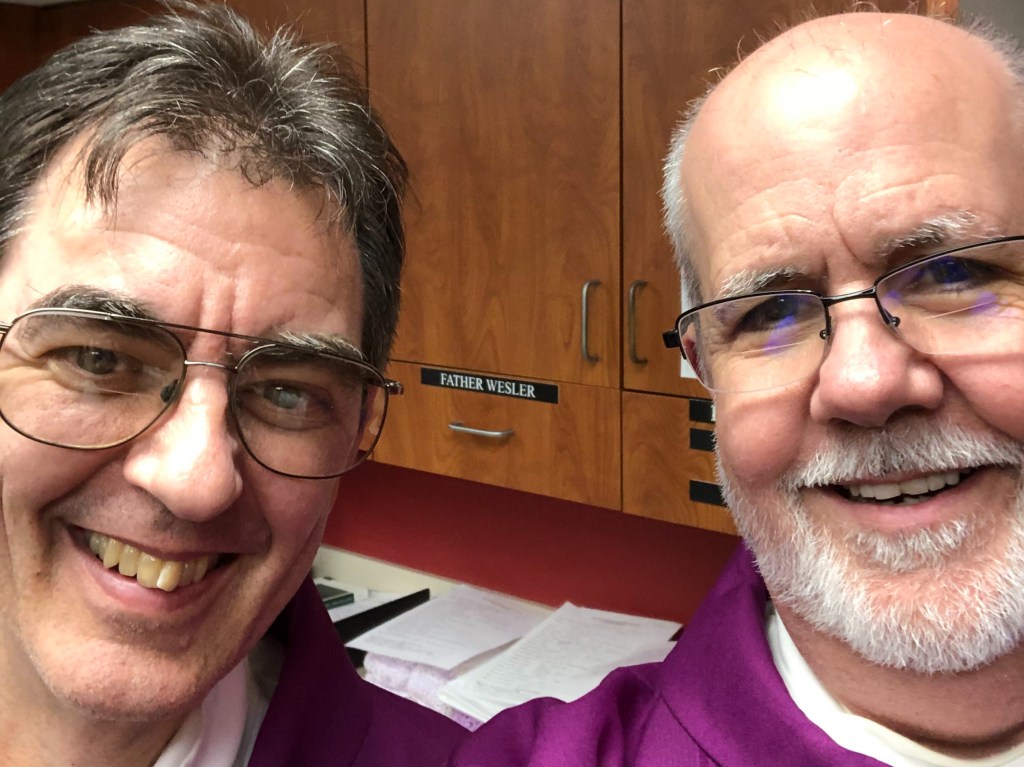
Photo: Being welcomed back to my first Mass since my return from CA last December from by brother in Christ, Deacon Steve.
Jesus built relationships with others. Are we willing to do the same?
“While he was at table in his house, many tax collectors and sinners came and sat with Jesus and his disciples” (MT 9:10).
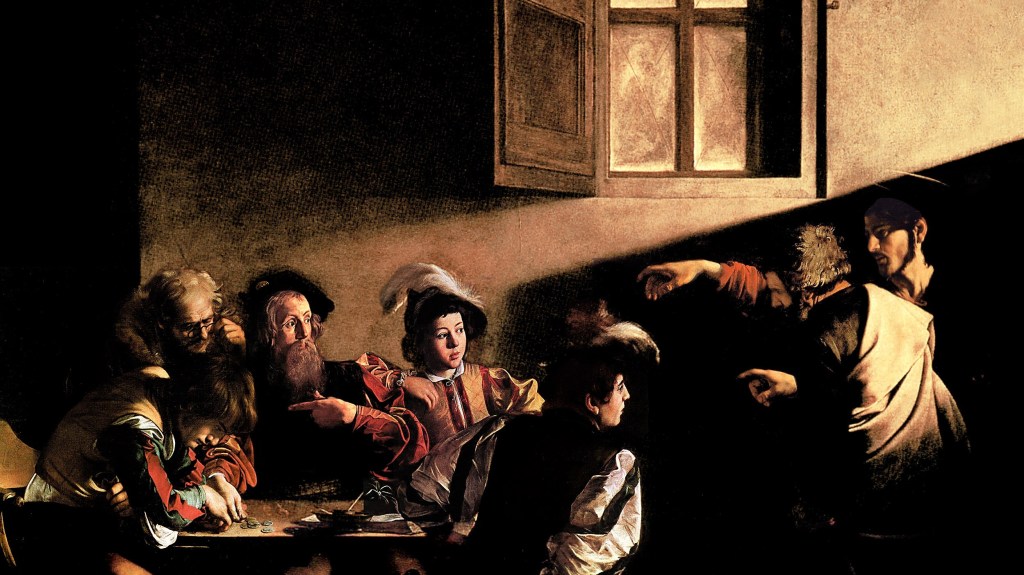
We as the Church, we as followers of Jesus, still have much to learn from him. Today’s reading provides another wonderful example. Once Jesus begins his public ministry he is constantly on the go. Going to where? Meeting people where they were, in the midst of their daily lives as he did with Matthew in today’s Gospel reading. And what is the response to Jesus calling Matthew, a tax collector, and then partaking in table fellowship with other tax collectors and sinners? The Pharisees question the disciples about his practice and curious onlookers follow at a distance. But to those who have, maybe for the first time in their lives, been respected as fellow human beings, feel hope. A hope that there actually may be a path leading in from the peripheries. A hope that they no longer have to be on the outside looking in. A hope that they, for the first time in their lives might finally belong.
Jesus is shown time and again encountering the person as they are in their present circumstances and the chaos of their lives. He welcomes, is present to, and embraces the person as they are. He invites people to be part of something greater than their self-absorbed posture, to actualize their potential and embrace a life of meaning and purpose. The only requirement is that they are willing to: be loved, be human, be free, and once experiencing this encounter, share what they have received with others.
Do we: deny or mask our own fears, stoke our own pride believing that we can take care of ourselves without the help of anyone else, seek false truths and the glittering lures of power, wealth, pleasure, and honor for our security and satisfaction, that in the end leave us empty, attached, and/or addicted? Or are we willing to have: the humility to recognize our sinfulness, our need for Jesus and receive his love, so to let go of our bondage to false illusions of security, and realize that we are, at the deepest core of our being, a living, craving hunger and desire to be loved by God and others, so to love in return?
If we are willing to risk being vulnerable and will open our hearts to Jesus we will experience the love, fulfillment, and belonging we seek in the very depths of our soul. This is the fulfillment that no other pursuit or person can bring. We do this best as Jesus did, by being willing to enter into the lives of others, by resisting judgment and accepting another as they are for who they are, by being present and willing to accompany our fellow brothers and sisters. For as Jesus said, “I desire mercy, not sacrifice” (Mt 12:7). Mercy, as I have quoted Fr. James Keenan, S.J., before, “is the willingness to enter into the chaos of another.” Jesus is willing to do so for us. Are we willing to be loved by him, to be called by Jesus like Matthew, so we can love others and enter into the midst of their chaos as well?
——————————————————
Painting: The Calling of St. Matthew, Michelangelo Merisi da Caravaggio, 1600
Link for the Mass readings for Monday, September 21, 2020

God will give us a just wage.
At dawn, nine, noon, three, and five o’clock the landowner hired day laborers to go into the field to work and bring in the harvest. Many familiar with this parable may side with those working since dawn and may also grumble, against the landowner, saying, “These last ones worked only one hour, and you have made them equal to us, who bore the day’s burden and the heat'” (Mt 20:11-12). Instead of being grateful for the wages they received and had agreed upon before the job began, those grumbling focused on what they perceived as an unfair allocation of payment. The landowner attempted to clarify with one of the obstinate ones saying, “My friend, I am not cheating you” (Mt 20:13).
In essence, the landowner sought to draw this laborer from his self-centered view to the broader context and reality of the situation. Each of the laborers in the parable were day laborers, they did not have a regular stable salary. They worked and received wages and provided for their family only when someone gave them an opportunity. It wasn’t that the landowner was favoring the last over the first, he was just being generous with the opportunity to provide work and pay for those who answered yes to his invitation. And in the end, he asked “am I not free to do as I wish with my own money? Are you envious because I am generous” (Mt 20:15)?
Jesus presented the parable of the workers in the vineyard (Mt 20:1-16) as he did with the parable of the prodigal son (Lk 11:15-32) to show his listeners and us the generosity of God’s love and mercy. We must resist the temptation to be envious and begrudge those, who having less, have received from God what is their due. Instead, we who have been blessed, need to be aware of the generosity God has bestowed upon us, to be thankful for his blessings, and so collaborate with God by sharing with others who are less fortunate than ourselves, for “the harvest is abundant, but the laborers are few” (Lk 10:2).
We have been invited to work for the Landowner in his vineyard. We are to be about his work building and restoring relationships and not worrying about seeking reward. Comparing what we have to what others have will only end in frustration and separation, for as the prophet Isaiah said, “For my thoughts are not your thoughts, nor are your ways my ways, says the LORD. As high as the heavens are above the earth, so high are my ways above your ways and my thoughts above your thoughts” (Isaiah 55: 8-10). The just wage for our work is God’s mercy and we are not to refuse or be jealous of anyone else receiving his mercy. Instead of judging God’s forgiveness and mercy, we are to seek to emulate it!
Photo by Pixabay from pexels.com
Nurture the seeds God has sown and we will bear fruit!
“The seed is the word of God” (Lk 8:11).
Jesus expressed in his parable of the sower the ways in which we lose the germination opportunity or coming to bear fruit of the seed that has been sown. The devil “comes and takes away the word from their heart that they may not believe or be saved.” Another way is with those who fixate on mere scientism or empiricism, and so denounce any spiritual or transcendental experience as a coincidence, or dismissed as offering no empirical substance, no proof, thus explaining away any trace of spirit. Others “receive the word with joy but have no root.” Some encounter God, experience a deep emotional connection at the moment but once the emotion wanes, they move onto other pursuits, other experiences. Still, others receive for a time God’s word, come to a place of germination and sprouting, experience new growth but “are choked by the anxieties and riches and pleasures of life, and they fail to produce mature fruit.”
We still fall prey to each of the above examples Jesus offers in his parable today. Each of them at different times. We are distracted, we are busy, we seek merely accomplishing and moving on to the next activity or item on the list, but if we ever want to experience mature fruit, we must “embrace [the word] with a generous and good heart, and bear fruit through perseverance.”
Do we read a book just to finish it, do we go to church just to say we went, do we visit or call relatives, friends, to say we have accomplished our duty, do we go to work or school just to get to Friday? To be fully alive we need to be present in the experience of what we are doing, we need to embrace a deeper experience of what we do, and to do that we need to slow down and breathe. Then maybe we can read to come to understand and put into practice what we may have learned. This is true for good fiction, non-fiction, as well as poetry. This is even truer still when we are reading the Bible. We need to meditate and contemplate upon, not just read a passage, close the cover and move on as if nothing ever happened.
When we go to church, in person or online, may we absorb one or two lessons from a prayer, a hymn, the word, or preaching, that we can take with us, think about and put into practice in the coming week. In this way, when we leave we are not just going but going forth to proclaim the Gospel in our lives. When we communicate and visit with friends and family, may we be more present, and open to their needs, willing to hear their stories, their experiences. May we also be willing to be present to those friends and family we have not yet met and in the past have just walked by or over. In our work, our dedication to school as a student, our entry into retirement, let us resist the attitude of just getting through the day and instead seek meaning in what we do. Let us embrace the joy of the gift of life we have been given.
I invite you to stop, take some deep breathes, and be present and more mindful in your daily activities. Look for the seeds that God has sown, nurture them, be patient with the process of germination and growth, and persevere in your discipline of prayer, worship, service, and relationship to allow good, firm roots to take hold. Soon you will begin to experience the harvest of some beautiful fruit from those seeds God has sown!
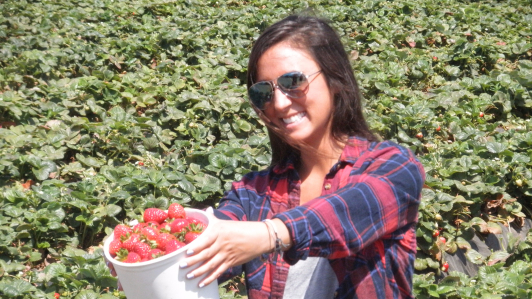
Photo: Strawberry picking with Christy in California 2014
Jesus chooses us for relationship with him and others.
Accompanying him were the Twelve and some women (Lk 8:1-2).
A simple statement to be sure, but very significant in how Jesus again is showing us how to live our lives as followers, disciples of him. Jesus, as I have written many times, is fully human and fully divine. What he has done and is doing as the Son of God incarnate is to draw close to us in our humanity, as a human being, so that we can enter into a relationship with him and his Father through the love of the Holy Spirit, thus becoming one with him in his divinity.
From the beginning of his public ministry and throughout, he is inviting people to participate in his life and the kingdom of Heaven which is at hand in his very presence. Time and time again Jesus does so by building relationships with people. This is how Luke can write the verses that Jesus was accompanied by the Twelve and Mary Magdelene, Joanna, and Susanna. These were real people with whom Jesus developed real relationships with.
Jesus invited people to experience and build a relationship with him. Christianity is not a Lone Ranger religion, it is not the survival of the fittest, and Jesus did not teach that we have to pull ourselves up by our own bootstraps. We are created by God to be in communion, to be in a relationship with him and one another, and that means we need to accompany and empower each other.
We are to go out, encounter, and make time for each other by exchanging the stories of our tragedies and our triumphs. Even during a pandemic, we are to resist the temptation of withdrawing into our own bubbles. Instead, we need to take the risk to be vulnerable with one another, obviously to do so more carefully and prudently during this pandemic. Relationships are messy but with commitment, God, and an open heart and mind, we can grow closer together.
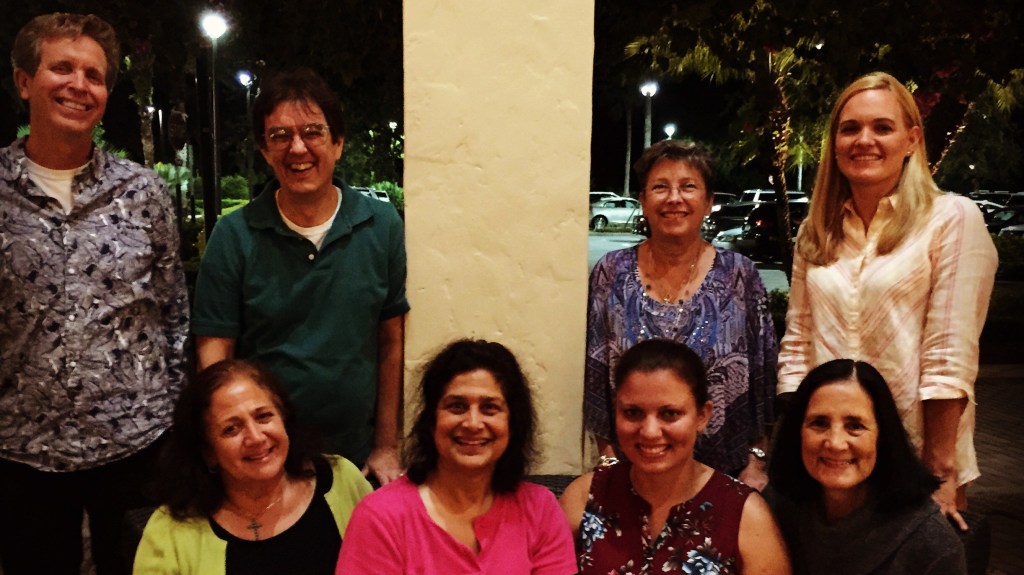
JoAnn and I experienced this gift of fellowship in a powerful way over the past, what will be four years next week. Eight of us have been meeting almost every week. We have been learning about and growing in our faith, yes, but more importantly building relationships grounded in our mutual respect for one other even when we disagreed. We have shared stories, exploring the good, the bad, and the ugly, of our lives.
We forged such a bond that JoAnn and I agreed without hesitation that each one of the members of our group would play a significant and intimate part in JoAnn’s funeral Mass. JoAnn is still a part of our group as she prepares the way for us to follow and still reminds Giovanna that we need to break by 8:30 because it is a school night and I need to get to sleep.
Jesus chooses each one of us to accompany him and to forge relationships grounded in mutual respect, where no one is last and where no person is left behind. This is what our faith is all about and this is why we are a joyful people, an alleluia people, even while it appears sometimes the world is coming apart at the seams.
Photo: Our small group celebrating two years of fellowship.
We can learn much from the woman with the alabaster jar.
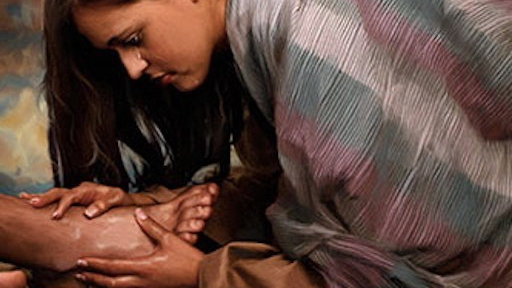
Bringing an alabaster flask of ointment, she stood behind him at his feet weeping and began to bathe his feet with her tears. Then she wiped them with her hair, kissed them, and anointed them with the ointment (Lk 7:37-38).
Logistically, to our modern minds, the setting of this verse may appear to be confusing. How could this “sinful” woman be standing behind Jesus such that her tears would fall on his feet? This could be confusing to us because when we think or imagine someone sitting and eating, they do so by sitting in a chair. Thus the feet would be toward the front of the person.
During the time period Jesus lived, the customary practice when eating was not to sit at all but to recline. Thus, the woman was standing behind the feet of Jesus as he reclined, and her tears fell on his feet. She then knelt down, dried his feet with her hair, and then anointed Jesus’ feet with the ointment she brought for him.
Today’s Gospel account is a simple but powerful scene of contrition. This is the posture we are to approach Jesus when we have sinned. We are not to rationalize, deny, ignore, or come grudgingly forward when we are caught and held accountable for our sin. We are to feel true contrition or sorrow for the sins we have committed because the healing presence of Jesus leads us to a place of compassion and understanding for the hurt we have caused others through our sinful actions.
Unfortunately, there are too many leaders in the secular as well as the church who assume the posture of Simon the Pharisee in this account. They puff up their chests in righteous indignation over the sins of others, while not being transparent and forthcoming with their own sinful choices and behavior. Using instead their means of power, prestige, and places of honor, not to serve and empower others but to hide and protect themselves from being held accountable, and/or justifying and rationalizing their own weaknesses and vices.
In so doing though, they are not aware of the depth of their own sin and thus to “the one to whom little is forgiven, loves little” (Lk 7:47). One is not forgiven because God is not willing to forgive but because he will not go against our free will. If we are unaware or unwilling to bring our sins forward in a contrite manner, we are cutting ourselves off from the healing forgiveness of God that he so much wants to share with us. But if we, like the woman in today’s Gospel account, are willing to bear our soul with humility and sorrow we will not only be forgiven but experience a deeper outpouring of God’s love. The one who confesses contritely more is forgiven more and thus is able to love more.
Would that each of us really grasped this gift of grace that God offers. What if instead of hiding from, being in denial of, rationalizing, or justifying our sins, we acknowledged them and sought the healing forgiveness of Jesus. In opening up our hearts and minds to the forgiving and purifying love of the Holy Spirit there is a pain, as there is in any healing, but also freedom, when we are able to do as the woman in the Gospel did today. When we trust Jesus as she did with our deepest and darkest sins, we too can be healed so to be freed of the shackles that bind us and to love as we have been loved. God loves us more than our worst mistakes and we will know and experience God’s love more fully when we confess and are forgiven of them.
Photo: accessed online
Link for the Mass readings for Thursday, September 19, 2020

“To live is to change, to be perfect is to have changed often.”
“To what shall I compare the people of this generation? What are they like? They are like children who sit in the marketplace and call to one another, ‘We played the flute for you, but you did not dance. We sang a dirge, but you did not weep'” (Lk 7:31-32).
In today’s Gospel, Jesus convicted those who held a narrow view of who was a true follower of God. He illustrated this by sharing the image of a flute being played and no one danced, thus when times of joy arose, there was no celebration, and when the funeral dirge was sung, they did not weep, they did not mourn. Jesus then tied the analogy to his present condition where there were those who did not accept the ascetical practices of fasting and the call to repentance from John the Baptist, nor did they accept the inclusive table fellowship of Jesus.
In our own time, we have encountered those that are not pleased beyond their own narrow focus and who suffer from tunnel vision. Anything that hints at even a slight variation of change sends tremors of discontent. If we are honest, we all have some resistance to change, but if we are to authentically live the Gospel, St. John Cardinal Newman’s quote is an apt barometer: “To live is to change and to be perfect is to have changed often.” JoAnn was one to embrace change much more easily than I. She consistently helped me, even when I didn’t feel it was helpful, to be more open to change instead of getting too comfortable in a set routine. She has done so again in “changing her address” to a heavenly zip code. Jesus and JoAnn have helped me to adjust to this whopper of a change as well.
The Church, at her best, is a balance between the rock foundation of our core beliefs, such as the Nicene Creed, which provides stability, assuredness, and identity, and being open to the life-giving movement of the Holy Spirit. Each generation must make the Gospel relevant in our own time. We must be flexible and resist rigidity, legalism, and clericalism, so to avoid molding the Church in our image, while at the same time be authentic to renewal, integrity, and embracing the Mystery of God’s movement such that we are molded, transformed, and conformed in the image and likeness of Jesus, who is the embodiment of Love.
We can live a life of joy when we are not threatened by those who are different. The gift of Catholicism is the universal call and invitation of Jesus open to all of humanity. As Catholics, we are to embrace the gift of unity AND diversity, the foundation of the deposit of faith AND the variety of cultural expression. The collaboration of the divine and the human is messy but this both/and not either/or approach is what Jesus guides us to participate in. Is this challenging? Yes. Hard? Yes. Impossible? On our own, and from our own egoistic perspective, yes. When we are willing to surrender our will to the Father, our heart and mind to the Son, and allow our soul to be led by the Holy Spirit, all things are possible!
Photo: At the base of the Jupiter Lighthouse in 1997, I have been truly blessed in my willingness to embrace two big changes in my life, marrying JoAnn in 1996 and moving to Florida in 1997.
Link for the Mass readings for Wednesday, September 16, 2020
 Spiritual Stepping Stones