Reflections on the Gospel Reading for the Day


Adrift in troubles or anxiety? Here are some ways to anchor yourself in God.
Our days are so full of activities, conflicts, health issues, technological stimulation, 24/7 news cycles, social media interaction, and mix into all of this, our present pandemic and you have a mix that can lead to our emotional, physical, and spiritual undoing. If we do not have the proper foundation and orientation, we can feel stretched, hollow, and/or fatigued at best. One day can seem to blend into another, and another, and another. The image of being on a hamster wheel or an unending treadmill can fall afresh in our mind’s eye when we actually do take a minute to breathe. Anxiety, worry, stress, fear, prescriptions, and addictions all appear to be on the rise and swirling out of control.
Is there an answer to this hyper pace or are we doomed to just keep going until the wheels fall off? The opening verse in today’s reading provides an antidote when we are feeling any or all of the above.
Jesus said to his disciples: “Do not let your hearts be troubled. You have faith in God; have faith also in me” (Jn 14:1).
We are invited to place our trust in God through his Son, Jesus. By putting them first does not mean that the externals to our life will take an abrupt turn for the better, but what it does mean is that we will have support and divine assistance. It means that we are not alone in our suffering. The disciples found this out when in the midst of a sudden sea squall, taking on water as the waves grew higher they were terrified and so, called to a sleeping Jesus. Jesus awoke and with a word, he calmed the sea (cf. Mk 4:35-41).
Jesus may or may not calm the sea of our trials and tribulations, but what he will do is be present with us through our storms in life and we can trust in him that he will guide us through. As we grow more confident in our trust in Jesus, knowing that no matter who or what comes at us, he will be there to assist us. There will be more peace and calm within – no Prozac or Zoloft required. The ultimate assurance that Jesus provides is that when we surrender our life to him we belong to him, we are not alone or orphaned. He gave his life for us, to redeem and save us so that we can be assured of our home for eternity.
If we are struggling at any level and are seeking to build our trust and faith in Jesus, we do need to realize that this takes time. We need to daily ask Jesus for help, seek his discernment about where we can make changes in our life, and make periodic efforts to stop in our day to be still. This time does not need to be lengthy, three to five minutes to start can do wonders. On the surface level, by stopping for five minutes to pray and breathe more deeply and consciously, we get off the wheel, we step out of survival and reaction mode, so we can then make more mindful decisions, and we can come to see that we truly have options, but more importantly, we begin to develop a relationship and intimacy with Jesus so to begin to recognize his voice that is calling out to guide us.
For me, the Liturgy of the Hours has been my anchor, and since my time in California, I have also included meditation in the morning and evening as well. I stop to pray throughout the day, some days are better than others, some days are less rushed than others, but each day I make the time. There have been days, especially since we have begun distance learning, that I have had so much to do that I have wondered if taking the time to pray and meditate was really the most sensible choice, and time and again it has been.
The Rosary is also a great way to get into God’s word by meditating on the mysteries of the life of Jesus. If you are not able to pray the whole Rosary in one sitting, periodically pray a decade at key points throughout the day, first thing in the morning, mid-morning, mid-day, afternoon, and evening. You may start with just one decade a day.
Read for a few minutes from the Bible once in the morning and then return to meditate on the same verse or verses that touch or challenge you throughout the day. You can also read the daily Mass readings each day and place your self in the scene as if you were actually there.
Each of these practices helps to bring the Word of God alive. They are just a few of the many ways to stop the madness and to connect with the power, the love, and the grace that Jesus yearns to share with us so we may be healed, whole, and more alive. May we trust in him today and each day going forward, for he is “the way and the truth and the life” (Jn 14:6).
—————————————————–
Photo: My prayer anchors for helping me to trust Jesus and put God first in my life each day
Link for the Mass readings for Friday, May 8, 2020

Are we ready and willing to serve no matter the task?
Today’s Gospel from John begins as Jesus had just finished washing the feet of his disciples. Jesus then said, “Amen, amen, I say to you, no slave is greater than his master nor any messenger greater than the one who sent him” (Jn 13:16). Jesus not only taught the truth that God the Father sent his Son to serve and not be served, he modeled this practice consistently.
From his conception, gestation, and birth, the Son of God developed as a human being in the very simplest of conditions and endured the hardships of those on the margins. Joseph, Mary, and Jesus were political refugees very soon after his birth. The young family was forced to flee from Bethlehem to Egypt. When Herod the Great died they returned to Nazareth, and other than the incident in the Temple, we hear nothing about the life of Jesus until he begins his public ministry. The most likely reason for this was that there was nothing to tell. Jesus most likely apprenticed with Joseph, in the trade of a simple tektōn, a woodworker, which was pretty low on the rung of the social ladder.
Through the short time of his ministry, Jesus modeled for his disciples what a follower of his entailed and what it meant to be one of his successors. To follow in his footsteps they would need to participate in servant leadership. He not only taught them but lived and modeled that there is no task too menial that we can’t roll up our sleeves and dive in to help. There is no person too other that we can’t assist when they are in a need.
A good prayer and meditation for us today is to ask Jesus to reveal for us how we have resisted his urgings in the past regarding serving others as well as when we have refused to interact or treat someone with anything less than the basic human dignity which they deserved. Have we ever thought that what he was asking of us was beneath us? Have there been people we have kept at arm’s length or refused to reach out to? For those ways in which we have withdrawn within ourselves and refused to be of help may we ask for his forgiveness.
Being willing to allow Jesus to shed some light on our lack of embracing opportunities to serve is a good place to begin. Renewed with his forgiveness and healing touch, may we be more willing to be bearers of his understanding, grace and mercy which we have received. May we be more open to each of the people and/or tasks that God will place before us, the discernment to know his will, and the clarity and courage to act as his servant with humility and without hesitation.
—————————————————————————-
Photo: Grounds work during my novitiate year with the Franciscans in Brookline, MA around 1992.
Link for the Mass reading for Thursday, May 7, 2020
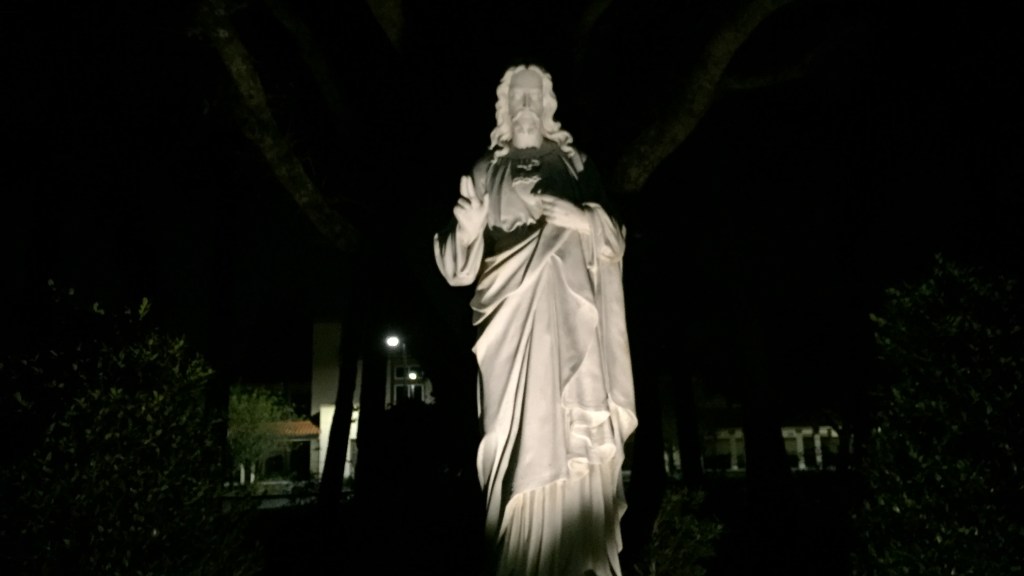
Jesus, our light, exposes our darkness.
“I came into the world as light, so that everyone who believes in me might not remain in darkness” (Jn 12:46).
What might be the darkness that Jesus refers to? It could be anything that turns us within ourselves, away from that which is True, Good, and Beautiful. This can be prejudice, ignorance, cynicism, sin, violence, hatred, war, division, dehumanization, and the list can go on.
A major root that keeps us in this darkness is fear. Jesus offers us the light of his Father. He encourages us to leave our self imposed imprisonment by loving us as we are, more than we can imagine, and more than we can ever mess up. Christianity is not just a set of moral principles, a set of doctrines, a philosophy, or a theology. Christianity is about an encounter with a person, the Son of God, Jesus the Christ.
The light of Jesus leads us and invites us to experience that which we have been created and are restless for – an intimate relationship with God the Father and each other. Through the light of his love, Jesus reveals to us those apparent goods, false substitutes, and idols that distract us and keep us separated from deepening our relationship with God. We come to know God when we are willing to receive the love of the Holy Spirit and are moved to share that love with each other.
Jesus, today, help us to resist any selfish impulse or reaction based on fear and guide us instead to love as you have loved us. Even in quarantine or from a distance, we can still smile, be aware and offer to be of help, reach out to someone and be present and willing to listen, and/or choosing to be more understanding, supportive, and encouraging. In these small ways, we allow the light of Jesus to shine in and through our lives outward toward others and the darkness will not overcome it!
Photo: Sacred Heart of Jesus statue on the grounds of St Peter Catholic Church, Jupiter FL
Link for the Mass readings for Wednesday, May 6, 2020
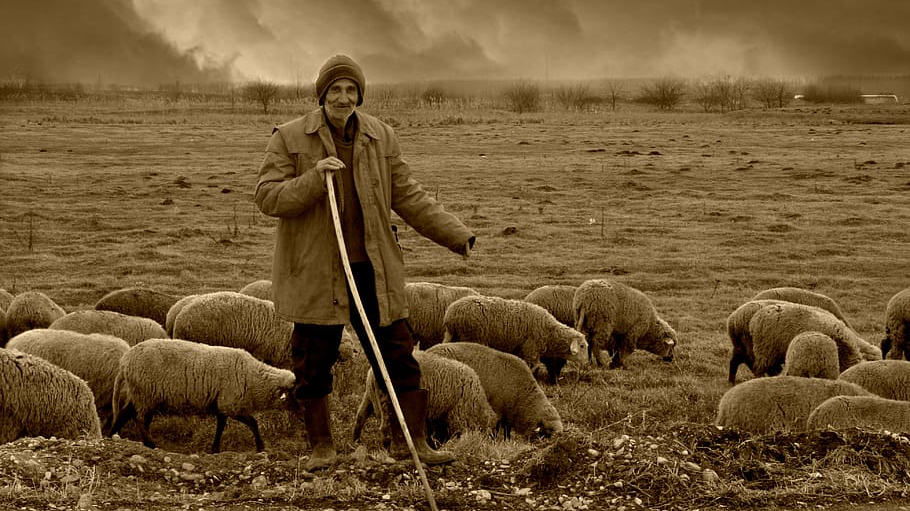
“No one can take them out of my hand.”
Jesus continues to present the imagery of the shepherd in today’s Gospel reading from John. He presents an assurance for security and protection that is to be found for those that are in his fold when he says, “No one can take them out of my hand. My Father, who has given them to me, is greater than all, and no one can take them out of the Father’s hand. The Father and I are one” (Jn 10:28-30). How does one enter the fold of the Good Shepherd? All who hear his voice and follow him will be known by him and so be a part of his flock.
Yet, there are those who hear his voice and do not recognize the Shepherd. They do not follow him and so are not known by him, although he seeks them out. They may know about the Shepherd, have heard of him, but do not know him. Their hearts and minds are closed to Jesus. They do not believe in his miracles, his exorcisms, his teachings, and the question of those opposing him in today’s reading is, “If you are the Messiah, tell us plainly” (Jn 10:24). Jesus did just that by saying that he and the Father are one. The response to the forthright comment of Jesus is that those who are closed to his answer pick up rocks to throw at him (see Jn 10:31).
Jesus offers, free of conditions, the gift of relationship with him, and his Father, to experience the love shared between them, the Holy Spirit. Jesus is open about who he is, who we are, and who we can become in participation with him. Those who say no to his invitation do so for their own reasons; some being, a demand for proof, a listing of the terms and conditions that need to be met first, assurances sought for, and/or excuses offered. Just as Jesus invites us to freely come to him, he will only come so far as we are willing to receive him. He does not conform to us or our will. Jesus does not need us, yet he loves us by willing our ultimate good.
Even we who have said yes, only go so far. We hedge our bets, dip our toes into the water, and maybe go in ankle-deep, but not too many of us are willing to relinquish control, let go, and surrender fully all at once. Jesus offers, eternal life, true, but also a life of meaning and fulfillment now. A perfect life? No, there will continue to be challenges, conflicts, mistakes, and misfires as well as Jesus’ voice continuing to call us to follow him to go deeper, to seek freedom from our anxieties, fears, and weaknesses. He urges us to face conflicts, to be disciplined in resisting temptations of apparent goods, and to stand up for the Gospel in and out of season.
Through all our experiences, the ups and downs, the only assurance is that we are not alone. No matter what we may face today or tomorrow, we can be assured that Jesus will never let us go and no one can take us out of his hand. Each step of the journey we take, we can be confident that Jesus, our Good Shepherd, will be there to guide and protect us as long as we are willing to listen to his voice.
——————
Photo: Accessed online
Link for the Mass readings for Tuesday, May 5, 2020
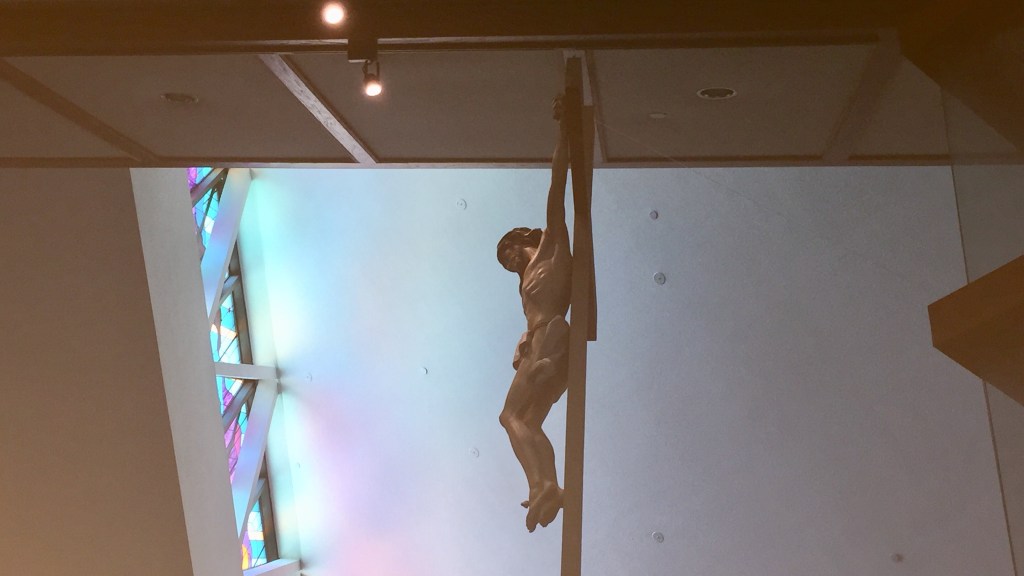
“I will lay down my life for my sheep.”
I am not sure how many people reading this reflection are shepherds, live on a farm, or raise sheep. Many of us are most likely removed from the daily life and commitment of a shepherd. With such ignorance as our starting point, we can fall prey to a false romanticism of the life of a shepherd as a reaction to the fast pace and hustle and bustle of modern urban and suburban life. The commitment and demands of shepherds during Jesus’ time were demanding and all-consuming, with little acknowledgment or recognition. In fact, many shepherds were looked down upon, and groveling at the bottom of the social class of ancient Palestine. Yet Jesus compared himself to being a shepherd.
Just scratching the surface of the social context of shepherds could help to shed light on John’s Gospel today where Jesus paints an image of himself as the Good Shepherd: “I am the good shepherd, and I know mine and mine know me, just as the Father knows me and I know the Father; and I will lay down my life for the sheep” (Jn 10:14-15).
Jesus is not just a shepherd, but the good shepherd. A good shepherd lived among his sheep, watched over them, cared for them, helped to birth and raise them, as well as was willing to protect them with his life from predators and thieves. Though we may not be fond of being compared to sheep, Jesus does the same for us. He watches, cares for, protects, nourishes us with his own Body and Blood, and has given his life for us.
We can get in trouble when we stray from his protective care and wander away. Yet, just as a sheep baas and bleats, so the Good Shepherd is always close to hear when we call. Each one of us is precious and important to him. We just need to remember that truth and reach out to him daily. And no matter how far we may find ourselves astray, he will come to us and will carry us back home on his shoulders.
I invite you to spend some quiet time with Jesus the Good Shepherd today. With the humility and simplicity of a lamb, allow yourself to rest your head on his lap, surrender to him all your cares, doubts, anxieties, and fears. Allow your self to feel the comforting weight of his hand and so be healed by confessing any sins that are weighing you down. Let him impart some healing balm on past hurts left unforgiven, and let him bind up any recent wounds. At some point in your contemplation, also let soak in the ultimate gift this shepherd gave: his life for you that you might have life in him, a life not merely to exist or survive, but a life of joy and fulfillment.
One of my views from Mass Sunday, the Good Shepherd, who laid down his life for us.
Link for the Mass readings for the Monday, May 4, 2020

We need to learn to discern between the voice of the thief and that of the shepherd.
“Amen, amen, I say to you, I am the gate for the sheep. All who came before me are thieves and robbers, but the sheep did not listen to them. I am the gate. Whoever enters through me will be saved” (Jn 10:7-9).
Some may bristle at these words of Jesus stating that they are arrogant, for how can anyone claim that it is only through him that all are saved. Today, the feeling among many is that statements of this natures are against interfaith dialogue and what is wrong with religion today.
The first point that I would make, is that those who would critique these words would have a case to make only if Jesus is not who he claims to be and the Gospel witness shows quite consistently that Jesus is sent by God, that Jesus is the Son of God, and if Jesus is fully God and fully human, then this statement is true, and to say anything to the contrary would not only water down this reality but it would also be false.
As such, if this is a true statement, I do not feel that it is antithetical to interfaith dialogue. For dialogue to be authentic, each party must bring forth the breadth and depth of what they believe. To water it down to get along would not be a true dialogue. The requirement though would be that those engaged would be willing to speak and listen to each other. In doing so, there can be not only mutual dialogue but also mutual learning, for God reveals his Truth to all. We are better when we engage in an argument that is constructive and passionate, yet remember to be respectful. We have just forgotten how to do so without devolving into personal attacks and talking past each other.
There may be a broader message that Jesus is sharing in today’s Gospel. When Jesus talks about the sheep knowing the voice of the shepherd, he could be very well speaking about what St Ignatius called the discerning of spirits.
We hear all kinds of voices. They are coming at us from without and from within, from the many influences around us to our experiences of the past. With the invention of the internet and Google the voice chamber has only been magnified. The voice of Jesus leads us toward our highest hope and good, not an apparent of fleeting good, but the Good, what we have been created for. As St Augustine wrote, “You have made us for yourself, O Lord, and we are restless until we rest in you.”
The challenge is being able to discern from the voice of the thief who seeks to lure us away from the fold to destroy us and instead develop an ear to hear the voice of the shepherd who will care for us. God loves us so much that he is willing to risk that we will reject him so that we are free to choose him. Even when we have been led astray, have exhausted all the glitter and flash, have been left wanting and empty, are worn out and wounded or even broken, even then we are not alone. If we are willing, Jesus the Good Shepherd will be there for us, lift and gently cradle us on his shoulders and bring us home.
Photo: Spending some quiet time last night listening to the voice of the Shepherd
Link for the Mass readings for Sunday, May 3, 2020
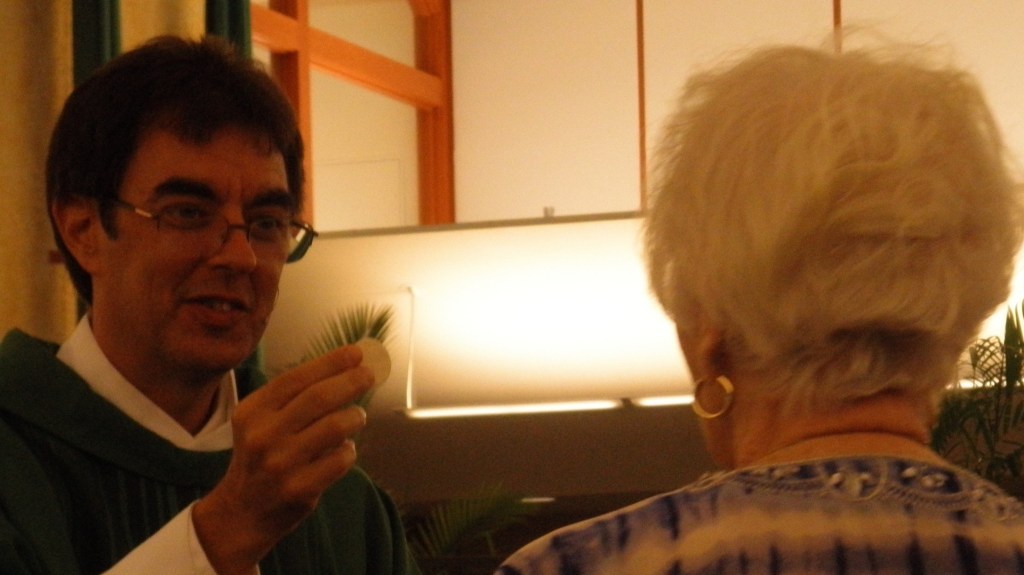
“This saying is hard; who can accept it?”
Even though Jesus had fed the five thousand and they were satisfied and there was plenty more where this gift of grace came from, even though they traveled by boat and followed him to Capernaum seeking a sign, the discourse regarding eating his Flesh and drinking his Blood was just too far of a stretch for most of the disciples and followers to take. In fact: Many of the disciples of Jesus who were listening said, “This saying is hard; who can accept it” (Jn 6:60)?
Many walked away from Jesus at that point. They returned to their former ways of life because they could not believe in what Jesus was saying. They could not believe because they did not fully appreciate who Jesus was, the One from above, who was sent by the Father. They had not developed a deep enough relationship with him such that they could trust him and what he said was true, they could not believe in the One whom God had sent.
Jesus then said to the Twelve, “Do you also want to leave?” Simon Peter answered him, “Master, to whom shall we go? You have the words of eternal life. We have come to believe and are convinced that you are the Holy One of God” (Jn 6:67-69). Peter’s response is one of belief and trust. I am sure they reacted in the same way as the other disciples gathered there, but they trusted Jesus enough that even though this teaching was hard, even inconceivable, he would make sense of it for them, just as he had done so when he helped to share with them the deeper meanings of his parables.
This is to be our response as well. When we find that some of the teachings of Jesus are hard to digest, we need to resist the temptation to walk away. Instead, we need to follow Mary’s model of pondering, as she did when Gabriel shared that she would bear the Savior of the world. She did not fully comprehend what the message meant, but she trusted God and said yes. We need to follow Peter, who may have also been dealing with mixed emotions and doubts, yet, remained firm in his belief in Jesus because he trusted that Jesus was the “Holy One of God”. Peter had experienced that Jesus had known what he was saying and doing before, he would continue to trust him this time as well.
Jesus is also model to follow, yes, but he is so much more! Jesus gives us his grace, the gift of his supernatural power, that builds on our nature. Jesus did not want to die, but he was willing to say yes, to submit his human will to his Father because he trusted him and knew he would bring about a greater good. Jesus gave his life and in so doing conquered death, transcending the time and space of our present dimension so as to be present to us in the Sacrament of the Eucharist. Jesus lives, he is the firstborn of the new creation, and he wants to not only lead us to eternal life but to impart his life in us, in such an intimate way that we may consume him, that we may be one with him in this life and for all eternity! May we with Peter come to believe and be convinced, that Jesus is the Holy One of God!
Amen. Amen.
I’m alive, I’m alive,
Because he lives.
Amen. Amen.
Let my song join the One that never ends.
Because he lives.
The verse from Matt Maher’s song, “Because He Lives (Amen)”.
—————————————————————
Photo: Sharing Jesus at my first Mass as a deacon in September of 2013
Because He Lives (Amen), Matt Maher, from cd: Saints and Sinners, 2015
Link to the music video: Music video by Matt Maher performing Because He Lives (Amen) [Official Lyric Video]. (C) 2014 Provident Label Group LLC, a unit of Sony Music Entertainment: https://www.youtube.com/watch?v=PBvU7arNhQs
Link for the Mass readings for Saturday, May 2, 2020

The Flesh of the Son of Man is the Bread of Life that when consumed will give us eternal life.
All that Jesus has been building up to is now coming to a climax. Any silent shock of disbelief or quiet murmuring has now escalated. The Jews quarreled among themselves, saying, “How can this man give us his Flesh to eat” (Jn 6:52)? Jesus hears the growing concern and disbelief. If he was speaking in a figurative or symbolic way, this would be the moment to clarify his point.
Jesus does speak, but he does not walk back or qualify his comments. Jesus doubles down: “Amen, amen, I say to you, unless you eat the Flesh of the Son of Man and drink his Blood, you do not have life within you” (Jn 6:53). Jesus does not only repeat that his disciples are to eat his Flesh but he also insists that they are to drink his Blood. Drinking or even eating meat with the blood of an animal was inconceivable for devout Jews. Also, the Greek used here in John’s Gospel for eating, is trogein, which is used to describe how an animal eats, by gnawing and tearing at the flesh. The imagery that Jesus is using here is more graphic than the customary use of phagein, which would be used for chewing, as a human would chew their food.
Jesus continues to make his point that whoever does eat his Flesh and drink his Blood, will not only remain in him, but also Jesus will remain in them, and they will have eternal life. A wonderful end goal, but would any be able to make the leap of faith to get there? In tomorrow’s Gospel reading we will be able to see the response to Jesus’ claims.
Almost two thousand years later, we continue to have the opportunity to celebrate Jesus in our midst. This happens through participating in the source and summit of our faith, the Mass. Our hearts have the opportunity to be set on fire as we hear the word proclaimed during the Liturgy of the Word, and then Jesus is made known to us in the breaking of the bread in the Liturgy of the Eucharist. We are invited to experience an intimate encounter with the Son of God, as we consume him, Body, Soul, and Divinity.
That so many of us are unable to do so now because of the quarantine does not dismiss that this sacred event is still happening. We can receive Jesus through spiritual communion as we watch the Mass live-streamed and pray the Act of Spiritual Communion prayer.
The thought of eating the Flesh and Blood of Jesus may sound just as bizarre as it did to Jesus’ followers. The term we have for this miraculous transformation of bread and wine is transubstantiation. What happens at the calling down of the Holy Spirit and when the words of institution are invoked by the priest is that the substance, the reality, of the bread and wine is transfigured into the Body and Blood of Jesus, while the accidental form or appearance remains the same. So we consume Jesus’ unbloody, acceptable sacrifice.
Jesus is giving all of who he is of himself corporally, fully, holding nothing back of himself so we can receive all of him. In consuming Jesus, we become what we eat, “bone of his bone and flesh of his flesh” (cf. Genesis 2:23), we become divine as he permeates our whole being. We are then dismissed at the end of the Mass to go, like Mary, to bear Jesus Christ, to love others as Jesus loved us, by giving of ourselves to others as he has given himself to us. This is the Good News we are called to proclaim. Jesus is risen, he has risen indeed, and he has not left us orphans but remains with us now and for all ages!
——————————————————–
Photo: Our tabernacle which is in the chapel at Cardinal Newman High School. Jesus is present to us in the consecrated hosts within. I miss beginning my school day looking at Jesus as he looks back at me!
Link for the Mass readings for Friday, May 1, 2020

 Spiritual Stepping Stones