Reflections on the Gospel Reading for the Day


COVID-19 – Choosing fear or an opportunity to grow in our faith?
As with last week, when the Samaritan women encounters Jesus, we again see this week an account of a transformation with the man born blind from birth. In both cases, neither are seeking the healing of Jesus, but they are open to Jesus as he encounters them in their present situations and are willing to be led by him. For the man born blind, Jesus, spat on the ground and made clay with the saliva, and smeared the clay on his eyes, and said to him, “Go wash in the Pool of Siloam” (Jn 9:6-7).
After the man followed the guidance of Jesus and washed in the pool of Siloam he was healed and his sight was restored. He then returned to his neighbors and they noticed that not only was he no longer begging but that he could see. They then asked him how this came to be and the man shared about his encounter with Jesus. Because of this miracle, they then brought him before the Pharisees.
Because this healing happened on the Sabbath and this was not the first time Jesus did so, they wanted to understand what had happened with this man and also some were hoping to gather information to make a case against Jesus. Unfortunately for them, this man would only share that Jesus healed him, confirm that he was born blind, and he would also ask if they would like to be his disciples!
This man had received the gift of sight from his encounter with Jesus and his conviction and faith in Jesus grew the more he was questioned and challenged. This is often the opposite response for many of us. Would that we could have the same healing of our spiritual blindness such that we could see the depth of our own hunger deep within for God and the needs of those around us.
With the present pandemic that we are experiencing on a world-wide scale, we can react with ever-growing anxiety and fear of the unknown or we can see with the eyes of faith and look at this as an opportunity to assess what is truly important in our lives.
We may be asked to remain in self-imposed quarantine, but that does not mean we are no longer in contact with one another. We have technological means through phone, different video applications, social media, and email, as well as time to take stock regarding opportunities we have taken for granted like going to Mass. A video Mass is not the same as being in person and receiving the Eucharist. Yet, being away from receiving the Eucharist could be just the opportunity for us to rekindle an appreciation that so many have lost. As many as 70% of Catholics do not believe in the Real Presence of the Eucharist.
Also, with a little more time for some of us and staring at death a little more closely than we usually do, we can regain a greater appreciation for each other. We can recognize how fragile our lives really are and better appreciate the gift of our humanity. This time can also be an opportunity to rekindle our relationship with God with some quiet and reflective prayer and meditation individually and with our families.
The man born blind was grateful for the gift of receiving his sight, so much so that he came to believe and worship the one who healed him. Maybe we too can come out of this present crisis more deeply committed to living as a disciple of Jesus and loving each other as he loves us through the many doctors and nurses who are putting their lives at risk to be present to those who are in need of healing from this virus.
Photo: This is a time to ask ourselves what brings us joy?

Jesus, please shine your light in our darkness.
It is much easier to find fault in others, and in some cases, the act of doing so has become entertainment in the private as well as the public sector. Gossip has a seductive allure and can be consuming. Judging others is also a way to justify and or project our own inappropriate behavior onto others. We may even place ourselves in a false sense of exalted pride. Have we ever, not just stated, but, thought or prayed something along the same lines as the Pharisee in today’s Gospel? “O God, I thank you that I am not like the rest of humanity — greedy, dishonest, adulterous — or even like this tax collector. I fast twice a week, and I pay tithes on my whole income” (Lk 18:11-12).
To pray any part of this prayer stunts the growth in our spiritual life because we are focused on ourselves instead of emptying ourselves before God. Anytime we rationalize, cover over, or deny our sinful behavior we create and support habits of selfishness. Left unchecked, we can become enslaved to them. Lent is a time for healing and transformation. To be able to heal from sinful attitudes and actions that have become habits, we first must be able to acknowledge and identify them.
Over time, reading more and more lives of the saints, I have come to understand that their recognition and their confession of their sinfulness was not just pious platitudes, but true presentations that they were growing closer in their relationship with Jesus. A simple example can help express where they are coming from.
When we drive our car while it is dark we don’t give much thought to the cleanliness of our windshield because we can see fine. Yet as the headlights from an oncoming car illuminate our windshield we can see how dirty in actuality it is. This can be evident in our spiritual life as well. The more we remain in our own darkness of denial, we feel we are fine, all is right with the world. The closer we grow in our relationship with Jesus, the more his light shines in our darkness, and he reveals to us our sin.
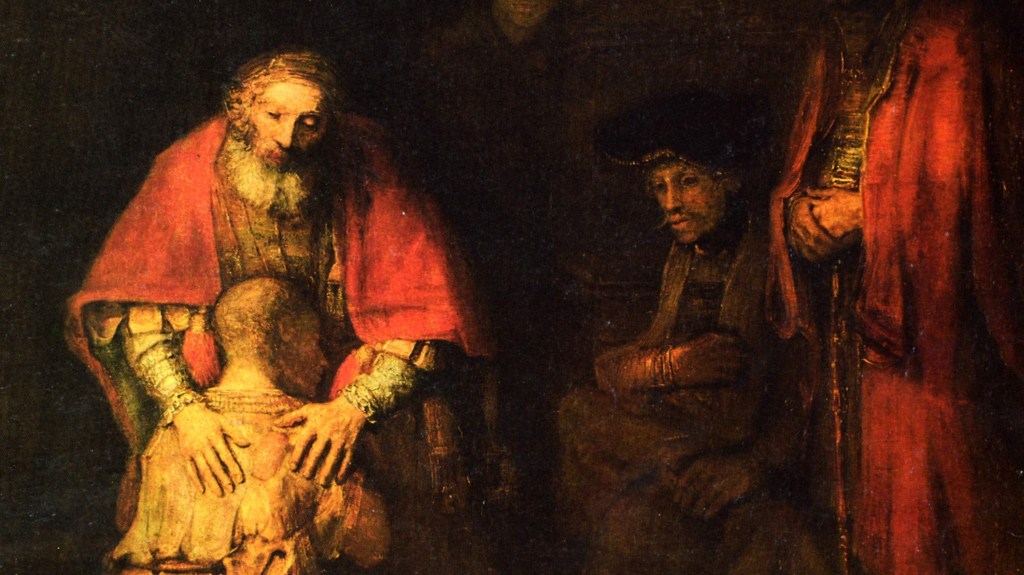
Jesus invites us to resist the prayer of the Pharisee who prays comparing himself to someone else, instead of acknowledging his own sinful actions and instead emphasizes that we are to follow the honest humility of the tax collector, who did “not even raise his eyes to heaven but beat his breast and prayed, ‘O God, be merciful to me a sinner’” (Lk 18:13). Now, Jesus is not saying this is the only way we pray. We have the opportunity to worship and praise the Lord joyfully, we can seek his help in praying for others through intercessory prayer or for ourselves in petitionary prayer, we can also sit in quiet meditation during adoration or out among God’s wonder of creation. Each prayer has its time and place and each type of experience of prayer helps us to grow and deepen our relationship with Jesus and each other.
True humility is brought about by being willing to see who we are from God’s eyes. If we are to set a standard to live up to and if we are to compare ourselves to anyone, let it be Jesus. A daily examination of conscience is a healthy practice and discipline. We just need to be willing to invite Jesus to shine his light of love into the darkness of our fear and anxiety. When we do so, we embrace our vulnerability by taking the risk to confess our sin and to experience the sorrow for the hurt we have caused. With a willingness to seek atonement for our sin, to seek God’s forgiveness, we will receive his love, mercy, and forgiveness that we have separated ourselves from when we justified and rationalized our sin.
One prayer I have found helpful over the last few years is the Jesus Prayer. It is very simple. Sit in a comfortable space, take a few deep breaths and exhalations, then as you take the next breath in recite, “Lord Jesus Christ, Son of the living God,” and then as you breathe out say, “Have mercy on me a sinner.” You are breathing in the light of Christ and you are breathing out the darkness of your sin. I use my rosary and pray an Our Father for each isolated bead and then the Jesus Prayer on each of the beads of each decade.
Traditional prayer ropes exist from the Eastern Orthodox tradition. They are made of wool, usually black, and have ten decades of ten beads. The bottom can also have a fringe representing the mercy of God wiping away our tears of sorrow. If you have neither a rosary or a prayer rope, you have your fingers. Start with a set of ten Jesus Prayer recitations each day so to embrace the light of Jesus that he may dispel the darkness of your sin, then confess it, and be forgiven.
—————————————————————————————
Photo: A light I came across while walking last night.
Link for the Mass readings for Saturday, March 21, 2020
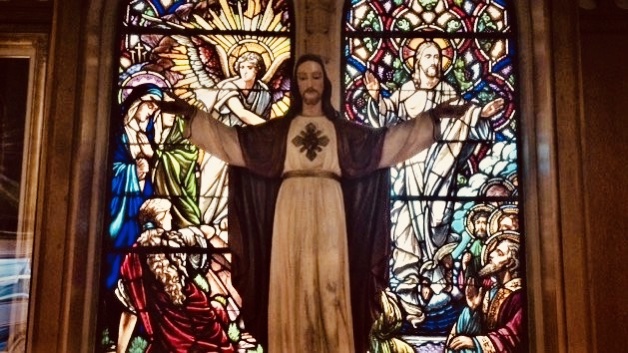
Jesus’ arms are wide open. How about ours?
Jesus recognized that the scribe, who asked him about which commandment was the greatest, “answered with understanding,” and then he said to him, “You are not far from the Kingdom of God” (Mk 12:34). What is it that the scribe understood?
The scribe understood that God “is One and that there is no other”. God is the true source of our being, our very existence. We have been created with an innate desire to be one with him. This is the longing we all feel in the depths of our soul, this is why nothing that is finite or material will ever fully satisfy us, why we are always wanting more. This is as true for the mystic as it is for the atheist and everyone in between.
God is “One and no other” also means that we are not God, we are his created beings. God is not just one being among many, not even the supreme being. This orientation is important for we can only see from our limited perspective. What we think or believe we might need, may in fact not be truly good or beneficial for us, the shimmer may be an apparent good, a distraction, a temptation, that will lead us away from the authentic fulfillment and meaning of life that we seek. God will guide us away from any unhealthy want, he will lead us away from temptation when we are willing to seek his guidance over and above our own. God will give us what we truly need, he will lead us to that which is, in reality, true, good, and beautiful.,
Once we come to believe that God is God and we are his created beings, then we can take the next step and surrender: “to love him with all [our] heart, with all [our] understanding, with all [our] strength”. In our surrender to God and his will, we become capable of receiving his love and so are able to love him in return. We all long to be loved and to love. Experiencing the love of God helps us to unconditionally love “our neighbor as our self” because through our surrender to his will we allow God to love others through us.
God invites us to open our minds and hearts to receive his love, to love him in return, and to love others as he has loved us. To love God then is like any other relationship, we need to spend quality time with God in stillness, be present One on one, as well as in our everyday activities. We are to resist compartmentalizing God and instead seek his presence in everything we do. The sacrifice he seeks is that we are willing to allow him to love others through us, especially those for whom we do not have a warm and fuzzy feeling, as this is not the unconditional love God loves with. We are to will the good of the other as they are.
Each of us is prone to sin, is wounded, and is broken. God loves us as we are, and when we are willing, he forgives our sins, he heals our wounds, and he transforms us. We need to stop running away from him and start running to him. The quickest way we can do this is to love our neighbor as our self. Going out of ourselves and giving to another, breaks down the walls of separation we build up around ourselves because of our fears.
Jesus’ arms are wide open before us in our neighbor. May we surrender all our heart, soul, mind, and strength into his loving embrace, to receive his love and love him in return, and to embrace loving our neighbor and our self in the same way. When we get this commandment, loving God, our neighbor and ourselves right, the other commandments will fall into their proper place. As we do so we too will hear Jesus say to us, “You are not far from the kingdom of God.”
—————————————————————————-
Photo: Side altar of St Augustine Parish, Culver City, CA, taken last week.
Link for the Mass readings for Friday, March 20, 2020
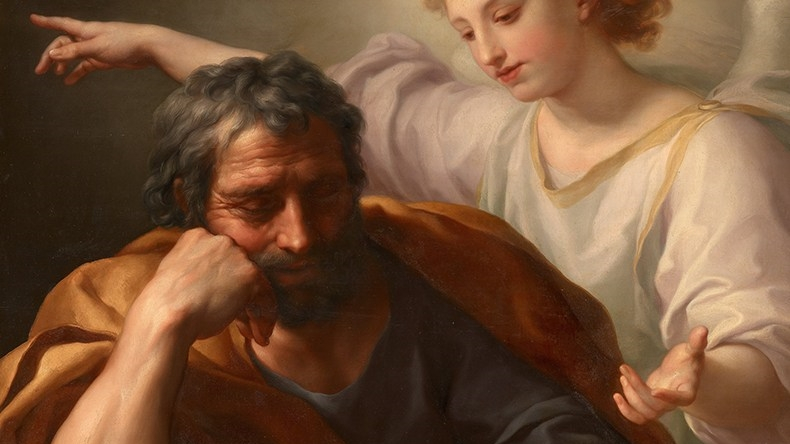
As with Joseph, God speaks to us in our dreams too.
Who do we want to be? It is so easy to get caught up in being busy, taking care of children, the home, school assignments, work, as well as a myriad of other activities that each of us, experiencing our unique vocation in life, can add to the list. These can all be good things, but we can lose ourselves in our busyness and responsibilities such that we slip into a state of survival mode or merely existing. We can fall into the trap of being defined by what we do instead of who we are and who God is calling us to be.
God has a plan for us with the end result being eternal communion with his Father in heaven. Living a life of holiness and becoming saints is our call. We need to remind ourselves of this from time to time, by assessing where we are now and listening to the guidance of God.
Our Gospel account from Matthew today gives us an opportunity to see this holiness in action. Joseph has become aware that Mary, his betrothed, is with child and he is not the Father. Joseph, “a righteous man” follows the law, but is “unwilling to expose her to shame, decided to divorce her quietly” (Mt 1:19). Joseph’s life of righteousness pulls him to follow the law, yet he shows that discernment in matters of the dignity of the person is just as important. Joseph not only was unwilling to make Mary into a public spectacle but was also unwilling to allow the possibility of her to be stoned to death.
Joseph pondered the idea of divorcing her quietly. Before he made his final decision, Joseph slept on the matter, which is often a good course of action when weighing such a heavy issue. How many times do we rush into decisions only to regret them later? Joseph receives God’s direction through the angel of the Lord in a dream.
When Joseph arises in the morning, he does not dig in his heels feeling he knows best and return to his original decision, he does not let fear or anxiety about the possible scenarios that could play out in his mind regarding what others may say or think sway him, nor do the possible and real difficulties he can envision deter him. Joseph trusts God. With confidence and assurance of who he is and what God calls him to do, Joseph acts on the guidance he has received.
St. Joseph is a model for us. When faced with decisions to make, we need to remember who we are, whose we are, and who we are called to be. We are children of God, and that means we belong to God, a God who loves and cares for us. He has a plan for each of our lives. Every decision and action is a step in fulfilling that plan.
When we are discerning, no matter how large or small the decision, we are invited to gather information, look at the reasonable options available to us, all the while, continuing to seek God’s guidance. God will guide us through many means and ways such as a thought, a family member or friend sharing an insight at an opportune time, as well as through our dreams. Joseph followed these steps and God granted him not only the guidance he sought but the support to fulfill the commission he received. We can be assured that God will do the same as we seek his direction too.
St. Joseph, pray for us!
——————————————————————–
Painting: “The Dream of St Joseph” by Anton Raphael Mengs about 1774
Link for the Mass readings for Thursday, March 19, 2020
Be assured that Jesus walks beside us each step of the way of our journey.
Jesus not only tells his disciples that he has not come to abolish but to fulfill the law, he constantly teaches how this is true, models how to put his teachings into practice, and empowers them to do so. In his Sermon on the Mount and Sermon on the Plain alone, we can see the development of his teaching and building on the foundation of the Torah. With his Beatitudes, such as, “Blessed are the poor in spirit for theirs is the kingdom of heaven”, and his Six Antithesis including, “You have heard that it was said ‘an eye for an eye,’ but I say to you offer no resistance to one who is evil”, we can see the further development of Jewish teaching on full display.
If we seriously take the time to read through Jesus’ teachings, we will see quickly how challenging they are. Jesus is not lowering the bar of discipline for his followers, but in fact, raising it. Jesus is not putting heavy burdens on us for burden’s sake, he seeks to make us holy. He himself lives what he preaches, but Jesus is no ordinary teacher or mentor. The principles that he teaches, forgiving seventy times seven times, loving our enemy, giving up all to follow him, these seemed impossible to his disciples then and to us today as well.
At face value, we may think that many of Jesus’ teachings are not possible to put into practice or very practical in our day and age. Attempting to do so with our willpower alone may lead to coming up short each time, and feeling more frustrated. Jesus does not expect nor desire us to accomplish living as his followers on our own efforts. We are to yolk ourselves with him and be open to the transforming power and love of the Holy Spirit acting through us. This happens when we daily invite Jesus into our lives and are humble enough to follow his lead.
We become a disciple of Jesus when we are willing to study his life, learn and put his teachings into practice, and surrender ourselves to his will through prayer, discipline, worship, service, and participation in the sacraments. Ultimately though, it is nothing we do, other than opening our hearts and minds to and allowing Jesus to live his life in and through us so that he may direct us to go outward to empower and serve others. In this way, we are transformed by his love and conformed to his life such that we can say with Paul, it is no longer I who live but Jesus who lives in me (cf. Galatians 2:20).
The path of faith is not a sprint or a one-time event, but a marathon, a journey. Each of us can be assured that Jesus is with us for the long haul, every step of the way. What we are experiencing now with the unpredictability of the Corona Virus can certainly tempt us to be anxious and fearful. But if we resist these temptations and refuse to make decisions from a reactive state, but instead lean into Jesus and each other, we will not only make healthier decisions, we will make it through each day together, no matter what arises.
Embracing the opportunity to slow down a bit, to appreciate simpler entertainment, spend some more time at home, connecting with those important to us, being aware of and providing aid to those around us, and reassessing what is truly important in our lives are some good responses to our present situation. Not knowing what tomorrow brings may help us to realize we never really did. We can take comfort in that emerging reality and trust more in the one who does know what tomorrow will bring.
————————————————————————–
Photo: Torrey Pines State Park, La Jolla, CA 2014
Link for the Mass readings for Wednesday, March 18, 2020

Jesus invites us to build bridges of forgiveness at each opportunity.
Forgiveness is a wonderful gift of grace and mercy. If we asked many people if they would like to receive forgiveness most would say yes. The number would most likely be less if we were to ask them how many would be willing to forgive others. If we were asked to forgive someone seven times, that number would shrink significantly, and if we were invited to forgive someone seventy-seven times, is there any among us who would say yes, any among us willing to consider doing so?
Why is forgiveness so hard for most of us? I do say most because there are those who have an openness to being forgiving. One reason could be that we have few role models. I would imagine those that are more forgiving have not only experienced positive role models but have received forgiveness themselves.
How often do we seek forgiveness from others when we have done something wrong, inappropriate, or made a mistake? We often seek to explain first, make excuses, justify, or ignore our behavior altogether. When we resist being humble, confronting our offenses, and do not seek reconciliation, we do not experience the healing balm of forgiveness. We are then less likely to be willing to offer forgiveness and more likely to hold a grudge or to seek revenge.
Yet, even if we receive the gifts of mercy and forgiveness, as the servant did in today’s parable (Mt 18:21-35), we may still choose to be unforgiving toward others. We may resist forgiveness because we have already created patterns of distancing ourselves, making someone else as other, somehow justifying the hurt and pain we feel. We think that by holding a grudge or offering another the cold shoulder, we are giving them just what they deserve.
Unfortunately, patterns of not seeking forgiveness for ourselves, not willing to forgive others, allowing ourselves to bear grudges, to distance ourselves, or project negative feelings on others to cover up our own inadequacies, not only perpetuate a climate of isolation and divisiveness, continues to fuel a fire of mistrust, division, that when continuing unchecked metastasizes into hatred and violence. Even in a case where someone has truly wronged us in some way, we are still invited to forgive, to make an attempt to understand why someone might act in such a way, and to shift the momentum away from the perpetual cycle of hurt and to seek to bring about healing and reconciliation.
Jesus is very clear that if we are not willing to forgive we will not be forgiven. This is true because we are closing ourselves off from the healing invitation of God’s grace and mercy. When we separate ourselves from one another, we are also separating ourselves from the love of God. The Sacrament of Reconciliation is a gift of healing, and a pattern of regular confession helps us to receive the healing and forgiveness of our loving God and Father. As we develop a regular practice of examining our conscience, experiencing contrition, true sorrow for our sin, confessing our sin, and are absolved and forgiven, we will experience healing. We then will come to the realization that we need to put God first, instead of ourselves.
From this awareness, we can encounter one another with more understanding and more of a willingness to forgive. Jesus invites us to resist the temptation of building walls of separation to keep others out and instead invites us to forgive, yes even seventy-seven times. We can do so by asking Jesus to forgive through us, one person, one handshake, one hug at a time. In doing so, we will be builders of bridges of forgiveness!
————————————————————————-
Photo: accessed from pexels.com
Link for the Mass readings for Tuesday, March 17, 2020
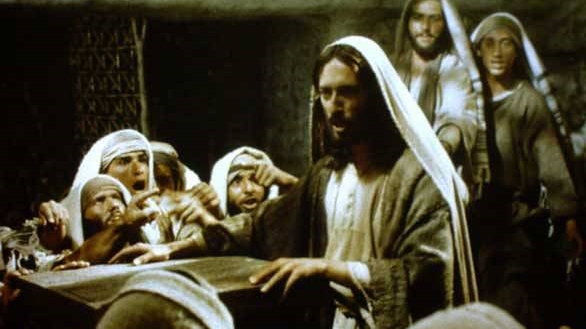
Jesus came to bring glad tidings not to a select few, but to all who would receive him.
The people in Jesus’ hometown synagogue in Nazareth are incensed, rise up to drive him out of town, “and led him to the brow of the hill on which their town had been built, to hurl him down headlong” (Lk 4:29). What got Jesus’ hometown crowd so twisted and contorted? Not only did he stand up earlier in the account of Luke and proclaim that he, the carpenter, was the fulfillment of the prophecy of Isaiah, but it was to the widow of Zarephath that Elijah came and Naaman the Syrian that Elisha healed.
All three of these points may be a big ho-hum to us, but they were a big deal to his people. Being a carpenter, more likely a simple day laborer was not high on the social status ladder even in a poor town like Nazareth. The gospel writers even show the sensitivity of this. In the Gospel of Mark, Jesus is mentioned in this scene as “the carpenter” (6:3), in Matthew, “the carpenter’s son” (13:39), and in today’s Gospel of Luke, “Joseph’s son” (4:22). By the time we get to Luke’s account, Jesus is not even associated with the trade of carpenter, how could someone of such simple and humble means assert the mantle of Messiah?
Jesus does not go quietly in the night as the people’s wonder at his words turn to doubt and consternation. Jesus instead gives two seemingly obscure examples of people who receive God’s blessings. There were many widows and lepers in Israel, but it was to the widow of Zarephath that Elijah came and from Elisha that Naaman the Syrian received healing. The significance of these two people was that they were Gentiles, they were other, they were not part of the chosen people. Jesus is aligning himself in the prophetic tradition and the universalism of God’s salvation. Jesus is invoking a choice that will consistently ripple throughout the remainder of his public ministry. People will either embrace his universal ministry or they will oppose it.
Jesus said to his own people, from his hometown, “Amen, I say to you, no prophet is accepted in his own native place” (Lk 4:24). We may look and wonder why Jesus would say such a thing and why after speaking of the widow of Zarephath and Naaman the Syrian that these same people were “filled with fury” and sought to throw him headlong out of town.
Yet if we resist domesticating Jesus and allow ourselves to hear his words echoed today from our podiums and ambos, we might feel some of the same angst the people of Nazareth felt. Jesus most likely not bring up the widow of Zarephath or Naaman to us, but instead, those considered as other in our society, the oppressed of today that he might mention could be Dreamers, immigrants, refugees from Syria or from south of our border, as well as the homeless, hungry, and addicted in our own communities. Jesus might come to proclaim liberty to those in our jails, prisons, on death row, as well as those detained by I.C.E officials.
Jesus might come to bring healing, to accompany, and be present to recover the sight of those blinded by prejudice, bigotry, paternalism, misogyny, racism, violence, arrogance, elitism, and nationalism. Jesus could come to return dignity to the unborn, the LGTBQ community, those impoverished in our urban, rural, and reservation communities. He could shine his light on the darkness of human trafficking, domestic violence, molestation, child abuse, pornography, war, terrorism, hatred, and violence in all its forms.
As we imagine ourselves sitting and receiving his message, to whom might we bristle at Jesus reaching out his healing hand. Would we embrace his message or begin to cross our arms and seeth? Would we too want to rise up and reject Jesus outright or worse do our own thing in Jesus’ name which has nothing to do with Jesus in actuality? If we are humble this Lent, we can walk up to Jesus and ask him to heal us of our own prejudices and biases, we can come to realize what gifts he has given us, and ask him to show us what ways we can be engaged in bringing glad tidings of his universal message to those in our communities. The choice is ours to make. Are we willing to receive the same Spirit that fills Jesus to overflowing to also fall afresh upon us?
Photo: Jesus in the synagogue of Nazareth from Jesus of Nazareth, Franco Zeffirelli film, 1977
Link for the Mass reading for Monday, March 16, 2020
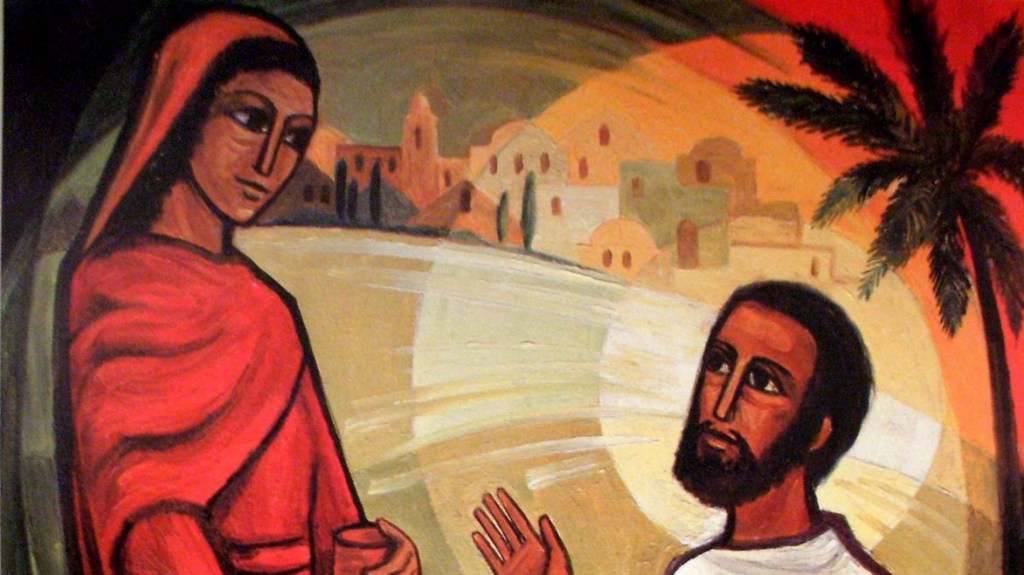
We too can experience the love of the Holy Spirit by experiencing Jesus in each other.
Meanwhile, the disciples urged him, “Rabbi, eat.” But he said to them, “I have food to eat of which you do not know” (Jn 4:31-32).
The disciples of Jesus had just returned with some food, but Jesus was already fulfilled from his encounter with the Samaritan woman at Jacob’s well. Though one of the longest readings we will experience during Mass, save the Passion narrative, it is one of the most powerful.
From the beginning of this retelling, Jesus again does not recognize social taboos. He engages a woman at the well at noon who is also a Samaritan. None of these three details are in any way minor. Devout Jewish men did not speak with women in public, and they surely did not engage in discussions with Samaritans male or female. The most subtle of details, that the woman is by herself at the well around noon, may well be missed by us who do not frequent many wells.
The most common time to gather water would be the early morning or evening when it was cooler. This would also be an opportunity for social interaction with others doing the same. This woman coming at this time of the day would be sure that she would be alone. This Jesus picks up on when he asks her, “Go call your husband and come back” (Jn 4:16).
From the beginning of the conversation that Jesus initiates to the time she heads back to her village, Jesus engages her and leads her to a higher level. He does not judge her but loves her. He meets her where she is, engages her as she is, but seeks more for her. The blessing is that she is willing to follow his lead. By the end of the conversation, she has gone into her town with the courage of any of the earliest martyrs.
This woman, who came to the well at noon to avoid being seen, now left to return to the people of her village to proclaim that she had encountered the Messiah, a Jewish man. Her witness must have been powerful for the people who most likely had judged her and made certain that she was on the peripheries, came to see Jesus because of her testimony, and then they encountered Jesus for themselves and believed.
Jesus entered the Samaritan woman’s life through her door but she went out of his door. So many of the conversion stories in the Gospels happen in this way. The transformation happened in the lives of people because Jesus made the time to be present with them, he loved and accepted them as they were, and then lead them to realize there was so much more to life than the limited-expression they had experienced. Jesus also helped so many to be free from the self-imposed outsider status from within or exteriorly from the community without.
Jesus seeks to encounter us in the same way and once we have encountered his acceptance and love we are to resist holding on to this gift for ourselves alone, but to go forth to proclaim the good news we have received as did the Samaritan woman. We are to treat those in our realm of influence in the same way as Jesus treated so many.
Evangelization of the Good News is not about Bible-thumping and condemnation. Proclaiming the Gospel is about engaging in and building relationships, being present, and willing to accompany others in their lives and allowing God to be engaged through our relationships. This is when we are at our best and when we too are willing to be engaged and able to allow Jesus to work through us the love of the Holy Spirit is present. Then we too will be able to experience the satisfaction and fulfillment Jesus had with his encounter with the Samaritan woman who was lost but had now been found.
Painting: Closeup of Samaritan woman by the well – The Benedictine Sisters of Turvey Abbey