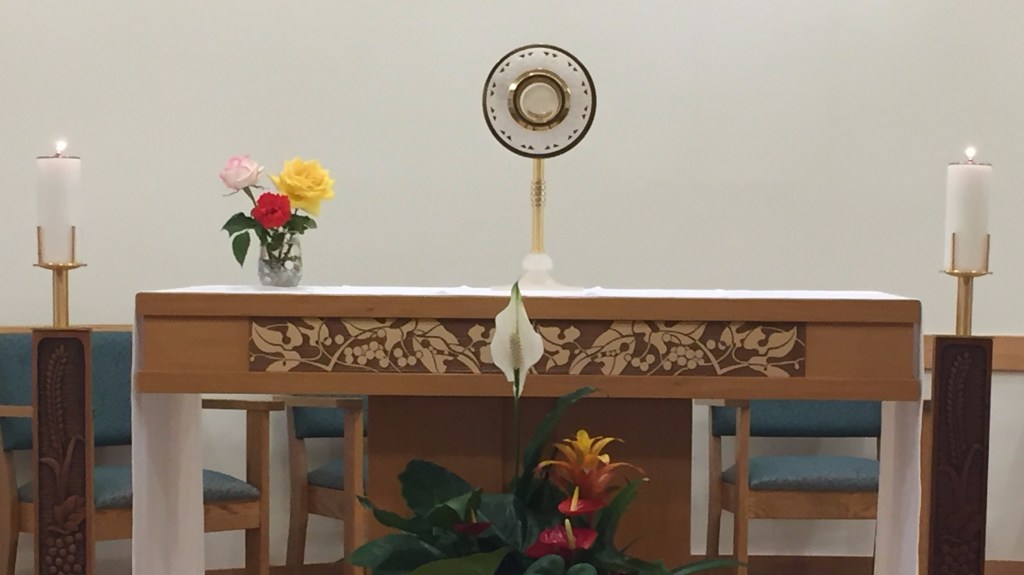
Reflections on the Gospel Reading for the Day

What is keeping us from gaining eternal life?
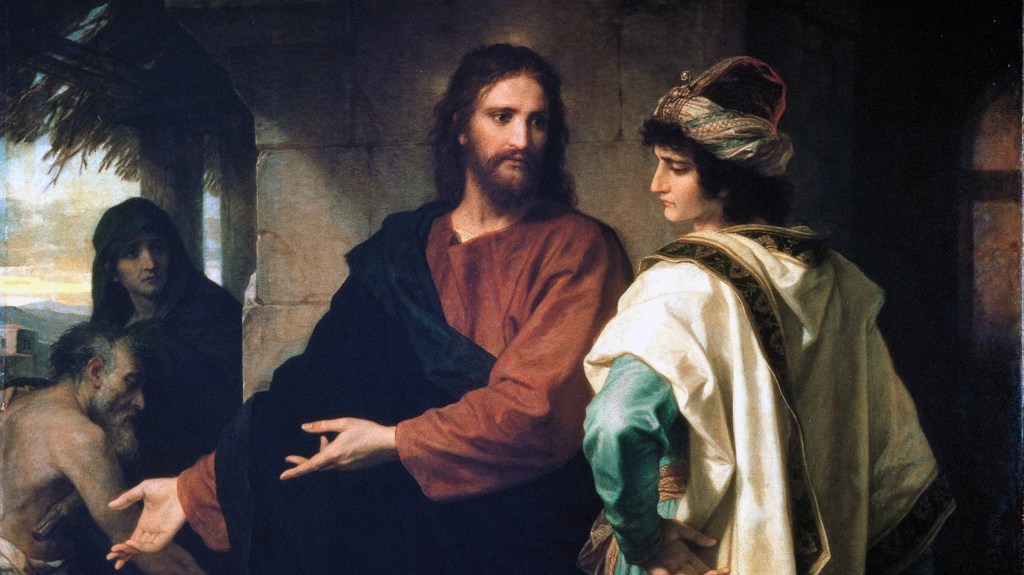
A young man approached Jesus seeking to know what he must do to attain eternal life. Jesus shared that the key was to keep the commandments. The man asked which ones he was to follow, a reasonable request as there were 613 commandments to choose from! Jesus gave him six: do not kill, commit adultery, steal or bear false witness; do honor his father and mother, and love his neighbor as himself (cf. 19:18-19). The man affirmed that he had followed them all. Then he asked that next question, “What do I still lack” (Mt 19:20)? I can feel the disciples wince, see the mouth of Jesus curl into a smile while his left eyebrow raises. Mark is more eloquent than me: “Jesus looked at him, and loved him…” (Mk 10:17). Matthew, in his Gospel account, does not engage in such subtleties.
Jesus said to him, “If you wish to be perfect, go, sell what you have and give to the poor, and you will have treasure in heaven. Then come, follow me.” When the young man heard this statement, he went away sad, for he had many possessions (Mt 19:21-22). The young man was so close!
Jesus saw the one thing that was keeping this man from following him. Jesus gave him the opportunity to renounce what he had, give to the poor and have eternal life, which was his original request. It is what we have all been created for, “You have made us for yourself, O Lord, and our hearts are restless until they rest in you” (St Augustine, Confessions). The young man knew what he needed to do, but was too attached to his wealth to let go, so he walked away sad.
We do not know if the young man reconsidered Jesus’ offer and returned to Jesus. I invite you to find a quiet space today, enter the stillness, and enter this scene in your imagination. Play it out again in your mind and come to the same ending, with the disciples and Jesus watching the rich man walk away sad. Continue your observation of them as they ever so slowly turn their heads and gaze at you. You then ask Jesus, “What do I still lack that is keeping me from walking a more intimate walk with you?”
What are you holding onto that is keeping you from giving yourself to the One who is truly Good? Jesus looks at you and loves you, and says, “If you wish to be perfect…” How does he fill in the blank for you?
———————————————–
Painting: “Christ and the Rich Young Ruler” Heinrich Hoffman, 1889
Link for the Mass readings for, Monday, August 19, 2019
Speak the truth and allow another to do the same.
“Do you think that I have come to establish peace on the earth? No, I tell you, but rather division” (Lk 12:51).
We often hear Jesus preaching about oneness and unity. Today’s statement from Jesus can seem contradictory, yet what he is articulating is an observation about an unfortunate reality. Those who speak truth to power, like the long line of prophets, such as Jeremiah in the first reading, face harsh treatment. Jesus would be no different. If we are living out the Gospel in our daily lives it will also be true for us.
The sad reality is that we still witness division and polarization today. We have forgotten or no longer want to have a good argument. One in which each person speaks for what they believe in while at the same time respecting the other person’s right to do the same. Also, we no longer enter the argument to learn from one another, but to win.
Our society has grown to the point where a common adage is all too well known. When you gather together do not speak about politics or religion. The reason is that too many of these discussions have just devolved into ad hominem attacks in which we just disparage or belittle someone we disagree with. This is a shame because these are two areas of our lives that we need to discuss and be passionate about.
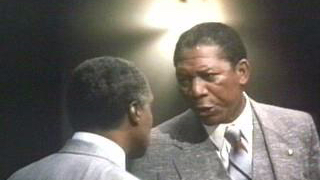
One of my favorite film scenes is from the 1989 film, Lean on Me, in which Robert Guillaume, acting as the school superintendent and Morgan Freeman, acting as a principle of the sub-par school he is trying to build up have a passionate and heated argument. Each vehemently makes their case for their perspective and do not come to a mutual agreement, but when the smoke clears and their professional relationship and friendship appears to be over, there is a brief pause and one says, “Come on, let’s get something to eat.” There is a passionate argument for what the two believe in though no demeaning of the other, but mutual respect.
Throughout the Gospels, we see that Jesus as a master of the argument because he knows and speaks the truth no matter the situation or pressure. He can speak among the religious and spiritual elite as well as the leper and the prostitute, yet in each case, the truth remains the same. He is not swayed by political, social or religious pressures. Jesus speaks the truth as his Father leads him and may we do the same while respecting and acknowledging the dignity of who we engage with.
————————————————————–
Photo clip from the film, Lean on Me, starring Robert Guillaume and Morgan Freeman, 1989
Link for the Mass readings for Sunday, August 18, 2019

“The Kingdom of heaven belongs to such as these.”
“Let the children come to me, and do not prevent them; for the Kingdom of heaven belongs to such as these” (Mt 19:14).
Again we see the disciples refusing access to Jesus. The scriptures are not clear why they are consistent in acting in this way. We see them doing so with the blind man Bartimaeus, the tax collector Zacchaeus, and the Canaanite woman. In today’s reading, they are refusing access to children. The consistent characteristic of each who are being refused is that they are considered to be on the periphery of Jewish society.
Children, paidia in Greek, especially so. Paidia could represent a child from infancy to twelve years of age. In ancient Palestine, children were particularly vulnerable, had no status and were completely dependent on their family for survival. Luke goes even further than Mark and Matthew by using, brephē, meaning infant, to describe the children. It is to these children and infants that Jesus states the Kingdom of heaven belongs.
Jesus is consistent in his ministry of paying particular interest to the individual person. He welcomes the children and blesses each one of them. Jesus continually acknowledges and affirms the dignity of each person he meets, especially those neglected and ignored. Those who have been on the periphery, those who have been on the other side of the glass looking in, Jesus gives admittance to. Jesus bridges the divide of separation through his presence and healing touch.
To enter the Kingdom of heaven, we must be willing to trust and place, as children, even more so, as infants, our total dependence on God alone, not on our own initiative or effort. There is nothing we can do to earn our way into heaven. The entrance into the Kingdom of heaven is a free gift of God’s grace. This gift is not about our worthiness, for all of us fall short, it is about our willingness to acknowledge our utter dependence on our loving God and Father and accept the invitation he offers us to be in relationship with him. And then, we are not to prevent others from having access to this wonderful gift, but we are to share the same invitation we have received with others.
Photo: A stained glass image of Jesus with children at Our Lady of the Angels Cathedral, Los Angeles, CA.
Link for the Mass readings for Saturday, August 17, 2019
With this ring, I thee wed.
Some Pharisees approached Jesus, and tested him, saying, “Is it lawful for a man to divorce his wife for any cause whatever” (Mt 19:3)?
The question about divorce came from an already existing debate within Jewish circles of interpretation and schools of thought. Testing Jesus arose from time to time to better understand who he would side with. Regarding the issue of divorce, there was a range of interpretations. On one end of the spectrum, there was the School of Shammai, which permitted divorce only in the event of some sexual misconduct. At the other end of the spectrum, was the School of Hillel, which would allow a man to divorce his wife if she cooked a bad meal (cf. Harrington 2007, 275).
The Pharisees sought to understand the perspective of Jesus in this debate. Jesus responded: “Have you not read that from the beginning the Creator made them male and female and said, ‘For this reason a man shall leave his father and mother and be joined to his wife, and the two shall become one flesh'” (Mt 19:4-5)? This response negated both schools as well as rejected the precept that Moses set for allowing divorce, explaining that, “from the beginning it was not so” (Mt 19:8). Jesus’ defense went back to God’s original intent recorded in the Book of Genesis, which allowed no provision for divorce.
In God’s plan, marriage is a covenantal relationship, as is the relationship between God and his people. A covenant is a sacred bond that is not to be broken. In the Sacrament of Matrimony, a man and a woman who give themselves to one another and are open to children as the fruit of their union mirror the Trinitarian communion of Father and Son and the eternal love between then the Holy Spirit.
The ideal of marriage then is to be a lifelong commitment; for God does not break his covenant with us, nor should we. The goal is clear, yet we live in a fallen world and we do not often live up to what God has planned for us. For many reasons, there are times where a marriage does not work as intended, but that does not mean we are to give up on marriage. Even though Jesus holds the standard high, he does not abandon us when we ourselves fall. He is present in our brokenness, and fallibility. He reminds us: “Those who are well do not need a physician, but the sick do. I did not come to call the righteous but sinners” (Mk 2:17).
It is right to keep our goals high and resist the temptation to settle for anything less than what God has in store for us, which is a covenant relationship with himself and each other. Relationships are not easy and no we don’t naturally know what we are supposed to do. We need to educate, support, model and mentor those preparing for marriage as well as during their marriage to help them remain faithful to God and one another. And when a relationship breaks down, we need to be present to and walk with those who suffer through the pain of the rupture. We ought not to abandon one another for Jesus does not abandon us and instead loves us more than we can ever mess up.
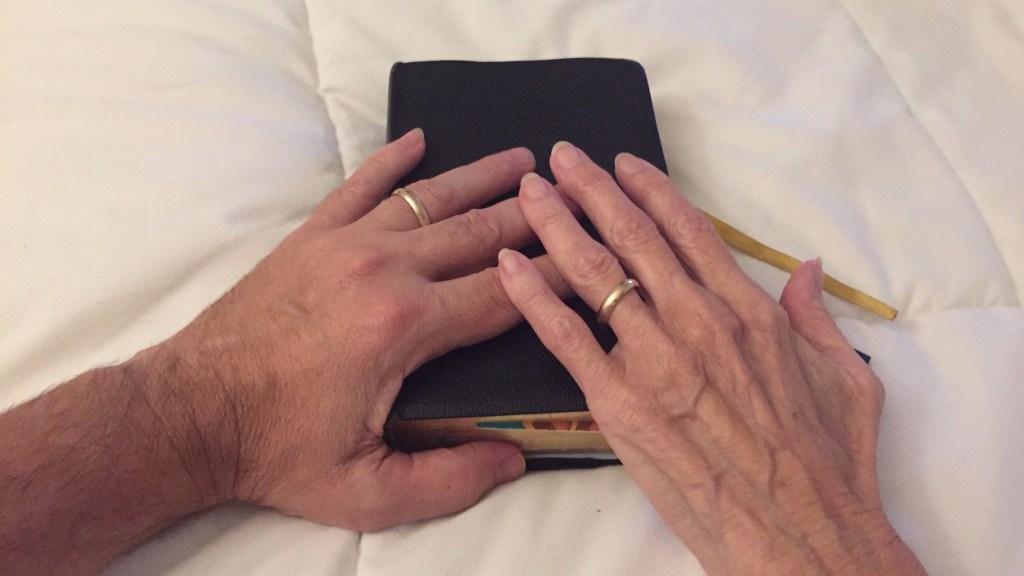
Photo: JoAnn and my hand on my breviary. We have dedicated our lives to God and each other, and on the inside of each of our rings is etched the word eternity.
Harrington, S.J., Daniel J. The Gospel of Matthew in Sacra Pagina, vol. 1. Edited by Daniel J. Harrington, S.J. Collegeville, MN: Liturgical Press, 2007.
Link for the Mass readings for Friday, August 16, 2019
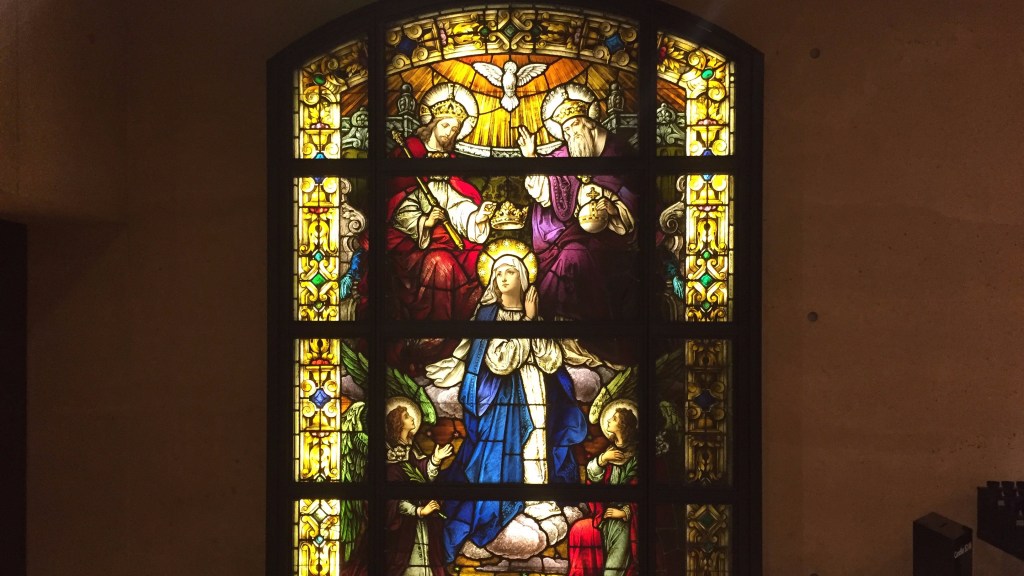
Mary is now where we one day will be!
“For at the moment the sound of your greeting reached my ears, the infant in my womb leaped for joy” (Lk 1:44).
When we experience a great joy we want to share it with others, just as Mary did when she conceived Jesus through the power of the Holy Spirit and also heard that Elizabeth was also with child. When we unite with those we love we leap for joy, sometimes literally, as John did in the womb!
There was no one on this earth closer to Jesus than Mary. She bore him, nursed him, raised him, initiated in a motherly fashion his public ministry, held him in her arms as he was taken down from the cross, and she was with the Apostles in the upper room when the Holy Spirit descended upon them. Mary, like Jesus, was also Immaculately conceived. When her time came to leave this life, who better than Mary to have experienced the “singular participation in her Son’s resurrection and an anticipation of the resurrection of other Christians” (Catechism of the Catholic Church 1997, 966)?
Today we celebrate the official dogmatic constitution issued by Pope Pius XII in 1950, the Assumption of Mary, a special grace she received from her Son. Jesus is the promise and Mary is the hope that we will live eternally with our heavenly Father, for Mary is now where we will one day be, body and soul. Today is a day of great joy!
Jesus and Mary have undone the sin of Adam and Eve. They, in their continual faithful life of saying yes to the will of God, opened up heaven for us. In our darkest trials, when the storm clouds of injustice, racism, and violence gather, when a situation or conflict does not appear to be getting any better, when death may be imminent, and/or when a loved one has died, even then, death does not have the last word.
There is hope because there is a light that shines in the darkness when we echo Mary’s song“My soul proclaims the greatness of the Lord; my spirit rejoices in God my Savior. For he has looked upon his handmaid’s lowliness; behold, from now on will all ages call me blessed.” (Lk 1:46-48). God is ever faithful and present to us in his mercy. May we, like Mary, ponder upon the wonderful gifts of Jesus, love, mercy, and the bestowal of his grace. May we also, like Mary, reflect the light of her Son as we experience the foretaste of heaven by receiving his love and being beacons of joy in a weary world.
Holy Mary, Mother of God, pray for us now and at the hour of our death!
Stain glass of the Assumption of Mary at the Cathedral of Our Lady of the Angels, Los Angeles, CA
For the readings of the Mass for Thursday, August 15, 2019
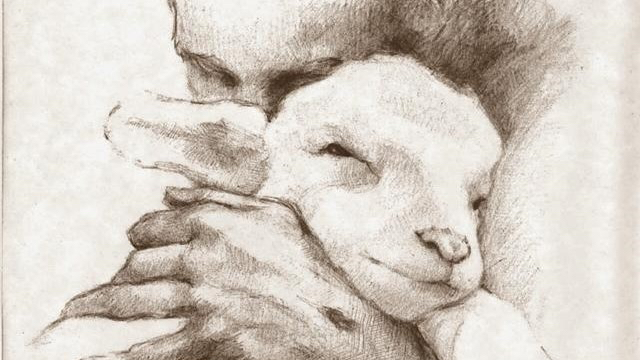
Reject gossip and choose to embrace reconciliation
Gossip is a seductive and enticing poison. Many of us fall for its lure and its intoxication. There are many different reasons we engage in gossip. We may think we feel better about ourselves by putting someone else down, we may be jealous of what another has, or maybe someone just rubs us the wrong way. The reason that we may feel justified in choosing to gossip is when someone has hurt, offended, or wronged us in some way. Even in that instance, we observe Jesus offering a different approach in today’s Gospel.
Jesus said to his disciples: “If your brother sins against you, go and tell him his fault between you and him alone” (Mt 18:15). Jesus is drawing on his Jewish heritage. Leviticus 19:17 warns against holding hate in your heart and instead encourages seeking to reason with your brother. Jesus is redirecting us from adding fuel to the fire by seeking revenge or stewing in our own hurt, which will build resentment and hate. Instead, he is inviting us to seek reconciliation.
Pope Francis, in his September 9, 2016, General Audience was very clear: “[G]ossip is a ‘terrorist’ who throws a grenade – chatter – in order to destroy,” he added. “Please, fight against division, because it is one of the weapons that the devil uses to destroy the local Church and the universal Church.” Let us refuse to be a weapon of the devil in his plot to divide us with our thoughts or our words, but instead, seek to be a disciple of Jesus by advocating for forgiveness and reconciliation.
We need to commit to being more discerning with our tongue. With our words, we can cut, wound, or destroy, or we can convict, reconcile, and heal. Let us choose today to lift up and empower one another. Yes, it is much easier to grumble about someone than to approach them in love and hold them accountable. If we are not quite ready for that, Pope Francis invites us to “bite our tongue” instead or we can choose to pray about the situation with someone we trust: “For where two or three are gathered together in my name, there am I in the midst of them” (Mt 18-20). In seeking the help of Jesus, we will have a better chance of choosing reconciliation over gossip.
Image credit: “Jesus and the Lamb” by Katherine Brown
Link for Pope Francis’ comments
Link for the Mass readings for Wednesday, August 14, 2019

Whoever becomes humble like this child is the greatest in the Kingdom of heaven.
“Amen, I say to you, unless you turn and become like children, you will not enter the Kingdom of heaven. Whoever becomes humble like this child is the greatest in the Kingdom of heaven. And whoever receives one child such as this in my name receives me (Mt 18:3-5).
The above response Jesus gave was to the disciple’s question regarding who is the greatest in heaven. Jesus offers an unexpected response, as children had no esteem, honor, or greatness in his society. Jesus was not pointing out so much the innocence of children, but emphasizing that children were completely dependent on others for their very survival.
If we are to embark or stay on the journey that will lead us to the Kingdom of heaven, we need to do the same. We need to give our control and apparent, self-sufficiency over to God and place our dependence on him alone. We need to depend on God as would an infant or young child does on their parent.
Very young children have not developed a defensive filter and they say what is on their mind, often with precise insights! How often do we do the opposite by automatically responding in a defensive manner, thinking about how we will be received or fearing an ulterior motive from the question? Jesus has taught us that our yes is to be yes, and our no is to be no, and anything more is from the evil one (cf. Mt 5:37). As his disciples, Jesus calls us to be humble, to admit to our sins, our mistakes, to confess, correct and learn from them.
We grow in humility when we take responsibility for our actions, turn away from that which we place before God, and release those biases and idols that can lead us down the path of prejudice. We also do so when we resist the allures of material, apparent goods, and our own self-centered postures, which so often can lead us to the imprisonment of addiction. We can avoid much of the pitfalls above when we follow the instruction of Jesus to “become like children”. This is more likely to happen when we depend more on God, surrender our control, and place our trust in him. By doing so, we can build a firmer foundation of truth and humility, we will begin to find that we will be more satisfied, fulfilled, and be less defensive and more present to those in need.
We live in a fallen world and there is a temptation to buy into the idea that “might makes right” and “the prize belongs to the survival of the fittest”. Yet the reality is that we are all wounded, a bit beat up, emotionally, physically, and spiritually, and in need of God’s healing. We are to resist assuming any defensive posture, or taking offense when presented with negativity but instead align ourselves with God and ask him to love others through us, so that we can be more understanding, loving and empowering. We could all use a little more support, empathy, and kindness. May we begin to be a little more humble, present, more like a healing balm for one another today, for whoever receives one child such as this in Jesus’ name receives him (cf. Mt 18:5).
Photo: Me and my nephew Nicholas some time ago. He is now 23. Please join me in prayer that in the name and power of Jesus, Nick may be freed and healed from the battering cycle of addiction. If you know of anyone struggling with addiction, add their name and we can join in praying together for the healing of so many who are ensnared and needing to be set free! Thank you.
Link for the Mass reading for Tuesday, August 13, 2019
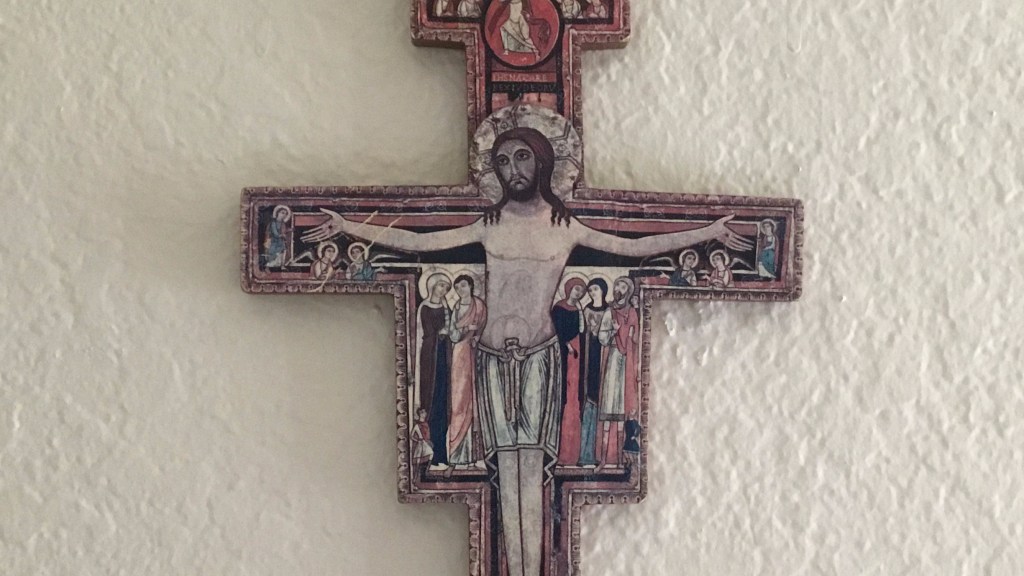
Death does not have the final answer, Jesus does!
Jesus said to them, “The Son of Man is to be handed over to men, and they will kill him, and he will be raised on the third day.” And they were overwhelmed with grief (Mt 17:22-23).
This is the second time in the Gospel of Matthew that Jesus shares with his disciples that he will die soon. They are overwhelmed with grief because their focus is on the first part of Jesus’ statement that he will be handed over to death. They do not understand or yet comprehend the second part about how he will be raised on the third day. How could they? There was no point of reference for them. Jesus did bring three people back to life during his ministry, but Jesus would not be merely resuscitated as they were and just die again. Jesus would resurrect and conquer death.
For us today, we can read today’s Gospel about the impending death of Jesus and gloss over it a bit too easily because we celebrate Easter each year, we celebrate that Jesus has risen. Yet, do we really take in what this means? Does the fact of the Resurrection, the reality that Jesus has conquered death and become the firstborn of the new creation really have relevance in our lives?
The life, death, and Resurrection of Jesus matters! The missing piece for those for whom this statement doesn’t register any relevance may be that they do not want to think about death all that much. To be honest, none of us really want to come face to face with our own mortality, and most of us don’t until we or a loved one is forced to.
Beginning the summer after my freshman year of college, I began working second shift in a nursing home as a CNA. It was the first time that I experienced death up close through the care of the residents I worked with. They were not merely patients but became family. I experienced, with each person who I was blessed to be with when they died, an experience of a peace that surpassed all understanding, that transcended the moment.
The most important lesson I learned from these moments of grace was to not take life for granted. Life is fragile and when we are able to contemplate and face our own death, I do believe that we live our lives more fully. And when we experience this exercise with the one who conquered death, the possibilities in our lives become unlimited.
Jesus understands each of our struggles and tribulations, our sins and our failings, as well as our deepest hopes and dreams. Jesus also knows about our deepest fear of death, for he, as a human being, experienced it too in the Garden of Gethsemane. The gift of the crucifix, the beautiful sacramental object of Jesus on the Cross, is a reminder to us all that death does not have the final answer, Jesus, fully human and fully divine, does.
Photo: Crucifix I have had with me since my early twenties. It now hangs in JoAnn and my apartment bedroom.
Link for the Mass readings for Monday, August 12, 2019