The Sign of Jonah

“An evil and unfaithful generation seeks a sign, but no sign will be given it except the sign of Jonah the prophet” (Mt 12:39).

Jonah is the prophet best known as the one who spent three days and nights in the belly of a whale, great fish or sea monster, depending on your scriptural translation. Jonah ended up in that predicament because he refused to follow God’s direction to speak his message of forgiveness to the sworn enemies of Israel, the Ninevites. It would be like God asking one of us to fly out to the Middle East to meet with members of ISIS or Al-Qaeda and invite them to repent. Not only would we not believe they would want to repent, would we want them to even if they would? Also, whether they did or didn’t, would we be able to return from such a meeting with our heads intact?

These were probably some of the issues running through Jonah’s mind when he refused to follow God’s will. Jonah overcame his resistance and followed the command of the Lord, kept his head on his shoulders, and the people of Nineveh repented. Happy, happy, joy, joy! Not exactly. At the repentance of his enemies and God’s expression of mercy and forgiveness, Jonah said to God, “This is why I fled at first to Tarshish. I knew that you were a gracious and merciful God, slow to anger, rich in clemency, loathe to punish” (Jonah 4:2)”. Jonah shows his hardness of heart in that he did not want to go to Nineveh because he did not want his enemies to receive God’s forgiveness!

The scribes and the Pharisees asked Jesus for a sign and the sign of Jonah is what he gives them: The Ninevites, who were Gentiles, non-Jews, were willing to repent at the word of Jonah, and those scribes and Pharisees questioning Jesus, God’s chosen, were not willing to repent at the urging of one greater than Jonah, the Son of God, who was in their midst.

Jesus announced his ministry, as recorded Mark 1:15, with the words: “The kingdom of heaven is at hand. Repent and believe in the Gospel.” That is again our invitation today. Let us examine our conscience by asking God to help us to recognize his presence among us, then reflect on what good God has done in our lives and give him thanks. Review the last day or two to see where God has called us to act. Where did we answer his call, where did we, like Jonah resist?

Where we resisted the will of God, especially in refusing to bestow God’s grace, mercy and forgiveness upon someone else, or committing some other sinful action, may we ask God for forgiveness. May we ask God that he bestow his grace upon us today.

Someone greater than Jonah is in our midst today, he is Jesus the Christ. May we be willing to bestow his Love and Mercy on all those we meet today even, and especially, those to whom we would rather not: those who get under our skin, grate on our nerves, or those we may consider an enemy. Let us repent from our hardness of heart, be willing to forgive, and be willing to encounter one another today with an attitude of understanding, kindness, patience, and encouragement.

—————————————

Photo: Encountering each other with patience and encouragement!

Link for the Mass readings for, Monday, July 23, 2018: http://www.usccb.org/bible/readings/072318.cfm

Tearing down walls of enmity, by following the Shepherd of peace.

“Woe to the shepherds who mislead and scatter the flock of my pasture, says the LORD… You have scattered my sheep and driven them away. You have not cared for them” (Jer 23:1-2).

The shepherds that Jeremiah spoke about in our first reading were the five kings that Jeremiah consistently called to task during the 7th and 6th centuries BC. Each of these leaders were more corrupt than the next. More and more they looked after their own interests and welfare and less and less they sought to provide care and support for their people.

Jeremiah not only spoke truth to power he also prophesied:

“Behold, the days are coming, says the LORD, when I will raise up a righteous shoot to David” (Jer 23:5).

As Christians, we believe that Jesus is that righteous shoot. He is the Shepherd that has been caring for his sheep for generations up to this day. Jesus is also the one who the Psalmist sings of:

“Even though I walk in the dark valley I fear no evil; for you are at my side with your rod and your staff that give me courage” (Psalm 23:4).

In today’s Gospel from Mark, Jesus gathered his apostles together and lead them off to a quiet place for rest, but once they arrived at their location and disembarked from their boat, Jesus “saw the vast crowd, [and] his heart was moved with pity for them, for they were like sheep without a shepherd” (Mk 6:34).

I invite you to imagine for a moment, that Jesus disembarks today on the shores of America. If he is allowed to enter, who does he encounter? Unfortunately, he will meet two thousand plus unborn whose lives have been cut short today, ninety-six citizens killed by gun violence today, two thousand plus immigrant children who still have not been reunited with their families. He will also walk among thousands affected by human trafficking, domestic violence, discrimination, racism, sexism, and addiction, hundreds of thousands of homeless, millions without access to healthcare and gainful employment. Jesus weeps because of the level of indifference and rationalization, the widening gap between the rich and poor, and his heart aches as he witnesses the gathering darkness of polarization and division.

May we too have the eyes to see and the ears to hear, the suffering of our brothers and sisters. It is time for us as Christians to remember who we are. We are an Alleluia people, we are a people of hope and joy because we are members of the Body of Christ, the Church. We just need to remember who our Shepherd is.

Moments ago, we heard the words that St. Paul wrote to the Church at Ephesus and he speaks to us right now:

Jesus is our peace, he who made both ONE and broke down the dividing wall of enmity.

Our starting place is to acknowledge where we contribute to building walls of enmity, or hatred, between ourselves and others. Instead of projecting our fears, anxieties, biases, and prejudices out toward one another, Jesus shines a light for us, to help us to see within our own darkness, to identify the roots of our sin growing deep within us, so that we can confess them to God and one another.

Jesus commands us to love, to will the good of the other as other. We are better able to do so when we are willing to die to our own ego, our own self-centered, fallen nature and instead collaborate with Jesus in his work of redemption, to establish peace, and with God, in one body, through the cross, tear down the walls of division that have been suffocating us.

Christianity is not a private club for the select few. Jesus’ message of the Gospel is an invitation for ALL PEOPLE to share in the oneness of a relationship with the Trinitarian communion of Father, Son, and Holy Spirit. God, in giving us life, has created us each unique and we as the Church are at our best when we embrace the gift of our diversity.

The challenges of a culture of death and division that poison our country and world can be countered, if all of us are willing to work together. How do we meet the myriad of challenges that are before us?

The best way we can begin to bring about effective change, is that we first, need to resist making ourselves, our family, groups, political affiliations, president, the flag, and/or nation into our idols. For when we place our identity solely in anything other than God we will go astray. When we put God first, develop and deepen our relationship with him, learn about and live his teachings in our daily lives, we will begin again to see each other through God’s eyes, so to see people not as other, but as human beings created in his image and likeness.

When we are less governed by protecting the group and seeing the dignity of the person, we will be less apt to belittle, demean, dehumanize, and demonize those who are different as well as those who have opposing views and perspectives. We can be more open to engage in dialogue, instead of shouting at or over each other. We can be more open to share our diverse ideas, talents, cultures, and perspectives, so to learn from one another, stand up for and empower one another.

Second, we must make the time to pray and be still so to discern what is the gift that God has given each of us to contribute to building up his kingdom. Each one of us, has something to bring to the table, because each of us are loved by God more than we can ever imagine. When we engage ourselves in whatever challenge we face, no matter the situation in which we are called to serve, we are to bring the love that we have received in our own unique way and allow God to be God through us.

Third, we need to trust in Jesus. When anxieties and fears arise, it is a barometer that we are not trusting in the love and power of God.

I understand this very well. Much preferring to stay in my own world, I have struggled often with the fear of going out from myself. Speaking publicly in my youth was not even an option. When I was a child my father introduced me once as, “This is my son, he doesn’t talk.” The first time I read from this ambo as a lector, my legs shook the whole time. I have felt the urge, too many times, to reach out and help another, was instead indecisive and the moment passed where I did nothing. Each day I seek God’s help to do better, to not give in to my fears, but instead trust in the Good Shepherd who has remained by my side and who has led me to be a husband, father, teacher, and deacon.

Finally, we need to, in the words of Blessed Archbishop Oscar Romero, “be God’s microphone”. We are called to speak truth to power, to speak and act on behalf of the dignity of those for whom we witness being belittled, demeaned, disrespected, or dehumanized in any way.

As followers of Jesus the Christ we need to be willing to stand up for one another, for God’s creatures and his creation. When we begin to act and speak as God’s microphone, and the first experiences of anxiety and fear attempt to silence us, we need to call on the power of the Holy Spirit and he will give us the courage and the words to speak. Even if Satan himself stands before us, the weakest Christian is stronger. For all we need to say is, “In the name of Jesus, get behind me Satan.” And through the power of his name, the devil must flee.

Jesus has come to us today as our Shepherd and preaches peace to us who are far off, who are polarized and divided. He promises that through him we all have access in one Spirit to the Father. As we receive Jesus today, may we remember who we are called to be as Christians. Let us refuse to contribute to building walls of hatred and division, but instead commit our lives to putting God first, praying and discerning how best we will serve him through each other. May we trust that Jesus is with us, even in the darkness, and seek the courage of the Holy Spirit to be God’s microphone, speaking on behalf of a consistent ethic of life for all of humanity and all of God’s creation.

Let us be good shepherds today, by being a light in the darkness of division, by providing hope for those in despair, by offering a smile of acceptance, an understanding ear to hear, a kind word of encouragement, and a loving shoulder to lean on for someone in need today.


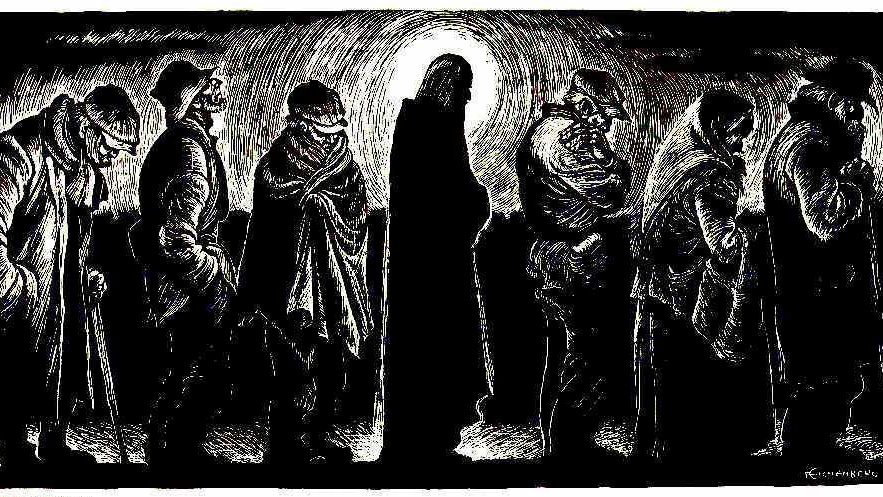
Photo:Jesus in the Breadline, woodcut by Fritz Eichenberg

I am also preaching at the 9:30 and 11:00 Mass, join us at St Peter or watch our live feed at: https://www.stpetercatholicchurch.com/ and click on WATCH, then then Live Streaming at St Peter.

Link for the readings of the Mass for Sunday, July 22, 2018:

http://www.usccb.org/bible/readings/072218.cfm

Walking away from negativity

In today’s Gospel from Matthew, Jesus realized that: “The Pharisees went out and took counsel against Jesus to put him to death” (Mt 12:14). Jesus did not then start to plan how he would defend himself against their plot, he did not arm his supporters, nor is there any indication that Jesus let the fact that he was a marked man bother him. What did Jesus do with this bit of news?
“He withdrew from that place” (Mt. 12:15) and cured those who followed him. Was Jesus being a coward by withdrawing? No. Jesus was refusing to engage or give any of his time or energy to their negativity. He focused on what he was about and that was continuing the mission that God had sent him to achieve, which was to help bring about the salvation of humanity and the world, and call those who would work with him to continue his mission.
Many of us will hopefully not receive death threats, but many of us have and will witness and/or receive critical, negative, belittling, or dehumanizing looks, words, and outright actions to cause physical, mental, emotional or spiritual harm, just in the course of our daily interactions. For those of us who choose to practice publicly the teachings of Jesus, we may receive even more!
Our common response to the many forms of perceived or actual animosity directed toward us is to react. Our reactions generally are based on learned defense mechanisms we have adopted through our lives. Often when we react, we slip into survival mode, experience increased anxiety, defensiveness, anger as well as a myriad of other emotions. Ideally, as we mature in our faith, our response is to draw into the present moment, breath, and call upon God’s guidance to direct us.
Many times the best way to diffuse negativity is to do as Jesus did in today’s Gospel, resist to engage in it altogether and continue to be about enacting God’s will in our life. May we recall a time that we have taken offense and reacted in kind toward someone who pushed our buttons and got under our skin. Let us ask Jesus how we could have reacted differently in that situation and then imagine doing so, and pray for God’s guidance and help to be more patient and understanding in the future. Life is short in the best of scenarios, let us not take a day or moment for granted, nor give away our precious time to engaging in negative reactions. Instead may we begin our day today by meditating on these words attributed to St. Teresa of Avila (1514-1582):
“Let nothing disturb you,
Let nothing frighten you,
All things are passing away:
God never changes.
Patience obtains all things.
Whoever has God lacks nothing;
God alone suffices.”

Photo: 2010 Hike, taking a walk is often a good way to decompress and leave negativity behind! Photo credit – Jack McKee
Link for the Mass readings for Saturday, July 21, 2018:
http://www.usccb.org/bible/readings/072118.cfm

Something greater here… Mercy!

I say to you, something greater than the temple is here. If you knew what this meant, I desire mercy, not sacrifice, you would not have condemned these innocent men. For the Son of Man is Lord of the sabbath.” (Mt 12:6-8).

Jesus continues to rock established regulations and practice. Here he is challenging the understanding of the Sabbath itself when justifying the accusations leveled toward his disciples who were picking and eating grain on the Sabbath, and he does so in a profound way by saying that, “something greater than the temple is here.” Present in the heart of the temple, the area called the Holy of Holies, was the ark of the covenant. Atop the ark was the lid called the mercy seat of God. Jews believed that this was where God sat and when the blood of atonement was offered from sacrifices, God’s mercy was offered to the people. In the temple then, was the very presence of God.

Jesus’ claim that he is greater than the temple is putting him on the same level as God. A blasphemous statement to say the least, unless of course, he is God. Not only does he make this claim, but he doubles down by claiming that he is the Lord of the sabbath; Jesus is God!

In quoting Hosea 6:6: “I desire mercy, not sacrifice”, Jesus is not only saying that he is the something greater, but that his way is something greater. One of the foundational points of the Way of Jesus is mercy. Through the incarnation, the Son of God dwelt among us, became one with us in our humanity. He restored our dignity in the midst of our brokenness. What Jesus is saying, in his defense of his disciples eating from the grains of wheat on the Sabbath, he is saying to us today, and that is: “What is owed to every human being on the basis of his or her human dignity is personal respect, personal acceptance, and personal care” (Kasper 2014, 202).

We as the Church are also greater than the temple, because in our participation in the life of Christ we become the Body of Christ and are to follow Jesus in his bestowing acts of mercy on our neighbor. “The works of mercy are charitable actions by which we come to the aid of our neighbor in his [or her] spiritual and bodily necessities. Instructing, advising, consoling, comforting are spiritual works of mercy, as are forgiving and bearing wrongs patiently. The corporal works of mercy consist especially in feeding the hungry, sheltering the homeless, clothing the naked, visiting the sick and imprisoned, and burying the dead. Among all these, giving alms to the poor is one of the chief witnesses to fraternal charity: it is also a work of justice pleasing to God” (Catechism of the Catholic Church, 2nd ed. 2447).

Let us review the spiritual and corporal works of mercy above and choose one to practice this week. May we desire and seek the mercy of God, be open to receiving it, and be open to sharing his mercy. May we pray for and communicate with our leaders that they apply works of mercy regarding a consistent ethic of life respecting the dignity of all people living in and seeking to come to our countries. Let us draw strength and courage from Jesus, so to be willing to face our own brokenness and come to healing, while at the same time bestowing mercy; which is “the willingness to enter the chaos of another” (Keenan, 2015).

—————————————

Photo: Soldier giving refugee child water accessed from powerful article from Wall Street Journal from May 2017. Would that our president and his administration read it especially regarding the quote from the UNICEF six-point agenda that stresses the need for the G7 to protect child refugees and migrants: https://wsimag.com/economy-and-politics/26464-a-tale-of-children-and-smugglers

Link for the Mass readings for Friday, July 20, 2018:
http://www.usccb.org/bible/readings/072018.cfm

Kasper, Walter. Mercy: The Essence of the Gospel and the Key to Christian Life. NY: Paulist Press, 2004.

Catholic Church. Catechism of the Catholic Church: Revised in Accordance with the Official Latin Text Promulgated by Pope John Paul II. Vatican City: Libreria Editrice Vaticana, 1997.

Keenan SJ, James. “The Scandal of Mercy Excludes No One.” Thinking Faith. December 4, 2015.
http://www.thinkingfaith.org/articles/scandal-mercy-excludes-no-one

With Jesus Our Burdens Are Lighter

Jesus said: “Come to me, all you who labor and are burdened, and I will give you rest” (Mt 11:28).

Scripture scholar, Fr. Daniel J. Harrington, SJ, states that in this passage Jesus’ invitation was given to those who are not yet his disciples, those Jews who do not yet believe in him and his way. He also intuits that Jesus is calling them from the heavy burdens laid upon them by the scribes and Pharisees and inviting them to accept his burden that is lighter (cf. Harrington , 167). We can read this in Matthew 4:3: “They tie up heavy burdens [hard to carry] and lay them on people’s shoulders, but they will not lift a finger to move them.”

The key to the conviction that Jesus levels against the Pharisees is that they impose the law, but do nothing to assist those they are teaching. I would say the demands of Jesus are even more challenging than those of the Pharisees, Sadducees, or the scribes! I shared yesterday one of the six antitheses, here is another: “You have heard that it was said… whoever kills will be liable to judgment. But I say to you, whoever is angry with his brother will be liable to the judgment, and whoever says to his brother, ‘Raqa,’ will be answerable to the Sanhedrin, and whoever says, ‘You fool,’ will be liable to fiery Gehenna” (Mt5:21-22). Jesus is equating calling someone Raqa – an air-head, or calling someone a fool akin to murder. Our words can destroy or empower! We need to choose our words wisely.

The difference between Jesus and the religious leadership is that Jesus, the Son of God in the fullness of his divinity, entered the chaos of our humanity as a human being, walked among us and suffers along with us. He offers to yoke himself to us and so carry the burden with us, making it lighter. Many impose burdens on us, we impose burdens on others, as did the Pharisees. We also impose them on ourselves and turn away from the invitation of Jesus’ help.

A handful of injuries I have suffered through the years were because I attempted to lift or carry something beyond my strength, instead of seeking assistance from another. I would think, “I can do it, I don’t need any help!” That is just the physical; there are also the mental and emotional burdens of anxiety, doubt, pride, fear, worry. This is not Jesus’ way. He offers a path for us to follow that leads us to joy, peace, and rest in this life and fulfillment in the next. No matter what pain, suffering, trial or challenge we are facing right now, we do not have to go through it alone. May we remember to reach out our hand to Jesus, and then we will find his hand already waiting there to grasp ours.

We will find rest not in going it alone but in our collaboration with Jesus. In aligning ourselves with God’s will life isn’t necessarily going to be easier, but he will give us the strength and peace of mind to endure. Let us take our first step together today, hand in hand with Jesus, and so find rest in knowing we are not alone! Also, may we be kind to those in our midst with our words, actions and faces. May we not react toward others but instead be present and understanding. We are not aware of the burdens they carry. A simple smile can make a heavy load just a little lighter.
—————————————

Photo: California visit 2015

Harrington, S.J. Daniel J. The Gospel of Matthew. Vol. 1 of Sacra Pagina, edited by Daniel J. Harrington, S.J. Collegeville, MN: Liturgical Press, 2007.

Link for the Mass readings for Thursday, July 19, 2018:

http://www.usccb.org/bible/readings/071918.cfm

tradition or Tradition?

“At that time Jesus exclaimed: ‘I give praise to you, Father, Lord of heaven and earth, for although you have hidden these things from the wise and the learned you have revealed them to the childlike’” (Mt 11:25).

Why did the wise and the learned, referring to the Sadducees, Pharisees and scribes, reject Jesus? One possibility is that Jesus challenged their idol of tradition. Even though Jesus did not come to abolish the law but to fulfill it (cf. Mt 5:17), the invitation to go deeper was and continues to be challenging. This is certainly highlighted in the six antitheses, Jesus shared during his Sermon on the Mount. Here is one such example: “You have heard that it was said, ‘An eye for an eye and a tooth for a tooth.’ But I say to you, offer no resistance to one who is evil” (Mt 5: 28). Offer no resistance to one who is evil? Hard to swallow for people of Jesus’ time. For us today as well.

Jesus offered then and continues to offer us today the intimacy of the Trinitarian Love shared between Father, Son and Holy Spirit. To be fully alive, to share in his Love, we need to resist being governed by our fear and holding blindly on to tradition for its own sake. Instead we need to be open to growth, change, and renewal. Gerhard Lohfink, in his book, No Irrelevant Jesus, quotes the Polish philosopher Leszak Kolakowski: “A society in which tradition becomes a cult is condemned to stagnation; a society that tries to live entirely through revolt against tradition condemns itself to destruction” (Lohfink 2014, 2).

Many have left the Church because they feel we are too steeped in tradition, rules, and laws, but in their throwing the baby out with the bathwater, they have no secure ground or foundation, no anchor in their life. Others remain hunkered down entrenched in a bunker of tradition fearing the secular tide, holding on to tradition, not to Jesus. Both tendencies weaken us because we are choosing our self over accepting Jesus’ invitation to let go and enter into the living stream of the communal Love of the Trinity we can then share with one another.

Jesus sees the potential we have as well as our brokenness and fear. He meets us where we are, as we are, in our present condition, and from that starting point he invites us to crawl, then to walk, then to run, and eventually to fly – to experience and share the experience of his unconditional Love. Let us resist the temptation of rejecting tradition altogether or idolizing tradition alone, but instead build on the foundation we have been given; Jesus Christ: “The Way, the Truth and the Life” (cf Jn 14:6). Within the life of the Church, “we must not do away with its traditions, but at the same time it must continually clarify, renew, and deepen them” (Lohfink 2014, 2).

May we entrust ourselves to the Holy Spirit and ask him to burn away those small “t” traditions that keep us from God, so to reveal to us those capital “T” Traditions, that which remains from his purifying fire of Love. In this way, we may come to know that which in reality is the foundation of our identity that leads us to being people of integrity. May we be open to receiving that which Jesus wants to teach and reveal to us, learn it, and live it in our everyday lives!
—————————————

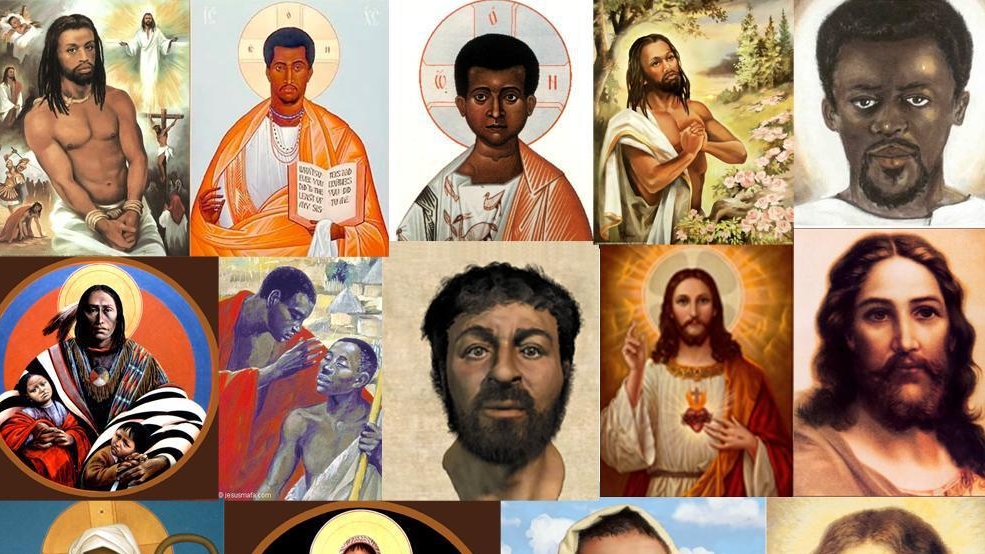
Photo: Collection of just a few artistic representations of Jesus. Historically, Jesus was a Palestinian Jew, yet the majority of traditional depictions over the years have been of a white Jesus. Which picture of Jesus do you most identify with?

Lohfink, Gehrhard. No Irrelevant Jesus: On Jesus and the Church Today. Minnesota: Liturgical Press, 2014.

Link for the Mass readings for, Wednesday, July 18, 2018:

http://www.usccb.org/bible/readings/071818.cfm


May we be willing to repent and believe in the Gospel.

“Jesus began to reproach the towns where most of his mighty deeds had been done, since they had not repented.” (Mt 11:20).

To encounter Jesus is to be invited to change. Jesus shines the light of his love and mercy into the darkness of our own fallen nature, where we are wounded, sinful, and broken. He invites us to repentance, healing, and reconciliation. A wonderful invitation, but why would we turn away? The light is too bright.

Facing our own darkness and brokenness is not easy and can be frightening as well as intimidating. That is why we are so vulnerable to temptation and distraction. We are not able to sit still because we want to keep moving so as not to face the fear and pain, nor let go of our false senses of security and the glitter of apparent goods.

May we pray for one another and be present to one another, that we can embrace the light of Christ, be willing to change, to repent: to turn back to God. God loves us more than we can ever mess up. Jesus loves us more than we can ever imagine. Jesus’ arms are wide open to receive us in the midst of our pain and brokenness, but we must be willing to stop running from the pain and experience it to feel his loving embrace. The God of Jesus Christ, Father, Son and Holy Spirit, is our source, our security, our refuge, our hope, and our fulfillment and when we trust him, he will lead us to all that is Good, True, and Beautiful.

“This is the time of fulfillment. The kingdom of God is at hand. Repent, and believe in the Gospel” (Mark 1:15).


Photo: Morning sunrise, a good day to begin again.

Link for the Mass readings for Tuesday, July 17, 2018:

http://www.usccb.org/bible/readings/071718.cfm

“I have come to bring not peace but the sword.”

“Do not think that I have come to bring peace upon the earth. I have come to bring not peace but the sword” (Mt 10:34).

Words to live by from the King of Peace. The reality of this statement is the reality of his mission. Jesus entered the lives of individuals. Some said yes to following him and some said no; some saying yes and no within the same family. The image of the sword represents how sharp and stark this choice could cut. If you do not think that is true, just look at the polarization in our country right now. The cut between democrat and republican bleeds quite deep.

During the time of Jesus and for most within the first generation of believers, there was not a luke-warm choice. You were either for Jesus or against Jesus. Unfortunately, today, the Gospel is being shaped more by politics than the Gospel shaping politics. To live as disciples of Jesus and to actively engage in living out the teachings of the Gospel it is more important that we follow Jesus, putting him first before any politician or political party. The platforms of democrats, independents, libertarians, and republicans are all deficient in following the teachings of Jesus.

We, who have chosen to follow Jesus, need to speak truth to the issues and hold leaders accountable on all sides. Our starting point for any issue needs to be respecting, first and foremost, the dignity of the person from the moment of conception and everywhere in between until natural death as well as promoting a healthy stewardship of God’s creation. In that dialogue, dialogue, not monologue, we need to respect those we share our views with and be willing to also listen. We can and will disagree, but we need to resist demonizing one another.

In the first reading from Isaiah today (Isaiah 1:15-17), I felt God was speaking to us directly as a country: “Though you pray the more, I will not listen. Your hands are full of blood! Wash yourselves clean! Put away your misdeeds from before my eyes; cease doing evil; learn to do good. Make justice your aim: redress the wronged, hear the orphan’s plea, defend the widow.” 

There are those who promote a right to choose taking the life of their own unborn, there are those who support taking children away from parents because they are seeking asylum and weeks and months later still not returning them, and those refusing to welcome the refugee and the migrant fleeing from dire situations. There are those who say we can’t pray in our schools, while others say we can’t take a knee to protest the disproportionate unjust killings of people of color by our law enforcement agencies. Mass murders, including the death of students in our schools as well as the daily violence in our cities abound. The addiction rate of our youth has reached epidemic proportions with little concrete help and support, while equal access to education, jobs, and health care is woefully unbalanced.

These issues are complex and there is no silver bullet that will solve them. When Jesus said, “I have come to bring not peace but the sword” (Mt 10:34), he meant that we are not to settle for a false peace of appeasement to get along and water down the Gospel message. We must wield his sword, which is the Word of God, that speaks truth to power. When seeking to counteract a culture of death to build a culture of life, we must resist making political party affiliations and leaders into our idols, we must resist the urge to give in to our fears and prejudices such that we demonize each other. Instead may we recognize that there is a need to promote a consistent ethic of life, and in any policy dialogue or discussion prioritize the dignity of each person involved.

Let us not contribute to division and polarization nor despair but be people of hope, mercy, and love. May we take up the sword of the Word of God by immersing ourselves in the teachings of Jesus, apply them to our lives, pray for all of our leaders, for one another, and invite the Holy Spirit to give us the words to speak, the ears to hear and the actions to engage in, regarding how we can recognize that the kingdom of heaven is at hand and strive to make it a reality in our world today. Jesus, may your love make us what you have called us to be.


Photo: Sunrise at St Peter Catholic Church. As the sun rises may the Son of God rise in our hearts.

Link for the Mass readings for Monday, July 16, 2018:

http://www.usccb.org/bible/readings/071618.cfm

Instead of gathering a cloud of negativity, let us shake off the dust from our sandals.

Getting back at someone, seeking revenge, and/or being unforgiving has taken a firm root in our fallen nature and our interaction with one another. Living from this perspective also skews our perspective of reality. If someone aligns them self with a particular political party affiliation, holds certain views, is of a particular religious belief, race, ethnicity, gender, or sexual orientation, more often than not, the dynamic and depth of the person is no longer seen, but a two dimensional caricature of them is assumed.

This posture says more about our own weakness and brokenness than it does about another. As human beings we are much more dynamic, have greater depth and wide ranges of beliefs and interpretations than the caricatures that our prejudices and biases cast on each other.

Certainly, throughout the Gospel Jesus models and shows us that this is not the way we are to behave toward one another, and Mark records a good way for us to begin in our interactions in today’s Gospel account when he writes: “Wherever you enter a house, stay there until you leave. Whatever place does not welcome you or listen to you, leave there and shake the dust off your feet in testimony against them” (Mk 6:10-11).

First and foremost, what Jesus shares with the Twelve, as he sends them off to preach, is that they are to trust in the divine providence of God. God will provide for them on their journey and their itinerant ministry. When they come to a village they are to seek those who are hospitable to them, providing a place of lodging. Once settled they are not to leave if a better, richer, or more prestigious accommodation opens up.

For those who do not welcome or reject their message, the Apostles are not to bear a grudge, they are not to take offense, and/or seek revenge, they are to simply leave “and shake the dust” from their feet. Now this was a common symbol of passing on judgment for Jesus’ time, but the main principle is that they are not to carry the weight of their negative reactions with them. They are to invite and offer, those who accept and are hospitable will receive the blessing they have bestowed, and those who do not, separate themselves from the gift that has been offered.

We can learn a lot from the simple phrase of “shaking off the dust” from our Gospel today, because we so often do the opposite. We carry a cloud of negativity that weighs us down because of our unwillingness to forgive, let go of grudges, or our active ruminations of seeking revenge that feeds our prejudice and biases. When unwilling to let go of our negative reactions, we often walk around in a dust cloud of gloom, looking somewhat like a negative Pigpen from the Peanuts cartoon. In actuality, Pigpen, “Despite his outward appearance, he always carries himself with dignity, knowing full well that he has affixed to him the ‘dust of countless ages.’”

Jesus encourages us to let go of that which is negative and destructive, because it poisons and darkens our soul. God is the ultimate arbiter and judge. We can let go of our grudges and unforgiveness, trusting in God’s judgment and believe that there will be an accounting for all of us, including ourselves. When we do so, we can feel a wonderful weight that has been lifted and see clearer to witness to others.

May we seek to deepen our relationship with Jesus, learn from him, learn our faith, live our faith, and share what we believe to be true, leading not with judgment and condemnation, but with joy and love. With those that we encounter, may we answer what we are able, clarify where we can, seek answers to that which we do not know, and above all allow God to happen. This means being open to learning from others. If we do receive rejection or ridicule, may we just shake off the dust and move on.


Photo: Pig Pen, character created by Charles Schulz for his comic strip “Peanuts”, quote from: https://www.peanuts.com/characters/pigpen/

Link for the Mass readings for Sunday, July 15, 2018:

http://www.usccb.org/bible/readings/071518.cfm

Becoming like the teacher, becoming one with Jesus!

Jesus said to his Apostles: “No disciple is above his teacher, no slave above his master. It is enough for the disciple that he become like his teacher, for the slave that he become like his master (Mt 10:24-25).

Following the teachings and guidance of Jesus was hard for his apostles and disciples then and it is for us now. To live as authentic disciples, we need to learn and put his teachings into practice. That means more than reading some of his teachings: love God with your whole heart, mind and soul and your neighbor as yourself, turn the other cheek, and what you do to the least of my brothers, you did it to me, and acknowledging, that, “That is some good stuff!” Then just moving on to the next thing on the to do list.

Living as a disciple also happens in a public way, which means public scrutiny. One thing we all have in common as human beings is that we want to belong, to fit in, and to be a part of. We risk rejection and ridicule by following Jesus and living as his disciple because we run up against our own fallen nature and the fallen nature of others. As with yesterday’s reading, Jesus said he would be sending us as sheep among wolves and in today’s reading he announces that we are not to be afraid of those who kill the body. Those two invitations just make you want to hop out of bed and get to proclaiming the Gospel don’t they?

Jesus affirms more than once in today’s reading that we are not to be afraid. He is the most important relationship we will develop. He cares for us, just as he cares for the sparrows, but even more. He knows us by name and we are his, we belong to him. God, our loving Father, has known us not only before we were born, but before all creation began. We are not alone. As we risk, grow in confidence, and begin to live our life in alignment, in relationship with Jesus, we begin to become unified with him so to feel a joy and a fulfillment that is unmatched.

The key to living the Christian life is understanding that it is more than a philosophy, a set of teachings, or a theology. Being a Christian means building our relationship with a person such that we become unified, one with him. Jesus is that person, and turning to him, through our ups and downs, and in risking to share our stories of faith with others, we invite others to join us, because as we develop our relationship with him, we also are to build relationships with others. Some will decline, some will sneer, some will be outright hostile, and yet some will say yes.

What is important is that we stay true to Jesus and follow his lead, then we will be truer to our self and who we have been created to be. In being willing to share our faith journey with others, in bringing Jesus to others that he may minister and be present through us, we come to experience the fulfillment and fullness a joy of the relationship with him that we have been created for and that expression of experienced joy that rises from within is beyond words.

Becoming unified with Jesus, we will experience deeper and fuller relationships because we are less turned in on ourselves, from our selfish postures and we are more open to giving of ourselves to others. We will also experience the wonder and connectedness to God’s creation in a deeper way because we begin to not only see the footprints of God in the beauty of his creation, but we see the natural world and each other through his eyes, because he is more deeply present within us. In “becoming like the teacher” we are not just modeling his teachings, we are becoming deified, we are becoming one with God, we are becoming God through our participation in the life of Jesus through the love of the Holy Spirit. This is some Good News to get up out of bed and be joyful about and want to share with others!
————————

Photo: Leaves of green from my visit back home this past June.

Link for the Mass readings for Saturday, July 14, 2018:

http://www.usccb.org/bible/readings/071418.cfm