Let Us Turn Our Heart and Mind to God in Prayer

Jesus went up to the mountain to pray, and he spent the night in prayer to God (Lk 6-12).

Jesus spent the whole night in prayer to God. When his disciples asked Jesus to teach them to pray he taught them what we call the Our Father or Lord’s Prayer. What is prayer? All of us as human beings seek meaning and to belong. We desire security and stability, as well as direction and adventure. We want to be accepted, to love and to be loved: to be in relationship. These are very primary yearnings that can operate consciously or unconsciously. The key is to be aware of our needs and desires, and resist the temptations of filling and appeasing our wants such that we aspire to achieve apparent goods, that ultimately leave us unsatisfied and more important ignoring what will truly fulfill us: developing a relationship with God through prayer.

If you want to pray, you have already begun. The desire in and of itself to pray is prayer. The danger of reading about prayer in learning to pray, is that we think we are praying, but only imagining we are doing so because as we turn each page, complete each chapter, we feel as if we are accomplishing something. Peter Kreeft wrote: “It is tempting to remain in the comfortable theater of the imagination instead of the real world, to fall in love with the idea of becoming a saint and loving God and neighbor instead of doing the actual work, because the idea makes no demands on you” (Prayer for Beginners, 12).

There are a myriad of ways to pray and each practice will match each of our unique personalities. The key to prayer is to make a commitment to a time and a place to pray each day. Start with five minutes and build to ten. Depending on the discipline of prayer you practice, your schedule, you may go to twenty minutes or spend the night in prayer! The amount of time is not important. What is important is the commitment to pray each day. Over the past few days I have been sharing a prayer practice that helps with becoming aware of God in our everyday lives. This is called the Examen. I will post the five steps of the Examen tonight or tomorrow if you would like to experience it.

A good way to approach prayer is as did St John Damascene who wrote: “Prayer is the raising of one’s mind and heart to God or the requesting of the good things from God” or similarly, St Therese of Lisieux who wrote, “For me, prayer is a surge of the heart; it is a simple look turned toward heaven, it is a cry of recognition and of love, embracing both trial and joy” (CCC, 2559). Both acclamations are good starting points. As we pray our goal is that our life is conformed to Jesus, we encounter and build a relationship, such that our experience of prayer matches St Augustine’s: “True, whole prayer is nothing but love” (Foster, 1).

As we pray, may we experience and participate in the Trinitarian communion of love. We are all beginners at prayer. It is the healthiest attitude to have. Let us begin to pray today.


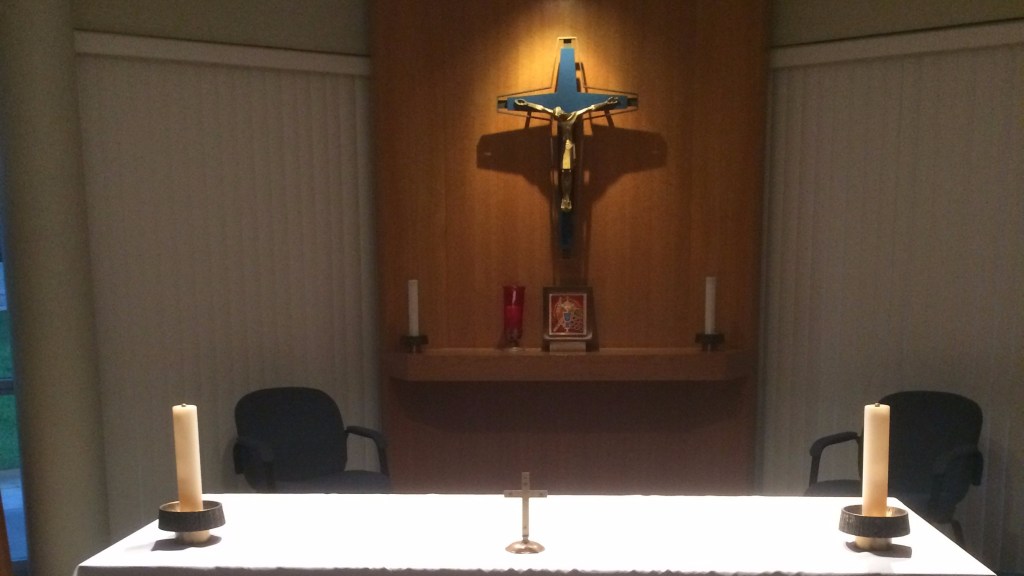
Photo: Small Chapel at Our Lady of Florida Spiritual Center, a great place to pray!

Link for today’s Mass readings:

http://www.usccb.org/bible/readings/102817.cfm

Catholic Church. Catechism of the Catholic Church: Revised in Accordance with the Official Latin Text Promulgated by Pope John Paul II. Vatican City: Libreria Editrice Vaticana, 1997.

Foster, Richard J. Prayer: Finding the Heart’s True Home. NY: HarperCollins, 1992.

Kreeft, Peter. Prayer for Beginners. San Francisco: Ignatius Press, 2000.

Reading the Signs

“You know how to interpret the appearance of the earth and the sky; why do you not know how to interpret the present time” (Lk 12:56).

Reading this verse brought two memories from my childhood. The first one is from when my friend Steve and I had a general interest in the weather, reading the natural signs and the patterns, and we enjoyed watching our local weather forecaster, Hilton Kaderli. Another memory was with my cousin Danny. We were at my Uncle Pierre and Aunt Claudette’s house one afternoon and we saw a storm rising. We headed to the road and started running as fast as we could in the opposite direction to see how far we could get before the storm caught us, and when it did we walked home, sucking in air, being pelted by the rain, and enjoyed a good soaking. We read the signs of the earth and the sky, but we didn’t pay to much attention to things of the spirit.

Jesus made a wake up call to his listeners. What Jesus was doing: teaching and preaching on his own authority, not from the training of a learned Pharisee or rabbi; casting out demons, forgiving sins, healing people, meeting with sinners and women. These were some pretty amazing signs that the Messiah was in their midst, yet there were those who did not see, would not see, rationalized away that he could not be who he said he was. Though there were those who did see, did hear, did believe.

Because they did so, some two thousand years later, Jesus speaks to us again. The stories and encounters of Jesus have been preserved, passed on generation after generation. Do we see his presence working in our lives? Do we see coincidences or God-incidents? May we take some time today to be still for five or ten minutes, to take some deep breaths and ask God to help us in reviewing the past twenty four hours so we can acknowledge what we are grateful for, to recall some God-incidents no matter how small, to admit to the times in which we may have said no to some of his invitations to reach out beyond our self to another. Let us ask Jesus to help us to be aware of how much the Holy Spirit has been present in our experiences and thank him. For those times that we have refused his presence or failed to recognize his closeness, especially from others seeking help, we can ask for his forgiveness and assistance to be more aware, to more intentional tomorrow.


Link for today’s Mass readings:

http://www.usccb.org/bible/readings/102717.cfm

Photo: souls-of-my-shoes world teach tumbler


On Fire for Jesus

Jesus said to his disciples: “I have come to set the earth on fire, and how I wish it were already blazing” (Lk 12:49)!

Yesterday I had mentioned also about Jesus setting the fire on earth and that we were to catch and carry that fire. In reading this verse today, I believe Jesus meant more, not just that we catch and spread the fire, like touching a torch and becoming a torch bearer. He wants us to be consumed by the fire.

Whatever fire touches it transforms. Many in California are unfortunately experiencing this up close and personal. Encountering Jesus effects a change in us. Once the embers in the depths of our souls are fanned through an encounter in prayer, worship, injustice, love, or suffering, and we move out of our complacency, we turn to Jesus for help, the tinder begins to ignite. If we continue to fuel the fire, getting in touch with what God has called us to do in our place and in our time, the fire continues to spread and like the saints whose shoulders we stand upon we are consumed and transformed.

We come to Christ, not to be a Christian in name alone but in thought, word, and deed. Such that consumed and transformed by the fire of his Love, others look at us and they see no longer us but Jesus Christ. Pope Francis, in his exhortation The Joy of the Gospel, wrote: “THE JOY OF THE GOSPEL fills the hearts and lives of all who encounter Jesus. Those who accept this offer of salvation are set free from sin, sorrow, inner emptiness and loneliness” (Francis, 9). Joy is a gift, a holy flame, that is given to us by the Holy Spirit and it wells up within. It is different than passion which arises when the stimulation of the senses are aroused, but fade once the external stimulus has ended.

Happiness is also external and fleeting. It lasts longer than passion in that the memory of the experience will linger on, but it too will also dissipate. Joy wells up from within, as it is imparted by God and can be present even when the external experiences are stressful or chaotic. I experienced this while I was still teaching 5th and 6th Grade Religion, acting as the dean of students at Rosarian Academy, while at the same time immersed in my studies and formation activities for the permanent diaconate, parish, and family life.

One particular morning I woke up exhausted. When the alarm went off my first response was to skip my morning prayer and hit the snooze button to get an extra twenty minutes before getting up to go to school. Instead, I literally crawled to my small chapel area, lit the candles and opened my breviary. When I read the words in Psalm 42: “Hope in God; I will praise him still, my savior and my God”, something ignited within my soul. I felt an energy well up within me that I cannot fully describe. I felt a joy that was inexpressible. Not only did the experience carry me into the day, but lasted through the whole week.

God meets us where we are in our present situation, and even when we are at our lowest, running on reserves, we need to remember to turn to him and he will provide the fuel to keep the flame burning. Pope Francis encourages us to discern the path that Jesus points out for us and we are “to go forth from our own comfort zone in order to reach all the ‘peripheries’ in need of the light of the Gospel” (24). When we are on fire for Christ that fire will continue to burn as long as we resist dousing the flame with indifference and complacency, but instead continue to share it, to spread it, such that we join with Jesus and set the world on fire. “The joy of the Gospel is for all people: no one can be excluded” (25).


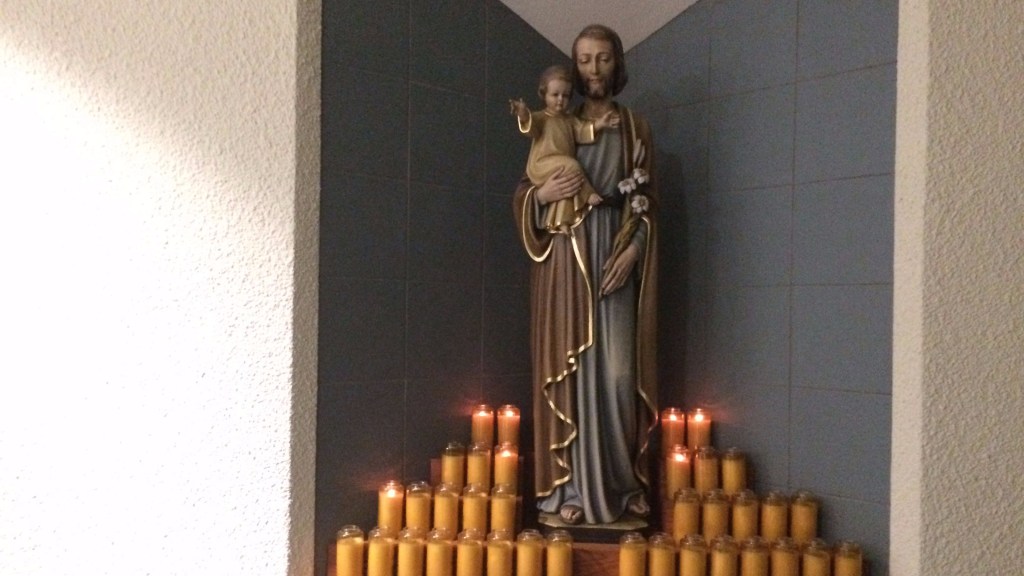
Photo: Statue of St Joseph and Jesus, St Peter Church, Jupiter, FL

Link for today’s Mass readings: http://www.usccb.org/bible/readings/102617.cfm

Pope Francis. Evangelii Gaudium: The Joy of the Gospel. Frederick, MD: The Word Among Us Press, 2013.

Bearers of the Light of Christ

“That servant who knew his master’s will but did not make preparations nor act in accord with his will shall be beaten severely” (Lk 12:47).

Jesus, as did the prophets, spoke in ways that can be jarring. The purpose was to shake his listeners out of a dulled state and to make clear his point. In today’s Gospel passage, Jesus addressed Peter’s question: “Lord, is this parable meant for us or for everyone” (Lk 12:41)? Jesus was most likely speaking to Peter and the Twelve. They are the ones he entrusted with continuing his mission of the kingdom of God. And just as he had been clear to point out those Pharisees who had abused their positions, he was being clear with Peter and the apostles. They knew his will and better follow it. The reason was that to not make the preparations that Jesus required of them would not only affect the Twelve, but those whose care they have been entrusted with.

We have been witnesses to those in Church leadership who have in effect “beat the menservants and the maidservants, to eat and drink and get drunk” (Lk 12:45) on their own power. Those who have: abused children, covered abuse, skimmed off the top of the donations of the blood and sweat of their parishioners donations, limited access to positions within the leadership of the Church to only male or clergy, been unmerciful confessors, held up the sin of one group or groups while turning a blind eye to others. These and other forms of hypocrisy do irreparable damage.

We need to remember that the world was fallen before the Son of God was born of Mary, reached a deeper darkness at his death, but his light still shown in the darkness. The Resurrection and Ascension into heaven of Jesus has set a fire on this earth that we are to catch and carry. Even when those of the Body of Christ are infected by the darkness we are not to lose heart nor hope. As Bishop Robert Barron writes, we are called out of “the realm of hatred, racism, sexism, violence, oppression, imperialism, what Augustine termed the libido dominandi (the lust to dominate).”

We are to continue the mission of Jesus, to bear his light to a world still in darkness. We are to shine his light so that we and others will recognize the sin present in our lives, repent, and turn back to the True, the Good, and the Beautiful. We are the Church, the Body of Christ. We are the heralds of his Good News. May we seek opportunities to share the healing salve of the Father’s Love we have received with those we meet today.


Link for today’s Mass readings:

http://www.usccb.org/bible/readings/102517.cfm

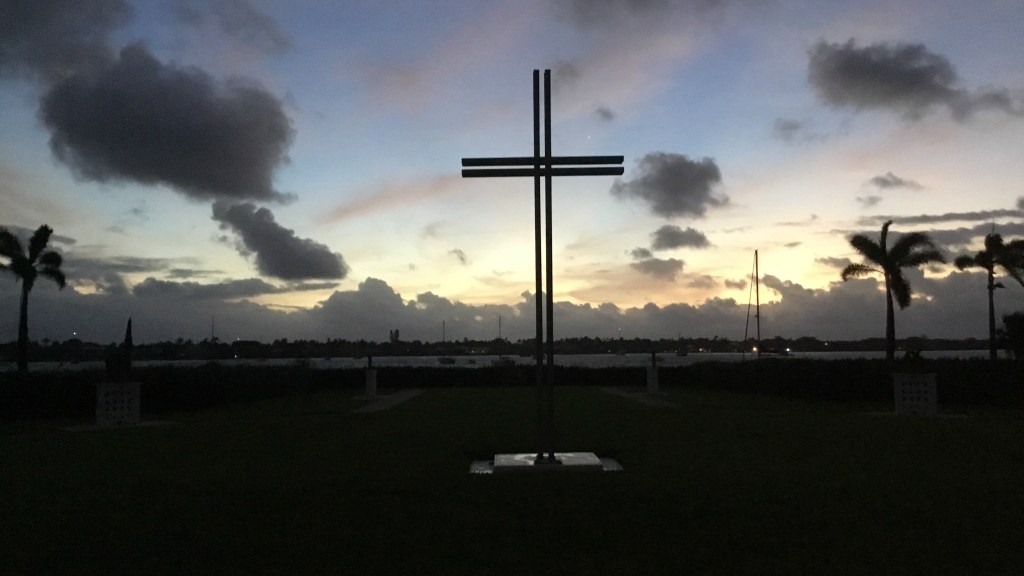
Photo: Crucifix front entrance of Our Lady of Florida Spiritual Center

Barron, Robert. Catholicism: A Journey to the Heart of the Faith. (NY: Image, 2011), 149.


Plan or Prepare?

Jesus said to his disciples: “Gird your loins and light your lamps and be like servants who await their master’s return from a wedding, ready to open immediately when he comes and knocks” (Lk 12: 35-36).

Jesus is emphasizing that as disciples we need to be ready for his coming, yes for when he comes again, but more importantly to be prepared for his coming each day in the midst of our lives. If we do not prepare to encounter him daily, the likelihood of us being  prepared for his coming again, and only the Father knows the time or the hour, will be slim. One of the most important lessons that I learned from my one and a half years with the Franciscans of Holy Name Province was the distinction between planning and preparing.

To plan means we outline all that needs to be done down to the last detail. This can be an advantage especially when we are dealing with blueprints for a home or building. By having detailed plans we can be sure we have the proper materials and tools, an estimated budget, hire the help needed to accomplish the goal. There are many areas in our life where planning is an advantage. Planning our spiritual life is important, deciding when and how we are to pray, meditate, study, engage in Bible and spiritual reading and/or watching, scheduling which service we are going to attend, establishing a routine of spiritual direction, time for fellowship or small groups. These are all plusses to planning.

The challenge with planning is when we become too radically attached to the plan and we leave no room for the Holy Spirit, no awareness for the knock at the door because we are so focused on finishing the plan. Thanksgiving and Christmas dinners are on the horizon. How many times have we experienced planning a dinner and guests, and spent more time adhering to the plan and its execution such that we miss engaging with those we are working so hard to provide hospitality for?

Preparation is pretty much all of the steps of planning I discussed above. The only difference is that we are more open and flexible with the execution. Life is not perfect, no matter how well we plan, unforeseen circumstances arise. Not holding so tightly to the plan, we can be in a better posture to adjust and see new possibilities that we had not planned for and more easily make adjustments in the moment. Also, in the midst of accomplishing the goal we may be more open to the guidance of the Holy Spirit instead of completing the plan come hell or high water. The upcoming familial meals can be much more enjoyable, even if a little messier, if we place a priority on spending time with those gathered instead of making sure each detail of the list is checked off at the proper time.

Jesus calls us to be ready, to be prepared to receive him. He thirsts and yearns for us to answer him when he knocks: in the classmate, colleague, family member, or neighbor who asks for help at what we feel is an inopportune time, the homeless person who is asking for some aid, the undocumented immigrant, or refugee looking for safety and security, the unborn striving to actualize her potential, the coworker that has not been pleasant to us in the past five years, the person that we perceive to be different from us – whether it be by gender, race, ethnicity, nationality, political party, religious or non religious affiliation – who we keep at arm’s length.

May we take some quiet time this day to reflect on those recent invitations we received to spend some time with Jesus through those he brought into our life and we refused. After some time of reflection can we be better prepared to be more open to encountering those we meet today as human beings, as brothers and sisters, created in the image and likeness of God? Are we willing to see and serve Jesus, who is present in them, for: “Amen, I say to you, whatever you did for one of these least brothers [or sisters] of mine, you did for me” (Mt 25:40).


Link for today’s Mass readings:

http://www.usccb.org/bible/readings/102417.cfm

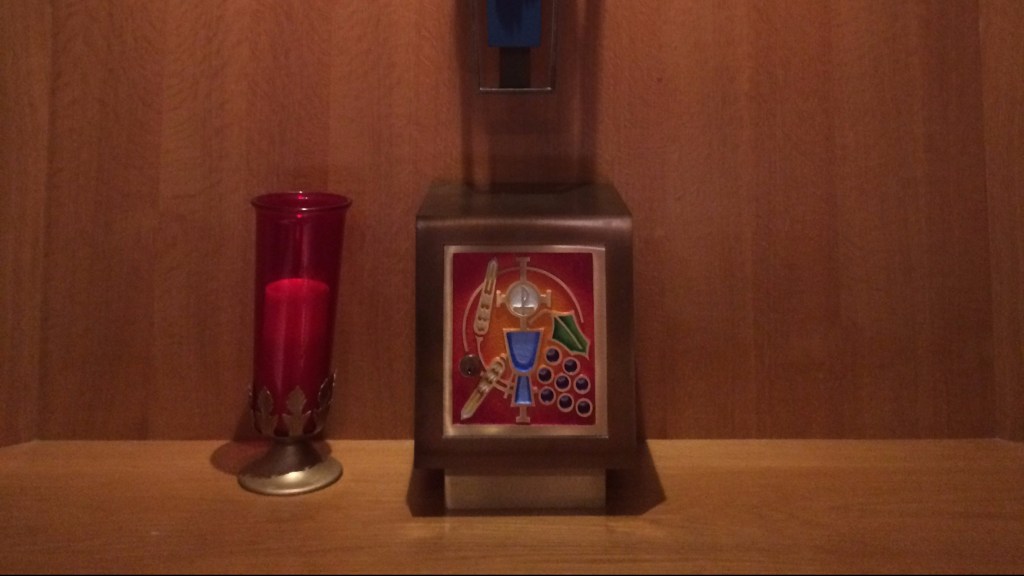
Photo: Tabernacle and Sanctuary Lamp in the small chapel at Our Lady of Florida Spiritual Center.

“One’s Life Does not Consist of Possessions”

“Take care to guard against all greed, for though one may be rich, one’s life does not consist of possessions” (LK 12:15).

Jesus wisely warns us to be careful to resist the temptation of greed, which can be defined as an intense, selfish desire for something. Here Jesus addresses the greed of money, but we can also have unhealthy selfish desires for anything. Jesus also stated that “one’s life does not consist of possessions.” Material goods are finite and will not ultimately fulfill us but they can be good when used for the purpose they were intended and in moderation.

God provides for our need. Fostering an attitude of thanksgiving for that which we have received and then being good stewards helps us to resist the temptation of greed. St Clement of Alexandria (150-215 AD) wrote: “How could we do good to our neighbor if none of us possessed anything.” God does bless us, and from what we have been given we are to assist those in need. The problem comes when we interfere with the flow of receiving by stopping the giving and instead hoarding what we have received and rationalizing our unwillingness to share. Also, when we look to our wealth as our safety net, instead of God’s providence, we begin to cling to what we have and develop an unhealthy attachment.

Acts of charity, willing the good of the other in our love and support for one another in need will help us to resist the temptation of greed and help us to be open conduits of God’s mercy. Pope Leo XIII (1810-1903 AD) has written that, “Once the demands of necessity and propriety have been met, the rest of your money belongs to the poor.” How many of us are willing to put that quote on our bathroom mirror? More so, put it into practice? How about posting this quote from John Chrysostom (349-407 AD) over our closet and reading it before we enter: “The man who has two shirts in his closet, one belongs to him; the other belongs to the man who has no shirt.”

God has given us the gift of his Son, Jesus. In so doing he has given us the free gift of our salvation. He loved us into creation and is loving us into eternity. We are invited to participate in the love of the Father and the Son and the Holy Spirit. We are to share what we have received from this infinite source and spring of eternal Love. We will be fulfilled people of joy, not by how much we have in our bank account, but by how much love we invest in our realm of our influence.


Link for today’s Mass readings:

http://www.usccb.org/bible/readings/102317.cfm

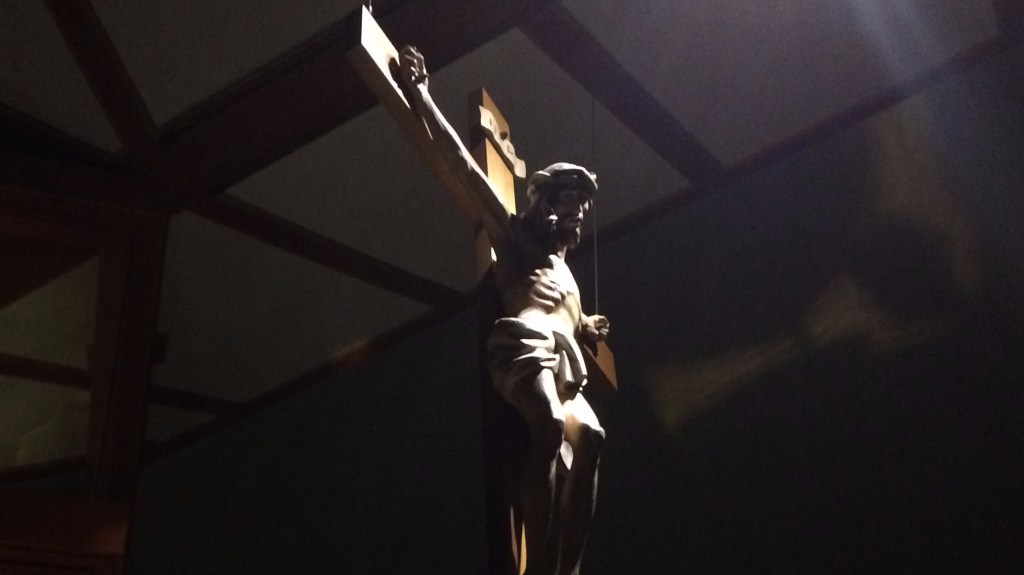
Photo: Crucifix in the main sanctuary of St Peter Catholic Church, Jupiter, FL.


Repay to Caesar What Belongs to Caesar and to God What Belongs to God.

The Pharisees and Herodians had hatched a clever plot to trap Jesus. The Pharisees pretty much went along with paying the Roman taxes, which is equivalent to approximately a laborer’s wage for the day, to keep the peace with Rome. The Herodians showed public support for the paying of the tax because they supported the house of Herod and his dynasty. Herod Antipas, the tetrarch or prince of Judea and son of the deceased Herod the Great, would only stay in power as long as he abided by the authority of Rome. Which meant making sure his subjects paid the tax and he kept the peace. The Jews that identified themselves as nationalists or zealots were more openly opposed to the Roman tax, as they were opposed to the oppression by Rome, the presence of Roman leadership, and the military in their land.

If Jesus sided with paying the tax to Rome he would upset the nationalist zealots, and if he sided with not paying the taxes he would upset the Herodians. The disciples of the Pharisees were sent with Herodian representatives to ensnare Jesus and so begin to divide and conquer his support base. The only problem was that they were used to playing two-dimensional chess and they were on their way to meet a master at three-dimensional chess. Jesus immediately saw through their flattery and called them out for what they were – hypocrites! Jesus then deftly answered their challenge with, “repay to Caesar what belongs to Caesar and to God what belongs to God” (Mt 22:21).

The coin used to pay the tax was a denarius, and it bore the inscription of the Roman emperor, Tiberius, on it. In point of fact, the coin did belong to Tiberius. Jesus not only evaded their verbal trap but also utilized the situation as a teaching moment for those present with him and for us today. We are citizens of states and countries, while at the same time citizens of heaven. We are to give to the government that which is for the greater good of the society to provide for appropriate services and protect its citizens, especially in being sure to take care of the poorest and most vulnerable among us. We are also to pay to God that which belongs to God, our very life.

Jesus presented a consistent message that God is to be first in all things, that he is to be the priority over everything. Also, God wants all of us, not just that we worship one day a week. We are to align ourselves with his will and have the courage to follow him. Jesus was no hypocrite. What he required from his followers, he did himself. Jesus showed this in his encounter with Pontius Pilate. Jesus did not call down the angelic host to wipe out the soldiers that came to apprehend him at Gethsemane, nor did he do so with Pilate and his army in the Praetorium. Instead, Jesus said: “You would have no power over me if it had not been given to you from above” (Jn 19:11). God allowed the judgment of Pilate to stand, the death of an innocent man, and Jesus followed his Father’s will to his death, and death on a cross, to bring about a greater good, the salvation of the world. Jesus rendered to Caesar what belonged to Caesar and to God what belonged to God.

May we pray daily for the discernment to know and the courage to follow the will of God as did Jesus and the saints, such that we too can be engaged citizens in our society while remaining faithful to our God.

———-——————————————

Link for today’s Mass readings:

http://www.usccb.org/bible/readings/102217.cfm

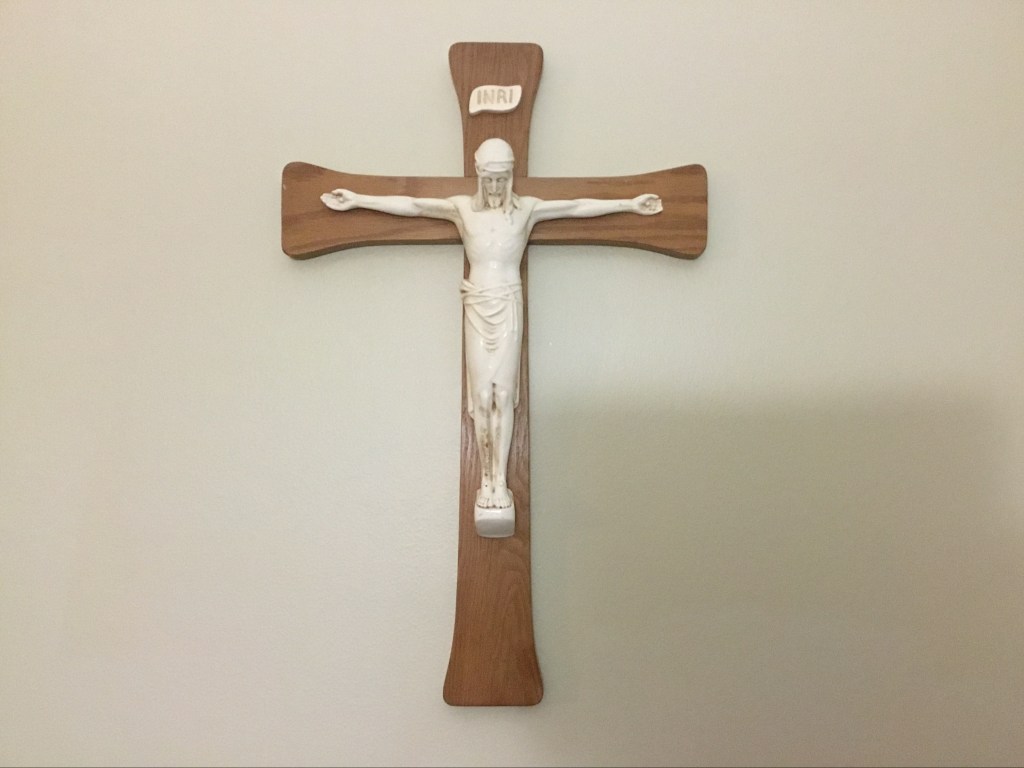
Crucifix in my room at Our Lady of Florida Spiritual Center. Looking for a place to get away, renew, and reflect: check out https://ourladyofflorida.org


Let Us Say Yes to God’s Invitation

“Everyone who speaks a word against the Son of Man will be forgiven, but the one who blasphemes against the Holy Spirit will not be forgiven” (Luke 12:10).

This verse is often referred to as the unforgivable sin and it can be difficult to understand. What is Luke saying here? Also, if you have been reading this blog regularly you may have read more than once that God forgives us more than we can ever mess up, so you may be thinking, “What’s the deal? Why can’t we be forgiven for blaspheming the Holy Spirit?”

One way to approach the understanding of this verse is to refer to my reflection from yesterday, but then turn it on it’s head. I shared an example from my late teens in which I followed the leading of the Holy Spirit, not so much aware I was doing so at the time. I followed my curiosity imparted on me by my teacher which led me to purchase a Bible, then I was led to leave a party and when I got home I had the urge to open my newly purchased Bible and did so. Because of each successive yes to the invitation and guidance of the Holy Spirit, I placed myself in a better position each time to hear the word of God.

Now, that experience could have taken a different turn. I could have resisted the initial curiosity that welled up within me from my teacher’s discussion and instead of going out to purchase a Bible, I could have stayed home that day and opened up my copy of The Stand and given it a second read. If then, each time I had the urge to purchase a Bible, I denied it, I would not have had a Bible when I went to that party. Instead of leaving the party I might have stayed. I would not have had the experience of reading the Bible that night, nor hearing God’s voice. Say each step did happen up to and including hearing God’s voice, but then I denied that I heard God, instead attributing the experience to some bad pepperoni pizza from the party. Each are examples of how I could have closed myself off to God’s communications.

God reaches out to us in many ways and just as we can open ourselves up to God,  we can also close ourselves off to those potential opportunities of hearing him as well as dismissing examples of his communications as mere “coincidences.” With each denial, we further limit ourselves to the possibility of acknowledging an encounter with God and or even begin to doubt that he even exists. We could then develop “a mentality which obstinately sets the mind against the Spirit of God, and as long as that obstinate mindset perdures, God’s forgiveness cannot be accorded to such a person” (Fitzmeyer 1985, 964).

Yes, God loves us more than we can ever mess up, so much so that he gives us the freedom to reject him. He does not impose his will on his, but invites us. John the Baptist and Jesus got this, and this is why their emphasis on repentance was so preeminent in their preaching. If we turn to God with humility and contrition, true sorrow for our sins, he will forgive us. The danger of a consistent obstinate disposition, is that like a muscle that is not used, it will atrophy, so will our ability to see God working in our lives. We will become less and less able to see, we will become blind, our heart will become hardened. Now that does not mean God stops communicating, he does, but when we harden our heart, when we close ourselves off from him, and dismiss each invitation and attempt at communication, we are less and less able to receive the forgiveness he so thirsts to give us.

Let us continue to seek ways to experience God and share our experiences with others, though as invitations not as impositions. We need to remember to meet people where they are and as they are, accepting them and their dignity to say no to the invitation. Jesus gave us the gift of to be able to participate with the Holy Spirit, who is the Love that is shared between the Father and the Son. The more we say yes to his guidance and leading, the more we will see him in our everyday experiences, and the more we will experience and participate in his love. In this way, our life may be more attractive and inviting to others such that we may be the only Bible someone else ever gets the chance to read, and maybe, just maybe, they may hear God speaking to them through us.

_________________________

Link for today’s Mass readings:

http://www.usccb.org/bible/readings/102117.cfm

Fitzmeyer, Joseph A. The Gospel According to Luke X-XXIV in the Anchor Bible. NY: Double Day, 1985.

Photo: Our Lady of Florida Spiritual Center, great place to slow down and encounter God!

The Sparrows, nor We Escape the Notice of God

“Are not five sparrows sold for two small coins? Yet not one of them has escaped the notice of God. Even the hairs of your head have all been counted. Do not be afraid. You are worth more than many sparrows” (Lk 12:6-7).

About thirty-five years ago I was in high school and either in my junior or senior sociology or psychology class my teacher mentioned that if we thought Stephen King told amazing tales, we should definitely read the Bible, especially regarding the imagery found in the Book of Revelation. My teacher’s comment piqued my interest because at the time I enjoyed reading Stephen King, though I had not spent any time reading the Bible. My teacher’s words stayed with me beyond that class period.

A few weeks or months later I remember going to Waldens, a book store, at the Enfield Mall in the next town over from where I grew up in East Windsor, Connecticut. I purchased a King James Bible. I don’t remember reading it right away, but shortly some time after, I do remember leaving a party with some classmates. I don’t remember anything about the party or why I left, but when I arrived home, I went up to my room and for some reason grasped my new Bible. I then just opened it at random and began reading. The verse above was what I read, and it was the first time I can remember experiencing God speaking to me.

It was not the booming voice I imagined emanating from the burning bush that was directed to Moses, the room didn’t shake, nor did the lights flicker. In the quiet and still moment though, I heard in my mind something along the lines of, “You will not ever win the lottery, but like the sparrows, I will take care of you. I will always give you the ability and means to work.” God has proven true to his word. There have been some tight financial times through the years, but each time God has provided through the kindness of friends, families, as well as some amazing assistance out of the norm.

My students ask me from time to time if God still speaks to us as he spoke to the people in the Bible. I share, “Absolutely!” Then offer the example I shared above as well as move on to the wide range of ways God communicates and reaches out to us. He does speak to us directly, he also speaks to us through his Word in our personal reading, in our time of communal worship, he speaks to us through music, through the preaching we hear, he speaks to us through others, through our serving each other, through his creation, and a myriad of other infinite possibilities.

The question is not so much, does he still speak to us? The question is how do we open ourselves up to the reality that we can hear his words or his silence? The first way is to ask God to help us to recognize his voice, just as the sheep that come to learn the shepherd’s voice. Another way is to come to a stillness that provides the opportunity for reflection and ask God to reveal times in the past where he has spoken and we were not aware. See what comes up. Not only do we need to make a consistent time each day to pray, but stay long enough to listen! One of the biggest reasons many of us do not hear God is because we are not listening. There are other ways to put ourselves in a position to hear God’s voice, these are a few to start. The main point is being willing to be open and believe that God speaks, and then look for God in all the aspects of our life, he really is present in the midst of our everyday experiences.

Fr Jim Martin, S.J. has expressed the search for finding God in this way: “God is always inviting us to encounter the transcendent in the everyday, the key is noticing” (Martin 2010, 86). May we take time to notice God. Let us ask him as we begin to help us to be aware of him and how he is inviting us to encounter him, and that he may help us to notice him, to recognize his voice. May we also ask God to help us to be aware of one sin today that may be blocking us from hearing him, a way in which we have said no to his invitation. Let us be a little more aware today than we were yesterday. Happy seeking!

Oh, and by the way, yesterday morning about 6:30 am at Cardinal Newman where I teach, as I was walking up to one of the side doors, I saw sitting in front of it a small sparrow sized bird. The sparrows do not escape the notice of God and neither do we. We can trust and believe that God loves us, he cares for us, and he provides for us.


Link for today’s Mass readings:

http://www.usccb.org/bible/readings/102017.cfm

Martin, S.J., James. The Jesuit Guide to Almost Everything: A Spirituality for Real Life. NY: Harper Collins, 2010.

Building Bridges of Encounter

Woe to you, scholars of the law! You have taken away the key of knowledge. You yourselves did not enter and you stopped those trying to enter” (Lk 11:52).

I have quoted my friend, mentor, and brother, Dr. Sixto Garcia, before, and it is worth quoting him again: “We are a living, craving, hunger and desire to be one with God and one another. This is true for the atheist and believer alike.” At the very root, in the very bowels of our being, we yearn for God. The psalmist echoes this point as well: “As the deer longs for streams of water, so my soul longs for you, O God” (Psalm 42:2). Whether we know it or not, believe it or not, we yearn for God, he is the only one who can fulfill what our deepest longing is, because as St Augustine also wrote in his Confessions, he “has made us for himself and we are restless until we rest in thee”.

To prevent access, to those who seek, as did those for whom Jesus points out today, is an egregious offense. Especially in the way that Jesus describes. They themselves have the key to enter, do not avail themselves of the gift they have received, and worse, prevent others from going in! I remember a time in eighth grade where I had wanted to ask a girl I liked out to the school dance. I confided with someone my desire, but of course the word got out. A few days later in math class, the teacher laughed aloud and announced to the whole class that I was the first one he had ever heard of being rejected before I could even ask someone out. I wanted to melt into the floor.

Now, this may not be the most direct example of what Jesus was talking about, but there is a parallel. Teachers, like religious leaders, are entrusted with the care of those they have been entrusted to teach, and when they betray that trust and belittle those they are charged to empower, they slam doors in the faces of those who seek to actualize their potential. We are all caretakers of each other. We need to resist any temptation to belittle, to dehumanize, or crush the spirit of another who seeks.

St Paul in his most theologically mature letter wrote: “We who are strong ought to put up with the failings of the weak and not to please ourselves” (Romans 15:1). People are hungry for God. We must resist building walls or refuse to open doors to those who seek. We need to build bridges of encounter and accompaniment. Even when the seeker does not recognize they are seeking, and express their thirst to us in not the most pleasant of ways. Here it is even more important that we resist reacting, and slipping into a defensive posture, but instead risk to be open, to be understanding, to listen with our spirit instead of our ego for what the need truly may be. As Pope Francis wrote: “Each one of us is called to be an artisan of peace, by uniting and not dividing, by extinguishing hatred and not holding on to it, by opening paths to dialogue and not by constructing new walls! Let us dialogue and meet one another in order to establish a culture of dialogue in the world, a culture of encounter” (Pope Francis, 128).


Link for today’s Mass readings:

http://www.usccb.org/bible/readings/101917.cfm

Pope Francis. The Church of Mercy: A Vision for the Church. Chicago: Loyola Press, 2014.

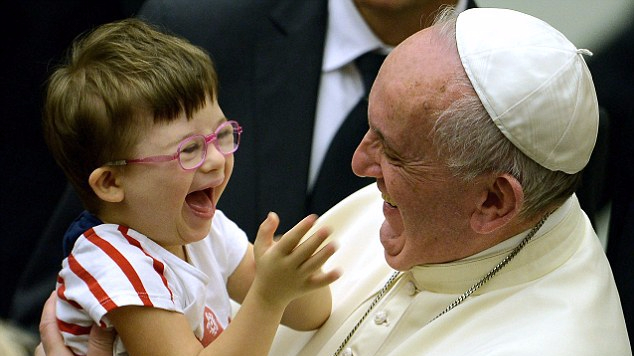
Photo of Pope Francis and friend: © AFP/Getty Image