The Way of the Cross

The Lord Jesus appointed seventy-two disciples whom he sent ahead of him in pairs to every town and place he intended to visit (Lk 10:1).

Jesus sent out disciples ahead of him. He sends us out as well. Just as Mary conceived Jesus through the overshadowing of the Holy Spirit, she went in haste to assist Elizabeth who also was to give birth. What happened when Mary came upon Elizabeth? No sooner had Mary’s greeting reached Elizabeth John leapt in her womb with gladness. This is the model of evangelization. Sharing the joy of Christ that we experience with others.

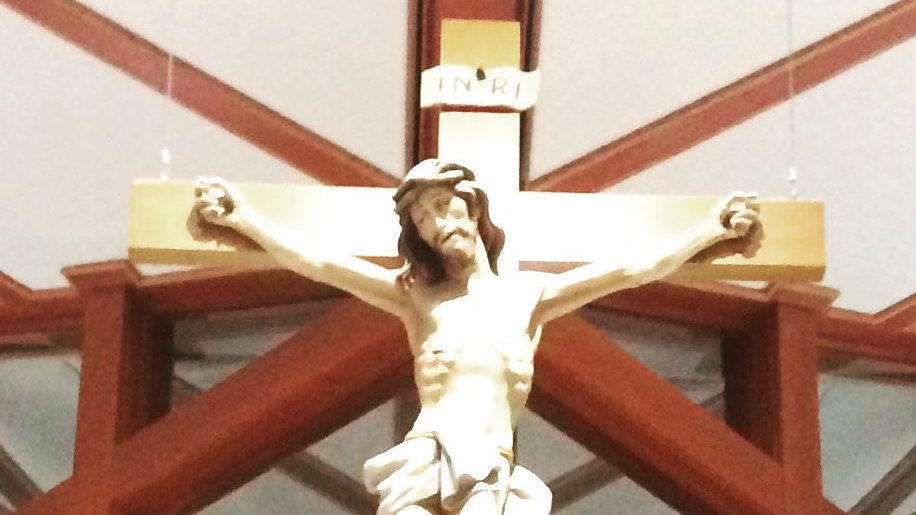
Christianity is a religion of encounter, yes we are a people of the book like our Jewish and Muslim brothers and sisters, but we are primarily a people of encounter with Jesus the Christ. We encounter Jesus through a regular practice and discipline of prayer, worship, study, fellowship, and service. Our pastor Fr. Don has shared with us a wonderful image to represent the path of discipleship and that is the image of the cross. The vertical part of the cross represents how we develop our personal relationship with Jesus, the horizontal represents our bearing Jesus to and with others. If we only have the vertical, the one on one relationship with Jesus, we just have a stick. If we just serve others without encountering Jesus, we just have a stick.

Christianity is the way of the cross, not the way of the stick. We are to be contemplatives in action. We are about building relationships between ourselves and Jesus and others. When we experience the joy of encounter with Jesus, as did Mary, as did his apostles, as did his disciples, we are to then go out to share the good news of that unique encounter. Not necessarily to some far away land, but primarily into our everyday experiences. We are to love others as Jesus loves us, we are to share the inexpressible joy of that love, and that love we share is to be unconditional, agape in the Greek. “[T]he surrender of life for the sake of others” (Lohfink, 73).

The Christian commission is to build Christian communities one smile at a time, one person at a time, one encounter at a time, one relationship at a time. I agree with Gerhard Lohfink in his piece, “What Does the Love Commandment Mean?” that love is not a pious universal that we love all humanity in some vague removed or remote way, no: this love is something tangible, corporal, it’s hands on: “This love constantly breaks out of the individual communities to embrace non-Christians, guests, strangers, the suffering (obviously including those in other countries) but it is always tied to the concrete experience of common life in the individual community” (72).

May we pray for and experience the gift of joy this morning and share that experience with those we meet today. With each encounter let us reach out beyond our self to engage others with hospitality, respect, and joy. Each pair of eyeballs that you engage, smile and say hello. Just that simple, genuine expression acknowledges to the other that they matter to you. If someone asks you how you are, instead of saying, “Fine.” Say instead, “Better since you asked.” There are many ways to reach out and give of ourselves to others in love. Be open, surrender to Jesus, let us rise up, and be on our way to bear Christ to those we encounter today!


Link to today’s Mass readings:

http://www.usccb.org/bible/readings/101817.cfm

Lohfink, Gerhard. “What Does the Love Commandment Mean?” In No Irrelevant Jesus:      On Jesus and the Church Today, translated by Linda M. Maloney, 64-74. Collegeville, MN: Liturgical Press, 2014.

 

Resist Hypocrisy, Embrace Hospitality

The Lord said to him, “Although you cleanse the outside of the cup and the dish, inside you are filled with plunder and evil. You fools” (Lk 11:39).

Jesus’ harshest convictions were for acts of hypocrisy. He did so to show in no uncertain terms how dangerous this was for religious leaders. Those entrusted with the care of God’s people who observed the proper rituals, spoke and dressed to match their role, which all meant nothing when their hearts were hard, closed to the will of God, but most of all, they themselves were obstacles, stumbling blocks to those who sought God. Jesus calling them fools meant that they were bereft of the wisdom of God they projected to have.

A recent Pew study tracing religious affiliation from 2007 to 2014 found that approximately 56 million Americans identify themselves as following no religious affiliation. Some have labeled this group as the “nones”. I am sure the context and nuance of why this trend is on the rise has many components, but I believe one ingredient is that many feel they have witnessed unacceptable levels of hypocrisy that have turned them off to organized faith traditions.

In the depths of our very being we seek and yearn for the transcendent, the infinite, we are spiritual seekers, because this is how we have been created. Yet, time and again, we experience suffering, injustice, and hypocrisy at the hands of the very ones who are our leaders in both the religious and political sphere. Jesus got this, and this is why he convicted those who abused their positions, because he knew the significant damage that could be inflicted on the believer.

We as people of faith must first and foremost recognize that we live in a fallen world. No one is perfect, even and especially our leaders. We all fall short of the perfection we seek and aspire to. If we put anyone up on a pedestal they, sooner or later, are going to fall, and the higher up they go, the greater the fall. Our actions must follow Jesus’ lead of resisting the urge to project all is well and good, that we are fine, when we are not, and none of us are all of the time.

Jesus is inviting us to transformation. To experience this gift we need to seek help and assistance when needed. We must be people of courage allowing the light of Jesus to shine upon those dark places of sin within our souls, and be willing to see that which needs healing so as to release our own “plunder and evil”, which we harbor within. Jesus’ light shines brightest and most often through others. We need to trust one another with our weaknesses, faults, and shortcomings, not hide them or pretend they are not there, if we are ever going to be able to overcome them. Allowing the gifts of others not present within us to come to the fore affirms their unique gifts and provides healing for us. At the same time we need to offer what we uniquely can give, not judging another who has fallen, but providing empathy, support, and encouragement so they too can heal. When we are transparent with our sin, and empower and accompany one another, we as Church can resist the temptation of hypocrisy and instead embrace the gift of hospitality.


Link for today’s Mass readings:

http://www.usccb.org/bible/readings/101717.cfm

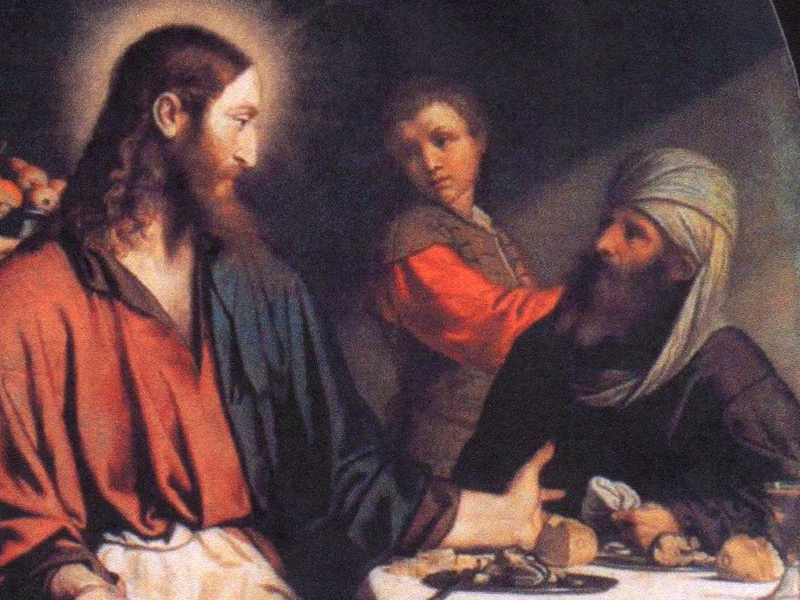
Painting: Supper In the House of Simon, by Italian artist Moretto da Brescia (1150-1554)


Repent and Believe in the Gospel

While still more people gathered in the crowd, Jesus said to them, “This generation is an evil generation; it seeks a sign, but no sign will be given it, except the sign of Jonah” (Lk 11:29).

To understand what Jesus means we need to understand the sign of Jonah. Jonah was sent by God to go to Nineveh, the capital city of Assyria, to call them to repent from their wicked ways. The Jews not only considered Nineveh to be a place of decadence, wickedness and godlessness, the military of Assyria had invaded Israel and eventually conquered the northern kingdom around 721 BC. We can understand Jonah’s initial refusal follow God’s lead. Not only did he not want to go to Nineveh, Jonah wanted God to punish and destroy them. Those who have read the tale, know that Jonah acquiesced and within hours of his proclamation to the citizens, including the king, they repented and God showed them mercy.

Jesus is drawing a parallel between the people of Nineveh and his listeners. The people of Nineveh listened and repented to a reluctant messenger. The Ninevites, Gentiles, the sworn enemies of Israel, received God’s mercy when they repented. Now, in their midst was one greater than Jonah, the Son of God, and they were demanding of him a sign. The sign of Jonah was repentance. Jesus, from the beginning of his public ministry preached the same: “This is the time of fulfillment. The kingdom of God is at hand. Repent, and believe in the Gospel” (Mk 1:15).

We would do well to listen to Jesus’ message. Repentance is a key spiritual discipline. We are called to consistently examine our conscience. We need to come to accept that we live in a fallen world. This is not a pessimistic view. This is an awareness of the reality of our present condition. Jesus warned about the cult of personality, the messiah complex. Jesus himself is the sign, he is the Way, the Truth, and the Life.

Through accepting that we live in a fallen world, by recognizing we need a savior, we can make the next step to recognize that we need to repent and turn back to him who can save us, for apart from him, we can do nothing. If we believe we can solve our problems on our own, we will consistently fall short. Julian the Apostate, Roman emperor from 361-363 AD attempted to adopt and mimic Christian charitable works, which he saw value in but he sought to do so through the state by enacting policies without practicing Christianity. In essence, doing good on his own without Jesus. This did not work.

St Mother Teresa recognized the need for Jesus and stressed this when she taught her novices that she was not interested in numbers, she was not interested in having a branch of social workers. She and those who followed Jesus were to be missionaries of God’s charity. They were to serve Jesus in the distressing disguise of the poor. To do so they participated in daily Mass for an hour and adoration for an hour. Empowered by Jesus, blessed by his mercy and love they could serve Jesus in those they met in harshest of conditions.

May we not so much seek signs, but seek Jesus. Let us begin this morning by turning away from our own selfish pursuits and pray today that Jesus may be the center of our lives, the very source of our thoughts and actions. For it is, “Through him we have received the grace of apostleship, to bring about the obedience of faith, for the sake of his name” (Romans 1:5). Let us trust that God is at work within us. We are called to follow his lead, to do what he asks of us today. Let us rise and be on our way to go and announce the Gospel of the Lord in word and deed.


Link for today’s readings:

http://www.usccb.org/bible/readings/101617.cfm

We Are Invited to the Feast

The Parable of the Wedding Feast (Mt 22:1-14) continues with a similar tone to The Parable of the Tenants presented last Sunday (Mt 21:33-43).  There is invitation, rejection, death, and harsh judgment. We need to remember that these are parables, not specific historical accounts, in which Jesus is seeking to reveal something significant. Jesus would have also shaped this parable, as well as others, depending on the audience he was speaking to, a common practice in oral tradition. This can be a possible reason for the similarity and differences in the account of the same parable given in Luke (14:15-21).

Jesus often shared table fellowship with many, we see consistent evidence of this. Jesus also “used meal imagery to depict the eschatological banquet or final salvation” (Meier, 271). The imagery of the great wedding feast in this parable conveys to the listeners then and us reading today, that all are invited to participate in the kingdom of heaven. Jesus first sought to gather the scattered people, once united under King David as the twelve tribes Israel, yet there were those who rejected his invitation. They, as the chosen people of God, were to be a holy people, a faithful witness to the one God. Jesus sought to reignite their original purpose, yet there were those who refused and so he shared in this parable that others would be invited. Jesus’ invitation as a universal message echoes that of Isaiah: “On this mountain the LORD of hosts will provide for all peoples a feast of rich food and choice wines, juicy, rich food and pure, choice wines” (Isaiah 25:6).

As with the Parable of the Tenants, Matthew emphasizes not only the rejection of the invitation, but includes the violent images of the abuse and death of the servants sent by the king, and the king’s punishment, by putting them to death and burning of their city. Some biblical scholars see this as a possible allusion to the destruction of the Temple in 70 AD. Luke does not include the abuse of the messengers or the king’s punitive justice. Matthew was emphasizing that there will be accountability to the way in which one responds to the invitation. We do not know the time or the hour, so we must not delay in our decision. “In the concrete context of his ministry, at any given time Jesus would have spoken this parable to this or that group of his fellow Jews as a salutary warning not to ignore his urgent final message, lest they suffer the consequences on the last day… Decide now, or soon it will be too late and your place will be taken by another” (Meier, 272). This message was directed to all who heard it. Each person then and now needs to make a decision.

Jesus, the Son of God, in the humanity he has assumed, in his willingness to give his life for us, opened up heaven for us. This act of love and grace is a free gift and we are invited to receive or reject. Many of those who have said yes, have followed the same path to martyrdom by sharing the message they have received and losing their life, but now wear the white robes at the great wedding feast in heaven. The invitation has been given to us today. Will we make excuses or say yes to this invitation? The writer of the second letter to Timothy gives us this encouragement, that we can depend on this, that we are to remember that Jesus Christ, who was raised from the dead assures us that, “If we have died with him, we shall also live with him; if we persevere, we shall also reign with him” (2 Timothy 2:11-12).


Link for the Mass readings for today:

http://www.usccb.org/bible/readings/101517.cfm

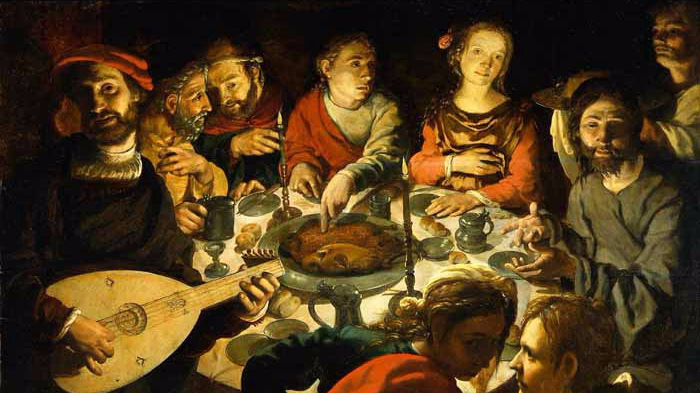
Painting: The wedding at Cana, Jan Cornelisz Vermeyen, c. 1530

Meier, John P. A Marginal Jew, vol 5, Probing the Authenticity of the Parables. New Haven: Yale University Press, 2016.


Mary, Model Disciple

While Jesus was speaking, a woman from the crowd called out and said to him, “Blessed is the womb that carried you and the breasts at which you nursed.” He replied, “Rather, blessed are those who hear the word of God and observe it” (Lk 11:27-28).

The woman’s comment directed to Jesus in today’s reading is certainly better than the charge leveled against him yesterday that he was healing by the power of Beelzebul, yet even this complement is still off the mark. What made Mary truly blessed was her fiat, her yes, to being willing to participate in the incarnation, conceiving, carrying to term, and giving birth to the Son of God. Then continuing to hear the word of God and observing it through the rest of her life. Mary is the model disciple.

Jesus is, in correcting the woman who called out, also helping her, those present, and us to keep proper perspective regarding living under the kingdom or reign of God. God is to be sovereign, primary, first and foremost. We need to be careful not to put any “thing” or any “one” before God. Even today we need to be careful not to make Mary into a goddess. We honor Mary and the saints, we invoke their intercession for assistance as we do family and friends with us now. We do not adore them, as we do with God. Mary points us to her Son, not to herself. She is like the moon that radiates the light of the sun. This is the point of discipleship.

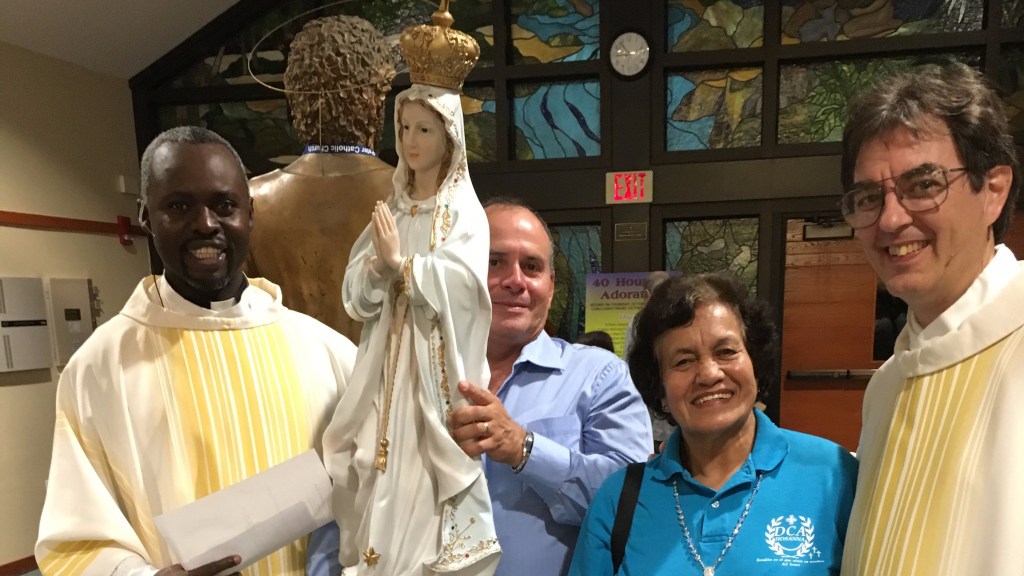
Last night we experienced a beautiful Mass commemorating the 100th anniversary of Mary’s appearance to the three shepherd children at Fatima, Portugal. Did we process in with a statue of Our Lady of Fatima, yes, and was the statue given a place of honor yes. But the focal point, the ultimate procession was of those coming toward the altar, affirming their commitment to serving Jesus, by receiving him in his Real Presence in the Eucharist. Mary brought us out on a Friday night, away from our tv’s, cell phones, iPads, restaurants, and also from our trials, challenges, and weariness, to celebrate a bilingual Mass, the rich diversity of our parish, the coming together as a community for the sole purpose of worshipping her Son. Nourished then by Jesus through his presence in our communal gathering, his Word, and his Body and Blood, we were then sent forth to be his disciples and radiate his light to those we meet.

As blessed John Henry Cardinal Newman articulates so well in his prayer, the goal of the disciple of Jesus is to come to that point where others may look up at us and “see no longer me, but only Thee O Lord!” How do we do that? We place ourselves in a posture of humility, of prayer, willing to hear the word of God, observe it, and then serve him in one another, to act upon it in our lives. This means we need to slow down, resist the urge to accomplish and just get something done. Sometimes when I am reading the Office, I will catch myself just reading the psalms, the readings, and the prayers, to get them done, instead of letting the words pierce my heart, convict me, call me to conform my life to Jesus. Prayer then becomes a function instead of an encounter with the living God. I will stop myself and begin again.

To hear God’s word, as we do with any person, we must stop and listen. This can happen in the events of our daily lives as well if we are attentive. It is resisting the temptation to walk around or away from someone who is homeless, and instead share a few moments, a few dollars, to ask their name. Is this uncomfortable, yes, challenging, yes. But the Word of God calls us out beyond ourselves to be there for others. The image of fire used for the Holy Spirit is appropriate in this regard, because whatever fire touches it transforms. When we are touched by the Love of the Holy Spirit we need to share that same love with others. When we experience the love of God, as did Mary, and say yes to his invitation we will never be the same again. We will continue to experience suffering and pain because we live in a fallen world.

Again think of Mary who from the beginning experienced suffering with Jesus. She conceived Jesus through the power of the Holy Spirit, what a gift, but what a trial, how to explain this to Joseph, her betrothed! Simeon’s prophecy at Jesus’ dedication in the temple ending with the words to Mary, “and you yourself a sword will pierce” (cf Luke 2:25-35). We can trace Mary’s sorrows, and continued faithfulness as “she pondered these things in her heart” (cf Luke 2:19) throughout her life raising Jesus and then escalating as she was also present during his public ministry where she saw him rejected in their hometown of Nazareth, the questions and accusations hurled at him, his arrest, scourging, and crucifixion.

Yet, if we keep our eyes on Jesus, turn to him in our trials, challenges, experiences of injustice, we draw upon an infinite source, as did Mary, and experience a joy, a peace that surpasses all understanding, a fulfillment that is beyond comprehension because of the blessing and love we receive from her Son. Through these experiences of Jesus present to us in our time of need, sorrow, and pain, we are given his grace. We then need to ask for courage to reach out to provide aid and comfort to those he sends us to, instead of turning within because of our fears, prejudices, and pride. This is how we observe his words, by loving, willing the good of others as he has loved us. In hearing and observing the words of Jesus, we cannot help to be transformed. May we say yes, as did Mary, and so to radiate Christ to others from the very depths of our soul.


Photo: Mass celebrating 100th anniversary of visitation of Our Lady of Fatima with St Peter family

Link for today’s Reading:

http://www.usccb.org/bible/readings/101417.cfm

The prayer, Radiating Christ, by John Henry Cardinal Newman you may find posted on my blog

Trust in Jesus!

When Jesus had driven out a demon, some of the crowd said: “By the power of Beelzebul, the prince of demons, he drives out demons”(Lk 11:15).

There are consistent acts present during Jesus’ ministry. The Gospels show him teaching, preaching, healing, and exorcising demons. Many will accept that Jesus preached and taught, some might even agree that he healed, but there are many who might dismiss that he exorcised demons. The person in today’s passage did not scoff at the fact that Jesus dispelled a demon, but emphasized that he did so through the power of Satan. Jesus corrected him with simple logic by stating that, “if Satan is divided against himself, how will his kingdom stand?”

This Gospel passage expresses the reality of the culture and beliefs of their time. Were, and are, all illnesses caused by demons? Most likely no. But to dismiss demons all together, we do so at our own peril. There is a spiritual reality as well as a physical reality. Demons are fallen angels, those angels who chose to follow Satan, a fallen angelic being (cf. Luke 10:18), the archangel, Lucifer, instead of God. The term śāṭan is Hebrew and is found in both the Old and New Testaments. There are some English equivalents depending on how it is used. Most commonly śāṭan can be translated as accuser, slanderer, or adversary. Clearly, Satan is one who opposes the will of God and the demons are his minions who support him in that effort.

Satan and his demons roam the world seeking to sow division, to do us harm, as well as seeking the ruin of souls. Their power lies in false truths, temptations of apparent goods, deception, and condemnation. Although it is important to acknowledge that they exist, we need not fear them; for no demon, nor Satan himself, can possess or harm us against our will. The weakest Christian can overpower any negative spiritual influence, because we have access to the name of Jesus. In invoking the name of Jesus, the powers of evil have no sway. “So submit yourselves to God. Resist the devil, and he will flee from you” (James 4:7).

Condemnation is one of the devil’s worst attacks. First we are tempted, and then when we fall, the hammer of accusation and slander comes down to invoke shame. We are not to feel guilty regarding our misdeeds or sins. Instead we are to have a healthy sense of guilt. The difference is that when we walk around moping in a cloud of feeling guilty and berating ourselves for how awful we are, we keep the focus on our self and sink deeper into our own morass of self pity. When we embrace a sense of guilt, we are clear when we have sinned. With humility we can admit that sin, come to a place of contrition – truly being sorry, then seek confession, absolution, forgiveness and reconciliation.

Satan, demons, and evil are realities in this world. God did not create evil. All that God created he created good. Evil is a deprivation, a twisting, and distortion of the good. The angelic beings he created good also with free will like us, and yet some turned away. Demons distort their original purpose as messengers of God. We need not be paranoid, just aware. We need to develop spiritual discipline, we need to discern spiritual influences, from our guardian angels, as well as fallen angels, and build our relationship with Jesus, knowing that we are God’s children and under his care. We need to resist any thought that says we are not worthy of being in relationship with God, that our sin is too great, or that it is too late to repent. God loves us more than we can ever mess up. Be strong and stout hearted, be not afraid. Whenever you feel threatened, anxious, tempted, or fearful, just call on Jesus, speak his name, he is our great deliverer.

One of the most powerful weapons against evil is music, a reflection for another time! But for now here is a quote from the chorus of Trust in Jesus, track 5, from Third Day’s Move as well as the You Tube link. A good song to carry with you throughout the day!

Trust in Jesus
My great Deliverer
My strong Defender
The Son of God
I trust in Jesus
Blessed Redeemer
My Lord forever
The Holy One, the Holy One


http://www.usccb.org/bible/readings/101317.cfm

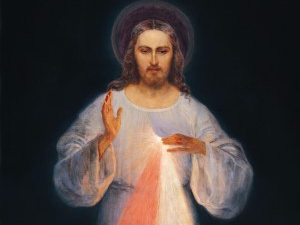
Painting of St Faustina’s vision of the Divine Mercy by Eugeniusz Kazimirowski

Why Bother Praying?

“And I tell you, ask and you will receive; seek and you will find; knock and the door will be opened to you. For everyone who asks, receives; and the one who seeks, finds; and to the one who knocks, the door will be opened” (Lk 11:9).

There is a challenge to prayer and that is our pride and self-centered stance. We can be frustrated in prayer because when we do make the time to pray, we feel or think that nothing is happening or has happened. We may pray a specific petition for our self, or for a particular intention for another and felt, or thought, that there was not an answer from God. One may pray a sincere, seemingly selfless prayer for a loved one, a child, a spouse, a friend, to be healed and the person still dies. They may be deeply hurt because they did what Jesus said, they asked, they pleaded and begged, but felt they did not receive the healing; they sought for, but found no cure, instead what they found was nothing but pain and heartache from the loss; they knocked until their knuckles were raw and experienced no one on the other side.

Our attitude and orientation to prayer matters. When we sincerely turn our heart and mind to God in prayer, something happens between us and God, though it may be beyond our cognitive grasp to understand or our sensory access to experience. There may indeed be emotional high’s and consolations experienced in prayer, but if seeking those is the primary motivation for prayer we will find ourselves more frustrated than not. Emotions are fleeting and not a good barometer when measuring the effectiveness for prayer.

Another big misconception is when we pray, “Our Father, highest gumball machine of all…” It may seem a silly analogy, but how many of us really do pray and only pray that way, and when we do not receive the specific thing we asked for, at the specific time specified, and as we wanted, we brood and think God doesn’t care or does not, in fact, even exist. We may even slip into the barter posture. God if you grant me this, I will do that. Now, prayers of petition are valid, but if that is the only way we pray, and we are only open to receive on our terms, again we are setting ourselves up for frustration.

The primary orientation, the primary foundation of prayer is relationship with God. Like any relationship, if we are only going to be a part of the relationship when all is good, free of conflict, fun in the sun, but once things get bumpy we are out of there, or we are only going to be a part of another’s life as long as we get what we want when we want and how we want with no concern for the other involved, our relationships will be shallow and unfulfilling.

The answer to ask, seek, and knock is found at the end of the Gospel reading for today: If you then, who are wicked, know how to give good gifts to your children, how much more will the Father in heaven give the Holy Spirit to those who ask him” (Lk 11:13)?

God knows what is best for us, he sees our potential, he wants us to experience joy and be fulfilled. How can we best live our lives in this world to attain that reality? We do so by receiving the Holy Spirit. Who is the Holy Spirit? The infinite, communal love expressed between God the Father and God the Son. Our goal in prayer is to enter into God’s reality of infinite Love. Through building a relationship with God, participating in his very life, we come to see the truth of empty promises, apparent goods, and faulty defense mechanisms that we have been utilizing as guideposts to get through life. In aligning ourselves with the Holy Spirit, we can then begin to conform our lives to that which is True, that which is Good, and that which is Beautiful. This is our true barometer of whether something is happening in prayer, if our life changing. Are we bearing the fruits of the Holy Spirit in our lives which are love, joy, peace, patience, kindness, goodness, gentleness, and self-control (cf. Galatians 5:22-23)?

Why mounting violent deaths, why prejudice, racism, polarization, when we pray for peace? There is no simple answer to the questions of why. For to answer those, we would need to be able to read the mind of God. We do need to remember that God is God and we are not. He does not cause evil, but he does allow it to happen. God sees from a greater perspective than we can from our individual, finite point of view. Though through prayer, we can glean some insights, as we trust in him, get to know him, experience his love, and so become not a part of the problem, but having experienced his love and blessing, ourselves reach out in giving ourselves to others so to be part of the solution.

Why did God not answer a prayer for healing a loved one that had to be taken so soon? Can’t answer that either. But we need to resist running from the pain of loss and be willing to mourn, to spend time in prayer. Our tears can then become a healing salve, a doorway into the open arms and embrace of Jesus who awaits us in the depth of our grief. Our loved ones have not come to an end, but a new beginning which we may experience with them when we become still enough. There have been many who have been graced by after death encounters.

Ultimately, what we ask, what we seek, and what we knock for is to be loved, to belong. We have been created as a living, craving hunger and desire to be one with God and one another in his love. The Holy Spirit, the love shared between the Father and the Son, is the gift of prayer that is open to us all. He is the answer to our prayer, though sometimes to be aware of him it takes perseverance, because it is not that God is not answering, but that we are needing time to mature, to send or roots deeper into our soul; we are needing time to heal or to build trust; to receive, and recognize his presence, his answer, his guidance.


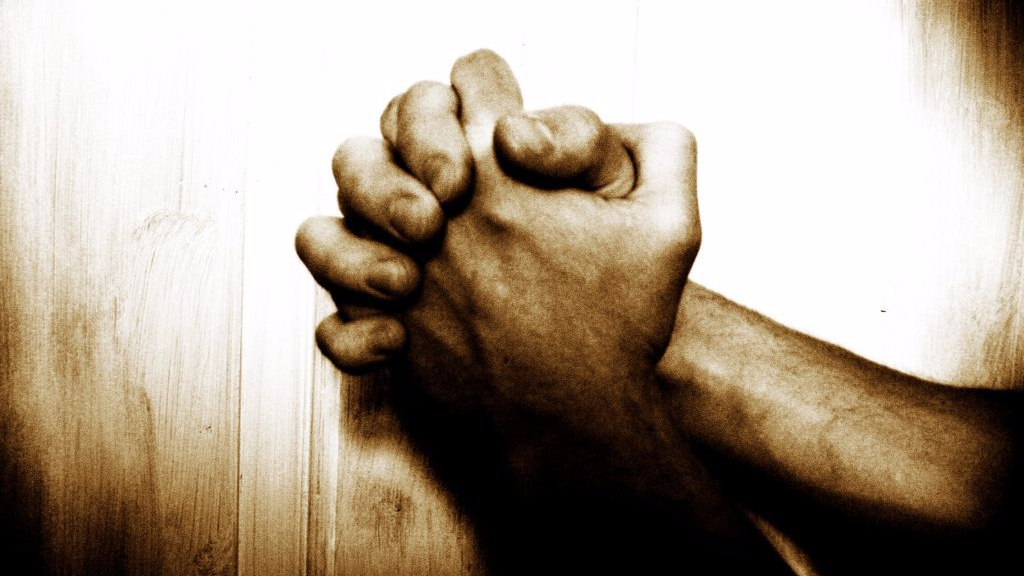
Photo credit:

31 Days of Praying for Your Husband (or Wife)

Link for the Mass readings for today:

http://www.usccb.org/bible/readings/101217.cfm

Lord, Teach us to Pray

Jesus was praying in a certain place, and when he had finished, one of his disciples said to him,”Lord, teach us to pray just as John taught his disciples” (Lk 11:1).

Jesus’ response to the disciple’s question is what we typically call the Lord’s Prayer or the Our Father. The longer and more common words are paralleled in Matthew 6:9-13. The Lord’s Prayer provides for us two basic ways to pray this prayer: as a rote prayer and as a model of prayer.

Rote prayers are those prayers that we memorize word for word. The value in rote prayer is that when we have memorized them, it gives us a good starting point for prayer. How many times do we sit down to pray and not even know where to begin? Starting with the Our Father shows us a way to lift our hearts and mind to prayer. Also, during times of stress, anxiety, or trial, having rote prayers at the ready, when we are not able to focus our mind, gives us a natural rhythm that we can access and slow ourselves down. The more we can then be mindful of the words we are saying, adding slow and deep breathes, matched with their familiarity, will assist us in bringing a calm and collected manner which we have experienced in the past having prayed these prayers over and over before. It is a calm alternative to feeding a mental storm that seeks to undo us.

Rote prayers are also beneficial when we pray with others. When we gather for worship or fellowship, praying the Lord’s Prayer is a wonderful place to begin. This is where we can pray together no matter the age gap. I have fond memories of my grandfather leading us in the Our Father before Sunday meals, Thanksgiving, Christmas Eve, or Easter dinners. When I pray the Our Father, I can often hear his voice, his laugh, how he called me Sergie. As I type these words, I can feel him with me and I could write on and on with the memories flooding in, let loose just from reciting the first few words, “Our Father, who art in heaven…”! Even in the worst case, if we are just saying the words without being attentive to them, I think there are worse things we could be saying without thinking. Though the Our Father can also draw us deeper.

The Lord’s Prayer as a model takes the prayer, which we can apply easily to other rote prayers, like the Hail Mary, Come Holy Spirit, and many others, to a deeper level. As a model of prayer, we pray the prayer slowly, then stop at a word or phrase and then speak freely. Here are a few examples. “Our Father, thank you for this moment that we have to spend together.” From there we can enter into a conversation with God, as we would with our parent, sharing the joys as well as the struggles. This could take two or twenty minutes or more and we have only recited two words!

“Hallowed be thy name. God you are holy, majestic, so beyond my understanding. How can you be so distant from me, yet know me better than I know myself?” Again, from there we just enter into a dialogue. We can then, with the first or second phrase go into prayers of petition, bringing our needs before our loving Father. We can offer prayers of intercession, praying for the needs of others with Holy One who is Love. We can also continue our conversation or just quietly pause and rest silently in the loving presence of our God. We can continue to take each part of the prayer and do the same, there are infinite possibilities to explore.

I invite you today to pray the Our Father as if for the first time, slowly embracing each word. Another opportunity is to allow memories to emerge from times praying this prayer with others. Maybe reach out beyond yourself and pray the Our Father imagining yourself sitting next to Jesus, or someone living in a different part of the state, another state, or country, or who has left this physical plane of existence that we know and is now where we too will be. Pray the Our Father with someone you seek to forgive or seek forgiveness from, pray for reconciliation and healing.

Create a quiet place for yourself with a picture, a cross or crucifix, a candle, rosary beads, pictures of those you would like to be closer to, whatever sacramental object helps you to turn your heart and mind to God in prayer, then take a deep breathe, say “Our Father,” and let God happen!


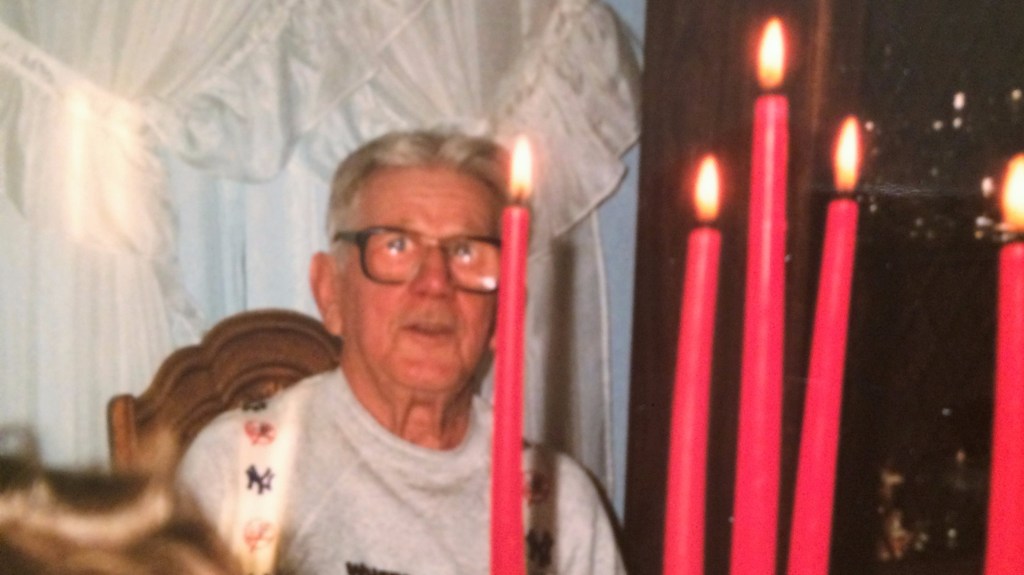
Photo: My maternal grandfather, Bernard Morcus, just about to lead us in the Our Father

Link for today’s Mass readings:

http://www.usccb.org/bible/readings/101117.cfm


Martha, Martha, We Can Do Better

“Martha, Martha, you are anxious and worried about many things. There is need of only one thing. Mary has chosen the better part and it will not be taken from her” (Lk 10:41-42).

Many deacons get to enjoy fuller and more in depth discussions regarding this reading than do priests, as many of us are married and the greater majority of priests are not. My wife JoAnn and I have had a few spirited exchanges on this Gospel each time it arises. One reason may be, is that from many women’s point of view, they see Jesus as not showing any empathy and regard for not only Martha’s gift of hospitality, but also all the work she is doing while all the men are sitting around listening to Jesus with Mary doing the same, and who is left to do all the work – Martha.

It is not only deacon’s wives who carry extra weight and burdens in support on the homefront to allow their husbands the time to serve, (Just the time it takes for me to write this daily post is less time I am spending with JoAnn or less time that I have to devote to the needs of our home) but many wives who are full time homemakers, run in home businesses, or carry a job outside the home, as well as caring for the children, overseeing the bills, the day to day grind, find themselves at times, rightly so, underappreciated, undervalued, and not respected for all they do. To all husbands reading this, WE definitely need to do a better job of being present, more patient, respectful and attentive to our wives and be more of an equal partner in our journey. God is to be first, then our vocation to marriage and family must come second, then work, then our vocation.

With that said, I do not believe that Jesus was dissing Martha. Especially, in the Gospel of Luke, there are so many instances in which Jesus empowers women so far beyond the cultural reality of the time period. We read this account from our twenty first century mind set. Contextually, the men sitting at the teacher’s feet in a different room, the women cooking and most times eating in another was commonplace for those in the first century AD. The only person out of step was Mary.

Another possible consideration, the root of Martha’s anxiety may not have so much been that she wasn’t helping in the kitchen, but because she was breaking a social construct of sitting with the men. Jesus addresses her from the perspective that Martha is anxious about many things and that Mary has chosen the better part. I can visualize Martha being taken aback at first, but slowly seeing the muscles in her face relax, and then taking her apron and throwing it off to the side and then sitting down next to Mary. Before you think I have watched one too many Hallmark movies, there is consistent evidence that beyond the Twelve, Martha, Mary, and Lazarus were Jesus’ closest friends.

When Jesus came four days after the death of Lazarus, it was Martha who came out to Jesus, not Mary, and in that exchange made the claim that he was the Messiah, the Son of God (cf Jn 11:27). She would not have had this insight, the same as Peter, who Jesus said only knew this through the intervention of the Holy Spirit, if she was still holding a grudge over the dinner. Also, Jesus who had compassion on the 5,000 and fed them with a few loaves and fish, who washed his disciples feet at the last supper, would he not step up to assist with the meal, the clean up, would he leave Martha hanging? We don’t know.

The reaction and push back from this scene is not so much a reflection of Jesus, but how poorly we have emulated Jesus in our interactions with our wives. When women are told to honor their husbands, that is only the half of it. Men are also told to honor their wives as Jesus does the Church. Women are to be respected and appreciated not exploited, demeaned, and devalued.

And let us not forget the vocation of single women who were instrumental in the beginnings of the Church and continue to be so today! By all accounts, I believe Martha and Mary were single women. They were close friends with Jesus, that is no small thing. The gift of the Church, and when we are at our best, is when we recognize the gifts, contributions, and value of each of our members. When we embrace the diversity in our midst and empower one another.

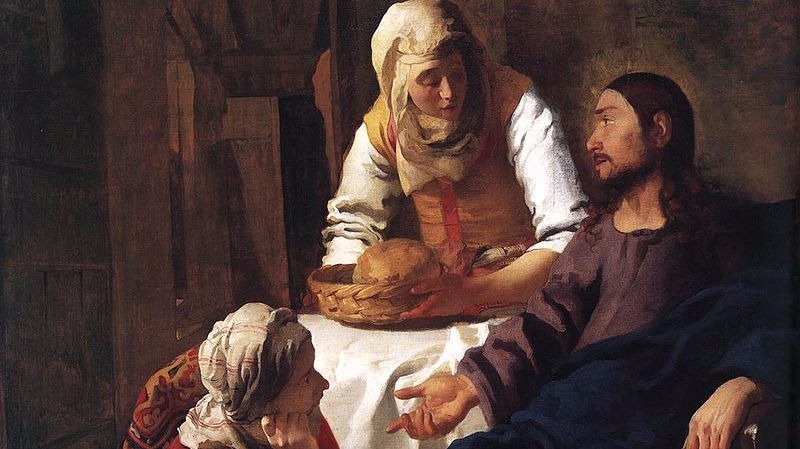
Let us meditate on this image today, Jesus, Martha, and Mary, and the other disciples present, sitting in communion, learning how to be supportive and caring, and then living as contemplatives in action. When we are anxious about many things, let us not take out our anxiety on one another, but come and sit a Jesus’ feet, breathe slowly, let the anxiety dissipate, and then seek his guidance, and begin again. Let us be sure tell those we know that we love them. “Encourage one another while it is still today” (Hebrews 3:13).

Special prayers today for those individuals and families who are anxious about many things because they are: contemplating an abortion; homeless; in fear that one or more of their family members may be deported; sacrificing everyday their members who go off with the possibility of not coming home because they are serving in the military, as police officers, firefighters, or EMT’s; still recovering from the hurricanes that hit Puerto Rico, the Caribbean and the South East and the earthquakes in Mexico; and refugees throughout the world who would love to find themselves in this situation where they were arguing over having help in the kitchen, instead of wondering if they will live another day.


Mass Readings for the day:

http://www.usccb.org/bible/readings/101017.cfm

photo source:

http://www.soulshepherding.org/2012/06/prevent-burnout-be-a-mary-nated-martha/

Who Is My Neighbor?

“And who is my neighbor” Luke 10:29.

This question of the scholar of the law lines up with Peter’s question: “Lord, if my brother sins against me, how often must I forgive him. As many as seven times” (Mt 18:21)? Both the scholar and Peter knew the letter of the law, but sought justification in following a minimalist approach to putting the law into practice. Jesus invites us to a deeper appreciation of the purpose of the law of God and that is to uphold the dignity of the person. Laws can be certainly unjust, and a mere following of the law for the law’s sake can wreak havoc .

Jesus made this point when he was challenged for even thinking that he would heal someone on the Sabbath when he said: “The Sabbath was made for man, not man for the Sabbath” (Mk 2:27). Time and again Jesus is calling us to have the courage to resist keeping others at arm’s length. He is calling us to risk assuming a stance of understanding, taking time to listen and be present to, as well as accompany those we encounter. The Samaritan did just that. The Jericho road was known for attacks just as the one suffered by the man who was left for dead. The priest and Levite may not have stopped to help because they might have thought the man was faking, or in the time they took to care for the man those that harmed him could have returned to abuse them. We don’t know the reason they continued on, what we do know is that they did not stop to help, but the Samaritan did.

When Jesus asked who was the neighbor to the man robbed and beaten, the scholar said, “The one who treated him with mercy.” The scholar could not bring himself to say the Samaritan, as the Jews and Samaritans had a long standing agreement of mutual loathing. Just remember a few days back when we read how Jesus sought hospitality from a Samaritan home, did not receive the invitation, and James and John were quick to implore God to send fire to destroy them.

Before we discuss amongst ourselves life’s issues or implore our lawmakers to enact policies, and the topics of the unborn, people on death row, Syrian refugees, immigrants and refugees who have fled from violence and drug wars from Mexico and Central America seeking hope and a better life, children who have made a life here and this is the only home they know, oil corporations seeking to lay pipe lines that threaten clean water resources and disregarding indigenous people’s rights, opening up dialogue with the LGBT community who have felt like they have been treated like dirt by members of the Church, and people of color who have been humiliated, profiled, and lost their life for nothing other than the color of their skin, we may want to read the parable of the Good Samaritan again, slowly and prayerfully.

In speaking to the US Bishops in his 2015 visit Pope Francis said: “And yet we are promoters of the culture of encounter. We are living sacraments of the embrace between God’s riches and our poverty.” Many human beings feel demeaned, dehumanized, lost, and afraid in our country.  Those listed above are our neighbors. They are wounded and in need. Will we whip out the statutes and law code, wrap ourselves in the flag; will we, like the priest or the Levite just walk on the other side of the road, indifferent or afraid; will we dig in our heels and embrace our fear and prejudices; or will we have the courage to show forgiveness, mercy, compassion, and understanding and accompany them on their journey? The scholar said the neighbor was the one who showed mercy. Jesus’ response to him and us: “Go and do likewise.”

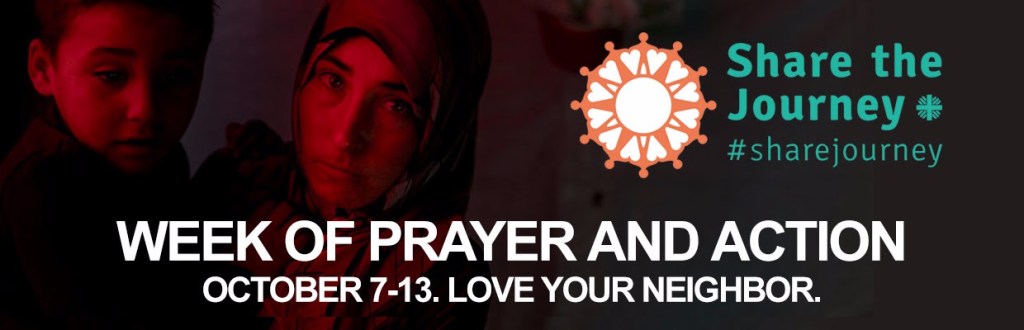
Let us join Pope Francis and the world this week. Pope Francis has invited all of us to participate in Share the Journey, a global campaign in support of migrants and refugees in partnership with the United States Conference of Catholic Bishops (USCCB), Catholic Charities US (CCUSA), and Catholic Relief Services (CRS). The Share the Journey campaign aims to engage the Church and others who care about migrants and refugees, around the world and in the United States.

October 7-13 Week of Prayer and Action: Love Your Neighbor!


Link for Mass readings today:

http://www.usccb.org/bible/readings/100917.cfm