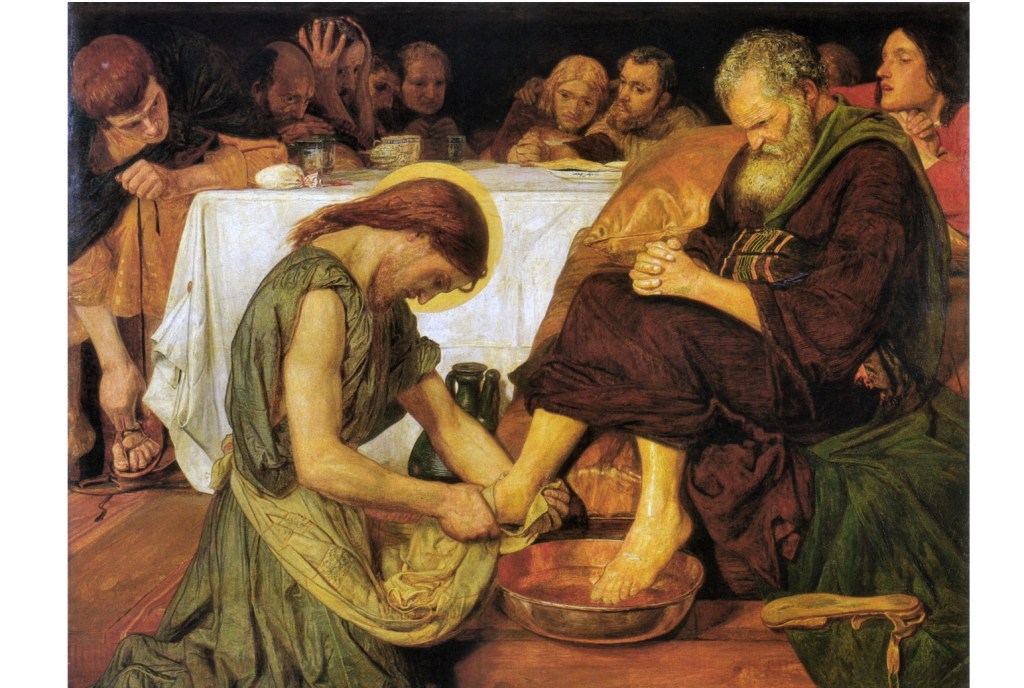
We too ought to wash one another’s feet.

A key focal point of the last supper narrative in the Gospel of John is Jesus washing the feet of his disciples. Washing feet was certainly a custom in the ancient Near East, for either people walked barefoot or wore sandals. In either event, people’s feet became quite sore and dirty getting from here to there. What accumulated on a person’s feet was also substantial. Washing of the feet was a hospitable way to welcome guests into one’s home. This action though was the most menial of tasks and often performed by slaves or the lowest of servants.

After washing his disciples’ feet and sitting down, Jesus said to them, “Do you realize what I have done for you? You call me ‘teacher’ and ‘master,’ and rightly so, for indeed I am. If I, therefore, the master and teacher, have washed your feet, you ought to wash one another’s feet” (Jn 13:13-14). Jesus shared with those who were to carry on his message and ministry that they were not to feel so high and mighty in this appointment. The Apostles, those sent by Jesus, were to look at their ministry as seeking how best to serve others, not seeking to be served themselves.

The ultimate service will be displayed in only a few more days. Jesus’ washing of his disciples feet was a foreshadowing of the ultimate act of humility and service that Jesus would show in giving his life for them on the cross. The most degrading, humiliating, and painful of deaths. Jesus gave his life on the cross as did Peter: “Unless I wash you, you will have no inheritance with me” (John 13:8). Peter did not grasp what Jesus was talking about. He followed Jesus on the literal level of the feet washing and much as he did when Jesus told him that he must die, Peter did not understand then either.

Traditionally, this evening at the Mass of the Lord’s Supper, select members of the parish will come to have a foot washed by the priests, following the model set by Jesus washing his disciples’ feet. This would remind all of us, as members of the Church, that we are all an integral part of the Body of Christ. Reenacting the actions of Jesus proclaimed in the Gospel, brings the vivid reality of Jesus’ invitation. We are at our best when we are willing to serve, support, and lift one another up. This is to be true when all is well and rosy, in addition to when conflict and challenges arise in the messiness of our daily lives.

Pope Francis, in his homily on April 5, 2020 highlighted this same point: “Dear brothers and sisters, what can we do in comparison with God, who served us even to the point of being betrayed and abandoned? We can refuse to betray him for whom we were created, and not abandon what really matters in our lives. We were put in this world to love him and our neighbors. Everything else passes away, only this remains. The tragedy we are experiencing summons us to take seriously the things that are serious, and not to be caught up in those that matter less; to rediscover that life is of no use if not used to serve others. For life is measured by love.”

We best exemplify Jesus’ washing of the feet when we resist the allure and temptation of pride because our life is not about us. We are not the center of the universe. Jesus shows us a better way and invites us to walk away from the table presenting a buffet of false substitutes for God: pleasure, wealth, fame and power. We are not to curve in upon ourselves either, afraid that our sins are not forgivable. Jesus has not abandoned us and he never tires of loving, forgiving, and serving us. Jesus gave his life for us, and is with us every step of our journey. As we receive and experience his love and forgiveness, may we be more willing to love and serve one another.

————————————————————

Painting: “Jesus Washing Peter’s Feet” by Ford Madox Brown

Link for the Mass reading for Holy Thursday Evening

May our hearts beat in time with the heart of Jesus.

Today is February 16, 2024, A.D. The letters, AD, stand not for after death or analog to digital, but Anno Domini. This is a Latin phrase that means in the year of our Lord. We are living in the age of the Church, as well as in between the time when Jesus experienced his life, suffering, death, resurrection, and ascension into heaven until he will come again.

In the Gospel of Matthew, we read today about the account of Jesus comparing himself to a bridegroom: “The days will come when the bridegroom is taken away from them, and then they will fast” (Mt 9:15). In a sense, the bridegroom has been taken from us, in another sense, he is closer to us now than he was when he was with his disciples when he walked the earth. The fullness of his reign though will not be consummated until Jesus comes again. While we wait, when we are willing to set aside other distractions and be still, we can hear and feel the beating of his Sacred Heart.

We need food for our survival, but we don’t need as much as we think we do! Fasting from food is not the only focus of our Lenten fast. The discipline of fasting provides an opportunity to keep our passions in check. By resisting the impulse of instant gratification, we better discern between apparent goods and the actual Good in our lives. When we navigate through the maze of distractions, diversions, temptations, and allurements on a physical level, we can begin to go deeper into the spiritual reality to begin to expose some of the demons and unclean spirits that we may be feeding, such as “distrust, apathy, and resignation” that Pope Francis talked about in his 2018 Ash Wednesday homily.

Pope Francis mentioned that these three demons “deaden and paralyze the soul of a believing people.” He continued by stating that: “Lent is the ideal time to unmask these and other temptations, to allow our hearts to beat once more in tune with the vibrant heart of Jesus.”

When we are willing to discipline our impulsiveness, to slow down, to take a breath, to be more aware, we can begin to see more clearly our complacency, contempt, and indifference. We can then be more open to God’s invitation to enter into a relationship with him and each other. We can then better assume the posture of John the Apostle by resting our head on the chest of Jesus (cf John 13:25), such that our hearts will beat in the same rhythm as his Sacred Heart.

This is the gift of contemplation that drives us to service. This is the same rhythm that beat in the prophet Isaiah who reminds us in today’s first reading what true fasting is all about:  “releasing those bound unjustly, untying the thongs of the yoke; Setting free the oppressed, breaking every yoke; Sharing your bread with the hungry, sheltering the oppressed and the homeless; Clothing the naked when you see them, and not turning your back on your own” (Isaiah 58:6-7).

————————————————————————

Photo: Mosaic of Sacred Heart of Jesus, Sacred Heart Hall, St. Vincent de Paul Regional Seminary, Boynton Beach, FL.

Link for Pope Francis homily:
https://aleteia.org/2018/02/14/pope-francis-offers-a-worksheet-for-lent-check-it-out/

Link for the Mass readings for Friday, February 16, 2024

Are we willing to come close as Jesus does for us?

“Whatever villages or towns or countryside he entered, they laid the sick in the marketplaces and begged him that they might touch only the tassel on his cloak; and as many as touched it were healed” (Mk 6:56).

The people of Jesus’ time were in need of healing, hungry to draw closer to God, often searching, wandering, and wounded, like sheep without at shepherd. This is just as true for us today. Though Jesus is not as visible to us as he was to those in the land of Gennesaret, he is just as present if not closer. We who receive Jesus in his Word proclaimed and through his Body and Blood, in the sacraments, prayer, healing, mercy, and grace are sent forth to bring Jesus to others.

We are not to go home as if nothing of any significance just happened in our gathering as the Mystical Body of Christ at Mass. Jesus does not send us to walk around with an air of superiority over others, to judge and condemn people, to refuse to help those in need because we feel they deserve the condition they are in, that they are “illegal” (people may do illegal actions but no person is illegal), that they chose their lifestyle, that they are lazy and just need to pull themselves up by their own bootstraps. Jesus was and is not indifferent to the plight of others. Jesus met people and continues to meet us where we are and as we are, and then he leads us with his “gentle chords of love” (cf. Hosea 11:4) to the truth of who his Father has created us to be.

Pope Francis was asked in an interview by Fr. Antonio Spadaro, S.J., in 2013, “What does the church need most at this historic moment?” And Pope Francis answered, “that the thing the church needs most today is the ability to heal wounds and to warm the hearts of the faithful; it needs nearness, proximity. I see the church as a field hospital after battle.” We need to be “near”, in the same “proximity”, to bear Christ to one another: “The church sometimes has locked itself up in small things, in small-minded rules. The most important thing is the first proclamation: Jesus Christ has saved you. And the ministers of the church must be ministers of mercy above all.”

Jesus, please help us to be present and willing to come near. Lead us to experience your love, mercy, forgiveness, and like you, be willing to enter into the chaos of one another. Help us to resist the temptation to keep others at a distance and refuse to be indifferent to the needs of those you bring to us in their time of need. May we too, in the words of Pope Francis, go out to “heal the wounds and to warm the hearts of the faithful” by being willing to accompany others in their sorrows, anxiety, trials, and tribulations.

People are really hurting all around us. Help us to let go of the need to fix them or fix their problems. Jesus, help us to be present, to listen, to hear, understand, and be open to allow the Holy Spirit to speak through us at the appropriate time, so that, in the end, we do not prevent people from encountering you, but become a means for them to encounter you, the divine physician, and be healed.

—————————————————————————————————————

Photo: Are we willing to grow together like these three trees? Rosary walk, St. Vincent De Paul Regional Seminary, Boynton Beach, FL.

Spadaro, S.J., Antonio. “A Big Heart Open to God: An interview with Pope Francis”. America Magazine. September 30, 2013 Issue: https://www.americamagazine.org/faith/2013/09/30/big-heart-open-god-interview-pope-francis

Link for Mass readings for Monday, February 5, 2024