“Jesus walked by the Sea of Galilee, went up on the mountain, and sat down there. Great crowds came to him, having with them the lame, the blind, the deformed, the mute, and many others. They placed them at his feet, and he cured them” (Mt 15:29-30).
There is a key yet subtle point before Jesus began to heal that might be missed. Before great crowds came to him, Jesus “went up on the mountain, and sat down there.” This is no insignificant sentence. The posture of sitting on the mountain would have been recognized right away by the people of Jesus’ time. This was the posture of the teacher and sitting on the mountain a reference to Moses. Prior to the healing in this setting, as he did throughout the Gospels, Jesus taught about the reign of God. In fact, time and again, Jesus’ “works of healing took place in this context of his preaching of the kingdom of God” (Lohfink 2014, 58).
A great multitude of people came to Jesus to hear his message and also brought with them a wide range of needs. Jesus made himself available, restored, and healed those who were brought to him. He encountered them as they were in their present condition. There is no record in this Gospel account that Jesus asked for any identification, that he discussed their belief system before healing them, nor did he ask if they were Jewish or Gentile, and nowhere in this account did Jesus deny anyone who came to him. The response of those to being healed and restored was that “they glorified the God of Israel”. This is because, “where God is master, there is salvation and healing” (Lohfink 2014, 62).
The recorded accounts of mass healings in today’s Gospel are but a foretaste of the heavenly realm of eternal communion with the Father, where death will be destroyed forever. Jesus is the kingdom of heaven at hand, for as St Irenaeus wrote, “Jesus opened up heaven for us in the humanity he assumed.” Jesus came to show humanity what life with the Father is so that we could have a clear choice of what living with him is like and what living apart from his is like. Living with Jesus and following his teachings provides healing and life.
For three days, Jesus served the people who came to him, and as people were getting ready to leave, Jesus showed compassion yet again. He sought the assistance of the disciples because he did not want to send the people away hungry.
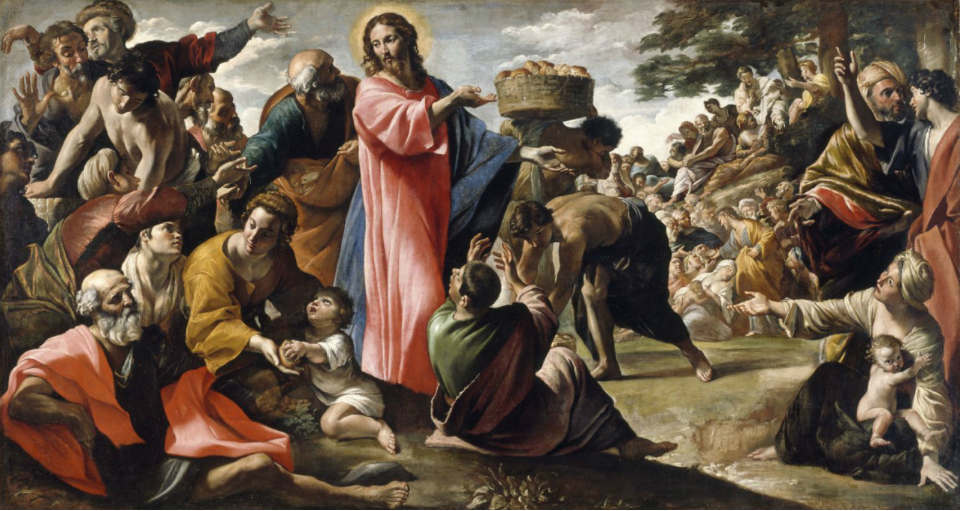
The disciples, of course, were taken aback because of the reality of the undertaking Jesus proposed. Jesus asked what they had with them and they shared just some bread and fish. Jesus took “the seven loaves and the fish, gave thanks, broke the loaves, and gave them to the disciples, who in turn gave them to the crowds. They all ate and were satisfied. They picked up the fragments left over–seven baskets full” (Mt 15:36-37).
This Advent let us make an extra effort to surrender our will to God. May we pray with and meditate upon the Gospels such that they become a living word that takes root in our hearts, may his teachings become relevant in our lives, and may they move us to also have compassion on those around us. May we resist the temptation to withhold our service because of someone’s religion, race, gender, creed, or political affiliation.
What matters is that we are willing to see in each person before us a human being with dignity and worth. Even if we feel we have little to give and that is not limited to material means, let us give as God guides us. As the disciples gave the seven loaves and fish, no where near enough to feed the thousands, Jesus multiplied what they gave him. Jesus will do the same through us. We just need to be willing to follow his lead and like Jesus be willing to feel compassion and love for others and let God happen.
—————————————————————————
Painting: The Multiplication of the Loaves by Giovanni Lanfranco between 1620-1623
Lohfink, Gerhard. No Irrelevant Jesus: On Jesus and the Church Today. Collegeville, MN: Liturgical Press, 2014.

 Spiritual Stepping Stones