Jesus calls us to be salt and light.

As we continue our journey in Ordinary Time, we continue to be blessed to sit at the feet of Jesus for the next few weeks as we hear, ponder, and hopefully begin to put into practice his teachings from the Sermon on the Mount. In today’s account, Jesus has just finished presenting the beatitudes and encourages his disciples to live out this empowering teaching by being “the salt of the earth” and “the light of the world” (cf. Mt 5:13-16).

This call continues to ring true for us today as his disciples. We too are to be “salt” and “light”. Salt has two major properties, preservation and flavor. Jesus emphasizes the aspect of salt being seasoning that one puts on food, which enhances its flavor. Our lives are better when we put into practice Jesus’ teachings and are transformed. Not only does the life of God living in us enhance our experience of life, we enhance the lives of others. 

We are also to preserve the goodness that God has created. For all that God has created is good. The enemy, Satan and his minions seek to corrupt and disorder that which God has made good. We are to counter the effects of sin with remaining faithful in times of darkness. Allowing Jesus to shine his light in us, we experience his love in the darkness in our lives, are forgiven, experience, healing and move to wholeness. Through our transformation we then radiate the light of Jesus for others and invite them to allow the light of Jesus into places where they too may not feel loved, where they feel alone, or isolated. In experiencing God’s love and light shining through us to them, they can begin their own journey of healing.

Each morning upon awaking and experiencing our first breather of the day, let us remember that we are an Alleluia people. A people grounded in hope and joy which we experience more as we die to our old self, our sinful self, so that we become less and Jesus becomes more. Our faith is not just for us alone, we are to go out and share it with others, we are to bring Jesus to others. “Isreal was to be a light to the nations (Isa 60:1-3; Bar 4:2). Jesus calls his disciples to fulfill this role by living the beatitudes in such a way that the world may see your good deeds and glorify your heavenly Father” (Mitch and Sri, 92). 

Pope Francis, in the very first line of his apostolic exhortation, Evangelii Gaudium, writes: “The joy of the gospel fills the hearts and lives of all who encounter Jesus. Those who accept his offer of salvation are set free from sin, sorrow, emptiness, and loneliness.” The Pope is not saying that when we accept Jesus into our lives and develop a relationship with him that all will go our way and on our own terms, there will no longer be conflict or pain, and that our life will now be perfect. 

Jesus is the very embodiment of love and the light that leads us away from the darkness of our sin. His love invites us to experience a better way. Instead of path leading to death, Jesus lights the way to eternal life. Jesus is present and accompanies us in our pain and sorrow and assures us that we are not alone. Jesus is the one who fulfills the longing of our heart’s deepest desire, he reveals to us our meaning and vocation in life. Jesus offers us hope as well as his hand to lead us through our darkest nights of despair and trauma.

We who have experienced the healing balm of the presence of Jesus in our lives, have grasped his hand for strength, have leaned on his shoulder to cry on, and experienced the joy of our encounter with him, are to be present to others in the same way. We are to be salt by bringing the joy of Jesus to all those we encounter. We need to resist becoming salt that has lost their flavor, meaning that we are no different than those in the world. We are not to slip into gossip, cynicism, and relativism, but instead are to be people of integrity, understanding, and truth.

I am not extroverted or outgoing by nature. I was much more reserved and internal as a youth. In my freshman or sophomore year of college, I heard a talk on cassette given by Mother Theresa of Calcutta. She mentioned reaching out to others with a smile. I still remember the first time of risking to smile at someone after hearing Mother’s encouraging words. I was walking up the sidewalk toward the parking garage on campus. I do not remember if the person I smiled at returned the smile, yet I do remember that day as a key moment in my faith journey. 

Having heard practically how to share the light of God’s love with another, and then to follow through, filled me with joy. Smiling continues to make a difference in my life and hopefully, the lives of others. When we are living our lives as Jesus guides us, as we read, meditate, ponder and put into practice his teachings, then the people in our realm of influence then we are being salt and light. People feel better after having been in our presence, because they have had an encounter with Jesus through us. Even if they feel convicted, they are not condemned but offered a better way that leads from shadows or darkness and into light.

How can we be salt and light that Jesus invites us to be? Live our lives as he did and commit daily to spending time breathing, receiving, resting and abiding in the presence of his Father and following his will. A simple way of adding some flavor and some warmth in our interactions is offering a smile. Doing so need not only be limited to those we feel comfortable with or like. We can share a smile with those we may have had conflicts with and even those for whom we may feel a bias or prejudice toward. This is only a small beginning, but it draws us out from our own self-centered focus and directs our attention toward willing the good of another.

A simple, yet genuine smile can work wonders for someone who begins to believe that no one cares or has the time of day for them. This is true for the recipient as well as the giver. If you have felt like you have lost some of your flavor or if you are not sure how to be a light for others, next time you catch the eye of another, smile.

In this small act, we say to the person on the receiving end of our smile that we care enough to notice them, that they are loved just for being present in that moment. They have worth and dignity just for who they are. A simple, sincere smile can bring a little flavor to someone in a sour mood, as well as a little light to someone in a very dark place. 

———————————————————-

Photo: As we allow ourselves to be transformed by the love of the Holy Spirit we will radiate the love of God to others.

Mitch, Curtis. The Gospel of Matthew. Grand Rapids, MI: Baker Academic, 2010.

Link for the Mass readings for Tuesday, June 9, 2026

Blessed is the one who hears and ponders the word of God and puts it into practice.

Curtis Mitch and Edward Sri, in their commentary on Matthew, offer three key insights into how to understand the beatitudes. Contextually, Jesus does not make up the genre of beatitudes himself. The Greek, makarios, can be interpreted to mean happy and “denotes blessedness or happiness not in the sense of an emotional state but in terms of being in a fortunate situation… In the Jewish tradition, beatitudes either commended those who take a certain path of life or promised future consolation to those in affliction” (Mitch and Sri, 88). 

The Hebrew Scriptures provide examples that Joseph and Mary would have read or shared from memory to Jesus, and he would have prayed with himself. “Forty-five beatitudes are found in the Old Testament, most in the Psalms and Wisdom literature, where they commend a certain quality, condition or situation. For example, the blessed are those who delight in God’s law (Ps 1-2), who take refuge in the law (Ps 2:12)… and trust in him (Ps 84:12).” (Mitch and Sri, 89).

Who is blessed to Jesus? Not even his own mother because she is his mother, but blessed is the one who hears and ponders the word of God and puts it into practice (cf. Luke 11:28). Jesus presents to his followers a path of how they are going to live a particular way of life. He is setting a road map that will guide them through the trials and tribulations that will come in doing so, and even when challenges arise, Jesus promises that his Father will provide consolation. Those who put the beatitudes into practice and live as his disciples will experience happiness and fulfillment. 

Mitch and Sri also show that “Jesus’ beatitudes represent a reversal of values, turning the world’s standards for happiness upside down” (Mitch and Sri, 88). Mature disciples of Jesus will come to experience consolation no matter the external storms that arise. Even in times of desolation, they will remain persistent and on course, so to come out on the other side stronger for having trusted that Jesus is with them even when they did not feel his presence. 

Jesus does not commend those who wage war as blessed, but instead: “Blessed are the peacemakers, for they will be called the children of God” (Mt. 5:9). Jesus does not promote the lives of the rich and famous, but instead: “Blessed are the poor in spirit, for theirs is the kingdom of heaven” (Mt. 5:3). Jesus does not affirm those who thirst for power, pleasure, wealth, and fame, but instead: “Blessed are they who hunger and thirst for righteousness, for they will be satisfied” (Mt. 5:6).

These are just a few of the eight beatitudes Jesus presented. A good practice is to review each of the eight beatitudes that Jesus presents in the beginning of his Sermon on the Mount. Which one(s) strike a nerve. Stop there and meditate with Jesus leading us. Where is he helping us to see a way where we can release an attachment so to better follow more faithfully?

Jesus invited his disciples to sit at his feet as the “new Moses”. He came up the mountain like Moses who came up to receive the law. Jesus did not come to receive the law, he came to “teach it” (Mitch and Sri, 87). As he begins his Sermon on the Mount with the Beatitudes, the other wonderful thing we will realize about the beatitudes is that he was not just sharing head knowledge but practical ways to inherit the kingdom of Heaven, to grow in intimacy with his Father and share in the love of the Holy Spirit. All practices that he himself lived through and through.

The Beatitudes, like the Ten Commandments, are boundaries that define us as the children and inheritors of God’s will and blessing. They help us to uncover that which seeks to lead us astray, to isolation, and to our death, and instead identify how to stay focused on that which leads us to eternal life. The most important thing we can do every day is to pray, and the enemy knows that, so he will seek with all his means to distract, divert, and dissuade us from doing so or to keep our prayer and practices merely at the functional level. 

Jesus offers us his love that we might trust him to allow his light to shine in our hearts and minds and the places we would rather no one would see. Even those places that we may feel unlovable, because even there, Jesus will love us when we let him in. He seeks to reveal our sin and failures, not to condemn and shame us, but to help us to see what is enslaving and isolating us and that which keeps us from greater intimacy with his Father. The light and love of Jesus help us to see what our lives are like without God and what they are like with him.

As our consciences become better formed through following Jesus’ teaching, such as the Beatitudes, as we allow him access to our wounds and sins, as we are loved by Jesus even there, we will be purified by the loving fire of the Holy Spirit, and we will then be blessed with a clean heart and see God. See our Loving God and Father who has made us to be happy, fulfilled, and at rest; a rest that we will find when we breathe, receive, rest, and abide in Him.


Photo: Quiet time praying Evening Prayer after the Saturday Vigil Mass at St Helen Catholic Church in Vero Beach.

Mitch, Curtis. The Gospel of Matthew. Grand Rapids, MI: Baker Academic, 2010.

Link for the Mass readings for Monday, June 8, 2026

Nourished by the living bread of life, we will find rest in God’s love and know who we are.

Jesus said to the Jewish crowds: “I am the living bread that came down from heaven; whoever eats this bread will live forever; and the bread that I will give is my flesh for the life of the world” (Jn 6:51).

Jesus is the bread that came down from heaven. He is to be our nourishment, source of refreshment, and very life. Like a tree that is planted near the streams of living water (see Psalm 1:3) we are refreshed in all seasons, when all is tranquil as well as when we are immersed in our unique challenges and struggles, as long as our roots remain tapped into the well spring of the life of Jesus.

We are to look to the things of heaven for our foundation, not the things of this earth. For the things of this earth are passing away as many of us know all too well. This does not mean we aren’t to enjoy the blessings that God has given us. All that God has created is good and to be enjoyed as a gift of his grace. It is more a matter of perspective. 

We are not to be attached to the things of this world, even to those closest to us, because we are finite and imperfect and so we will never be fully satisfied because we seek the eternal in the depths of our souls. With God as our center and our refuge, we have a stability that is not only unshakable but eternal so cannot be exhausted. We know that no matter what, we are accepted, we belong, and we are loved. We renew, heal, and grow in wholeness as we receive him most intimately and concretely in the Eucharist, the bread from heaven, but also in resting in him, his creation, spending time with good friends and family as well as those he calls us to serve.

And we can do this more authentically and purely when nothing or no one else, including ourselves, but Jesus is the center of our lives. Letting go of our attachments takes time and effort but is well worth it because when we ask Jesus to reveal to us that which we place before the Father he will do so.

When we collaborate with our Loving God and Father to let go, this practice leads to a freedom and peace that we would otherwise not experience. We will still encounter the pain of loss, but it will not be as debilitating. In putting God first and deepening our relationship with him, we receive his love, we start to see ourselves as he sees us and grow in his wholeness which overflows into our relationships because instead of attempting to be something we are not just to fit in or get along, we experience the relief and rest of being simply ourselves. 

As we experience God’s love, we will slowly and surely come to identify ourselves not by what we do, who we think we are or who we think others think we are supposed to be, and/or others tell us to be, but rest instead in the truth and identity of being his beloved daughter or son. Our anxieties and fears will have less power over us, we will become less insecure and more confident, pride will weaken because we no longer place ourselves first. We will also begin to experience the maturing of the fruit of the Holy Spirit. We become more loving, joyful, peaceful, patient, kind, generous, faithful, gentle and able to practice more self-control. 

During this Corpus Christi Sunday then, may we recommit to the truth and reality that Jesus is with us in a special and unique way as the “bread of life” in the gift of the Eucharist. He will nourish and lead us deeper into relationship with his Father so we may experience the intimate love of the Holy Spirit.  “Strengthened by the food that God gives us, let us bring Jesus to the hearts of all, because Jesus involves everyone in his work of salvation by calling each of us to sit at his table. Blessed are those who are called, for they become witnesses of this love!” – Pope Leo XIV Homily, June 22, 2025


Photo: Pope Leo leading procession, June 22, 2025, taken by Antoine Mekary – Aletia.

Link for the Mass readings for Sunday, June 7, 2026

Do we place our trust in ourselves or in God?

In our Gospel reading from Mark, there appear to be two separate accounts. In the first, we witness Jesus’ critique of the scribes, and in the second, the generosity of a poor widow is emphasized. There could not be a starker contrast between the two. Jesus points out those scribes with the primary motivation of self-aggrandizement, “who like to go around in long robes and accept greetings in the marketplaces, seats of honor in synagogues, and places of honor at banquets” (Mk 12:38-39). They make a lofty show of themselves, yet, what is worse is the following verse. “They devour the houses of widows and, as a pretext, recite lengthy prayers” (Mk 12:40).

The implication is that certain scribes used their position not to edify, provide care for, and lead widows closer to God, but instead chose to exploit them for their own selfish gain. As Jesus finished his rebuke of the scribes, he then observed those making contributions at the treasury of the Temple. A poor widow donated two coins. No one, except Jesus, appeared to notice her. Jesus called his disciples to him and said, “Amen, I say to you, this poor widow put in more that all the other contributors to the treasury. For they have all contributed from their surplus wealth, but she, from her poverty, has contributed all she had, her whole livelihood” (Mk 12:43-44).

Jesus commends this woman for her generosity. She does not make a fancy show of what she is doing, she quietly and simply gives all that she has. Is Jesus sharing his critique of the scribes who seek to exploit widows, just moments before sharing the generosity of this widow? Could her having so little have resulted from the exploitation of one of the scribes? We are not told why she has so little nor why she gives all she has, but her willingness to do so is clearly on display.

Often in the Gospels, Jesus holds up a mirror, as he did with the scribes, to those in positions of religious authority who place their focus on themselves, their own gain, and prestige. They are placed as stewards instead to help those they are supposed to serve, along with widows, orphans, the stranger, and those in need. Those like Matthew and Zacchaeus, though not scribes but tax collectors, embraced Jesus’ invitation of repentance, made a 180-degree turn from their old ways of self-service, and instead changed and began anew in following Jesus.

Will we be like the unnamed scribes and Pharisees who were not willing to look in the mirror that Jesus held before them, more interested in supporting their place of entitlement and privilege, and unwilling to change? Or will we, as did Matthew and Zacchaeus, allow our consciences to be convicted, be willing to repent, and rend our hearts so to be moved and more willing to love, so to stand alongside our brothers and sisters in need? The scribes are not the model in today’s reading, the widow was.

What affects one of us, affects all. If one among us is hurting, we are all hurting. We can do better to help one another. In allowing ourselves a time for a prayerful pause, Jesus will lead us to discern which thoughts to entertain, which words to speak, and actions and choices to make that are aligned with our loving God and Father’s will. Then we too will have the courage of the widow. She who did not give out of her excess but gave without counting the cost and trusted that God will provide. We will be more generous with our time, talent, and treasure when we are willing to trust God and freely give as he directs us.


Painting: “The Widow’s Mite” by James Christensen

Link for the Mass readings for Saturday, June 6, 2026

Jesus is our LORD!

The opening scene from today’s Gospel from Mark opens with Jesus teaching in the temple area. He poses this question to those gathered, “How do the scribes claim that the Christ is the son of David” (Mk 12:35)? The question that Jesus is offering engages in the Jewish debate regarding the promise of the Messiah or Mashiach in Hebrew, the Christ or Christos in Greek. Messiah or Christ is not a surname but a title meaning anointed one.

One interpretation of the long-awaited Messiah was a kingly figure descended from King David. Son of David is a common Messianic title. The blind Bartimaeus called out to Jesus using this title (cf. Mk 10:46-48). Jesus then quotes the beginning of Psalm 110 as he goes deeper. “David himself, inspired by the Holy Spirit, said: The Lord said to my lord, ‘Sit at my right hand until I place your enemies under your feet’” (Mk 12:36).

This statement can be a little confusing, especially if you are hearing this word proclaimed and not reading it closely. The first Lord referred to by Jesus has a capital letter “L”and the second lord has a lower case “l”. The reason for this is that in the original Hebrew the sacred name of God was not to be uttered or written. Instead, the Hebrew Adonai, meaning LORD, would be used to refer to God. The use of the word lord, Hebrew, adoni, with a lower case “l” could refer to a patriarch of a family, tribe, or military king and ruler like King David.

In this very short account from Mark today, Jesus deftly addresses some of the titles floating around about him, Messiah, Son of Man, Son of David, and with his final question, “David himself calls him ‘lord’; so how is he his son” (Mk 12:37). Jesus is saying that this One to follow David would be even greater than the expectations of these messianic titles because he preceded David and so is even greater than the genetic heir to David. Jesus is saying that he is the Son of God, LORD, as well as Lord. Just a little bit dizzy yet?

Jesus as Son of God, as LORD, as God, not only far surpasses even the highest ideal of messianic hope but would also be a direct challenge to the occupying Romans. For in the ancient Greek, of which Mark is written, Kyrios, means Lord. For the Romans, Caesar is Lord. Jesus is challenging the worldly establishment by saying that he, not Caesar, is Lord. He is challenging the religious establishment by saying that he is LORD, God.

Jesus, soon after speaking these words, will participate in his suffering, death, resurrection, and ascension, where he will return the right hand of God his Father. The enemies that will be subjected under his feet will be Satan, sin, and death, each of which he will defeat in his crucifixion, resurrection, and celebrate in his ascension as well as continue to lead us from his throne at the right hand of his Father.

This is why Jesus is our hope even and especially during our troubled times: personally, within our family and communities, country, and our world. Jesus is our Lord – not any emperor, president, or worldly leader. Jesus is our LORD to whom we are to place our trust and follow. Jesus our Lord, and our LORD, will lead us to freedom from our bondage to addiction, sin, suffering, fear, insecurity, powerlessness, poverty, self-sufficiency, and ultimately even our death.


Photo: Jesus our Lord will lead us out of our present darkness and into his wonderful light.

Link for the Mass readings for Friday, June 5, 2026 

Loving God with all our heart, soul, mind, and strength and our neighbor as ourselves begins the moment we allow God to love us.

“Which is the first of all the commandments” (Mk 12:28). This may have been a challenge to Jesus, or it may just have been a valid question of one seeking the Truth. Scribes were the experts in securing and making known the Torah. They could read and write, a skill not only used for protecting and passing on the faith, but also for the daily tasks of commerce and contract writing.

This question of the scribe was one that was asked often by those who sought how best to live out the Torah. Not only were there the Ten Commandments, but throughout the Torah, there were 613 prescribed laws! A common debate that was often entered into was which were the most important to follow to be faithful, as well as the minimalist approach, being, which were the most important to be followed so someone could just get by?

Jesus replied, “The first is this: Hear, O Israel! The Lord our God is Lord alone! You shall love the Lord your God with all your heart, with all your soul, with all your mind, and with all your strength. The second is this: You shall love your neighbor as yourself. There is no other commandment greater than these.” With this response, Jesus drew first on Deuteronomy 6:4-5 and then regarding loving your neighbor, Leviticus 19:18. By answering in this way, Jesus stated that when we orient our lives to who God has created us to be, which is to Love God first, place God at the center instead of ourselves, we can then better love our neighbors and ourselves.

St Augustine, the bishop of Hippo (354-430), echoed Jesus’ “Greatest Commandment” by stating that we can love God and do whatever we want. The order of that statement is aligned to the commandment Jesus gave. God is first. The problem many of us have is that we place ourselves first and seek to bend God’s will to our own. We look to flip the words to: do what I want and God will love me. It is true that God will love us, but we will not experience the intimacy of his love, just as we weaken intimacy with our human relationships when we put ourselves, our interests first before others.

When we shift our orientation to God first, such that he is the foundation of our life, our world opens up and expands. Many of us are wounded by our own sin and the sin of others. We retreat into defensive postures and actualize defense mechanisms to survive. These may be good and necessary at the moment, but the challenge is that if we continue to live in a posture of survival mode, we are merely existing.

God lays out for us a life of consolation and joy, and we can experience this more when we recognize our need for and open ourselves up to receive God’s love. When we allow him to love us, we can then receive his healing balm of forgiveness, love, and mercy. Once we begin to experience these gifts, we will begin to see ourselves and others, not from our own limited perspectives where we can slip into defensive postures that may feed our insecurities, biases, and prejudices, but see from the greater breadth and depth of how God sees us as his children, made in his image. We are not constricted by God’s love but expanded.

God reaches out to us in so many ways to tell us that he loves us more than we can ever imagine. Unfortunately, when we are diverted and distracted by other false pursuits and find ourselves opposed to his will, we limit our experience of his love. Yet, God’s love for us remains unconditional. God loves us as we are, right now, right at this moment. We just need to take some time to sit, breathe, and be willing to accept the gift of being loved for who we are as well as embrace the fullness of who he has created us to be as mental, physical, emotional, and spiritual human beings; as well as resist repressing any aspect of who we are, allow God access to all of us, and when we do we will grow in holiness and wholeness.

Through embracing God’s healing forgiveness, love, and mercy and being engaged in the fullness of our humanity, we can begin to relax our defensive postures. We can become advocates for healing the division, dehumanization, disrespect, and polarization in our realm of influence, in person, and online. In being loved, we begin to feel safe and no longer controlled by our fears and insecurities. Being loved, we will project, react, and should over ourselves less, and be more open to encounter and accompany one another as human beings, and experience our differences not as obstacles but as gifts for our mutual growth.


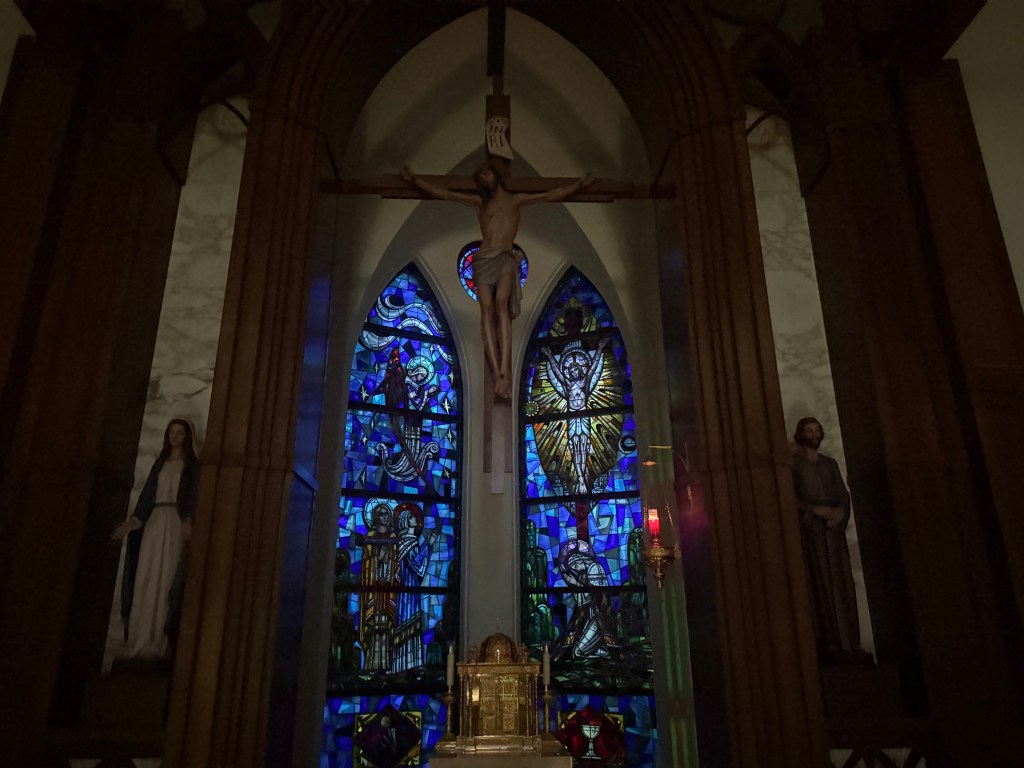
Photo: The fire of God’s love burns in each sanctuary lamp where his Son is present in the tabernacle. May we join him, sit awhile, breathe, receive, rest, and abide in his love.

Link for the Mass readings for Thursday, June 4, 2026

In knowing God, we will discern how to repay to God what is God’s and to Caesar what is Caesar’s.

Two groups usually at odds have come together in their mutual disdain for Jesus. The Herodians – supporters of the Galilean tetrarch, Herod Antipas, have acquiesced and allied themselves with the Roman occupation so that their “party” can remain in leadership, and the Pharisees, who are opposed to Roman occupation, seek nothing to do with, nor seek to support in any way Caesar’s self-imposed status as a god. Mark indicates that representatives of each group are sent to Jesus to “ensnare him in his speech.” The intent is to trap him and so gain evidence to bring charges against him.

They come up with an elaborate plan that seems foolproof. A representative from these groups asks Jesus, “Is it lawful to pay the census tax to Caesar or not? Should we pay or should we not pay” (Mk 12:14)? If Jesus assents to pay, then the Pharisees can bring charges against him for idolatry. If Jesus refuses to pay, the Herodians can then bring charges against him for disobeying Caesar’s tax. Jesus asks for a denarius, a Roman coin, and asks what image is on the coin, the response is Caesar. So Jesus said to them, “Repay to Caesar what belongs to Caesar and to God what belongs to God.” They were utterly amazed at him (Mk 12:17).

Jesus bested them at their own game in thinking outside of the limitations that were imposed on him by his questioners. Our faith is built on Jesus’ response. Not in the modern distinction of church and state, but more often than not we are to follow Jesus’ model and guidance of how we are to live in the world but not be of it. In most cases, we are to embrace not an either/or response, but a both/and response. Ultimately, the final determiner is God.

One example of such a false dichotomy often displayed is that faith and reason are opposed and cannot co-exist. One could approach Jesus today, as did the representative for the Herodians and the Pharisees, and ask, “Rabbi, should we follow faith or reason?” We are more authentic in actualizing and pursuing the greater breadth, depth, and width of understanding who we are as human beings and our place in the cosmos when we embrace both faith and reason. Our science and intellect are spurred on by our sense of wonder and awe in that we seek to understand our world around us. 

Faith seeks understanding! Using our ability to reason, to hypothesize, and ask,  “Why?” has lead humanity to some wonderful discoveries. Reason and science though can only take us so far.

God’s grace does not diminish but builds upon nature. The gift of faith helps us to go beyond the ability to solve problems in the sensory or physical realm alone and to experience the ground of Mystery by entering into a relationship with God and the spiritual realities of his creation that transcend our physical world and capacity to measure it. God has created all things visible and invisible.

Just a few of the many examples of practicing Catholics from our past who have shown this both/and approach are Copernicus (1473-1543), who developed the theory of heliocentrism, meaning that the earth is not the center of the universe but instead revolves around the sun; Nicolas Steno (1638-1686), who excelled in the study of anatomy, geology and is considered the founder of the study of fossils; Laura Bassi (1711-1778), first female professor of physics; Gregor Mendel (1822-1844), who was an Augustinian friar and is considered to be the father of genetics; and Fr. Georges Lemaitre (1894-1966), who is considered the father of the Big Bang Theory.

The Catholic Church is not opposed to science but discourages the concept of a hyper-scientism: that something is real or exists only if be measured by the senses or experimentation alone. This limits the gift of wonder. “Faith and reason are like two wings on which the human spirit rises to the contemplation of truth; and God has placed in the human heart a desire to know the truth—in a word, to know himself—so that, by knowing and loving God, men and women may also come to the fullness of truth about themselves” (Pope John Paul II, Opening line). We need to continue to embrace the gift of wonder and rise to meet its invitation by soaring aloft with both wings of faith and reason.

Pope Leo echoes these sentiments of a healthy, discerning both and approach: “Our first task is neither to demonize nor idolize technological tools, but to utilize them on the basis of a fundamental principle, namely that truth is a common good and not the property of those with power or influence” (paragraph 137).

Even in the new digital age and with growing advancements in AI, we can embrace that which can be helpful with moderation and prudence, while at the same time continue to protect the dignity of humanity and the value of the truth. We will do this best when we prioritize God as the foundational relationship and starting point for discernment in our lives. As we love God with all our heart, mind, soul, and strength, we will know better how to repay to God what is God’s, as well as how to repay to Caesar what is Caesar’s.


Photo: We know God better when we spend time in silence, in adoration, in prayer, meditation, and contemplation.

The following link lists an article by Shaun Mcafee regarding 11 Catholic scientists through the ages: https://epicpew.com/11-amazing-catholic-scientists-you-should-know/

Link for Fides et Ratio by Pope John Paul II

Link for Magnifica Humanitatis  by Pope Leo XIV

Link for the Mass readings for Tuesday, June 2, 2026

Will we serve ourselves or the owner of the vineyard?

“At the proper time he sent a servant to the tenants to obtain from them some of the produce of the vineyard” (Mark 12:1-12).

Unfortunately, not only did the tenants not offer the produce due to the true owner of the vineyard, but they also beat his servant and sent him back empty handed. This pattern repeated. The owner sent more servants. They were beaten and some killed, and then the owner sent his son, thinking that they would respect him. They killed him as well, thinking that then the inheritance would be theirs. Jesus ended the parable with an account of the swift retribution of the tenant farmers by the owner and the redistribution of the vineyard to others. The chief priests, the scribes, and the elders realized that the parable was directed at them.

The leaders were not happy about being compared to the wicked, tenant farmers. This only deepened their resolve to arrest and persecute him. Instead of digging in their heals, had they saw instead that the parable was an opportunity to see their own sinful behavior of not being faithful stewards, they could have repented and reconciled themselves to the will of God.

We who read Parable of the Tenants may be quick to judge the whole lot: the stewards, chief priests, scribes, and elders. If we do so, we do at our own peril. What does this parable say to us? How have we been good stewards of that which God has given, including our own lives? A common mantra is that this is my body and I can do whatever I want with it. Though this may be a popular cry of individualism and self-autonomy, it is not biblical.

All that we have is a gift from God, including our life and our very being. Each of us is a unique wonder, while at the same time we are not our own to do with as we please. We are God’s beloved children, daughters and sons created in his image and likeness. Our likeness has been dimmed by sin and so feeds our knee jerk and sometimes visceral reaction against the notion that we are not our own to do with as we please. This mentality is fueled by a radical individualism that seeks to be in control. We believe that we know better, that we know what will make us happy and what will fulfill us. So we give in to our pleasures, passions, and wants. 

Discipline, temperance, and self-control are shunned. This selfish posture often comes from our unhealed wounds, the whispers of the father of lies, as well as living under the influences of a fallen world. Where God is not first, someone or something will be. This is what gives rise to a cult of personality. These pedestals are often built on the weak legs of the precarious wood of our finite and fallen nature. This is why so many leaders, religious, political and familial, have time and again all fallen off and let us down. They were placed where they never ought to have been placed.

This will continue to be the pattern, just as we saw in Jesus’ parable, which will lead to our own undoing, unless we are willing to let go of our attachment to the things of this world, including our own self-aggrandizement and narcissism. “I, me, mine”, is a debilitating cry. 

The tenants in today’s parable looked for what they could get and take from what was never theirs. This grasping for immediate gratification undid the very core of their humanity and led not only to the desecration of the dignity of those the owner of the vineyard sent but lead to their own demise. In idolizing the things of the world instead of the things of heaven, they became undone. 

Will we feed on the same radical individualism, or embrace our role as good steward, acknowledging, all that we have, even our very lives, are a gift from God, the owner of the vineyard. Recognizing that God is God and we are not, and trusting in his will for our lives will truly make us happy, fulfill, and help us to embrace who we are: co-redeemers with God. God has given each of us gifts to better his kingdom. May we serve well and seek to bear fruit that will last.

When we fall short, let us acknowledge that God has sent his Son to us. He has come to lead us to all that is Good, all that is True, and all that is Beautiful. He is also the only one we can count on. We need to place our trust in Jesus first, so when others fall, we do not fall with them and/or despair, because none of us are perfect. Each of us have our strengths as well as our weaknesses. As we grow in humility, we will grow in freedom and restore our likeness with God. As Jesus redeems us, we will experience our freedom and healing. As we heal, we can serve to help others who have fallen to experience a true freedom that will last.


Photo: Blessed to serve God and my parish family here at Holy Cross!

Link for the Mass readings for Monday, June 1, 2026

Jesus is the Lord of the temple, the Lord of our lives.

Jesus had not only created a scene when he, literally, turned over the tables in the temple, but had been doing so since the beginning of his public ministry. Jesus had been figuratively turning the tables on the religious leadership. The conflicts between Jesus and those in charge were not subsiding but only growing, especially now that Jesus was present at the Jewish spiritual center of the temple, the very seat of God. The chief priests, the scribes, and the elders, are becoming more concerned about the teachings and actions of this itinerant preacher and believe him to be a false prophet. They approach him when he returns to the temple and ask, “By what authority are you doing these things? Or who gave you this authority to do them?” (Mark 11:28)?

Jesus, who is the Lord of the temple, “the lord of the house” (Mk 13:35), recognizes that the “servants in charge” (Mk 13:34) of the house, are not seeking the truth in this question. “The question is full of hidden irony: the stewards of the temple, whose authority is only delegated, are demanding that the Lord of the temple answer to them for his actions” (Healy, 234). Jesus deftly turns the table on them. In doing so, they reveal that they do not believe that John or Jesus are operating under the authority of God, but they fear the reaction of the people gathering around their discussion. This is the time of the Passover, and many pilgrims have come to Jerusalem to celebrate. The area is teeming with people. The last thing that the Jewish authorities want is another scene as Jesus had staged from his turning over the tables the day before. They do not want to have the Roman centurions getting involved.

The chief priests, scribes, and elders refuse to answer Jesus’ question. Jesus follows like fashion then and does not answer their original question. This episode and exchange, as with the other conflicts with Jesus leaves his challengers frustrated and angrier. They believe Jesus to be a false prophet, yet they are not willing to call him out publicly. Indecisiveness further fuels their already growing resentment. Jesus though is at rest because he knows that he is following the will of his Father and has nothing to prove.

How do we do with conflict? Are we as surefooted and confident in the love of our Father as Jesus? If not, there can be many reasons. Foundationally, we need to ask ourselves: “Are we following the will of the Father in all that we think, say, and do?” The peace that surpasses all understanding that Jesus experiences and promises comes from the assurance that our loving God and Father is with us, has our back, and supports us. We also experience rest when our conscience is clear. The challenge is to be clear in our discernment that we know the difference between God’s and our own will, as well as when our decisions are in accord with or opposed to God’s. When not, then we repent and turn back to him.

We may receive clarity, although many times we are indecisive. The answer to knowing God’s will is knowing God. We encounter and develop a better relationship with our Father as we would with any other person. Though until we develop a deeper prayer life, that is easier said than done. As many of the saints attest, the closer they grew in relationship, the more distant he appeared. This is true because Jesus invites us to go deeper, so we come to the point that we resist relying on our emotions, inspirations, and consolations, as well as our capacity to make sense of what we are asked. Jesus leads us on an eternal path that has no end, cannot be exhausted, and we are to follow without hesitation. Jesus speaks to us in the silence of our hearts. Why do we listen? Because Jesus is our Lord, the Son of God our Father.


Photo: The more time we give to Jesus in silence, the more he becomes the Lord of our lives!

Healy, Mary. The Gospel of Mark. Grand Rapids, MI: Baker Academic, 2008.

Link for the Mass readings for Friday, May 30, 2026

Not hangry but a holy zeal for God’s house.

Upon a first reading of today’s Gospel from Mark it appears that Jesus woke up on the wrong side of the bed. He and the disciples were heading to Jerusalem, he was hungry, so spying a fig tree in leaf, he walked up to it and when he saw that there were no figs growing, he unleashed the words, “May no one ever eat of your fruit again”(Mk 11:14)!

In the next scene, we find Jesus returning to the Temple. He witnessed the money changers in the outer court, and he began to drive out those selling and buying there. He overturned the tables of the money changers and the seats of those who were selling doves (Mk 11:15). Good thing for the doves that Jesus only went for the seats!

There was a series of commercials which ran a while back in which a character was very hungry and acting out of sorts until they were able to eat the candy bar being promoted. Once they did so, the character transformed back into themselves. Is this what is going on with Jesus? Is he just hangry? Has his blood-glucose level taken a nosedive? Or is there something deeper going on?

Remembering that Jesus fasted for forty days in the Judean desert, I would speculate that there is something else going on. What is more likely is that Jesus is asserting his prophetic role. As with other prophets recorded in the Old Testament, like Jeremiah, who gathered the elders of the people, then smashed a potter’s flask, then shared that this is what God would do to them for being unfaithful (cf. Jeremiah 19), Jesus is most likely going with a similar hyperbolic display to make a dramatic point.

The fig tree is often a sign for Israel and is recorded as such in both Hosea and Jeremiah. When Jesus comes to the fig tree, his reaction is an expression of the unfaithfulness of Israel not so much at the fig tree. The chosen people are to be faithful to God in and out of season. When the disciples and Jesus passed by the fig tree the next morning, Peter exclaimed that the fig tree Jesus had cursed had withered to the roots. Jesus, not missing a step, mentions to his disciples that they are to: “Have faith in God” (Mk 11:22). By doing so, they will not whither and fade as those not being faithful to the covenant.

Jesus assumes his role as a prophet again when he is casting out the money changers in the temple precincts. It is no minor detail that the tables with caged doves were spared. If Jesus was going off in some kind of unabandoned rage, he would not have thought twice about turning over the tables on them as well. Jesus is making a spectacle that people would take notice. “Is it not written: My house shall be called a house of prayer for all peoples? But you have made it a den of thieves” (Mk 11:17).

Jesus is cleansing and restoring the Temple to its proper place as a house of prayer, but he is also showing that the temple tax that has been paid and the sacrifices that have been offered will no longer be needed. “Jesus’ actions signal the arrival of ‘that day’ prophesied by Zechariah, when the Lord would gather all the nations to worship him in Jerusalem, and ‘there shall no longer be any merchant in the house of the LORD of hosts’ (Zech 14:21)” (Healy, 227).

Jesus is foreshadowing how he will replace the brick and mortar and he himself will become the New Temple. Jesus will be scourged and crucified, he will be the sacrifice offered and the price paid for our sins. The altar will be the new table where his sacrifice will be memorialized and re-presented.

Jesus’ message at the fig tree and the cleansing of the Temple are just as important for us today. As his followers, we are to bear fruit in and out of season, this means that we are to live out his teachings in all areas of our lives, individually and in communion with one another. Jesus has given us all a gift to offer, something that no one else can or ever will quite do in the way we can. This is how we are to bear fruit. Jesus in cleansing the Temple, shows that he is the new Temple. We too are to be a part of this Temple. We are to resist the corrosive and corruptive temptations that assail us. 

May we not be transformed by the fallen tendencies of the culture, but instead transformed by the love of God and remain steadfast and true to our calling. Let us be faithful to God’s will as members of the living Temple. We are precious stones, to be polished and refined, that we might radiate the light of Christ to those in our midst.


Painting: Raymond Balze, “Jesus Chasing Merchants from the Temple”

Healy, Mary. The Gospel of Mark. Grand Rapids, MI: Baker Academic, 2008.

Link for the Mass readings for Friday, May 29, 2026