“No. He will be called John” (Lk 1:60).
With these simple words, three inter-related points arise. First, Elizabeth is beginning to shift the momentum of original sin. Eve was tempted by the serpent to eat of the fruit that God had told her and Adam not to eat of, yet she did. Adam did not support her nor step in protect Eve during her dialogue but remained silent in the face of temptation Eve was experiencing. Both of them slipped into sin by disobeying the will of God and grasping for what God would have given to them if they were willing to receive their fulfillment of participating in his divinity.
At the time of the birth of Elizabeth’s son, there was even more cause for celebration, for Elizabeth had not born a child and was past child-bearing years. The eighth day had come in which following the Abrahamic law the boy was to be circumcised and named. Her relatives and neighbors gathered around with great excitement and there appeared to be a unanimous decision to name the boy after his father. Elizabeth did not, like Eve, cave to the pressure and temptation surrounding her. Unlike Adam who lost his voice at the time he needed to speak up, Zechariah found his voice, and had Elizabeth’s back. Both Elizabeth and Zechariah knew what God wanted them to do and were faithful to follow through.
Elizabeth and Zechariah were faithful to God even while facing the familial and social pressure placed on them. Some today may be removed by such familial pressure when naming a child, but for this time, Elizabeth, despite the pressure, held her ground and stood firm that the boy would be named John. Ignoring her, the people deferred to Zechariah, the boy’s father, thinking he would have more sense, but he, ignoring supported Elizabeth. The point here is not so much the name, but the following God’s will in the face of pressure to do the opposite.
This brings us to the third point and that is the maturation in moving from identity to integrity. Culture and traditions are not sacred, but God is. Elizabeth and Zechariah faced a lot of familial and social pressure to conform, yet they chose to be true to God, to be true to themselves, and they chose integrity over their identity.
The very simple account of Elizabeth and Zechariah naming their child John in opposition to the pressure offers for us a way to counteract the rising tide of polarization and conflicts that we face in our own country today. Identity provides safety, support, and security. It fuels one of our deepest pangs of hunger to belong, to be a part of something bigger than ourselves. We can find our identity in family, friendships, our religious traditions, culture, political affiliations, common interests, clubs, activities, hobbies, and sports. Our identity in these cultural norms, provides us with security and stability, which is good, but doing so can also be a trap.
We want to belong so much, the drive is so strong, that we may feel the pressure to make decisions, act in certain ways, and support others who go against who we are just so that we can belong. We may have known what God wants from us in a particular situation, heard the whispers of his voice in our conscience, yet were pulled by the louder voices of the group. We are sometimes so ingrained by our identity that we can be strangled and suffocated by it.
In today’s Gospel account, Elizabeth and Zechariah were true to the will of God and won over those placing pressure on them by their family and neighbors. More often though, being a person of integrity does not go so well. Their own son who would grow up to be John the Baptist, would lose his life by speaking truth to power.
John would also show his integrity when he said, “He must increase; I must decrease” (cf. John 3:30). John was talking about Jesus who embodied the moral courage that we all need today. Though more than just a model of a life well-lived, more than just a word on the page, Jesus is the Word of God embodied. Jesus is present to us now, to guide and lead us, to empower us with the same love that he embodies, such that when we invite him into our lives, we too can be transformed to live a life of truth, moral courage, and integrity.
Allowing ourselves, like John the Baptist did, to become less so that Jesus can be more in our lives, aligns ourselves with being disciples of Jesus. We are not to be first but God is. We come to this awareness through the process of repentance and being willing to read, pray, and meditate with Jesus’ teachings and put them into practice. As we prioritize our days by setting up those non-negotiable practices that help our relationship with Jesus to grow, we will begin to better resist internal temptations as well as the external temptations from the enemy and others and grow in the courage to live out our faith in real time in our daily interactions.
————————————————————————–
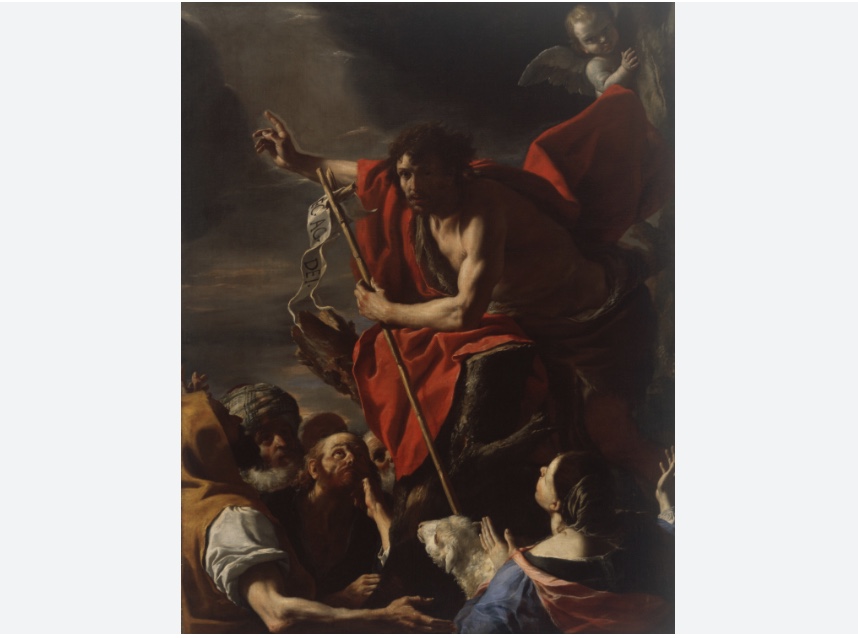
Photo: Painting by Mattia Pretti of John the Baptist preaching of the coming of Jesus, the Lamb of God who takes away the sins of the world.
 Spiritual Stepping Stones