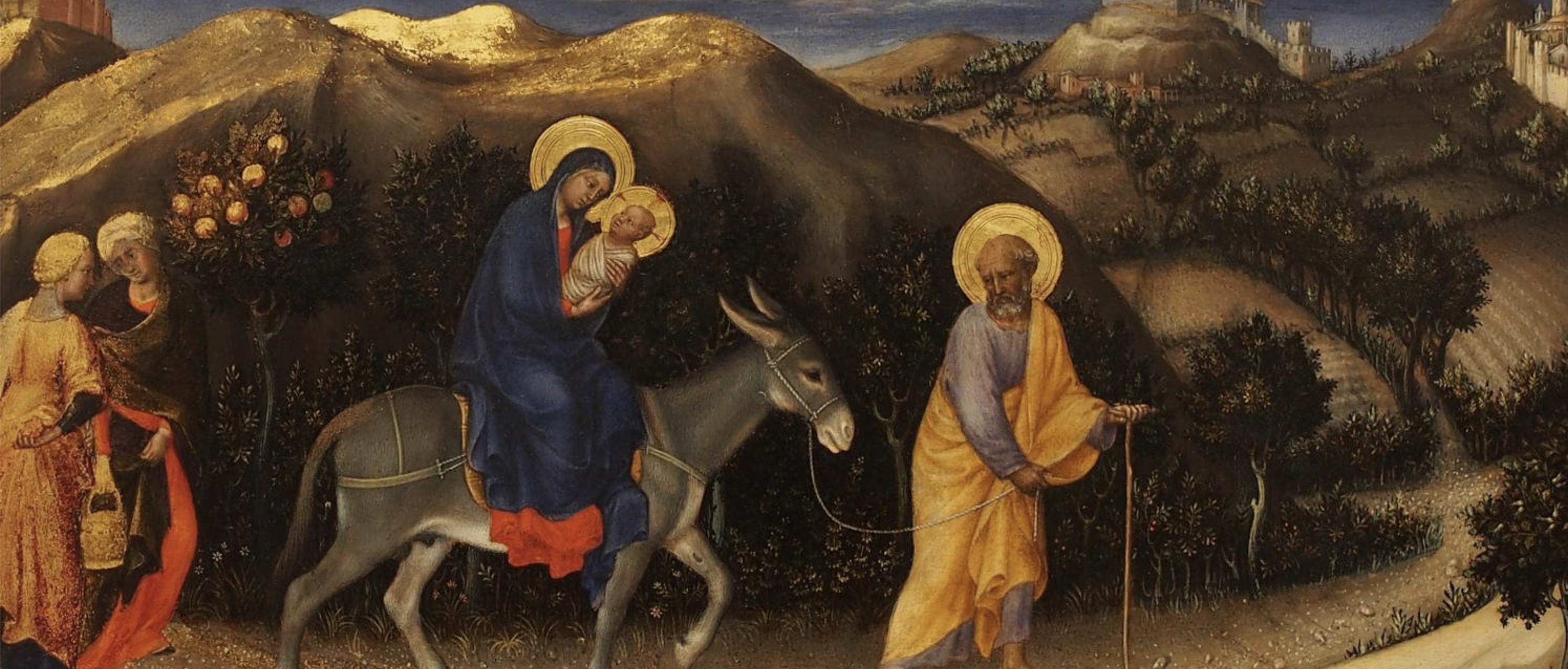
For the Feast of the Holy Family the Church gives us readings today that guide us in living as a family. When we see these guiding principles as guiding us in our relationships beyond blood family, to our family as human beings we will do even better.
Sirach gets us off and running by writing, “Whoever honors his father atones for sins” and “he stores up riches who reveres his mother”. This advice also presents the importance of caring for our parents in old age (cf. Sirach 3:2-6, 12-14). Sirach is building on the forth commandment of the Ten Commandments which is to honor our fathers and mothers. We are not to do so blindly. We can honor, respect, and care for our parents even when they have come up short in some ways. Doing so, will also help us to “atone for our sins.” No small insertion!
We begin the process of our own healing when we can be thankful for what our parents have done for us as well as acknowledging areas where they may have not been there for us. None of us are perfect. We all fall short of the glory of God. We have weaknesses as well as things we do well. We honor our parents when we see them as God sees them, through the lens of love.
To honor our parents, we first must honor God our Father, and so follow the guidance of the psalmist: “Blessed is everyone who fears the LORD, who walks in his ways” (Psalm 128:1). The reference to fearing the LORD here is not a cowering before a tyrannical ruler, but obeying and honoring our Father in heaven who has created us and trusting that he knows better than we do what is best for us and our lives. We do so when we spend time each day reading, meditating and being still with God’s word, so that we can also hear his word spoken in the silence of our hearts. The more consistent we are in this practice, the more his word becomes a living word within us.
As we slow our pace daily, breathe slower, seek God’s love and guidance regarding each thought, word, and deed, our relationships will improve. We will move away from a state of chronic stress and survival mode, such that any conflict, disagreement, or different way of seeing things is no longer perceived as an attack, and even when it might be, we will resist the knee jerk reaction to react in kind. Instead, we can assess what has been said, done or not done, seek to understand, and seek God’s guidance regarding how best to respond.
Practicing more the art of responding instead of reacting will lead to the fruits that St. Paul offers us in his letter to the Colossians (3:12-21) where he invites us to put on heartfelt compassion, kindness, humility, gentleness, patience, bearing with and forgiving one another, and above all to loving one another. The love St. Paul invites us to practice is sacrificing for one another, seeking each other’s best and good. This will provide opportunities to mend and reconcile relationships.
Living in this way will help us see the value in adopting peace and thankfulness. Paul also guides us to spend time in God’s word such that “the word of Christ” dwells within us “richly” and so we will better be able to teach and admonish one another, edify and guide one another, as Jesus does with us. One of the best ways to offer gratitude is through the “singing of psalms, hymns, and spiritual songs.”
Then St. Paul gets more specific as he addresses the relationship with husbands and wives. “Wives be subordinate to your husbands”. Reading this verse out of context and from a reaction to abuses of husbands toward their wives in Paul’s through every age and unfortunately including today, misses the point of what he is conveying. In the next line, he offers, “Husbands, love your wives, and avoid any bitterness”. Paul is seeking to help spouses to grow in mutual respect and love for each other. They are both to sacrifice, serve, and respect one another as well as love one another.
Subordination here in no way implies that wives are inferior to their husbands. Each are to serve and love one another. Paul continues to show this balance that he proposes as he then describes how children are to obey their parents and their parents are not to provoke them, they are not to crush their spirit.
These readings provide the foundation for the gospel from Matthew for today, where we see the model family that lives the above ideals out in practice. The focus is on Joseph today, not at the expense of Mary. Matthew focuses more on Joseph’s role and Luke highlights more of Mary’s role. There is very little about Joseph and in fact, there are no words attributed to Joseph in any of the gospels. Yet, what we see clearly in today’s account, which leaves out the massacre of the holy innocents, is Joseph faithfully in the face of severe persecution willing to protect and lead Mary and Jesus to safety, and keep them safe.
Joseph, as he did when first hearing the news of Jesus’ conception, follows the lead of an angel. In today’s account, he does so three times. He is first guided to escape Bethlehem and go to Egypt to avoid the murderous Herod. After the king’s death, Joseph is called to leave Egypt and return to Bethlehem and then diverts his course, led a third time by an angel, to avoid the son of Herod who is just as egregious a ruler as his father. The young family will go to Nazareth, the home town of Mary.
Joseph shows us that in the time of conflict, challenge, and even persecution, when we trust in God and follow his guidance, he will help us to overcome obstacles and challenges. We would do well to read again in full, meditate and ponder upon, the readings that we have been given today. Through them, we will experience wisdom to help us to grow in and improve our relationship with God and one another. As we read them, we will start to be drawn to parallels in other parts of the Bible.
One example is how Miriam, the older sister of Moses, also trusted in God and played an instrumental role to save her infant brother, from the decree of the pharaoh to put to death all male children. Joseph did the same for Jesus in protecting him from the decree of Herod. Moses would grow to become the savior of his people, freeing them from their bondage in Egypt and giving them the law. Jesus, whose birth we celebrate this week is the fulfillment of the law and the prophets, the Son of God and man, and the savior of all humanity. He came to free us from our sins and lead us back into right relationship with God.
Reading these and other accounts of God reaching out to save his children are not just inspiring accounts. They are relevant to us and life changing when we meditate upon them and place ourselves and our challenges in them. Doing so helps us to enter into the living word of God so that Christ will dwell richly in us. Just as his Father guided him and his parents, the Holy Trinity and the Holy Family will guide us as well!
Photo: “Rest on the Flight to Egypt” by Gentile de Fabriano
 Spiritual Stepping Stones