We can trust that where God leads we will find fulfillment and meaning.
“Jesus summoned the Twelve and gave them power and authority” (Lk 9:1).
Jesus summons us as he did the Twelve and empowers us for ministry in his name. The expression of our service is unique to each of us. Many resist exploring or entering into a deeper commitment to their faith because they are anxious or afraid that God may call them to something that they would never want to do, or that they couldn’t conceive they were capable of. Initially, there may be some trepidation even when we are clear of the direction God wants us to move in, but that may come more from our hesitancy to change and move out from our comfort zone. Ultimately, God wants for us what we want for ourselves; to live a life of fulfillment, joy, and meaning.
God knows what and with whom we will experience fulfillment. The challenge for us is to come to know this for ourselves as well. The work of discipleship begins by accepting the invitation of God to walk with him and trust that he knows what he is doing and where he is leading! No matter what our age, we are never too young or too old to begin or recommit to the journey along the path of discipleship. One good practice is to reflect on our dreams and desires, bring them to God in prayer, and imagine ourselves embracing what we desire.
When I first joined the Franciscans to study for the priesthood in the early ’90s, I would imagine from time to time my ordination day, especially in our second year as we were thinking about taking temporary vows. When I did so, a puzzling result consistently arose. I did not imagine feeling any excitement or joy. So, a year and a half into formation, I decided to take a leave of absence. I had asked to take off a year, but the minimum time for a leave of absence was two.
Though I balked at first about the two-year time frame required, I came to respect the wisdom of my formation director. It was in my second year away, that I realized that my vocational path was leading me to the Sacrament of Matrimony and not Holy Orders. About eighteen months after I made that decision I met JoAnn. As our relationship grew and we began to talk about marriage, whenever I envisioned our wedding day I felt excitement and joy. Each year together has been better than the one before. Though JoAnn left this life far too soon, knowing what I know now after twenty-three years of marriage, I would ask her to marry me all over again!
God has a plan for each and every one of us, he knows what will fulfill us, and he loves us more than we can ever imagine. When we ponder our dreams and desires, and as we investigate, research, explore potential outcomes and continue to pray and discern each step, we will come to see that as we align ourselves with God’s will that makes all the difference. We are not alone in this process and we have a God who can see the full picture, where we see only a small part.
There will be fits and starts, missteps and slips, doubts as well as confirmations, and desolations as well as consolations. The key through it all, is to remain faithful, to continue to trust in Jesus who called us. He will continue to accompany us along the way, he will give us the resources and strength we need, and he will send the Holy Spirit to empower and transform our lives. We need to remember that this process is not just for ourselves alone. We are transformed by the gift of God’s love to go out and share the invitation we said yes to with others.
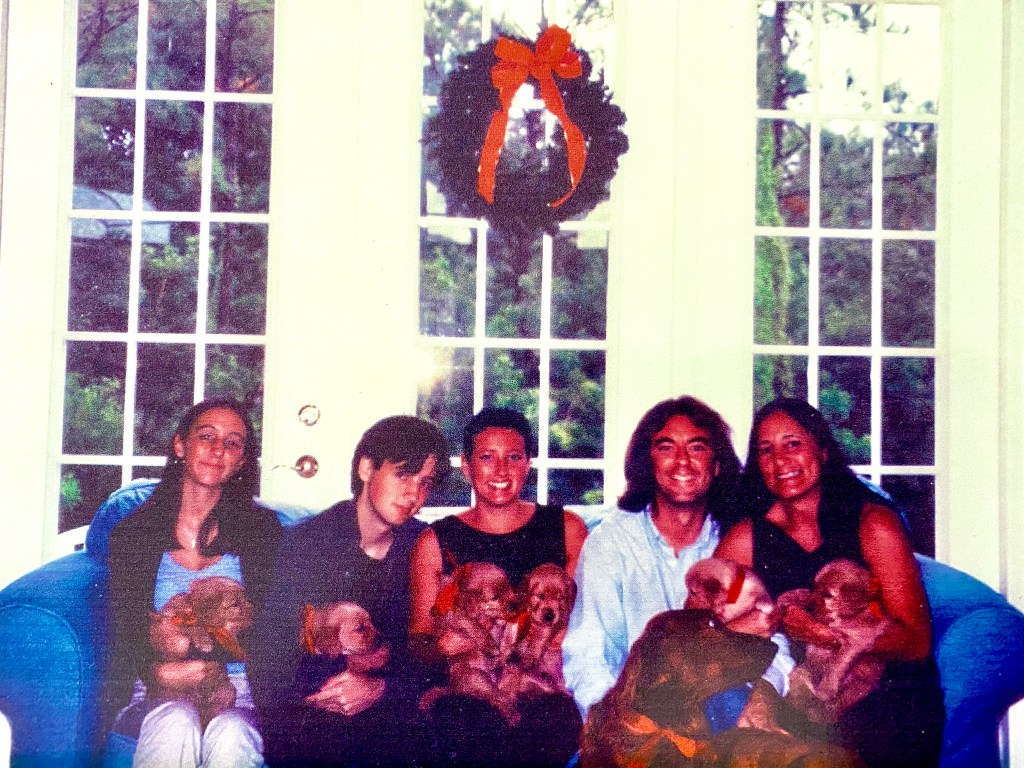
Photo: Following God’s discernment led me to JoAnn, family, and puppies! Picture from Christmas about 2002.
Link for the Mass readings for Wednesday, September 22, 2021
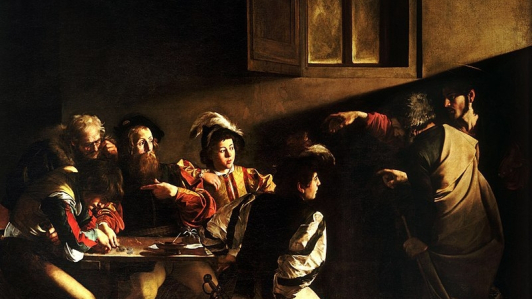
Jesus calls, what is our answer?
“While he was at table in his house, many tax collectors and sinners came and sat with Jesus and his disciples” (MT 9:10).
We as the Church, followers of Jesus, still have much to learn from him. Today’s reading provides another wonderful example. Once Jesus begins his public ministry he is constantly on the go. Going to where? Meeting people where they were, in the midst of their daily lives as he did with Matthew in today’s Gospel reading. And what is the response to Jesus calling Matthew, a tax collector, and then partaking in table fellowship with other tax collectors and sinners? The Pharisees question the disciples about his practice and curious onlookers follow at a distance. But to those who have, maybe for the first time in their lives, been respected as fellow human beings, feel hope. A hope that there actually may be a path leading in from the peripheries. A hope that they no longer have to be on the outside looking in. A hope that they, for the first time in their lives might finally belong.
Jesus is shown time and again encountering the person as they are in their present circumstances and the chaos of their lives. He welcomes, is present, and embraces each person as they are. He invites people to be part of something greater than their self-absorbed posture, to actualize their potential and embrace a life of meaning and purpose. The only requirement is that they are willing to: be loved, be human, be free, and once experiencing this encounter, share what they have received with others.
Do we: deny or mask our own fears, stoke our own pride believing that we can take care of ourselves without the help of anyone else, seek false truths and the glittering lures of power, wealth, pleasure, and honor for our security and satisfaction, that in the end leave us empty, attached, and/or addicted? Or are we willing to have: the humility to recognize our sinfulness, our need for Jesus and receive his love, so as to let go of our bondage to false illusions of security, and realize that we are, at the deepest core of our being, a living, craving hunger and desire to be loved by God and others, so that we too may love in return?
Are we are willing to risk being vulnerable and open our hearts to Jesus? If so, we will experience the love, fulfillment, and belonging we seek in the very depths of our souls. This is the fulfillment that no other pursuit or person can bring. We do this best as Jesus did, by being willing to enter into the lives of others, by resisting judging and instead, accepting another as they are for who they are, by being present and willing to accompany our fellow brothers and sisters.
Jesus said, “I desire mercy, not sacrifice” (Mt 12:7). Mercy, as I have quoted Fr. James Keenan, S.J., before, “is the willingness to enter into the chaos of another.” Jesus is willing to enter into the chaos of our lives. Are we willing to let him in, be loved by him, to be called like Matthew, so we can love others and enter into the midst of their chaos as well?
——————————————————
Painting: The Calling of St. Matthew, Michelangelo Merisi da Caravaggio, 1600
Link for the Mass readings for Monday, September 21, 2021

May we be willing to shine our light and welcome others.
Jesus said to the crowd: “No one who lights a lamp conceals it with a vessel or sets it under a bed; rather, he places it on a lampstand so that those who enter may see the light” (Luke 8:16).
God blesses us freely without cost, he gives himself to us. He has done great things for us and he is the source of our joy! We do not earn nor is there anything that we can do to gain God’s grace. But we can lose the gift we have been given. This happens either by refusing what has been offered, or once accepting and receiving, not doing anything with our gift. If we are people of faith in name only, but not followed by action, we are concealing the light we have been given.
Since being diagnosed with Covid and pneumonia in January, I have not been able to exert myself in any physical way for the past eight months. Now that I have been improving, I am in a position to begin walking and exercising again. I am so far away from any habit of either and demands to my time during the school year are high, it has been hard to begin again. I have a biopsy this Thursday and once I receive word on the results, probably sometime next week, I plan to begin to exercise and go for walks again, beginning easily and slowly.
Life can also interupt our spiritual practices. If we do not exercise our faith, we will receive signs of spiritual atrophy. To not even acknowledge the presence of God in our life, the free gift of his invitation to be in a relationship with him, we will experience limitations in our lives. For whether we believe in God or not, we hunger to be in communion with him and one another, so we will be looking for other apparent avenues of happiness that will fall short of fulfilling us. If we do accept that there is a God, yet don’t participate in worship, fellowship, service,meditation and prayer, we are not much better off. I can believe that my car will get me to where I want to go, but if I do not put the key in the ignition, turn on the engine, and put the car in drive, I will remain stationary.
If we claim to be people of faith, we need to put our faith into action. That means on a daily basis we need to spend time meditating and praying, reading the Bible, studying our faith through spiritual reading, CDs, DVDs (I at first wrote cassettes and videotapes!) and/or podcasts. We need to consistently participate in worship, the sacraments, and be engaged in service with one another. As we do so, we will begin to reflect Jesus to others and so be able to see God at work in our everyday experiences and better collaborate with him in all we do.
In allowing the light of Jesus to shine through us, we also need to resist the tendency to privatize our faith, while at the same time resisting getting in someone’s face. Instead, we need to be present, caring, understanding, supportive, and willing to accompany one another, even others of no or different faith traditions. Building relationships with one another in our community, schools, work places, and areas of activities are a good first step.
Jesus has given his life for us, and he continues to be present to us. May we be open to being conformed today and each day by his love and mercy. We do so by consciously turning away the temptations of sloth, indifference, prejudice, and fear, and instead seek to encounter one another. Jesus is willing to enter the chaos of our lives. May we too be willing to do the same for one another by seeking in each interaction to radiate the presence of Christ’s light, so as to shine with actions of patience, understanding, support, joy, and hospitality in such a way that anytime we come together, God happens.
hoto by Gursharndeep Singh from Pexels
Link for the readings for Monday, September 20, 2021

May the embers of God’s love catch fire in our souls.
James, from our second reading today, asks a question that unfortunately needs to be asked in every generation.
Where do the wars and where do the conflicts among you come from?
James gives us a place to start:
Beloved: Where jealousy and selfish ambition exist, there is disorder and every foul practice.
Conflict and division come from the disordering of our thoughts, desires, passions, words, and actions. There is something a bit off kilter with us. This disorder or dis-orientation is caused by our choosing our self over God. This stance of turning in upon ourselves, saying we are the center of the universe and all is to revolve around us comes from the condition of Original Sin which weakens and wounds our human nature. This condition is made worse by the belief that we can save ourselves.
We seek the truth, we seek to be happy and we seek to be fulfilled but we follow false promises, substitutes that are apparent goods that appeal to our egotism, our prid, and our fear. St Thomas Aquinas, the thirteenth century Dominican doctor of the Church, categorizes these four substitutes or temptations that lead us astray from our proper orientation to God:
Pleasure, Wealth, Power and Honor
In and of themselves there is nothing wrong with any of these, but when we make any or all of them into an idol, our primary focus, when we pursue them as a means to provide our stability, satisfaction and fulfillment, we will be led astray.
Pleasure feels good and it brings us instant gratification. The problem is that once the external agent or stimulus of the pleasure ends, so does the experience, and it leaves us empty and wanting more.
Wealth promises us that if we just have enough money we can get whatever we want, do whatever we want, we can also be safe and secure. But again, we will still experience that deep hunger within us that cannot be fed by that which is finite or material.
Power has the promise of access, of controlling the unpredictability of life’s challenges, yet, as the Catholic historian and moralist, Lord Acton, wrote: “Power tends to corrupt and absolute power corrupts absolutely.”
Honor, closely linked with power, we see played out in our present day through the cult of celebrity that is sown into the very fabric of our society. So many seek their fifteen minutes of fame, too many not caring how they can get it.
We witness the Apostles in today’s Gospel, the closest to Jesus and his teaching, falling for the temptations of power and honor as they argue among themselves who is to be the greatest among them. The deeper sadness of their debate is that they are engaged in it just after Jesus has explained to them that he will be handed over and killed. The Apostles are so ensnared in the hierarchical structure of the society of their time that they fail to have the empathy and compassion to be present to Jesus as he shares with them his horrific fate.
We witness time and again, from the ancient times to today, the effects of Original Sin. The English convert to Catholicism, GK Chesterton, wrote that, “original sin… is the only part of Christian theology which can really be proved” (Orthodoxy). We can see it in the streets, we can see it in the news, we can see it looking back at us in the mirror, for we too fall into indifference, lack of empathy, and resist slwoing down enough to be present and accompany others.
Original Sin is perpetuated when we choose to put ourselves in the center where God belongs. We must resist its lure and acknowledge that we cannot save ourselves, we cannot find happiness, security, joy and fulfillment in any finite or material pursuit. While at the same time, we can also acknowledge that even though Original Sin is real, even though we have been wounded and battered by its effects, we have not been overcome, we are not totally corrupt or destroyed by it.
We have been created good by God, and the embers of that goodness remain in each and every one of us. The embers still smolder, just awaiting to be stoked and set ablaze. God has created us as a living, craving, hunger and desire to be one with God and one another and this is true for the atheist and the mystic alike.
The antidote to the poison of Original Sin is Jesus the Christ. He, the Son of God, the Second Person of the Holy Trinity, who became one with us so that we can become one with him. In our Baptism we are cleansed from the condition of Original Sin and are indelibly marked, we are conformed to the very being of Jesus. We become part of his Body.
Yet, while freed from the bondage of Original Sin by our Baptism, we are still tempted to return to the place of our slavery, like the Hebrew slaves yearning for Egypt, like Lot’s wife looking back to Sodom and Gomorrah. We need to keep our eyes focused on looking ahead, to that which is above. Jesus shares with his Apostles in today’s Gospel that we are to turn the pursuit of pleasure, wealth, power, and honor on its head when he states that: “If anyone wishes to be first, he shall be the last of all and the servant of all.” Only a relationship with God will bring us happiness and fulfillment.
We begin our path of walking as disciples by becoming like the small child that Jesus brought into their midst. The child in ancient Palestine was nothing. He had no status, no significance, no wealth, power, or honor. Each child was completely dependent on their parents. This is to be our starting point in being a disciple. We need to reject the notion outright that we can heal ourselves and admit that we need Jesus to restore us to our relationship with our Father and place our sole dependence in him for everything. God, not self, is to be our end goal.
As James wrote, “the wisdom from above is first of all pure, then peaceable, gentle, compliant, full of mercy and good fruits, without inconstancy or insincerity. And the fruit of righteousness is sown in peace for those who cultivate peace.”
May we support and accompany one another as we seek to deepen our journey with Jesus. May we be willing to serve, to give of our time, talent and treasure to build up the Kingdom here on earth. May we be willing to gather and join a small group, so that we can feel the support and encouragement so as to realize that we do not have to walk alone. May we be open to pray to the one who created us, read the Bible to enter into the lives of those who have experienced an openness to encountering God, and read the lives of the saints, those who are now where we seek to one day be! May we participate in the sacraments and life of the Church, and above all, share our stories of faith with those in our realm of influence and invite others to join us on our journey.
We are one Body in Christ. All of us want to be happy, fulfilled, find meaning in our lives, to belong and to be a part of something greater than ourselves. This is who God has created us to be. St Augustine realized this when he wrote: “You have made us for yourself, O God, and we are restless until we rest in you.” It is never too late to come to realize that God loves us more than we can ever mess up and that God loves us more than we can ever imagine. God is our hope, our goal, and the answer to our deepest desire.
Let us cast off jealousy, fear, pride, and selfish ambition, and instead prepare our hearts, minds and souls to receive Jesus in our time of meditation, prayer, service, in his very real presence in the Eucharist celebrated today at Mass, so to be forgiven, healed, renewed, reconnected, and in so doing, find the fulfillment we have been created for.
Once we receive and experience his unconditional love, may the embers of our soul ignite with the flame of his love such that we can recognize the wonderful diversity of the Body of Christ in those we encounter and be willing to embrace and respect the human dignity of one another in each and every one of our interactions this week.
Photo by pixabay
Link for the Mass readings for Sunday, September 19, 2021
May we offer good soil for God’s seed to grow in our lives.
“The seed is the word of God” (Lk 8:11).
Jesus expressed in his parable of the sower the ways in which we lose the germination opportunity or coming to bear fruit of the seed that has been sown. Those seeds falling on a hard worn path with no opportunity to be buried in the soil are like devil that “comes and takes away the word from their heart that they may not believe or be saved.” Another way can be from those who fixate on mere scientism or empiricism, and so denounce any spiritual or transcendental experience as mere coincidence, or dismissed as offering no empirical substance, no proof, thus explaining away any trace of spirit. Others “receive the word with joy but have no root.” Some encounter God, experience a deep emotional connection at the moment but once the emotion wanes, they move onto other pursuits, other experiences that will satisfy the senses. Still, others receive for a time God’s word, come to a place of germination and sprouting, experience new growth but “are choked by the anxieties and riches and pleasures of life, and they fail to produce mature fruit.”
We still fall prey to each of the above examples and at different times. We are distracted, diverted, busy, we seek merely accomplishing and moving on to the next activity or item on the list, but if we ever want to experience mature fruit, we must “embrace [the word] with a generous and good heart, and bear fruit through perseverance.”
Do we read a book just to finish, go to church just to say we went, visit or call relatives, friends, to say we have accomplished our duty, go to work or school just to get to Friday? To be fully alive we need to be present in our experiences. To embrace what we do, it is important to slow down and breathe. Then maybe we can read to come to understand and put into practice what we may have learned. This is truer still when we are reading the Bible. Spending time meditating and contemplating upon a few words or phrases that spark our interest well past the initial reading is very helpful.
This practice can also apply when we go to church, in person or online. We can receive a lesson or two from a prayer, a hymn, the word, or preaching, take something with us, think about and put it into practice over the week. When we communicate and visit with friends and family, it is important to be present, and open to their needs, willing to hear their stories, and experiences. It is also good to be open to the wonder of those friends and family we have not yet met for whom in the past we may have just walked by or over. In our work, our dedication to school as a student, our entry into retirement, we can resist the attitude of just getting through the day and instead seek meaning in what we do and embrace the joy of the gift of life we have been given.
When we take some deep breathes, are present and more mindful in our daily activities, we might be more aware of the seeds that God has sown, more apt to nurture them, more patient with the process of germination and growth, and more able to persevere in our discipline of study, prayer, worship, serving one another, and strengthening our relationships to allow good, firm roots to take hold and soon experience some wonderful growth!
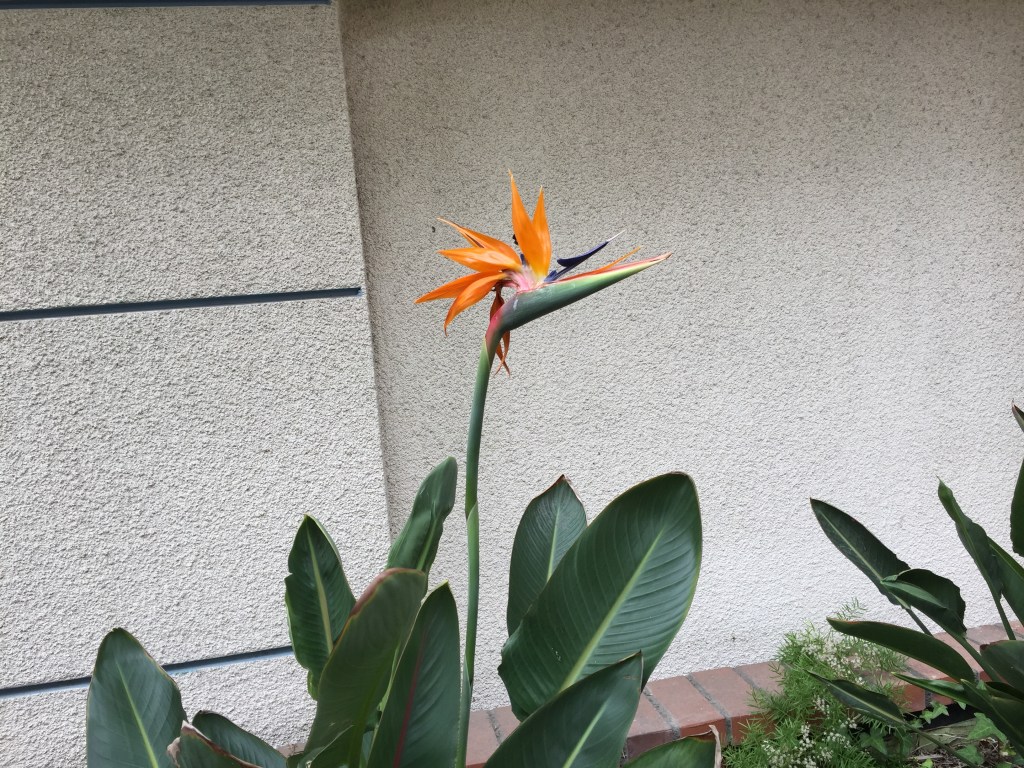
Photo: Bird of Paradise in the meditation garden outside our apartment while living in Los Angeles in 2019.
Link for the Mass readings for Saturday, September 18, 2021
Together in all kinds of weather.
Accompanying him were the Twelve and some women (Lk 8:1-2).
A simple statement to be sure, but very significant in how Jesus again is showing us how to live our lives as followers, disciples of him. Jesus, as I have written many times, is fully human and fully divine. What he has done and is doing as the Son of God incarnate is to draw close to us in our humanity, as a human being, so that we can enter into a relationship with him and his Father through the love of the Holy Spirit, thus becoming one with him in his divinity.
From the beginning of his public ministry and throughout, he is inviting people to participate in his life and the kingdom of Heaven which is at hand in his very presence. Time and time again Jesus does so by building relationships with people. This is how Luke can write the verses that Jesus was accompanied by the Twelve and Mary Magdelene, Joanna, and Susanna. These were real people with whom Jesus developed real relationships.
Christianity is not a Lone Ranger religion, it is not the survival of the fittest, and Jesus did not teach that we have to pull ourselves up by our own bootstraps. We are created by God to be in communion, to be in a relationship with him and one another, and that means we need to accompany, empower, and support one other.
We are to go out, encounter, and make time for each other by exchanging the stories of our tragedies and our triumphs. Even during a pandemic, we are to resist the temptation of withdrawing into our own bubbles. Instead, we need to take the risk to be vulnerable with one another, obviously to do so more carefully and prudently during this pandemic by getting vaccinated, wearing masks, and pracitcing social distancing. Relationships are messy but with commitment, God, and an open heart and mind, we can grow closer together.
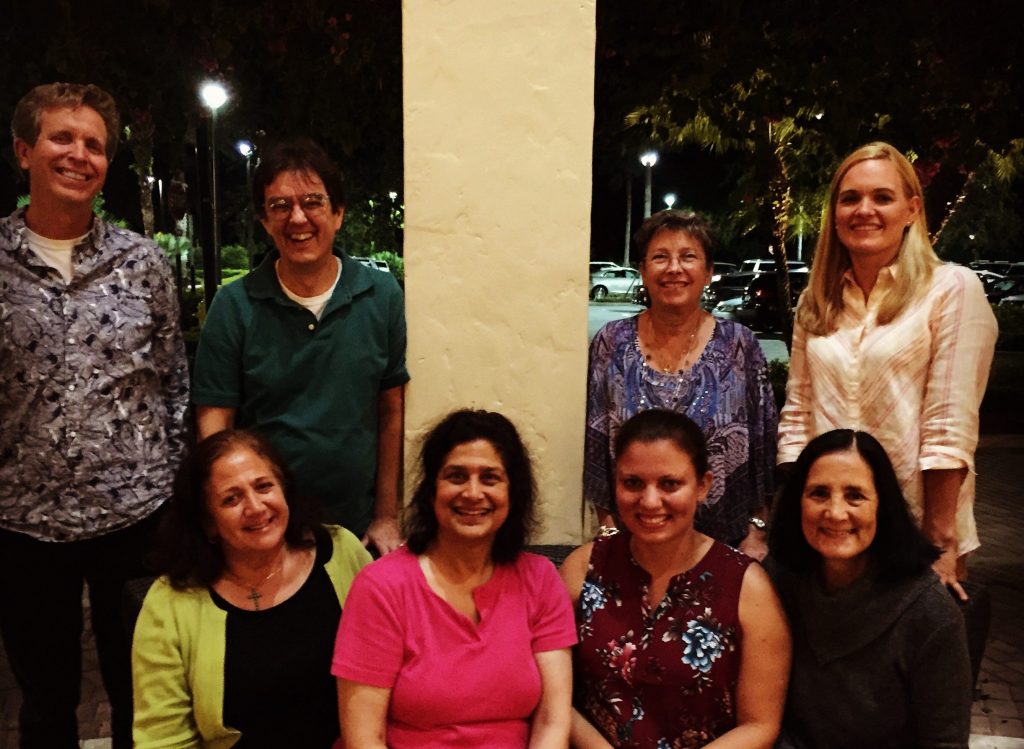
JoAnn and I experienced this gift of fellowship when we joined a small group at our parish. We learned about and grew in our faith, yes, but more importantly built relationships grounded in our mutual respect for one other even when we disagreed. We have shared stories and explored the good, the bad, and the ugly, of our lives.
We forged such a bond that JoAnn and I agreed without hesitation that each one of the members of our group would play a significant and intimate part in JoAnn’s funeral Mass. JoAnn is still a part of our group as she prepares the way for us to follow and still reminds Giovanna that we need to break by 8:30 because it is a school night and I need to get to sleep! Since my time of recovery, I have been able to attend less even though we meet on ZOOM. My hope is that my strength with return soon and I can return to our weekly gatherings.
Jesus chooses each one of us to accompany him and to forge relationships grounded in mutual respect, where no one is last and where no person is left behind. This is what our faith is all about and this is why we are a joyful people, an alleluia people, even while it appears sometimes the world is coming apart at the seams.
————————-
Photo: Our small group celebrating two years together.
Are we capable of the same contrition as the woman in today’s Gospel?
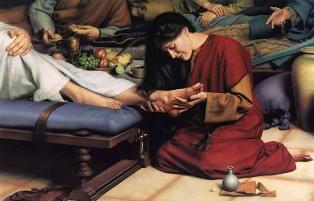
Bringing an alabaster flask of ointment, she stood behind him at his feet weeping and began to bathe his feet with her tears. Then she wiped them with her hair, kissed them, and anointed them with the ointment (Lk 7:37-38).
Logistically, to our modern minds, the setting of this verse may appear to be confusing. How could this “sinful” woman be standing behind Jesus such that her tears would fall on his feet? This could be confusing to us because when we think or imagine someone sitting and eating, they do so by sitting in a chair. Thus the feet would be toward the front of the person.
During the time period Jesus lived, the customary practice when eating was not to sit at all but to recline. Thus, the woman was standing behind the feet of Jesus as he reclined, and her tears fell on his feet. She then knelt down, dried his feet with her hair, and then anointed Jesus’ feet with the ointment she brought for him.
Today’s Gospel account is a simple but powerful scene of contrition. This is the posture we are to approach Jesus when we have sinned. We are not to rationalize, deny, ignore, or come grudgingly forward when we are caught and held accountable for our sin. We are to feel true contrition or sorrow for the sins we have committed because the healing presence of Jesus leads us to a place of compassion and understanding for the hurt we have caused others through our sinful actions.
Unfortunately, there are too many leaders in the secular as well as the church who assume the posture of Simon the Pharisee in this account. They puff up their chests in righteous indignation over the sins of others, while not being transparent and forthcoming with their own sinful choices and behavior. Using instead their means of power, prestige, and places of honor, not to serve and empower others but to hide and protect themselves from being held accountable, and/or justifying and rationalizing their own weaknesses and vices.
Those who are quick to point the finger at other’s sins are less apt to be aware of the depth of their own sin and thus “the one to whom little is forgiven, loves little” (Lk 7:47). One is not forgiven because God is not willing to forgive but because God will not go against our free will. If we are unaware or unwilling to bring our sins forward in a contrite manner, we are cutting ourselves off from the healing forgiveness of God that he so much wants to share with us. But if we, like the woman in today’s Gospel account, are willing to bear our soul with humility and sorrow we will not only be forgiven but experience a deeper outpouring of God’s love. The one who confesses contritely is forgiven more and thus is able to love more.
Would are offered the same gift of grace that the woman received. What if instead of hiding from, being in denial of, rationalizing, or justifying our sins, we acknowledged them and sought the healing forgiveness of Jesus as she did? In opening up our hearts and minds to the forgiving and purifying love of the Holy Spirit there is pain, as there is in any healing, but there is also freedom when we are able to do as the woman in the Gospel did today. When we trust Jesus as she did with our deepest and darkest sins, we too can be healed so as to be freed of the shackles that bind us and to love as we have been loved. God loves us more than our worst mistakes and we will know and experience God’s love more fully when we confess and are forgiven of them.
Photo: accessed yiahara.com
Mass readings for Thursday, September 16, 2021
If we experience sorrow, it is because we have been willing to love.
When Jesus saw his mother and the disciple there whom he loved he said to his mother, “Woman, behold, your son.” Then he said to the disciple, “Behold, your mother.” And from that hour the disciple took her into his home (Jn 19:26-27).
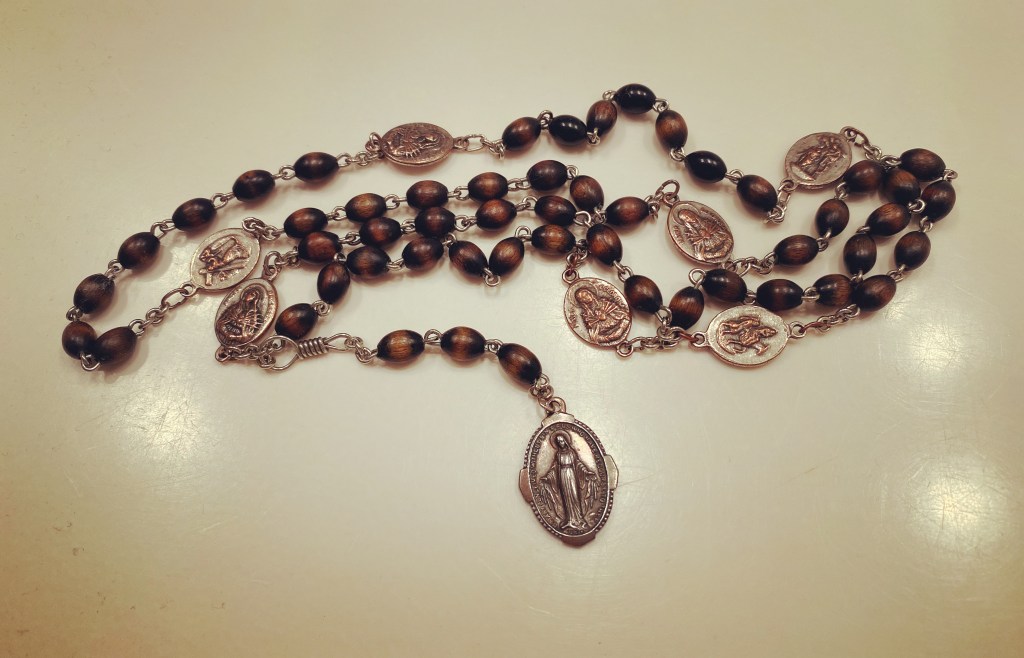
In the summer of 1991, I entered the Franciscans of Holy Name Province as a pre-novitiate and was stationed at Holy Cross Friary in the Bronx. My ministry for that year was working in the friary and the adjoining parish of Holy Cross. Shortly after entering, one of the friars, Br. Paul Goldie, passed away. He had been serving at the friary since 1953 and had been a friar for 54 years. A practice among the friars was to pass on personal items to those in the community when one of their own passed away. I was honored to have been given a picture of St. Francis, that hangs in my classroom and Br. Paul’s rosary.
I noticed that the rosary was different from others. Instead of a crucifix it had a Miraculous Medal, instead of five beads there were three beads leading to the decades of beads, and instead of five decades of beads, there were seven groupings of seven beads. In between each of the series of seven beads there was a small medal. On one side was a picture of Mary pierced in the heart seven times, and on the back of each medal was a different scene.
I would find out some time later that this was a Rosary of Our Lady of Sorrows. The depictions on the back of the seven medals represented Mary’s seven sorrows: Simeon announces the suffering destiny of Jesus, Mary escapes into Egypt with Jesus and Joseph, Mary seeks Jesus lost in Jerusalem, Mary meets Jesus as He carries his Cross to Calvary, Mary stands near the Cross of her Son Jesus, Mary receives into her arms the body of Jesus taken down from the Cross, and Mary helps place the body of Jesus in the tomb.
The fifth mystery, Mary stands near the Cross of her Son Jesus, is from our Gospel reading today. For Mary to witness her son dying such an agonizing death, it must have been the most sorrowful of the seven. Yet, Mary did not run from the pain, she embraced his and her own pain, the piercing of the lance, pierced her own heart, the depths of her own soul. Mary, though free of sin, was not free of the pain of a fallen world. In fact, Mary, like Jesus, felt it more deeply.
By being willing to love, we risk experiencing and entering into the pain of those we love. So many times we run from love, because we do not want to experience the pain relationships entail. We are finite and fragile beings, and so we will let each other down, we will make mistakes, say the wrong things, do hurtful things, we will get sick or deal with chronic illness and need care, we will lose patience, we will sin, and those we care about will die. Jesus though calls us, like Mary and John present at the Cross, to remain present to one another, to love, to will the good of the other, and so to experience the fruit of an authentic relationship which is grounded in the unimaginable love that God the Father has for us.
Love is the bond of communion that gives us the strength to move through the crossroads and upheavals of life. Love is the bond of commitment that draws us out from our selfishness so to learn from one another, to grow stronger together, and to be present to one another. Where there is an authentic relationship, there is love at its foundation. When we love one another we participate in the communion of the Holy Trinity, we participate in the very same divine communion of the Father, and the Son, and the Holy Spirit.
Is there risk of rejection in inviting another? Yes. Is there pain in love? Yes. Is there conflict in relationship? Yes. Yet to be fulfilled, to be fully alive, for love to be real, we must be willing to take the risk to love and be rejected, just as God does with us. As we enter relationships or strive for better authenticity in our present relationships, we must be willing to love, to commit to one another, to be present to one another, to sacrificew and share our pain and experience another’s pain. We must be willing to accompany each other in our imperfections as well as be humble and willing to offer and seek forgiveness and reconciliation.
I do not know if we can ever come close to imagining what Mary and John experienced with Jesus at the climax of his crucifixion. Each of them embraced horrific pain and sorrow at the foot of the cross, yet they remained, and so they were able to mourn, heal, and experience the full joy of the Resurrection. At the coming of the Holy Spirit at Pentecost, they also experienced the divine communion of love between the Father and the Son and shared that same love and commitment with the community of Jesus’ followers and those who had never met him.
Br. Paul’s Rosary, which I still pray with, was passed on to me. It is a reminder for me of the brotherhood I shared with the friars for the year and a half that I was with them. It is also a reminder that there will be pain and struggles in this life. Mourning JoAnn’s loss, recovering from pneumonia has been my most recent ways of joining with Mary’s sorrows. I am learning that instead of running from but being willing to embrace sorrow is to find Jesus waiting with his arms wide open to receive, hear, comfort, and assure us that he is with us. May we also remember to lean on, be present to, support, and love one another as Mary and John did. Peace and all God’s good be with you.
Photo: Br Paul’s Rosary of Our Lady of Sorrows
 Spiritual Stepping Stones