Rooted firmly in Jesus and cutting back the vines of false truths, we can mature.
In the Gospel today, Jesus explains to his followers his Parable of the Sower. Many people of faith would fall into the third category: “The seed sown among thorns is the one who hears the word, but then worldly anxiety and the lure of riches choke the word and it bears no fruit” (Mt 13:22). Jesus is a part of our life, we are growing in our faith, but our discipline and maturation, and so bearing of the mature fruit is diminished. We are limited because Jesus is only a part of our life, not the core foundation. This is because we look to the world and its false promises to be our security and support.
Pope Francis questioned in his apostolic exhortation, The Joy of the Gospel: “How can it be that it is not a news item when an elderly homeless person dies of exposure, but it is news when the stock market loses two points? This is a case of exclusion. Can we continue to stand by when food is thrown away while people are starving? This is a case of inequality” (Francis 2013, 53). How often is it that the top voting issue in our national elections has to do with concern about the economy?
If we are placing our hope and focus, if our primary source of building for ourselves a secure foundation is in the political and economic realm, we are going to be consistently anxious and stressed. Our faith is going to be choked, and worse our politics will be shaping the Gospel instead of the Gospel shaping our politics. We will justify and rationalize behaviors from our leaders that are contrary to living our life aligned with the teachings of Jesus as long as the economy is going well.
These subtle vines of false security also promote the privatization of our faith. If we seek to counter and challenge injustice, if we call for an awareness of those who are vulnerable and suffering, if we call out actions that are immoral, speaking out for the rights of the unborn, we can face the backlash of being accused of stamping on an individual’s personal rights; being called a socialist or a leftist, by seeking to keep migrant families together, to provide a safe haven for asylum seekers or refugees. Taking the risk to be “God’s microphone”, to speak the Gospel publicly, is challenging today because: “The process of secularization tends to reduce the faith and the Church to the sphere of the private and personal” (Francis 2013, 64).
To live our faith is not just a hobby and it means more than just doing so in our own home. If we are going to mature as disciples of Jesus, we are going to need to resist the false lures of riches and material security, we are going to need to be willing to face the anxieties of criticism and hostility for speaking the truth of our faith. The unfortunate part is that we may face a lot of push back from those of our brothers and sisters even within our own churches, the Body of Christ.
We can mature as disciples when we are willing to commit daily to reading the Bible, seeking resources to better understand his word, praying and meditating, pondering the teachings of Jesus, and so better have the eyes to see and ears to hear his Word and guidance. As we build our foundation on Jesus and his teachings, put them into action in our everyday lives, build a support group, we can share with others the trials and successes of our journey of faith. These small acts will make a tremendous difference.
Courage is a mark of feeling the fear and saying and doing what we are inspired by God to do anyway. Let us call on the name of Jesus when we are tempted to place our trust in anything other than God, may we call on the love of the Holy Spirit to give us the words to speak and the actions to impart, with understanding, and kindness, when we are in the midst of people expressing unjust, disrespectful, or dehumanizing words or actions.
Jesus is calling all of us to deepen our relationship with him and to invite others to do the same. The road ahead and the trials we will face will not be easy but as we face them, with Jesus and one another, we will become stronger. We will begin to mature and bear fruit when we allow Jesus to be our constant source and our foundation. Sustained by his power we can then act with courage and put into practice what we learn.
Apparent goods and the false expressions of material security seek to lull us into complacency and indifference. The tendrils of anxiety and fear, often from our limiting cultural identifications and social pressures, squeeze at our heart and throat to keep us indecisive and unresponsive to God’s call for us to act and speak beyond our comfort zones. Our answer to these pressures is to remember that we are not alone. We need to call on Jesus, trust in him, risk and step out in love to serve and accompany others in need, to build relationships with our brothers and sisters in faith, of different faiths, and no faith, so to cut away the vines and thorns, to remove all that is not of God, that attempt to choke us and keep us separated.
Over time our soil will become richer, our roots will grow deeper, the Love of the Holy Spirit will increase in our hearts, minds, and souls, we will begin to see others through God’s eyes, we will become more human, more open to a maturing relationship of communion with our loving God and each other, that bears the mature fruit of love, joy, peace, patience, kindness, goodness, gentleness, faithfulness, and self-control.
——————————————————————
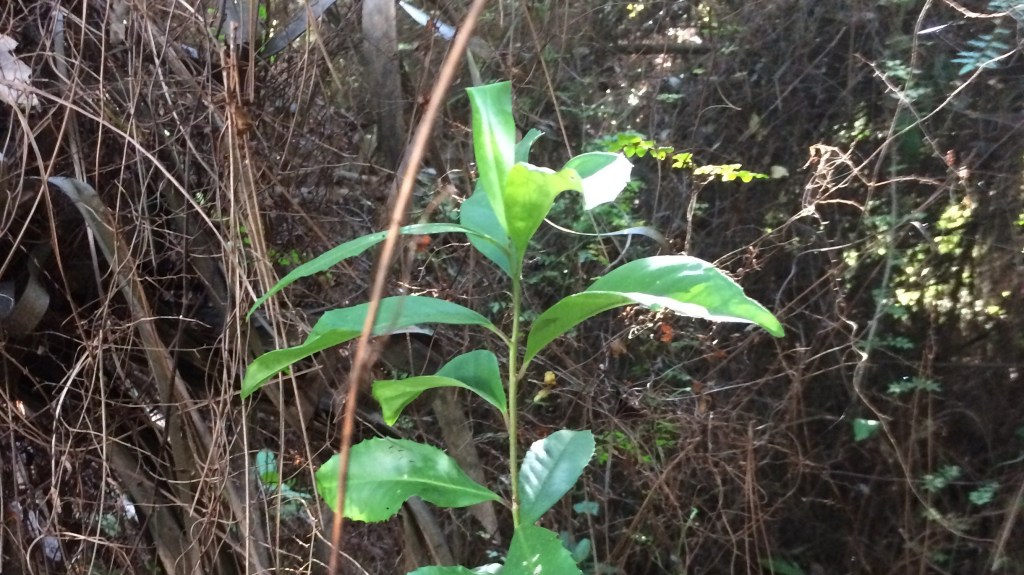
Photo: Plant in our backyard, a symbol for us to be true to ourselves and who we are called to be, growing and maturing free of the vines around that attempt to choke it.
Pope Francis. Evanglelii Gaudium: The Joy of the Gospel. Frederick, MD: The Word Among Us, 2013. Link for online access:
http://w2.vatican.va/content/francesco/en/apost_exhortations/documents/papa-francesco_esortazione-ap_20131124_evangelii-gaudium.html
Link for Mass readings for, Friday, July 24, 2020

May the light of Jesus soften our hearts and minds.
The root of the message offered in today’s Gospel is what is foundational to the beginning and continuing as a disciple of Jesus. This being the disposition of our hearts. Are we closed to receiving the message of the Gospel, or are we open to embrace the invitation of Jesus to become more active in living out our faith in our everyday life?
The exchange of Jesus with his disciples in today’s reading from Matthew comes after his sharing of the Parable of the Sower (Mt 13:1-9). In this parable, Jesus offers scenarios regarding the conditions of seeds sown. Some fell on a hardened path, some on rocky ground, some fell among thorns, and some fell on the rich soil. The seeds in the first three settings were not able either to germinate or come to full maturity. The seed that was sown in rich soil was able to germinate, sprout, mature, and bear fruit.
As disciples, we are meant to bear fruit. That means our beginning step to preparing rich soil is to have an open heart and mind to the message of the Gospel. If we have eyes to see and ears to hear, we can quickly assess when our hearts are hardened and our minds are closed. When someone makes a statement, do we immediately judge it before the sentence is even completed? If we are in touch with our emotions, are we aware of the tenseness of our body and our shortening of breath? Think back to some times when we have reacted in this way, think of some times when we have had similar reactions in prayer, or when we feel God leading us to serve in a particular way, or when a scriptural passage piques our interest and we ignore it, read on, or close our Bible. How about times when a person interrupts us with an issue, or we see someone in need and keep walking and while we walk away with feel the angst of guilt. More directly regarding our present situation, how do you feel discussing racial issues and getting in touch with our own biases and prejudices?
The good news presented in the above examples is that we are alive and our conscience is somewhat intact. Our soil may be on rocky ground, there may be some weeds and thorns, but at least there is some soil. The most difficult state and the one Jesus addressed in today’s Gospel is the heart of indifference that is closed, the seed falling on the well-trod path, that is hard and packed so nothing gets through. For these people, “they look but do not see and hear but do not listen or understand” (Mt 13:13). Yet, even this soil can be broken open and tilled. Even the hardest heart can be softened if one is willing to turn to Jesus.
Jesus, in his explanation of why he spoke in parables, returned to the inaugural message of his ministry: “This is the time of fulfillment. The kingdom of heaven is at hand. Repent and believe in the Gospel” (Mk 1:15). To be a disciple of Jesus we need to be willing to repent, to acknowledge the places in our hearts and minds that are closed, those areas that are hardened from real or perceived past pain or trauma, those situations in which we choose to shut down and separate ourselves from God and others. When we allow Jesus in, we can experience his healing touch. By risking to reach out in this way for help, we can begin to heal. As we do so, we can begin to hope, to care, and to love.
Being a disciple means that we will make mistakes, we will not be perfect, we will be hurt, betrayed, and experience the injustice of this world. But if we trust in Jesus, are willing to learn from our mistakes, return to him for healing and confession, our hearts will soften and our minds will open.
We will come to experience that we are not alone, that we have not been abandoned, that there is hope because there is a way forward, there is a goal we have to attain, which is to enter into the process of becoming true to who we are and who we are called to be. We will also begin to experience our interconnectedness with one another. When we come to realize that we are not alone, that we are not an island in a sea of people, that we are loved, we may be more willing to hear other people’s stories, be more understanding of their struggles and trials, and maybe begin to have eyes to see and ears to hear our brothers and sisters that have been beside us all along. Instead of being a part of the problem, we can then begin to be part of the solution.
Photo: Autumn Heart Leaf from pexels.com
Link for the Mass readings for Thursday, July 23, 2020
Jesus will meet us in our sorrow as he did with Mary.
Mary Magdalene went and announced to the disciples, “I have seen the Lord,” and then reported what he told her (John 20:18).
Mary is the Apostle to the Apostles! Though before she announces this proclamation, the foundation of our faith that Jesus has risen, we find Mary weeping outside the tomb. She is crushed by the death of her teacher and his body appeared to have been taken away. Peter and John, following Mary’s initial lead, ran to the tomb, saw it empty, and “then the disciples returned home” (Jn 20:10).
Mary stayed, she remained still, experiencing her doubt and growing despair.
How many times have our hopes been obliterated, what pain have we or do we endure, what horrors do we continue to witness in our lives, throughout our communities, country, and the world? When Jesus first speaks to Mary, she does not recognize his voice, thinking him to be the gardener. Are we like Mary, that we are so weighed down by our sorrow that we are unable to recognize Jesus in our midst?
Mary was willing to weep, to experience and not run from her sorrow, and deep down held on to hope. Even after seeing the tomb empty, even after Peter and John had left, she still looked in the tomb again. Despite a growing doubt and despair, even after encountering two angels, she did not leave the empty tomb. In the midst of her disillusion, Mary recognizes the risen Jesus when he calls her by name!
May we also not lose the ability to weep and to also hold on to hope. Both are part of our humanity. To lose our capacity to weep is to risk the slide into the temptation of indifference to our own pain and the agony of others. Hope is a cornerstone of our faith. Jesus is present in the midst of our brokenness. When we are willing to be still and experience our emotions, resist the temptation to run away from them, while at the same time embracing hope, we too will encounter Jesus.
Jesus is present in the midst of our trials and/or sorrows, as well as our joys, as he is present with us through the full range of our experiences. After we encounter Jesus, like Mary, may we go boldly forth with joy, to proclaim what he tells us! May we share the stories of our encounters with Jesus so as to be a living Bible to others. Our stories shared may be the only Bible someone else ever reads.
Mary of Magdalene, Apostle to the Apostles, pray for us!!!
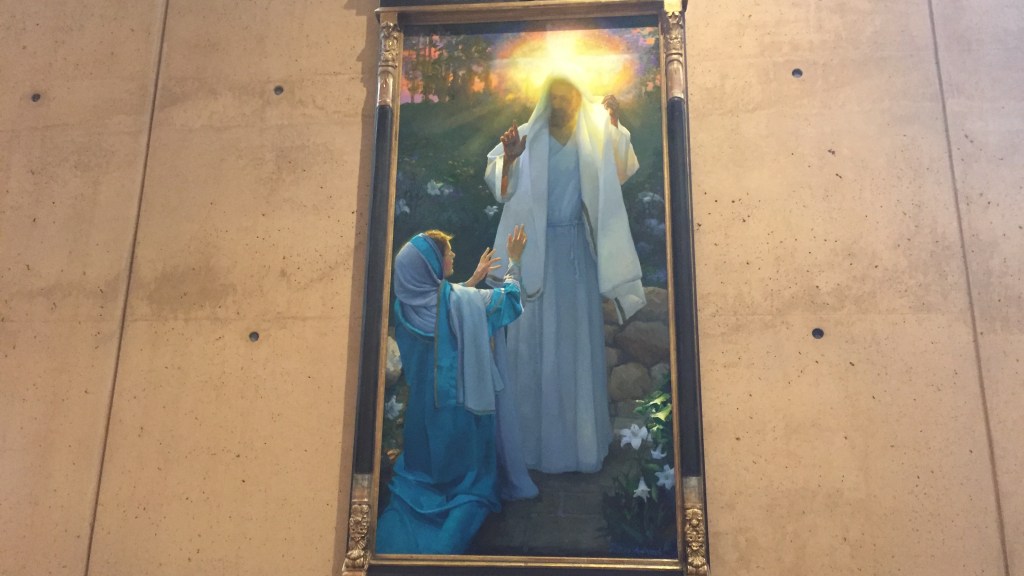
Painting: The Resurrection by Peter Adams, 2018 – hanging in the Cathedral of Our Lady of the Angels, Los Angeles, CA
Mass readings for Monday, July 22, 2020

Deepening our relationship with God will help us to deepen our relationship with our families.
What Jesus proposes is not an either/or statement, but is meant to be a both/and statement. The end goal of our life is to be in communion with God. To attain that goal, we need to not only acknowledge that God exists but also come to know and follow his will. As Jesus said, “For whoever does the will of my heavenly Father is my brother, and sister, and mother.” (Mt 12:50). The challenge is that there is so much that pulls at us for our attention, so much that reaches out to divert us. People, activities, material pursuits are all vying for first place for our minds, hearts, and souls.
The challenge and demands of family life are tremendous. We often read, hear, and experience ourselves, how much the family is being challenged in our modern age. Many of us strive to put family first in our lives. That ought to and needs to be a priority as healthy relationships require commitment, love, sacrifice, and persistence. What Jesus offers then seems to be counter-intuitive to that reality.
Jesus is approached, in the midst of is teaching, and told that his mother and brothers were there wanting to see him. We would think he would say, “Great! Bring them right in, I have a place reserved for them here, front and center!” Yet, I am sure that his comment, “Who is my mother? Who are my brothers” (Mt 12:49), raised a few eyebrows and hackles.
Jesus was not choosing his disciples over his family, he was clarifying that the primacy of place of God his Father is to be first and foremost. “For whoever does the will of my heavenly Father is my brother, and sister, and mother” (Mt 12:50). Families come in many different shapes and sizes, one size indeed does not fit all. Building our relationship with our heavenly Father is the foundation toward striving toward healthier relationships.
God first means that we become less and his Son becomes more, this means we come to truly experience the love of the Holy Spirit: sacrifice, willing to give of ourselves to each other, willing the good of each other, and making time for each other. As we deepen our relationship with God, balance will come into better focus. This is even truer for those in our family who say no to the invitation to building a relationship with Jesus. We need to resist the temptation of becoming defensive, imposing our will and God’s will on others. Instead, continually invite, but ultimately live our faith authentically, and others will see the transformation in us. Just as important, is that we will be able to be more present to our loved ones, be better equipped to accompany them, encourage, and support them as they need us.
Putting God first in our lives will help us with our family relationships. As we grow closer and deepen our relationship with Jesus, we mature and begin to experience the fruits of our relationship with him, which are love, joy, peace, patience, kindness, goodness, gentleness, and self-control (cf. Galatians 5:22-23). As we are putting these values into practice, we will be more present to and develop deeper relationships with our own family, while at the same time coming to experience a larger extended family, those beyond blood as well as the poor in our midst.
Who was the closest relationship Jesus had? Mary. Not because she gave birth to him, but because she was the premier model of discipleship. Would you like to deepen your relationship with your family? Follow Jesus’ invitation and with Mary let us begin our day and check-in often by saying, “May it be done to me according to your word” (Lk 1:38).
Photo: Leaning on God and each other last year in Los Angeles!
Link for the Mass readings for Tuesday, July 21, 2020
Are we willing to be bearers of God’s love, forgiveness, and mercy?
“An evil and unfaithful generation seeks a sign, but no sign will be given it except the sign of Jonah the prophet” (Mt 12:39).
Jonah is the prophet best known as the one who spent three days and nights in the belly of a whale, great fish, or sea monster, depending on your scriptural translation. Jonah ended up in that predicament because he refused to follow God’s direction to speak his message of forgiveness to the sworn enemies of Israel, the Ninevites. It would be like God asking one of us to fly out to the Middle East to meet with members of ISIS or Al-Qaeda and invite them to repent. Not only would we not believe they would want to repent, would we want them to even if they would? Also, whether they did or didn’t, would we be able to return from such a meeting with our heads intact?
These were probably some of the issues running through Jonah’s mind when he refused to follow God’s will. After swimming to shore, Jonah overcame his resistance and followed the command of the Lord, kept his head on his shoulders, and the people of Nineveh repented. Happy, happy, joy, joy! Not exactly. At the repentance of his enemies and God’s expression of mercy and forgiveness, Jonah said to God, “This is why I fled at first to Tarshish. I knew that you were a gracious and merciful God, slow to anger, rich in clemency, loathe to punish” (Jonah 4:2)”. Jonah shows his hardness of heart in that he did not want to go to Nineveh because he did not want his enemies to receive God’s forgiveness!
The scribes and the Pharisees asked Jesus for a sign and the sign of Jonah is what he gives them: The Ninevites, Gentiles, non-Jews, were willing to repent at the word of Jonah, and those scribes and Pharisees questioning Jesus, God’s chosen, were not willing to repent at the urging of one greater than Jonah, the Son of God, who was in their midst.
Jesus announced his ministry, as recorded in Mark 1:15, with the words: “The kingdom of heaven is at hand. Repent and believe in the Gospel.” That is again our invitation today, to examine our conscience by asking God to help us to recognize his presence among us, then reflect on what good God has done in our lives and give him thanks. Review the last day or two to see where God has called us to act. Where did we answer his call, where did we, like Jonah resist or refuse?
Someone greater than Jonah is in our midst today, he is Jesus the Christ. May we be willing to allow his love, mercy, and forgiveness to fill us, to soften our hardness of hearts. Pope Francis shared that, “God’s mercy is understood only when it has been poured out onto us, onto our sins, onto our miseries”. Once we are willing to repent and be healed we will be more willing to allow his love and mercy to flow through us to all those we meet in person and online. Even, and especially, those for whom we would rather not: those who get under our skin, grate on our nerves, and/or those who mirror to us our own biases and prejudices.
—————————————
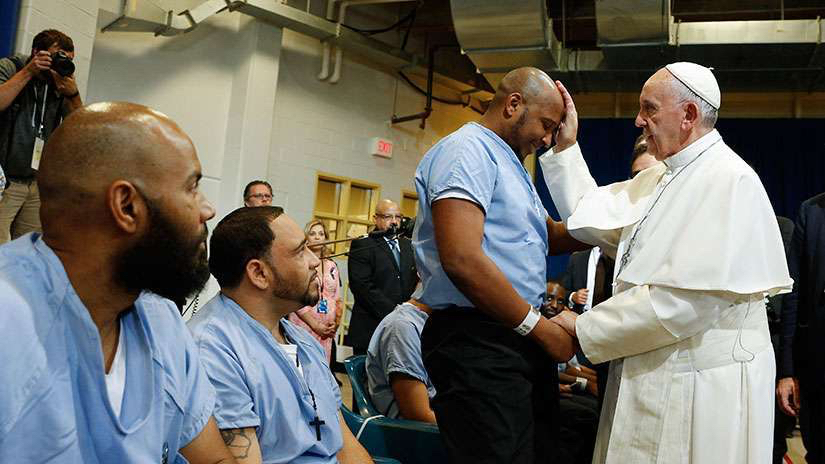
Pope Francis blesses a prisoner during his 2015 visit to Philadelphia – Photo credit – CNS photo/Paul Haring
Link for Pope Francis homily, October 6, 2015
Link for the Mass readings for, Monday, July 20, 2020
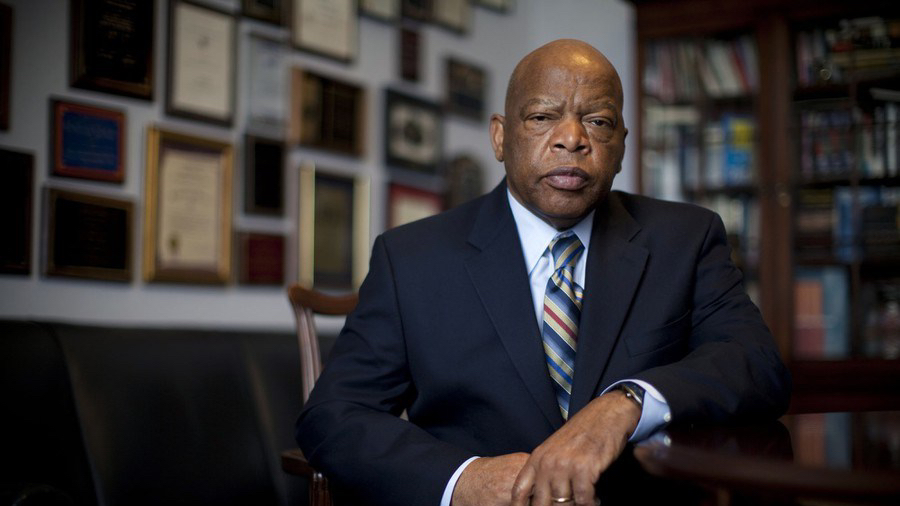
May we continue the work of Rep. John Lewis to build “The Beloved Community.”
The kingdom of heaven may be likened to a man who sowed good seed in his field. While everyone was asleep his enemy came and sowed weeds all through the wheat, and then went off” (Mt 13: 24-26).
The enemy in the parable we attribute to being Satan. In Hebrew, Satan means adversary or one who opposes. Satan is not a god or Demi-god, nor did God create Satan. He created a high arch-angel named Lucifer, just as he did with Michael, Gabriel, and Rafael. Lucifer opposed the will of God and took the stance of being his adversary. Satan seeks to bring about disunity and division.
God seeks to bring about unity and communion.
God did not nor does he create evil. God did not create Satan. Yet he allows evil. God did not create this pandemic, the division, nor the biases and racist attitudes some of us hold. Yet, he does allow these distortions of the good he promotes and invites us to participate in. Why? Because he loves us so much, angels and humans alike, that he is willing to risk that we will reject him. God is not a tyrant or a dictator. God loves us and wants us to choose him freely.
Yet, there are times when all of us will reject him and his will for our lives as well as there are times that we will say yes to him. The hope is that over time we will say yes more than we say no. This is why God allows the wheat and the weeds to coexist.
As humans, unlike wheat and weeds, we can change, we can mature, we can repent from our times of saying no and choose to say yes and walk a little closer with God.
Probably the most honest prayer that I ever prayed happened after I overheard my parents deciding to get a divorce. I was about seven or eight. I told God in no uncertain terms, that if he allowed this to happen we would be through. I walked away from God, but he never left me.
Through small ways, God continually reached out to me and during my late teens, I started to say yes again to his invitations. God encourages and invites each of us, just like a parent before his or her child. A mother or father encourages their small child to come to a wobbly stand and then to begin to take those first steps. If the child crawls away, the parent will go around and again meet the child in this intimate dance of love between the two that will eventually lead to the child learning to walk.
So, it is with our relationship with God. He has sent his Son to be one with us in our humanity so that we can become one with him in his divinity and share the infinite love between them who is the Holy Spirit. God is ever patient and ever-present. Yet, we often do not experience him in our lives, because we are preoccupied. We are distracted and diverted by so many other things or we are let down and disillusioned.
Last April or May when we first received the diagnosis that JoAnn, my wife, not only had pancreatic cancer but that it had spread throughout her abdominal region. The prognosis did not look good, I said, “Here we are again God.”
This time I was not angry. JoAnn and I both received the grace of his peace and the closeness of his presence because we did not turn away from him, even though the outcome was not what either of us wanted. This wasn’t fair, this was a devastating reality, but we decided to accept what was before us and decided not to take the time we were given for granted. We were then blessed with four months of love and closeness.
From this experience and others, I have realized that there is very little that we are in control of in our lives. But we can decide how we are going to live our lives no matter the external circumstances that surround us.
Jesus invites us to be like wheat. We are invited to grow where we have been planted, to mature, and to bear fruit that will become the seed to be sown in the lives of others. By our willingness to will the good of each other, we love as God loves us.
Representative John Lewis, who passed away yesterday at 80, certainly embodied this way of living. He was moved since his teens to put his faith into action and dedicated his life to building in his words “The Beloved Community.” To attain this goal he said, “[W]e must find a way to say to people that we must lay down the burden of hate.”
We can do so when we are more mindful of our thoughts, words, and actions. Will each be hurtful and dehumanizing or empowering and loving? Will we seek to divide and isolate or to unite and bring people together? Will we choose to be weeds that choke and kill or healthy wheat that nourish and give life?
When we choose to be wheat, the Holy Spirit will help us despite our weaknesses to be models of hope. We can then encourage each other to turn away from entertaining demeaning and hateful attitudes and actions to committing instead to thinking, speaking, and acting toward ourselves and each other in ways that are kinder, more understanding, and compassionate.
Photo credit of John Lewis in his DC office in 2009 – Jeff Hutchens / Getty
Link for the Mass readings for Sunday, July 19, 2020
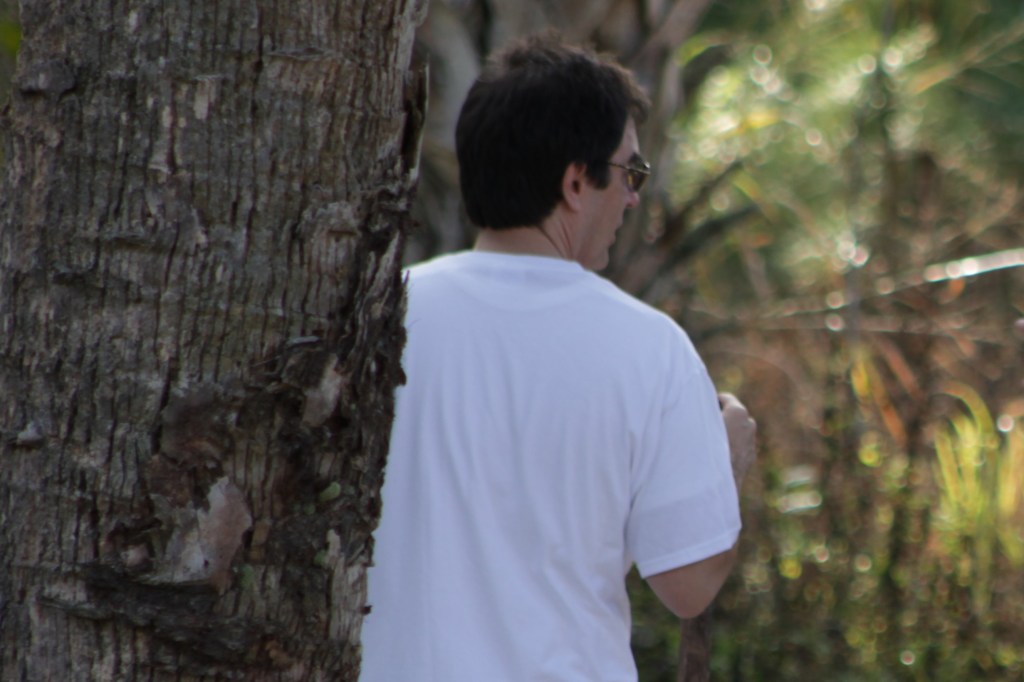
Make some time to withdraw, to be still, so that nothing may disturb you.
In today’s Gospel from Matthew, Jesus realized that: “The Pharisees went out and took counsel against Jesus to put him to death” (Mt 12:14). Jesus did not then start to plan how he would defend himself against their plot, he did not arm his supporters, nor is there any indication that Jesus let the fact that he was a marked man bother him. What did Jesus do with this bit of news?
“He withdrew from that place” (Mt. 12:15) and cured those who followed him. Was Jesus being a coward by withdrawing? No. Jesus was refusing to engage or give any of his time or energy to their negativity. He focused on what he was about and that was continuing the mission that God had sent him to achieve, which was to help bring about the salvation of humanity and the world and to call those who would work with him to continue his mission.
Many of us will hopefully not receive death threats, but many of us have and will witness and/or receive critical, negative, belittling, or dehumanizing looks, words, and outright actions to cause physical, mental, emotional or spiritual harm, just in the course of our daily interactions. For those of us who choose to practice publicly the teachings of Jesus, we may receive even more! Unfortunately, for many people of color, they cannot hide their physical appearance.
Our common response to the many forms of perceived or actual animosity directed toward us is to react. Our reactions generally are based on learned defense mechanisms we have adopted through our lives. Often when we react, we slip into survival mode, experience increased anxiety, defensiveness, anger as well as a myriad of other emotions. Ideally, as we mature in our faith, our response is to draw into the present moment, breath, and call upon God’s guidance to direct us such that we can act more mindfully and be advocates of God’s grace.
Many times the best way to diffuse negativity is to do as Jesus did in today’s Gospel, resist to engage in it altogether, and continue to be about enacting God’s will in our life. May we recall a time that we have taken offense and reacted in kind toward someone who pushed our buttons and got under our skin. Then seek to understand how we could have reacted differently in that situation and imagine ourselves doing so. May the Holy Spirit guide and help us to be more patient and understanding in the future.
Life is short in the best of scenarios, let us not take a day or moment for granted, nor give away our precious time to engaging in negativity. There are times that we do need to stand up and speak out, but that is a reflection for another time. Sometimes, we need to walk away and be still. During some quiet time today, I invite you to meditate on these words attributed to St. Teresa of Avila (1514-1582):
“Let nothing disturb you,
Let nothing frighten you,
All things are passing away:
God never changes.
Patience obtains all things.
Whoever has God lacks nothing;
God alone suffices.”
Photo: 2010 Hike, taking a walk is often a good way to decompress and leave negativity behind! Photo credit – Jack McKee
Link for the Mass readings for Saturday, July 18, 2020
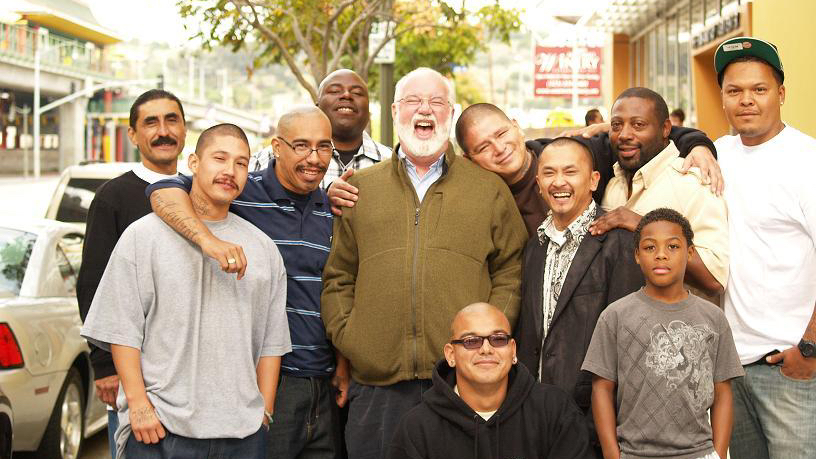
Are we willing to enter into the lives of another, especially if they are different?
I say to you, something greater than the temple is here. If you knew what this meant, I desire mercy, not sacrifice, you would not have condemned these innocent men. For the Son of Man is Lord of the sabbath.” (Mt 12:6-8).
Jesus continues to rock established regulations and practices. Here he is challenging the understanding of the Sabbath itself when justifying the accusations leveled toward his disciples who were picking and eating grain on the Sabbath, and he does so in a profound way by saying that, “something greater than the temple is here.” Present in the heart of the temple, the area called the Holy of Holies, was the ark of the covenant. Atop the ark was the lid called the mercy seat of God. Jews believed that this was where God sat and when the blood of atonement was offered from sacrifices, God’s mercy was offered to the people. In the temple then, was the mercy seat, the very presence of God.
Jesus’ claim that he is greater than the temple is putting him on the same level as God. A blasphemous statement to say the least, unless of course, he is God. Jesus even doubles down by claiming that he is the Lord of the sabbath; Jesus is God!
In quoting Hosea 6:6: “I desire mercy, not sacrifice”, Jesus is not only saying that he is the something greater, but that his Way is something greater. One of the foundational points of the Way of Jesus is mercy. Through the incarnation, the Son of God dwelt among us, became one with us in our humanity. He restored our dignity in the midst of our brokenness. What Jesus said, in defending his disciples eating from the grains of wheat on the Sabbath, he is saying to us today: “What is owed to every human being on the basis of his or her human dignity is personal respect, personal acceptance, and personal care” (Kasper 2014, 202).
Each one of us, in our participation in the life of Jesus, strengthen our unity in the Body of Christ when we follow Jesus in bestowing acts of mercy on our neighbor. “The works of mercy are charitable actions by which we come to the aid of our neighbor in his [or her] spiritual and bodily necessities. Instructing, advising, consoling, comforting are spiritual works of mercy, as are forgiving and bearing wrongs patiently. The corporal works of mercy consist especially in feeding the hungry, sheltering the homeless, clothing the naked, visiting the sick and imprisoned, and burying the dead. Among all these, giving alms to the poor is one of the chief witnesses to fraternal charity: it is also a work of justice pleasing to God” (Catechism of the Catholic Church, 2nd ed. 2447).
What we need in our present situation when all appears to be unraveling around us is to be willing to respect the dignity of each person, interact with and care for people different than us, be willing to journey together, and allow God to happen. Reviewing what the spiritual and corporal works of mercy above are is a good place to start. Then praying about and deciding which one(s) to put into practice would be a good next step. We can write a broader and brighter chapter in the coming weeks and months ahead if we are willing to follow Jesus and lead with mercy, which is “the willingness to enter the chaos of another” (Keenan, 2015).
—————————————
Photo: Fr. Greg Boyle, SJ, founder of Homeboy Industries has been willing to enter into the chaos of gang members since the 1980s.
Link for the Mass readings for Friday, July 17, 2020
Kasper, Walter. Mercy: The Essence of the Gospel and the Key to Christian Life. NY: Paulist Press, 2004.
Catholic Church. Catechism of the Catholic Church: Revised in Accordance with the Official Latin Text Promulgated by Pope John Paul II. Vatican City: Libreria Editrice Vaticana, 1997.
Keenan SJ, James. “The Scandal of Mercy Excludes No One.” Thinking Faith. December 4, 2015.
 Spiritual Stepping Stones