
We need to learn to discern between the voice of the thief and that of the shepherd.
“Amen, amen, I say to you, I am the gate for the sheep. All who came before me are thieves and robbers, but the sheep did not listen to them. I am the gate. Whoever enters through me will be saved” (Jn 10:7-9).
Some may bristle at these words of Jesus stating that they are arrogant, for how can anyone claim that it is only through him that all are saved. Today, the feeling among many is that statements of this natures are against interfaith dialogue and what is wrong with religion today.
The first point that I would make, is that those who would critique these words would have a case to make only if Jesus is not who he claims to be and the Gospel witness shows quite consistently that Jesus is sent by God, that Jesus is the Son of God, and if Jesus is fully God and fully human, then this statement is true, and to say anything to the contrary would not only water down this reality but it would also be false.
As such, if this is a true statement, I do not feel that it is antithetical to interfaith dialogue. For dialogue to be authentic, each party must bring forth the breadth and depth of what they believe. To water it down to get along would not be a true dialogue. The requirement though would be that those engaged would be willing to speak and listen to each other. In doing so, there can be not only mutual dialogue but also mutual learning, for God reveals his Truth to all. We are better when we engage in an argument that is constructive and passionate, yet remember to be respectful. We have just forgotten how to do so without devolving into personal attacks and talking past each other.
There may be a broader message that Jesus is sharing in today’s Gospel. When Jesus talks about the sheep knowing the voice of the shepherd, he could be very well speaking about what St Ignatius called the discerning of spirits.
We hear all kinds of voices. They are coming at us from without and from within, from the many influences around us to our experiences of the past. With the invention of the internet and Google the voice chamber has only been magnified. The voice of Jesus leads us toward our highest hope and good, not an apparent of fleeting good, but the Good, what we have been created for. As St Augustine wrote, “You have made us for yourself, O Lord, and we are restless until we rest in you.”
The challenge is being able to discern from the voice of the thief who seeks to lure us away from the fold to destroy us and instead develop an ear to hear the voice of the shepherd who will care for us. God loves us so much that he is willing to risk that we will reject him so that we are free to choose him. Even when we have been led astray, have exhausted all the glitter and flash, have been left wanting and empty, are worn out and wounded or even broken, even then we are not alone. If we are willing, Jesus the Good Shepherd will be there for us, lift and gently cradle us on his shoulders and bring us home.
Photo: Spending some quiet time last night listening to the voice of the Shepherd
Link for the Mass readings for Sunday, May 3, 2020

“This saying is hard; who can accept it?”
Even though Jesus had fed the five thousand and they were satisfied and there was plenty more where this gift of grace came from, even though they traveled by boat and followed him to Capernaum seeking a sign, the discourse regarding eating his Flesh and drinking his Blood was just too far of a stretch for most of the disciples and followers to take. In fact: Many of the disciples of Jesus who were listening said, “This saying is hard; who can accept it” (Jn 6:60)?
Many walked away from Jesus at that point. They returned to their former ways of life because they could not believe in what Jesus was saying. They could not believe because they did not fully appreciate who Jesus was, the One from above, who was sent by the Father. They had not developed a deep enough relationship with him such that they could trust him and what he said was true, they could not believe in the One whom God had sent.
Jesus then said to the Twelve, “Do you also want to leave?” Simon Peter answered him, “Master, to whom shall we go? You have the words of eternal life. We have come to believe and are convinced that you are the Holy One of God” (Jn 6:67-69). Peter’s response is one of belief and trust. I am sure they reacted in the same way as the other disciples gathered there, but they trusted Jesus enough that even though this teaching was hard, even inconceivable, he would make sense of it for them, just as he had done so when he helped to share with them the deeper meanings of his parables.
This is to be our response as well. When we find that some of the teachings of Jesus are hard to digest, we need to resist the temptation to walk away. Instead, we need to follow Mary’s model of pondering, as she did when Gabriel shared that she would bear the Savior of the world. She did not fully comprehend what the message meant, but she trusted God and said yes. We need to follow Peter, who may have also been dealing with mixed emotions and doubts, yet, remained firm in his belief in Jesus because he trusted that Jesus was the “Holy One of God”. Peter had experienced that Jesus had known what he was saying and doing before, he would continue to trust him this time as well.
Jesus is also model to follow, yes, but he is so much more! Jesus gives us his grace, the gift of his supernatural power, that builds on our nature. Jesus did not want to die, but he was willing to say yes, to submit his human will to his Father because he trusted him and knew he would bring about a greater good. Jesus gave his life and in so doing conquered death, transcending the time and space of our present dimension so as to be present to us in the Sacrament of the Eucharist. Jesus lives, he is the firstborn of the new creation, and he wants to not only lead us to eternal life but to impart his life in us, in such an intimate way that we may consume him, that we may be one with him in this life and for all eternity! May we with Peter come to believe and be convinced, that Jesus is the Holy One of God!
Amen. Amen.
I’m alive, I’m alive,
Because he lives.
Amen. Amen.
Let my song join the One that never ends.
Because he lives.
The verse from Matt Maher’s song, “Because He Lives (Amen)”.
—————————————————————
Photo: Sharing Jesus at my first Mass as a deacon in September of 2013
Because He Lives (Amen), Matt Maher, from cd: Saints and Sinners, 2015
Link to the music video: Music video by Matt Maher performing Because He Lives (Amen) [Official Lyric Video]. (C) 2014 Provident Label Group LLC, a unit of Sony Music Entertainment: https://www.youtube.com/watch?v=PBvU7arNhQs
Link for the Mass readings for Saturday, May 2, 2020

The Flesh of the Son of Man is the Bread of Life that when consumed will give us eternal life.
All that Jesus has been building up to is now coming to a climax. Any silent shock of disbelief or quiet murmuring has now escalated. The Jews quarreled among themselves, saying, “How can this man give us his Flesh to eat” (Jn 6:52)? Jesus hears the growing concern and disbelief. If he was speaking in a figurative or symbolic way, this would be the moment to clarify his point.
Jesus does speak, but he does not walk back or qualify his comments. Jesus doubles down: “Amen, amen, I say to you, unless you eat the Flesh of the Son of Man and drink his Blood, you do not have life within you” (Jn 6:53). Jesus does not only repeat that his disciples are to eat his Flesh but he also insists that they are to drink his Blood. Drinking or even eating meat with the blood of an animal was inconceivable for devout Jews. Also, the Greek used here in John’s Gospel for eating, is trogein, which is used to describe how an animal eats, by gnawing and tearing at the flesh. The imagery that Jesus is using here is more graphic than the customary use of phagein, which would be used for chewing, as a human would chew their food.
Jesus continues to make his point that whoever does eat his Flesh and drink his Blood, will not only remain in him, but also Jesus will remain in them, and they will have eternal life. A wonderful end goal, but would any be able to make the leap of faith to get there? In tomorrow’s Gospel reading we will be able to see the response to Jesus’ claims.
Almost two thousand years later, we continue to have the opportunity to celebrate Jesus in our midst. This happens through participating in the source and summit of our faith, the Mass. Our hearts have the opportunity to be set on fire as we hear the word proclaimed during the Liturgy of the Word, and then Jesus is made known to us in the breaking of the bread in the Liturgy of the Eucharist. We are invited to experience an intimate encounter with the Son of God, as we consume him, Body, Soul, and Divinity.
That so many of us are unable to do so now because of the quarantine does not dismiss that this sacred event is still happening. We can receive Jesus through spiritual communion as we watch the Mass live-streamed and pray the Act of Spiritual Communion prayer.
The thought of eating the Flesh and Blood of Jesus may sound just as bizarre as it did to Jesus’ followers. The term we have for this miraculous transformation of bread and wine is transubstantiation. What happens at the calling down of the Holy Spirit and when the words of institution are invoked by the priest is that the substance, the reality, of the bread and wine is transfigured into the Body and Blood of Jesus, while the accidental form or appearance remains the same. So we consume Jesus’ unbloody, acceptable sacrifice.
Jesus is giving all of who he is of himself corporally, fully, holding nothing back of himself so we can receive all of him. In consuming Jesus, we become what we eat, “bone of his bone and flesh of his flesh” (cf. Genesis 2:23), we become divine as he permeates our whole being. We are then dismissed at the end of the Mass to go, like Mary, to bear Jesus Christ, to love others as Jesus loved us, by giving of ourselves to others as he has given himself to us. This is the Good News we are called to proclaim. Jesus is risen, he has risen indeed, and he has not left us orphans but remains with us now and for all ages!
——————————————————–
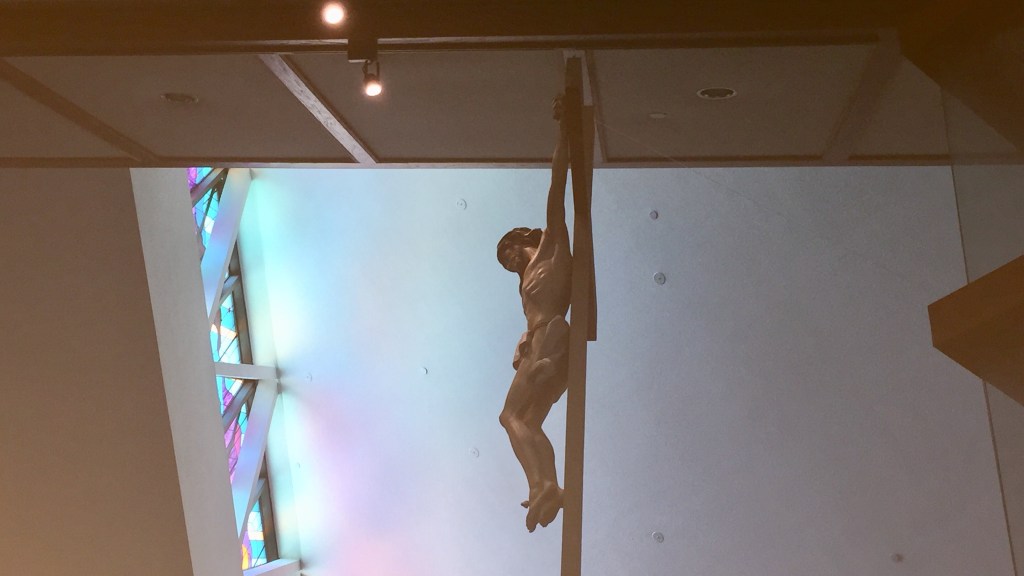
Photo: Our tabernacle which is in the chapel at Cardinal Newman High School. Jesus is present to us in the consecrated hosts within. I miss beginning my school day looking at Jesus as he looks back at me!
Link for the Mass readings for Friday, May 1, 2020

“I am the living bread that came down from heaven.”
Those in the crowd that Jesus is speaking with are those who experienced his multiplication of the loaves and fish. Step by systematic and deliberate step, Jesus is setting the stage for today’s insertion into his presentation.
Jesus begins slowly, but with each successive step, he is not willing to be tamed. He, as the One from above, the One who has seen and has been sent by the Father, is fully divine, as well as fully human speaking among those who have come to him. He has responded to the people’s request regarding how they were to “accomplish the works of God” and his response is that they are to believe in him, he who had been sent by God. They were to “work for food that endures for eternal life, which the Son of Man will give”. Jesus himself, as he did with the multiplication, will provide the food that will endure for eternal life. Jesus shared that he is this food, the bread from heaven, that will give life to the world.
What Jesus has shared thus far and what he shares in today’s Gospel message has been given to him to say from his Father and is for everyone who is willing to accept his invitation: “I am the living bread that came down from heaven; whoever eats this bread will live forever; and the bread that I will give is my Flesh for the life of the world.” We have an advantage, that those listening to Jesus, did not have. We just experienced Lent and we can certainly draw a line to how Jesus certainly does give his very life, his Flesh, that is sacrificed and hung on the cross. We believe too that Jesus died and experienced utter God forsakenness by giving his very life for the life the world.
But for those in the crowd who only the day before sought to unanimously make him their Messiah by popular acclamation are growing a bit uncomfortable. This discourse is now starting to move away from a more figurative discussion to a more dramatic and concrete presentation with horrific implications. After an initial gasp or two, some murmuring would have begun, centering around such questions as:
“Did Jesus really just say he would give his flesh?”
“Jesus is equating himself with the bread from heaven, and the bread he is offering is his flesh?”
“Is Jesus saying what I think he is saying?”
Yes! The Son is because the Father has given all that he is, holding nothing back, emptying himself into the Son. The Son has received all that the Father is and returns himself, giving all that he is, holding nothing back to the Father. This eternal giving and receiving, this eternal communion of Love shared between the Father and the Son is the Holy Spirit. Jesus is offering participation in this perichoresis, this divine dance of infinite communion, as he offers all that he is to his listeners then and to us, this day, to be consumed. He is holding nothing back in his offer. We are invited not only to receive all that Jesus is, we are to also give ourselves away in return.
—————————————-
Photo: Artistic rendition of the face of Jesus based on the Shroud of Turin.
Link for the Mass readings for Thursday, April 30, 2020
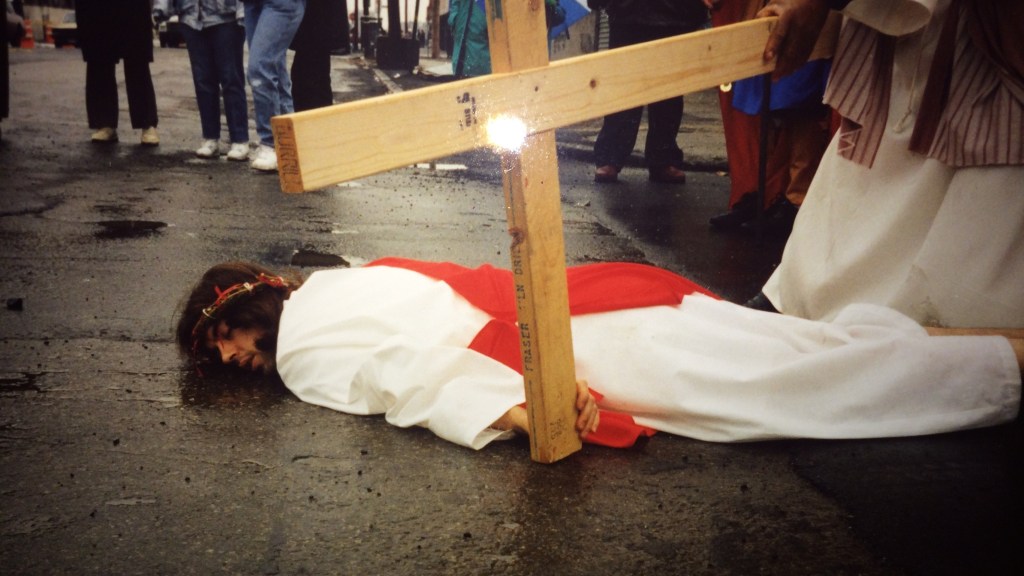
Jesus stays with us even when we fall.
“Everything that the Father gives me will come to me, and I will not reject anyone who comes to me, because I came down from heaven not to do my own will but the will of the one who sent me” (Jn 6:37-38). Jesus does not reject us, he accepts us as we are, first and foremost. Jesus has come to do his Father’s will which is to lead us all to salvation, to be redeemed and restored to the proper order of freedom from our enslavement to sin. This is why Jesus met Cleopas and the other disciple on the road to Emmaus. They were walking the wrong way! Jesus did not tell them that, he just opened up the Scriptures to them, so they could see that he was who he claimed to be and then revealed himself to them in the breaking of the bread. Once they had a deeper encounter with him, they determined on their own to turn back, and even though evening approached they went back to tell the Apostles the Good News of their encounter with him.
It was through sharing a meal with them that they recognized him. How many meals had they shared together before his death? A close reading of Sacred Scripture shows how important table fellowship is for Jesus and his followers before his death and after his Resurrection. True, Jesus eating with his disciples after his Resurrection shows that he is no ghost, he is human, but also he is reestablishing the cornerstone of his ministry, table fellowship.
Here the basic needs of sustenance are met, for the body, and his sharing his time and conversation with anyone willing to eat with him, no matter their level of ritual purity touches the deepest hunger within each of us, which is to belong, to be accepted as we are, for who we are. The majority of the crowd that Jesus is speaking to has continued to come to him because he fed them with only a few loaves and some fish. In the miraculous multiplication, Jesus is providing for their bodily nourishment, but also preparing them for the deeper spiritual nourishment of the body and soul to come in the next verses as he goes deeper into his Bread of Life discourse.
Jesus loves us, he wills the best for us. Many resist this claim because of our own callouses, scars, and growing cynicism as a result of our own wounds inflicted upon us because someone else burned us, did not fulfill our expectations, betrayed us, and in being let down by those we have looked up to and trusted. If we are involved in a relationship long enough, we will experience disappointment or worse, sooner or later, and it is often from those closest to us because these are the people we let into our inner circle.
We need to remember that none of us are perfect, ourselves included. We are all on a journey, and on our own, we will consistently fall short of our goal. That is why we need a savior. We need someone we can trust that will be there for us when we are let down and when we fall down face-first into the mud. Someone who, when that happens, will lay down in the mud with us, look us in the eye and smile.
Even if we are not able to look past the predicament, or smile in return, we might just be able to catch his eyes looking at us and then he will offer us his hand. Both of us then rise together, and we are able to stand again. That is how Jesus shows his mercy and love for us. He enters into our chaos and meets us in the midst of the muck and grime of our brokenness and sin. He loves us there, and when we are ready to accept his offer of love, he invites us to get up, and begin to walk again.
As our relationship grows and deepens and as our trust strengthens, we begin to believe that we belong. We realize that we are a part of something greater than ourselves and we are then strong enough to share that same mercy, forgiveness, and unconditional love with others. This is the path of discipleship. This is the road we are on, together. Let us be willing to love, to be there for, and accompany one another through this current pandemic and onward.
———————————————————————————
Photo: Me, as Jesus in the Living Stations, Jesus falls the third time, Good Friday around 1991 in the streets of the Bronx
Link for the Mass readings for Wednesday, April 29, 2020
Jesus, the Bread of Life, satisfies our eternal hunger.
Yesterday and today’s Gospel reading for John are laying the groundwork for the discourse of Jesus to come. In yesterday’s account, Jesus shared with the people who gathered about him, the people who had already received the miraculous multiplication of bread, that they were not to “work for food that perishes but for the food that endures for eternal life” and Jesus also shared that they were to “believe in the one [God] sent” (see Jn 6:27-29).
In today’s account, the people are asking for a sign, just as Moses gave to their ancestors in the desert. Jesus reminds them that his Father had given them the bread from heaven, and also added: “My Father gives you the true bread from heaven. For the bread of God is that which comes down from heaven and gives life to the world” (Jn 6:32-33). Certainly, this offer is appealing, and so the people not only want some of this bread also, they want an endless supply of it. Now Jesus moves from the subtle foundation he has been building to the core structure of his point: “I am the bread of life; whoever comes to me will never hunger, and whoever believes in me will never thirst” (Jn 6:35).
Jesus encouraged his listeners to pursue the food that “endures for eternal life” to believe in the one his Father sent, then he shares how his Father gives them the true bread from heaven “for the bread of God is that which comes down from heaven and gives life to the world.” Jesus is the one his listeners are to build their relationship with, for he is the very presence in their midst. Jesus is the promise of eternal life. Jesus is the one sent by his Father to give life to the world. Jesus is the bread of life!
We are a living craving, hunger, and desire to be one with God and each other, and this is true for the atheist and the believer alike. That which God has created, he has created good, but the material and finite will not fulfill us. We, in short order, experience the limitations of the finite and seek something more. This is how we are wired, because ultimately, our deepest desire, that which we seek to fulfill us, is eternal. The One to satisfy this eternal hunger which we can never exhaust is the bread of life, Jesus Christ.
Do we believe this to be true? Do we believe that Jesus is the bread of life, that he is the source and sustenance, the very foundation of our being and existence? During this time when so many are not able to receive the Eucharist because of the mandate against public gatherings, could this be a time to ignite again our hunger for the food that does not perish?
If we have been caught up: in the business of life, in the mere existence or survival mode of the day to day, in our sin, addiction, brokenness or disillusionment, or if we feel like we are just running on empty. If we have just taken this reality for granted, then let us “believe in the one who God sent”, commit or recommit our selves, our very life to the one who is our source and sustainer, Jesus, the Bread of Life. This is why we are an Alleluia people and ought to radiate joy even in our present situation.
——————————————————————-
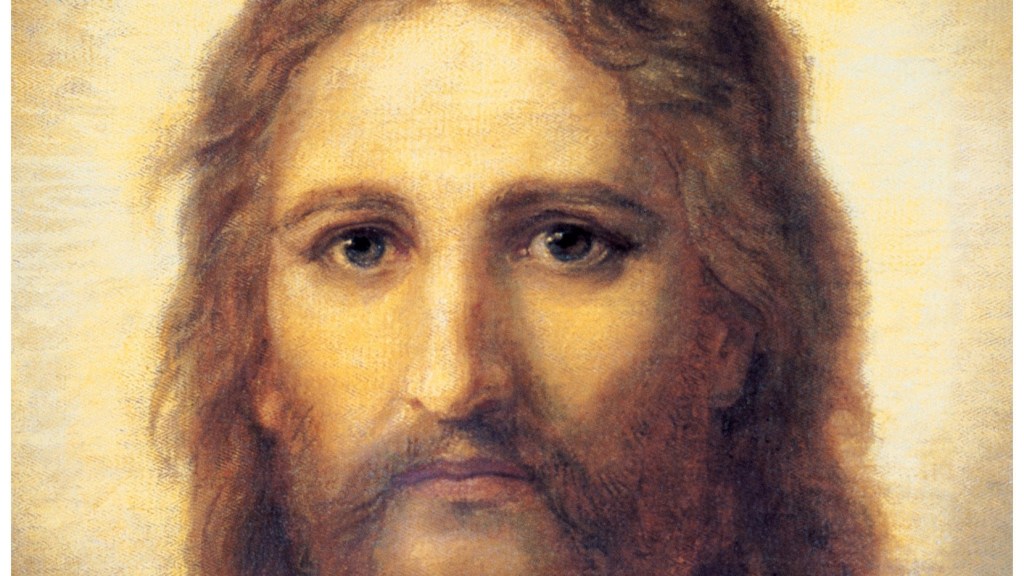
Painting: Portrait of Christ, The Savior, Heinrich Hofmann, 1894
Link for the Mass readings for Tuesday, April 28, 2020

Is Jesus the one whom God has sent?
One of the best ways to celebrate the Easter Season is to continue to conform our lives to the one who gave his life for us that we may experience and be engaged in our life to the full. We can accomplish this better by putting into practice what we read in the Gospels as well as being open to encountering God our daily experiences and one another.
Today’s Gospel reading continues after Jesus not only fed the 5,000 but also after he had walked across the Sea of Galilee and guided his disciples safely to the shore. Those who had eaten as a result of the multiplication of the loaves and fish, got in their own boats to follow Jesus to Capernaum as well.
When the crowd found and gathered around Jesus, he continued to teach them, guiding them to “not work for food that perishes but for the food that endures for eternal life, which the Son of Man will give you.” The people asked him what they could, “do to accomplish the works of God?” Jesus answered and said to them, “This is the work of God, that you believe in the one he sent” (cf: Jn 6:27-29).
The people asked Jesus what they were to do to accomplish the work of God, and he said to believe in the one he sent. The response of Jesus may not appear to fit the request. But to believe is not just a passive activity. Belief is to be followed by action. If we say that we believe in Jesus, do we pray with him, do we worship him independently and in communion with fellow believers, do we sing songs praising him, do we serve him through the giving of ourselves to one another by practicing the corporal and spiritual works of mercy?
When we experience setbacks, interruptions, conflict, or outright tribulations, do we turn to cursing and yelling or turn instead to Jesus for guidance and direction? Do we turn within ourselves or only surround ourselves with those of like mind, color, political and/or religious views, or do we embrace the richness, uniqueness, and diversity of God’s people?
If we are not consistently doing any of the above, then do we really believe in Jesus Christ, the one whom God sent? Where are we spending our time, talent, and treasure? Answering these questions is a good way to assess what and in who we truly believe. Admitting to ourselves where we really are in our relationship with Jesus is good to do. If our diagnosis today is that we are not as faithful as we would like, my recommendation is to take a spoonful of belief in Jesus and do one small thing today in his name with great love.
——————————————————-
A photo that I took of the Easter flowers after the Saturday Vigil surrounding the altar at St Peter Catholic Church, Jupiter, FL
Link for the Mass readings for Monday, April 27, 2020
Do we believe that “The Lord has been truly raised!”?
We return again to the reading of the Road to Emmaus pericope that we heard less than two weeks ago. This rich record is certainly worth many readings because there is within its telling so much contained in its depths that one, two, or three readings is nowhere near sufficient.
Jesus comes upon Cleopas and another disciple heading away from Jerusalem feeling devastated because not only had their teacher been brutally crucified but their hopes of him truly being the Messiah were also dashed.
During their discussion, an interesting point arises when they begin to discuss why they were leaving Jerusalem. Cleopas mentions that some women and some of the other disciples had confirmed that the tomb was empty on the third day since the death of Jesus. Cleopas and the other disciple were certainly close enough to the inner circle of the Apostles to know Mary Magdalene and the Twelve to be in hiding with them after the crucifixion.
This also meant that they knew Jesus pretty well. They had to have heard on more than one occasion either from Jesus himself or the other Apostles that Jesus would rise again on the third day. Why then did they leave after hearing the tomb was empty? Wouldn’t they want to find out if what Jesus said about his Resurrection was actually true? Last week we read about how Thomas was away when Jesus reappears to the Apostles. Did he leave with Cleopas and the other disciple, could Thomas have been the other disciple?
There were those like Mary, Peter, and John who stayed in Jerusalem, while at the same time we know about Thomas, Cleopas, and another disciple who had left, even after hearing about the empty tomb. Jesus was clear in what he taught about his coming back on the third day, just as he was when he told his followers that they would eat his flesh and drink his blood. People left then as well.
How many times have we given up or given in just when what we had been waiting for or working for would have been fulfilled? We may never know. Fortunately, for Cleopas and the other disciple that we read about this week and Thomas last week, Jesus was willing to reach out to them a second time. They heard his words about the Resurrection but they did not grasp or comprehend the full meaning of what Jesus meant.
The same is often true of us. Jesus invites us to follow him as he did the others, as he does with all of humanity, yet we often do not understand or fully appreciate the fullness of what Jesus is offering. Until we are able to relate to and value the deeper meaning and worth of what it means to truly develop a relationship with Jesus and be a follower of his, we will not be willing to invest our time and commitment. The Good News is that Jesus did not give up on Thomas or Cleopas nor will he give up on us. One day we too will also be able to exclaim with joy, “The Lord has truly been raised,” and our life we never be the same.
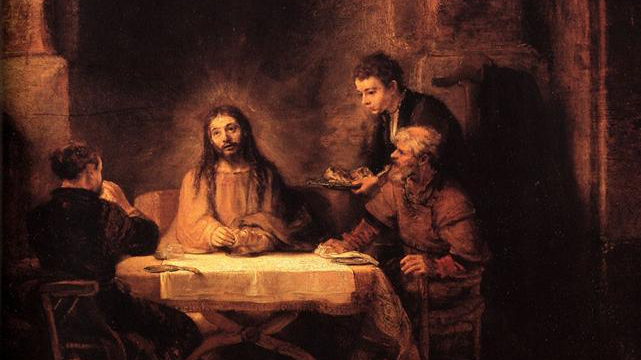
Painting: The Supper at Emmaus by Rembrandt 1648
Link for the Mass readings for Sunday, April 26, 2020
 Spiritual Stepping Stones