When we eat the Body and drink the Blood of Christ we have eternal life.

All that Jesus has been building up to is now coming to a climax. Any silent shock of disbelief or quiet murmuring has now escalated. The Jews quarreled among themselves, saying, “How can this man give us his Flesh to eat” (Jn 6:52)? Jesus hears the growing concern and disbelief. If he was speaking in a figurative or symbolic way, this would be the moment to clarify his point.

Jesus does speak, but he does not walk back or qualify his comments. Jesus doubles down: “Amen, amen, I say to you, unless you eat the Flesh of the Son of Man and drink his Blood, you do not have life within you” (Jn 6:53). Jesus does not only repeat that his disciples are to eat his Flesh but he also insists that they are to drink his Blood. Drinking or even eating meat with the blood of an animal was inconceivable for devout Jews. Also, the Greek used here in John’s Gospel for eat is trogein, which is used to describe how an animal eats, by gnawing and tearing at the flesh. The imagery that Jesus is using here is more graphic than the customary use of phagein, which would be used for chewing, as a human would chew their food.

Jesus continues to make his point that whoever does eat his Flesh and drink his Blood, will not only remain in him, but also Jesus will remain in them, and they will have eternal life. A wonderful end goal, but would any be able to make the leap of faith to get there? In tomorrow’s Gospel reading we will be able to see the response to Jesus’ claims.

Almost two thousand years later, we continue to have the opportunity to celebrate daily the person of Jesus in our midst. This happens through participating in “the source and summit of the Christian life” (Catechism of the Catholic Church, 1324), the Mass. Our hearts have the opportunity to be set on fire as we hear the word proclaimed during the Liturgy of the Word, and then Jesus is made known to us in the breaking of the bread in the Liturgy of the Eucharist. We are invited to experience an intimate encounter with the Son of God, as we consume him, Body, Soul, and Divinity.

That we eat the Flesh and Blood of Jesus may sound just as bizarre as it did to Jesus’ followers. The term we have for this miraculous transformation of bread and wine is transubstantiation. What happens at the calling down of the Holy Spirit and the words of institution which are invoked by the priest is that the substance, the reality, of the bread and wine is transfigured into the Body and Blood of Jesus, while the accidental form or appearance remains the same. So we consume Jesus’ unbloody, acceptable sacrifice. We consume his glorified body that has transcended the three dimensional realm as we know it.

Jesus is giving all of who he is corporally, holding nothing back of himself so that we receive all of him – Body and Blood, Soul and Divinity. The miracle does not stop there because in the receiving of Jesus’ fullness in the appearance of bread and wine, we also become divinized through our participation in his life as he permeates our whole being. We receive eternal life! This takes the saying, we are what we eat, to a whole new level.

This gift we get to then share. We are dismissed at the end of the Mass to go, like Mary, to bear Jesus Christ, to love others as Jesus loved us. In seeing and receiving Jesus in the Eucharist, we better see him in each other and are then inspired to serve one another. For what we do to the least of our brothers and sisters, we do to Jesus (cf. Mt 25:40). Jesus is risen, he has risen indeed, and he has not left us orphans but remains with us now and for all ages most intimately in the Eucharist! We are alive and given eternal life, because the Bread of Life lives within and among us! Amen. Alleluia!

——————————————————–

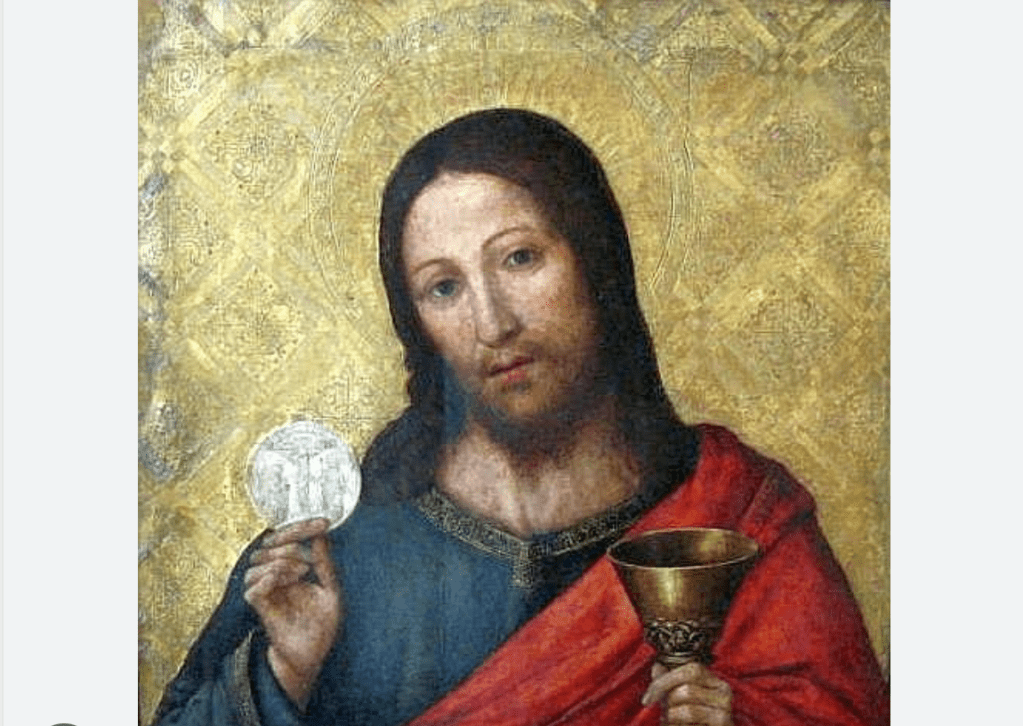
Photo: “Christ with the Host”, by Paolo de San Leocadio

Link for the Mass readings for Friday, May 9, 2025

“Behold the Lamb of God.” He who was born and died for us.

John the Baptist saw Jesus coming toward him and said, “Behold, the Lamb of God, who takes away the sin of the world” (Jn 1:29).

The only one who can take away sins is God. The unblemished lamb is the animal that is sacrificed at the Passover meal, commemorating when the angel of death passed over the Hebrews whose doorposts were marked with the blood of the lamb. The next day they were freed from their slavery under pharaoh, and the exodus event began culminating in their passing through the Red Sea to freedom.

The Son of God became human to become the Lamb of God. He experienced laughter, pain, suffering, love, tears, and all of our human condition even temptation, but he did not sin. The Son of God became human so that what he assumed in his human condition, he could redeem. As the Lamb of God, Jesus approached John for baptism, he took upon himself the sin of the world and submitted his divinity to his human condition and was willing to be baptized for repentance not because he sinned, but so that he could take upon the sin of the world upon himself. This act was also a foreshadowing of his crucifixion on the cross.

The Incarnation, the Son becoming fully human while remaining fully divine, was the premiere act of mercy, in that Jesus entered the chaos and woundedness of our lives. His allowing himself to die on the cross the greatest expression of his love. The same love that he shares with his Father, his receiving and returning all that he received to the Father and holding nothing back, we can see him doing so visibly when we look upon a crucifix. He was born and died, he gave everything, including his life for each and every one of us.

Alone we cannot be redeemed, we cannot be fully healed or restored to who we have been created to be. We need a savior. Jesus is, while at the same time, more than a model to follow or a teacher to guide us, he became one with us in our humanity to lead us up out of our brokenness and sin. In saying yes to his invitation, we can say with Paul, “yet I live, no longer I, but Christ lives in me; insofar as I now live in the flesh, I live by faith in the Son of God who has loved me and given himself up for me” (Galatians 2:20). This is the gift we have received again this Christmas, a reminder that when enter into a relationship with Jesus, he grants us the grace to access and share in the divine power of the Love experienced between God the Father, God the Son, and God the Holy Spirit.

Jesus holds his hand out to each one of us today. May we receive his hand in our own, and as our fingers touch his palm may we feel the wound there, embrace the remembrance of the nail that pierced his flesh, the pain that he endured, so we could have this very moment with him. Even in our brokenness, anxiety, confusion, fear, and sin, may we resist pulling away. May we feel the warmth of his hand grip ours. Let our gaze be drawn up to see his face, his smile, his forgiveness, and experience his infinite love for us.

I am blessed at each Mass as I hold up the consecrated host to be able to say, “Behold, the Lamb of God, behold him who takes away the sin of the world.” May we see, believe, and receive the Body and Blood of Christ. Amen.

———————————————————-

Photo: Christmas Morning Mass, Holy Cross Catholic Church, Vero Beach, FL.

Link for the Mass readings for Friday, January 3, 2025

“This is my Body”… “This is my Blood”

This Sunday, and for the next five Sundays we are being invited to participate in an adventure. Each week we will journey together through the pages of Chapter 6 of the Gospel of John. The beauty of this chapter and the road we will walk side by side is one that means everything to us as followers of Jesus Christ. And as we will see, not everyone in the written account, in fact only a few, make it through to the end.

My hope is that each one of us here today not only make it through the journey, but that we are transformed, and our faith is renewed. What Jesus unveils for us with each verse of his teaching is the miracle of miracles, the sign of signs, God from God and Light from Light. Jesus will be sharing with us his Bread of Life discourse. Jesus will reveal that he is truly the Bread of Life come down from heaven. Jesus, the Son of God, becomes one with us in our humanity so that we can become one with him in our divinity. He comes even closer when he gives us himself in the appearance of bread and wine to be consumed.

My invitation for you during these dog days of summer is to get out your Bible, dust it off, if it has been a while since you have pondered its pages, and then slowly, prayerfully, each day over the next month, read, pray and meditate with John Chapter 6 and so come into each Mass even better prepared to receive the miraculous gift that Jesus wants to share with us.

We begin our journey by joining the “large crowd” following Jesus. They have gathered around him because they have seen or have heard about his healings, his exorcisms, and his teaching with authority and they are hungry for more. They are not aware of how hungry they are, and what will truly satisfy their deepest hunger. This is just as true for each of us. As Jesus watches them gather, he wants to not just satisfy their immediate hunger, but also to set the stage to reveal for them the deeper hunger of their soul.

Jesus seeks the same for his Apostles and so asks them, “Where can we buy enough food for them to eat” (Jn 1:5)? Philip is stymied and doesn’t have a clue, but Andrew steps forward to share, “There is a boy here who has five barley loaves and two fish”. I can see Jesus’ eyebrows raise here as he looks to Andrew with some hope in his heart that Andrew is getting it. But then as Andrew continues he also assumes the posture of Philip, “but what good are these for so many” (Jn 1:9). So close, Jesus might have said and then sighed with a smile as he received the loaves and fish.

We know what happens next, Jesus took the five loaves and two fish, gave thanks to his Father, and all ate their fill and with enough left over to fill “five wicker baskets” (Jn 1:13). This miracle transpired with the little that was given, and remember Andrew received this meager amount from a boy.

In the ancient near East, children had no rites. Imagine this boy’s reaction. He was wise enough to bring food for the long trek back for him and his family, and now he had none. He was willing to give away his food and yet how would this be enough? Would he now go hungry too? Instead of running away at break neck speed when Andrew approached him for his food, the boy trusted and gave all he had. Was there something the boy saw in Jesus, just enough of a spark of faith to trust. There must have been because he gave and all were filled because he did so.

With the little that we give Jesus, when we trust in Jesus and let go, as the boy did, and as we surrender to his will, miracles happen. Jesus could have created food out of nothing, as his Father created the universe out of nothing, but he sought the participation of those around him. This happens at every Mass. The bread and wine that are brought to the altar represent the little that we bring to Mass. Our financial offerings yes, but also our prayers, our petitions for ourselves and intentions for others, as well as our deepest hunger.

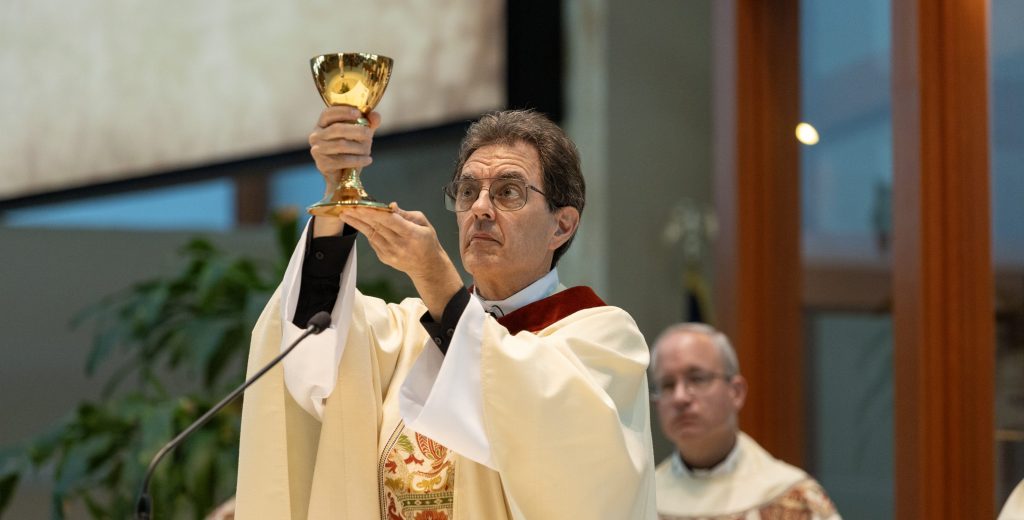
Jesus receives what we give and multiplies it just as he did with the multiplication of the loaves. The priest takes the bread first and then the wine into his hands and speaks the words of Jesus again and through the power of the Holy Spirit, the bread and wine become the Body and Blood of Jesus. How do we know this to be true? Because Jesus said then and we hear his words again at each Mass:

“This is my Body”.

“This is the chalice of my Blood”.

In the miracle of Jesus multiplying the five loaves and three fish to feed the thousands, he was setting the stage for the miracle we get to experience at each Mass. The appearance of bread and wine remains, but its substance, the reality at the core, has been changed to become the Body and Blood of Christ. This miracle we don’t just read about, but can experience and receive him again and again to satisfy the deepest hunger of our souls.

We are just beginning, the journey continues next Sunday!


Photo: Blessed to be a priest participating in the miracle of turning bread and wine into the Body and Blood of Christ during Mass each day!

Link for the Mass readings for Sunday, July 28, 2024