In our lives we experience periods of both desolation and consolation. There is an ebb and flow where we suffer from trials and also celebrate joys. The key to living a life of faith is to see God in both types of experiences. Jesus provided a period of great consolation for Peter, John, and James, the inner circle of the Twelve with the purpose carrying them through the deepest desolation to come on the cross. While he was praying his face changed in appearance and his clothing became dazzling white (Lk 9:29).
Jesus revealed his divine nature to his disciples in an awe provoking display that would prepare them for the next mountain that he would ascend, the cross on Golgotha. Not only was the Transfiguration a foreshadowing of his death, it may as well have also been a foretaste of Jesus rising from the dead in the Resurrection and his ascent to the Father at the Ascension.
Each year we are given opportunities to experience the wonders of Jesus’ significant moments of revelation in his Transfiguration, the Passion, Death, Resurrection, and Ascension. In entering into the yearly rhythm of the liturgical season as well as providing ourselves with anchor moments daily to pray, meditate, and contemplate with Sacred Scripture, we can begin to experience the life and presence of Jesus in our everyday experiences. May we resist the temptation to miss a transfigured moment, because we are seeking our security in those things or persons other than God first.
Jesus came to this mountain, traditionally Mount Tabor, to pray. To lift his heart and mind to the Father in a place of the heights, away from the everyday hustle and bustle, a place where the peak met with the sky, a place where heaven and earth met. He did not go alone but invited the three of his inner circle, Peter, John, and James. Moses, whose burial place was unknown and was thought to possibly have been lifted up to heaven and Elijah, who rose up in a chariot of fire, were both present as well. Their presence most likely impressing the stamp of approval of the Law and the Prophets.
Jesus invites us to let go of our pride, fear, and any sin that may prevent us from journeying to the mountain top. We can experience moments of transfiguration in our daily lives when we acknowledge that God breaks into our lives at that moment when we need him the most, recognize the assistance he has given us, and/or has revealed to us the path and direction we were to take. Our natural response is to offer prayers of thanksgiving, recognizing that we don’t walk alone, that God and those he sends to help us are a tremendous support.
Jesus cares and is also present in our desolations. Many of us run from our suffering, we are afraid of the cross. And yet, it is through the cross that we come to experience the Resurrection. We may not be aware, but when we run away from our suffering, we are running away from Jesus who awaits us with his arms wide open to embrace us in our suffering; to comfort, heal, and transform us. To receive the healing embrace from Jesus, we need to be willing to enter into our suffering.
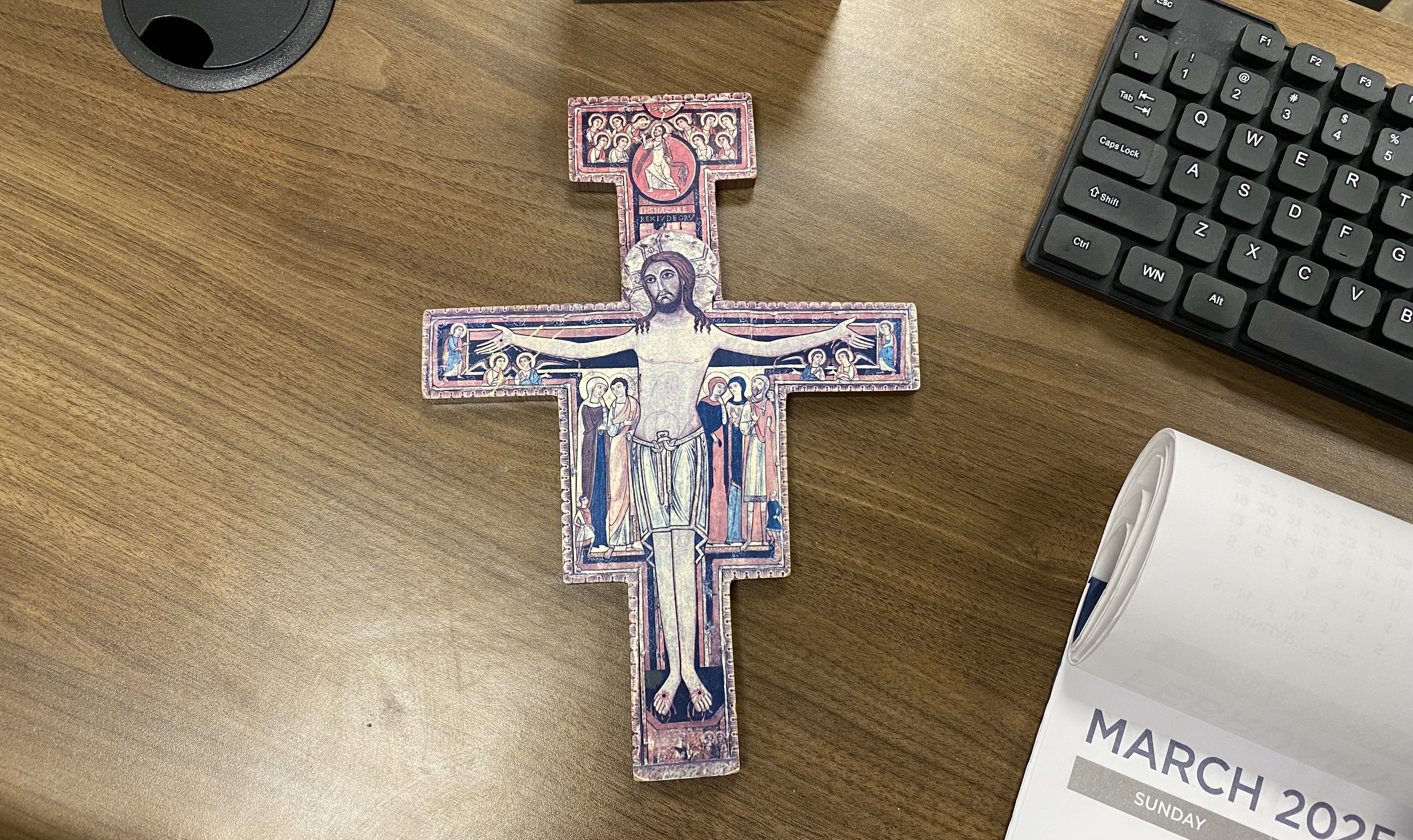
The older I get, the crucifix becomes more and more of a consolation. His body broken, emptied out for us on the cross, represents his unconditional love for us. He gave everything he had, holding nothing back. He took upon himself our sin, our anxieties, fears, and selfishness, and transformed the worst of our fallen nature through his love such that we are invited to be redeemed. The crucifix is not a sign of despair, but of hope and transfiguration, for it reminds us that no matter what we go through or are going through, what trial that we may be in the midst of at this very moment, Jesus has experienced it. He is now, and will be present with us.
Looking at, praying with, and meditating upon Jesus on the Cross has provided me moments of transfiguration, granting me the courage that I did not have to face various conflicts, challenges and trials so to grow and mature as Jesus calls. As he looks down from the cross he continues to love me despite my sin, my weakness, and failures, and is willing to lead and accompany me onward, so that I too may be continually renewed and transformed.
We were not there with Peter, John and James to experience Jesus’ transfiguration, but when we are blessed to participate in the gift of the Mass, we climb the holy mountain and sit at the feet of Jesus and are able to experience the transformation of the bread and wine that become the Body and Blood of Jesus the Christ the Son of God who became one with us in our humanity so that we can become one with him in his divinity. With each reception of the Eucharist, we are more and more transfigured by his holiness and become more and more like Jesus. As we receive him in that intimate encounter, may we also listen to the words of his Father and “listen to him” (Luke 9:35) and the words of his mother, “Do whatever he tells you” (John 2:5).
________________________________________
Photo: The crucifix that I have had with me since my early twenties and which is now on my office desk.
 Spiritual Stepping Stones