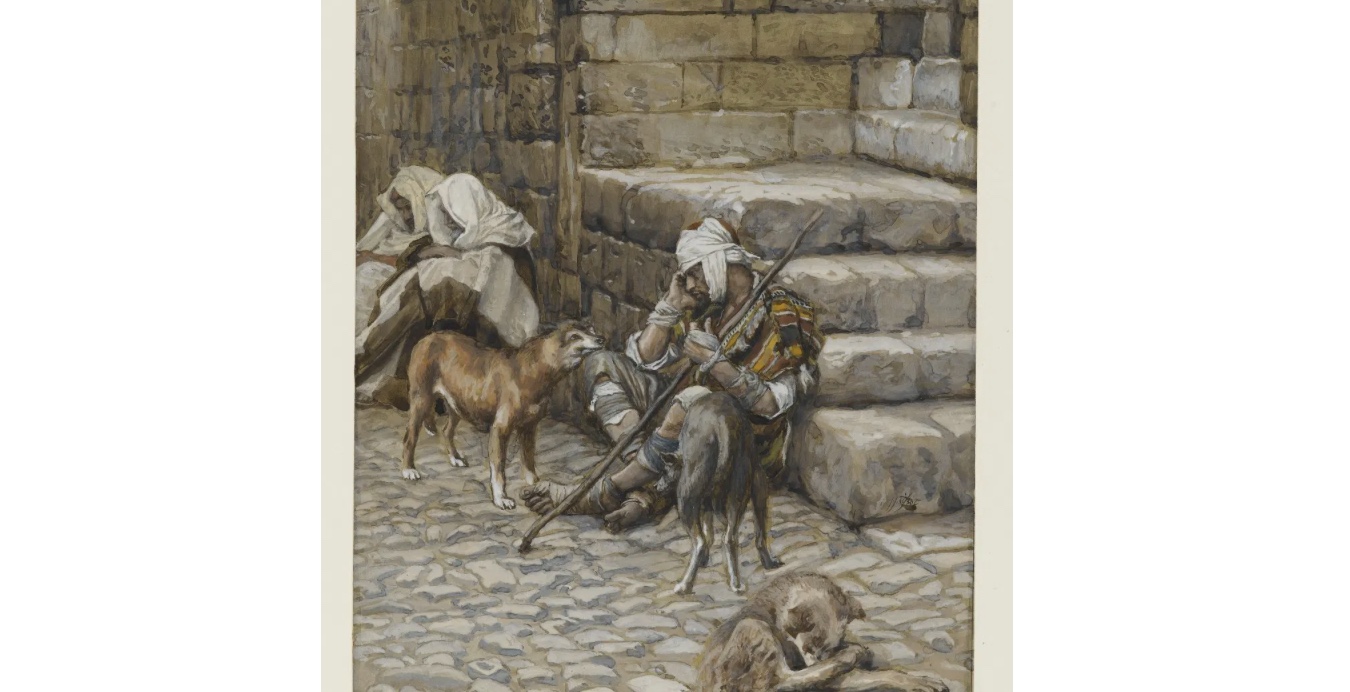
Jesus said to the Pharisees: “There was a rich man who dressed in purple garments and fine linen and dined sumptuously each day. And lying at his door was a poor man named Lazarus, covered with sores, who would gladly have eaten his fill of the scraps that fell from the rich man’s table” (Lk 16:19-21).
Two key points stand out right from the beginning of today’s Gospel regarding the two main characters of Jesus’ parable. The first is that this rich man has all he needs, and more, and is quite comfortable, and in his wealth and excess, he never even noticed the man Lazarus or his need. Lazarus who sat at his door presumably for some and died there from neglect.
Biblical scholars from the Church Father, Tertullian, living in the second and third century, to modern scholars today see in this telling of the rich man an allusion to Herod Antipas (Gadenz, 287). Herod who was compelled as well as feared, and then had John the Baptist killed, also “kept trying to see Jesus” (Luke 9:9). Had he spent some time himself with the poor, he would have had a better chance of that happening. Herod would later get his chance and was “very glad to see Jesus” when Pilate sent Jesus to him to be judged.
Whether or not Jesus intends the rich man to be Herod, the Pharisees, or anyone who does not follow the will of his Father in being generous to the poor, In sharing this parable, Jesus is not just pointing out something new. He is echoing the prophets such as Amos who said “Woe to the complacent in Zion” (Amos 6:1). The rich man is complacent, indifferent to the dire need of Lazarus who is right at his door. How many times did this rich man just walk by him paying him no notice?
The second point in this account is that the poor man, Lazarus, a homeless, hungry, and dying man is named, and the rich man is not. For ancient people’s, those without a name were those that had no status, were outcasts, lost. Jesus is turning over the table on this man from the very beginning of his parable in leaving him unnamed. The tragedy, because of this man’s unrepentance while he is alive, is that he will remain unnamed after his death.
The man’s indifference and complacency toward those he kept at arm’s length, highlighted by his treatment of Lazarus, allowed there to be a separation between them instead of the unity God calls for. This choice became an eternal choice and created the wide chasm between him and Abraham. This distance was of his own making because he did not seek to come close to Lazarus in life. In separating himself from Lazarus, he separated himself from God.
Jesus makes this same point in Matthew 25:31-46 when he taught that what we do not do to the least of these: the hungry, thirsty, the stranger, the naked, the imprisoned, you do not do to me. Jesus identifies himself with the poorest of the poor. Lazarus also dies and experiences an opposite fate as he is brought to the bosom of Abraham. Jesus here is echoing the Beatitude he shared earlier: “Blessed are you who are poor, for the kingdom of God is yours” (Luke 6:20).
The parable of the Rich Man and Lazarus that Jesus shared speaks an important truth to us today. Jesus is showing the importance of our interconnectedness and call to nurture relationships. He is not calling us to create a utopian ideal but to repent and allow the Holy Spirit to transform us as we learn and follow the commandments of God. We are to be open to meeting each other not as the rich man regarded Lazarus with indifference and contempt but to instead be aware of the needs of our neighbors, our brothers and sisters, to care, and to love one another person to person by willing their good.
Pope Leo offered similar advice a few weeks ago: “We need an extensive ‘covenant of humanity,’ founded not on power but on care; not on profit but on gift; not on suspicion but on trust. Care, gift and trust are not virtues to be practiced only in one’s spare time: they are pillars of an economy that does not kill, but deepens and broadens participation in life.”
Jesus encourages us to resist the temptation of callousness, cynicism, and indifferentism and to be open to breathing, receiving, resting and abiding in his love and to follow his lead to love others in concrete ways. A good place to start is to be willing to come close, to offer a smile, or to listen to another in need. In being willing to see Jesus in each other, “God in every human being” (St. Mother Teresa), we can then learn and put into practice the corporal and spiritual works of mercy. In doing so, we love God, our neighbor, and ourselves and help to make our corner of the world a little better.
————————————————
Painting: “The Poor Lazarus at the Rich Man’s Door” by James Tissot.
Link for the Mass for Sunday, September 28, 2025
Link for Pope Leo XIV’s address to the 3rd world meeting on human fraternity, September 12, 2025
 Spiritual Stepping Stones