Jesus is recorded, a few verses before (cf. 7:37-39) today’s Gospel, speaking about quenching the thirst of those gathered around to listen to him. The thirst he is talking about fulfilling is spiritual thirst, that thirst which we all desire to be refreshed by, that which we have been created to receive; the thirst to belong, to be in communion, to be loved and to love in return. Jesus speaks of coming to those who thirst to be refreshed with: “Rivers of living water [that] will flow from within” (Jn 7:38). Jesus spoke of the day when he would send the Holy Spirit to well up from within the soul of each person who would follow him. All who participate in the life of Jesus would come to experience also the love shared between God the Father and God the Son, who is God the Holy Spirit.
Some who heard Jesus speaking in this way were deeply moved, they believed him to be the Prophet, others believed him to be the Messiah. Yet, there were those who could not see past their own preconceived notions. They heard his teaching, may have even been moved as well but said, “The Messiah will not come from Galilee, will he” (Jn 7:41)? Remember Nathaniel’s first reaction when Philip had told him that they had found the Messiah? Nathaniel asked if anything good could come out of Nazareth (cf. Jn 43-47). Jesus was also rejected by his own hometown crowd most likely because they knew him most of his life and there was nothing special about him. He was a tekton, a carpenter or a day laborer, like Joseph.
Why the region of Galilee, the town of Nazareth itself, would be disparaged is a matter of speculation. The fact was that there were those, unlike Nathaniel, that could not see past their initial prejudices. Even though Jesus spoke and taught with authority, though as the Temple guards who were sent to arrest him said, “Never before has anyone spoken like this man” (Jn 7:46), and even when Nicodemus spoke out rationally, requesting they hear Jesus out and give him the opportunity to make his case, there were those in authority and among the people who could or would not hear Jesus. They closed themselves off to the invitation to receive the gift of the love of God. Their charge was that he was not from Bethlehem, he was not of the line of David, case closed.
It is helpful to come to terms with our ingrained, prejudicial attitudes and our limitations of thought that prevent us from seeing as God sees, otherwise, we will become like a stagnant pool. Like those in today’s Gospel, we can close ourselves off from the invitation of Jesus and his very life that he would like to impart within us. Many times, this happens because we buy into our anxieties and allow them to limit us. We can be paralyzed by them or on the other extreme act out impulsively. Aristotle wrote that virtue is the means between two extremes. In this case, courage is the means between being paralyzed with fear and excessive reckless abandon.
A more reasonable and rational approach is helpful for our spiritual life as well. We can pay more attention to fear and not trust Jesus. We can believe that Jesus has abandoned us or that he doesn’t care, that he does not exist. Or we can follow the lead of Pope Francis who shared in his Ubi et Orbi message at the height of the pandemic in 2020 that Jesus, “more than anyone, cares about us.” Jesus cares.
He his extending his hand out to us right now. We can reject it or grasp it, the choice is ours. Jesus is the source of living water, he is the eye in the midst of any storm, he is the light leading us through the darkness, and he celebrates with us in our victories. When we choose to breathe more and react less, when we are willing to be still and look, when we trust in Jesus and his love for us, we will experience his presence and we will be more likely to recognize and accept his invitation of love. By taking his hand and allowing him to lead us, we will act with more prudence, be more present and mindful, and better prepared to support one another each day going forward.
———————————————————————————-
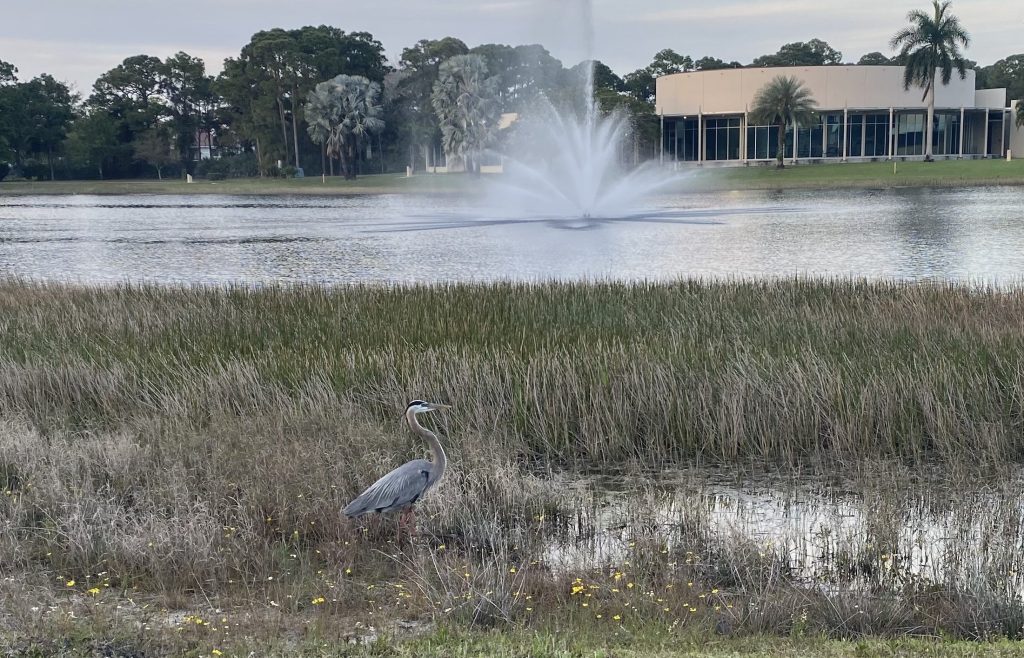
Photo: Great Blue Heron landed next to me as I began my Rosary walk. St. Vincent de Paul Regional Seminary, Boynton Beach, FL.
Link for the Mass readings for Saturday, March 16, 2024

 Spiritual Stepping Stones