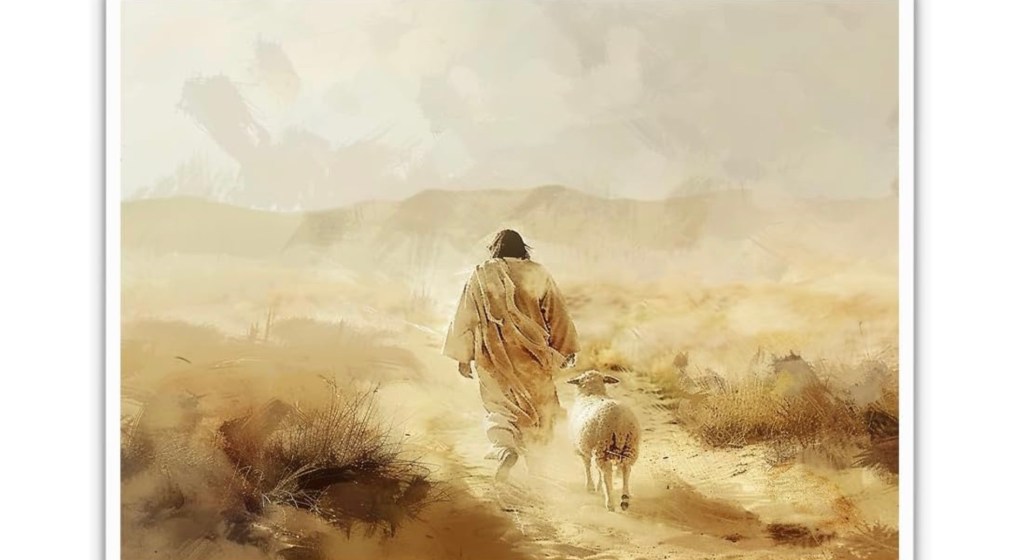
“Jesus walks with us. Always.”

Jesus continues to present the imagery of the shepherd in today’s Gospel reading from John. He offers the assurance of security and protection that is to be found for those that are in his fold when he says, “No one can take them out of my hand. My Father, who has given them to me, is greater than all, and no one can take them out of the Father’s hand. The Father and I are one” (Jn 10:28-30). How does one enter the fold of the Good Shepherd? All who hear his voice, believe in, and follow him will be known by him, come to know him, and so be a part of his flock.

Yet, there are those who hear his voice and do not recognize the Shepherd. They do not follow him and so are not known by him, although he seeks them out. They may know about the Shepherd, have heard of him, but do not know him. Their hearts and minds are closed. They do not believe in his miracles, his exorcisms, his teachings, and the question of those opposing him in today’s reading is, “If you are the Messiah, tell us plainly” (Jn 10:24). Jesus did just that by saying that he and the Father are one. The response to the forthright comment of Jesus is that those who are closed to his answer pick up rocks to throw at him (see Jn 10:31).

Jesus offers the gift of relationship with him and his Father, to experience the love shared between them, the Holy Spirit. Jesus offers eternal life. Jesus is open about who he is, who we are, and who we can become in participation with him. Those who say no to his invitation do so for their own reasons. Just as Jesus invites us to freely come to him, he will only come so far as we are willing to receive him. He does not conform to us or to our will.  Jesus does not need us nor does he force his will upon us, yet he loves us by willing our ultimate good. He is willing to risk that we will walk away, but he continues to be close and ready for when we turn back.

Even many of us who have said yes, only go so far. We hedge our bets, dip our toes into the water, and maybe go in ankle-deep, but not too many of us are willing to relinquish control, let go, and surrender fully all at once. Jesus offers, eternal life, true, but also a life of meaning and fulfillment now. A perfect life? No, there will continue to be challenges, conflicts, mistakes, and missteps. There will be suffering, pain, and heartache. All the while, Jesus’ voice continues to call us to follow him, to trust him, and seek safety and healing from our anxieties, fears, wounds, weakness, and sins. Our safety is truly in Jesus, because he is eternal and unchanging.

Jesus empowers us to face our conflicts and resistances, and as we grow in our trust in him, we can feel safe to let go of our control and defense mechanisms, and become more disciplined in resisting temptations and apparent goods. Through all our experiences, the ups and downs, the only assurance is that we are not alone. No matter what we may face today or tomorrow, we can be assured that Jesus will never let us go and no one can take us out of his hand. Each step of the journey we take, we can be confident that Jesus, our Good Shepherd, will be there to guide and protect us as he leads us to experience deeper intimacy with him, his Father, and the Holy Spirit.

——————

Painting: Accessed on Amazon.com wall art

Link for the Mass readings for Tuesday, April 28, 2026

Jesus cares.

Jesus is recorded, a few verses before (cf. 7:37-39) today’s Gospel,  speaking about quenching the thirst of those gathered around to listen to him. The thirst he is talking about fulfilling is spiritual thirst, that thirst which we all desire to be refreshed by, that which we have been created to receive; the thirst to belong, to be in communion, to be loved and to love in return. Jesus speaks of coming to those who thirst to be refreshed with: “Rivers of living water [that] will flow from within” (Jn 7:38). Jesus spoke of the day when he would send the Holy Spirit to well up from within the soul of each person who would follow him. All who participate in the life of Jesus would come to experience also the love shared between God the Father and God the Son, who is God the Holy Spirit.

Some who heard Jesus speaking in this way were deeply moved, they believed him to be the Prophet, others believed him to be the Messiah. Yet, there were those who could not see past their own preconceived notions. They heard his teaching, may have even been moved as well but said, “The Messiah will not come from Galilee, will he” (Jn 7:41)? Remember Nathaniel’s first reaction when Philip had told him that they had found the Messiah? Nathaniel asked if anything good could come out of Nazareth (cf. Jn 43-47). Jesus was also rejected by his own hometown crowd most likely because they knew him most of his life and there was nothing special about him. He was a tekton, a carpenter or a day laborer, like Joseph.

Why the region of Galilee, the town of Nazareth itself, would be disparaged is a matter of speculation. The fact was that there were those, unlike Nathaniel, that could not see past their initial prejudices. Even though Jesus spoke and taught with authority, though as the Temple guards who were sent to arrest him said, “Never before has anyone spoken like this man” (Jn 7:46), and even when Nicodemus spoke out rationally, requesting they hear Jesus out and give him the opportunity to make his case, there were those in authority and among the people who could or would not hear Jesus. They closed themselves off to the invitation to receive the gift of the love of God. Their charge was that he was not from Bethlehem, he was not of the line of David, case closed.

It is helpful to come to terms with our ingrained, prejudicial attitudes and our limitations of thought that prevent us from seeing as God sees, otherwise, we will become like a stagnant pool. Like those in today’s Gospel, we can close ourselves off from the invitation of Jesus and his very life that he would like to impart within us. Many times, this happens because we buy into our anxieties and allow them to limit us. We can be paralyzed by them or on the other extreme act out impulsively. Aristotle wrote that virtue is the means between two extremes. In this case, courage is the means between being paralyzed with fear and excessive reckless abandon.

A more reasonable and rational approach is helpful for our spiritual life as well. We can pay more attention to fear and not trust Jesus. We can believe that Jesus has abandoned us or that he doesn’t care, that he does not exist. Or we can follow the lead of Pope Francis who shared in his Ubi et Orbi message at the height of the pandemic in 2020 that Jesus, “more than anyone, cares about us.” Jesus cares.

He his extending his hand out to us right now. We can reject it or grasp it, the choice is ours. Jesus is the source of living water, he is the eye in the midst of any storm, he is the light leading us through the darkness, and he celebrates with us in our victories. When we choose to breathe more and react less, when we are willing to be still and look, when we trust in Jesus and his love for us, we will experience his presence and we will be more likely to recognize and accept his invitation of love. By taking his hand and allowing him to lead us, we will act with more prudence, be more present and mindful, and better prepared to support one another each day going forward.

———————————————————————————-

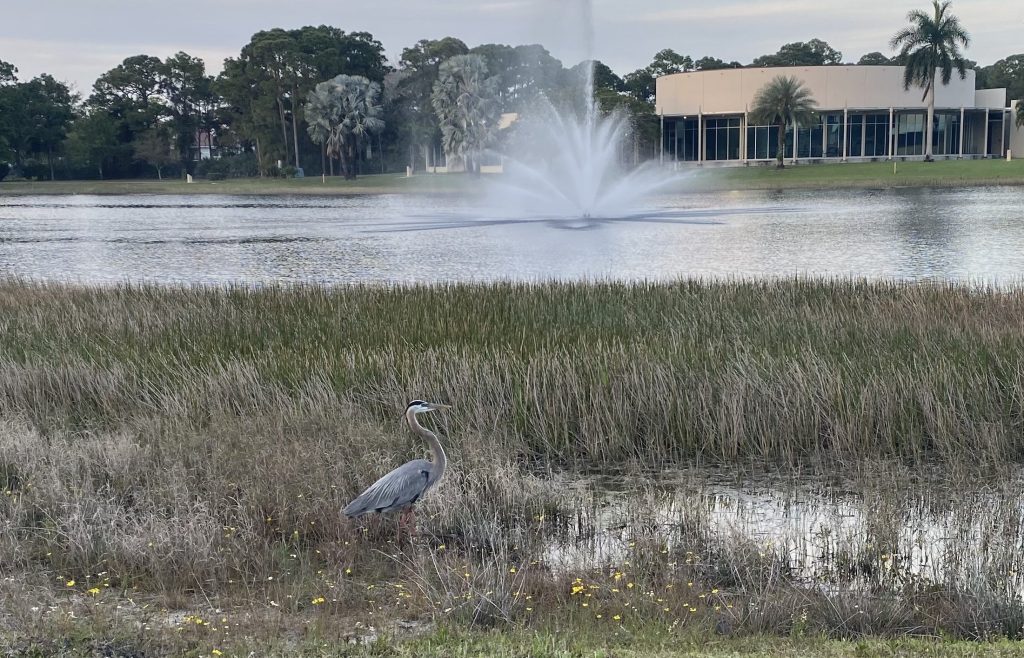
Photo: Great Blue Heron landed next to me as I began my Rosary walk. St. Vincent de Paul Regional Seminary, Boynton Beach, FL.

Link for the Mass readings for Saturday, March 16, 2024

Knowing we are cared about and loved makes a big difference.

“I yearn to see you again, recalling your tears, so that I may be filled with joy, as I recall your sincere faith that first lived in your grandmother Lois and in your mother Eunice and I am confident lives also in you” (I Timothy 1:3-5).

St. Paul writes these words to Timothy and what struck me was not only the affection he had for Timothy and that he knew his mother and grandmother’s names, but also that he knew the depth of the faith of each.

We are at our best when we make relationship with God and one another a priority. Christianity is not so much a philosophy or even a theology, as much as it is a relationship with a person, the God made man, Jesus the Christ. This faith in and willingness to enter into a relationship with God was lived by Lois and then passed on to Eunice, who then both passed it on to Timothy.

They knew and loved God and one another, they cared for and supported each other, and they welcomed Paul into their family such that he knew them well enough to refer to them by name in this letter. Do we know each other by name in our places of worship, in our communities, our neighborhoods?

Dr. Leo Buscaglia, a professor at USC shared a story about how he noticed that one of his students had missed class for a few days. When she did not return the following week, he asked her classmates about her whereabouts, and no one knew where she was. He then reached out to the dean of students, and she broke the sad news to Dr. Buscaglia that she had taken her life.

He was horrified not only by her death but even more by the fact that no one in the class knew anything about her. He then began to teach a course simply titled, “Love Class 101” in which his students came together to learn about building relationships with one another. He was doing what Lois, Eunice, Timothy, and Paul were doing, what the faith communities and families are called to do, what we as human beings are called to do.

We can help to shift the tide of growing anxiety, confusion, isolation, and loneliness, when we make a commitment to care, to be more present, communicate and listen, be more understanding and patient, support, empower and lift one another up. In other words, when we are willing to love God with our whole heart, mind, soul, and strength, and love our neighbor as ourselves.


Photo: I wasn’t the sharpest tool in the education shed, nor the best teacher, but I cared. Let us love and care for those in our realm of influence so that they know that they matter and they are loved.

Link for the Mass readings for Friday, January 26, 2024