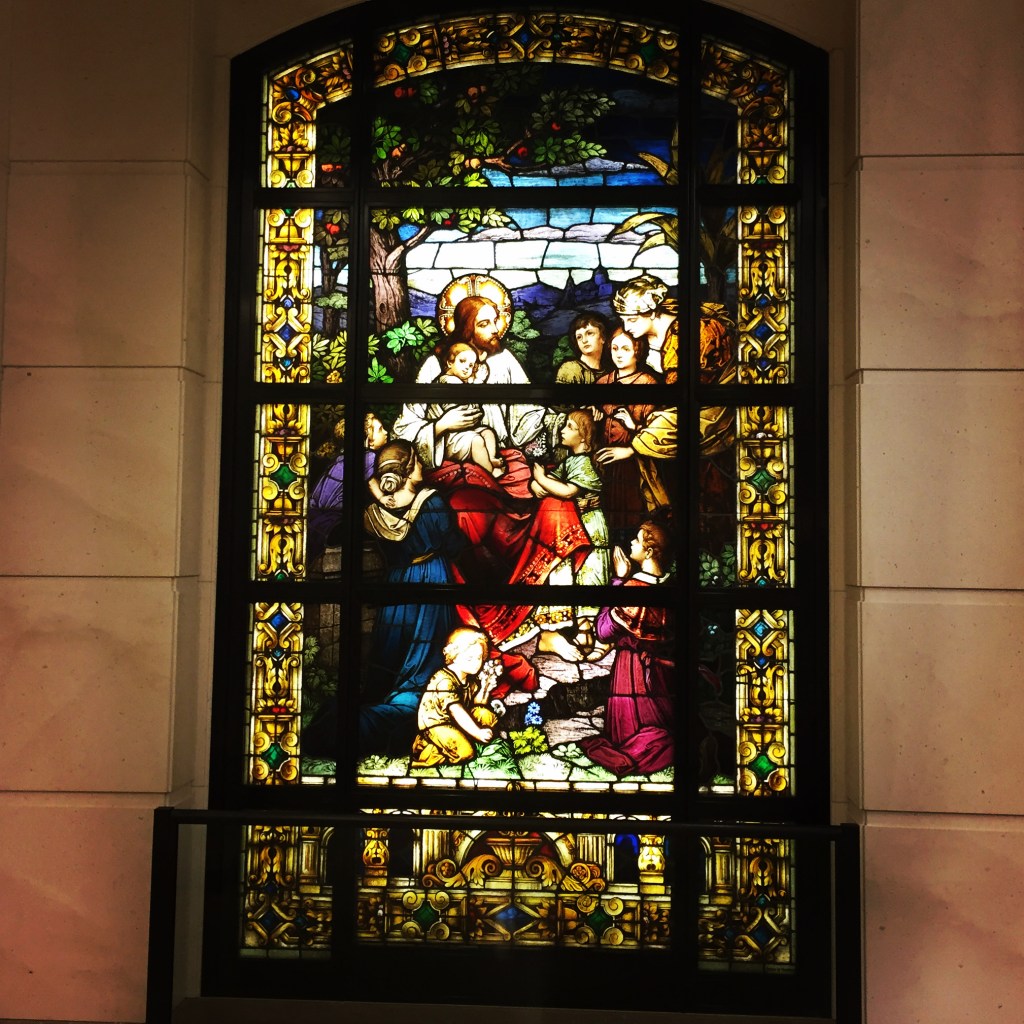
In today’s Gospel account, or pericope, people are bringing their children to Jesus to receive a blessing. To offer a blessing, especially this is an action a father would offer, was common. It is understandable that parents would want to bring their children to be blessed by Jesus. Even though children had very little status in the ancient near East of this time, especially in the very young because of high mortality rate, parents did care. They, as with others, sought Jesus for his healing touch, whether they needed a healing or a blessing.
Yet, the disciples step in to prevent this process from happening. Mark does not share the reason for their interference. The disciples apparently missed the lesson that Jesus sought to teach them earlier when they were arguing among themselves about who was the greatest. Jesus had then asked for a child to be brought to him and said, “Whoever receives one child such as this in my name, receives me” (Mk 9:37). This could be why Jesus was none to happy, in fact “indignant” for their interference. Jesus rebuked his disciples: “Let the children come to me; do not prevent them, for the Kingdom of God belongs to such as these. Amen, I say to you, whoever does not accept the Kingdom of God like a child will not enter it” (Mk 10:14-15).
Jesus consistently offered grace to those who might otherwise in the society of his time be prevented from receiving it. Jesus provided healings for the possessed, lepers, women, the blind, the lame, tax collectors and sinners. The very fact that this short account mentioning children is even included in an ancient near Eastern text says something profound. Jesus recognized the dignity of children as he already attempted to teach his disciples.
Children in the ancient Near East had no recognized social status. Orphans were at risk and needed to be taken care of. Children up to two years old were vulnerable in many ways and as such, experienced a high rate of infant mortality. Because of this reality, many parents may have developed an unconscious, defensive posture that they did not become too attached to their children until after they were two years of age. This harsh reality could also be a reason why these children were being brought to Jesus for a blessing.
Jesus, in his reaching out to the children to offer a blessing, impresses the point that he takes the life of children seriously and so encourages others to do so. There are historical accounts that Christians continued to take this teaching seriously. In ancient Roman society, if parents did not want a child, one recourse was to leave them in a local dump to die. Christians would retrieve the infants and bring them into their homes and raise them.
Jesus also used this opportunity as a teachable moment when he shared that “the kingdom of God belongs to such as these.” Jesus is recorded as using the image of God as a Father one hundred seventy five times in the Gospels. Jesus equating that the kingdom of heaven belongs to such as these would have been hard for his disciples to fathom. Maybe one of the reasons this message did not stick the first time. Jesus was helping his followers and us today to see the love of the Father for all his children. To enter the kingdom, we must accept that we are to depend totally on and place all our trust in God as our Father.
God has created us to be in relationship with him and one another. We need him just as much as an infant does for his or her very existence and survival. We do not buy or earn our way into the kingdom of Heaven because God and his realm is so transcendent, so beyond us, that we cannot possibly get there on our own efforts. We enter the kingdom of God through the door of his Son, who is the way, the truth and the life.
Just as Jesus opens his arms to embrace the children to receive and bless them, he seeks to do so with us. In our willingness to enter into and receive his embrace, we enter into the kingdom of our Father. It is relationship with God who we are wired for, he is our hope, our meaning, and our fulfillment. “[T]o receive the kingdom is as simple, trusting, and humble an action as receiving the embrace of Jesus. Indeed, to enter the kingdom is nothing other than to enter into a relationship with Jesus” (Healy, 201).
Thank you Jesus for the gift of loving us and revealing to us our dignity, value, and worth. Help us to accept and embrace this gift of your love so that we may love each other as brothers and sisters. Help us to promote a culture of life that recognizes and acknowledges the dignity and value of each and every person without exception from the moment of their conception, birth, throughout the ups and downs of daily life, up to and including our elder years until natural death.
——————————————————————
Photo: Stained glass depiction at the Cathedral of Our Lady of the Angels, Los Angeles, CA.Healy, Mary.
Healy, Mary. The Gospel of Mark. Grand Rapids, MI: Baker Academic, 2008.
Link for the Mass readings for Saturday, March 1, 2025

 Spiritual Stepping Stones