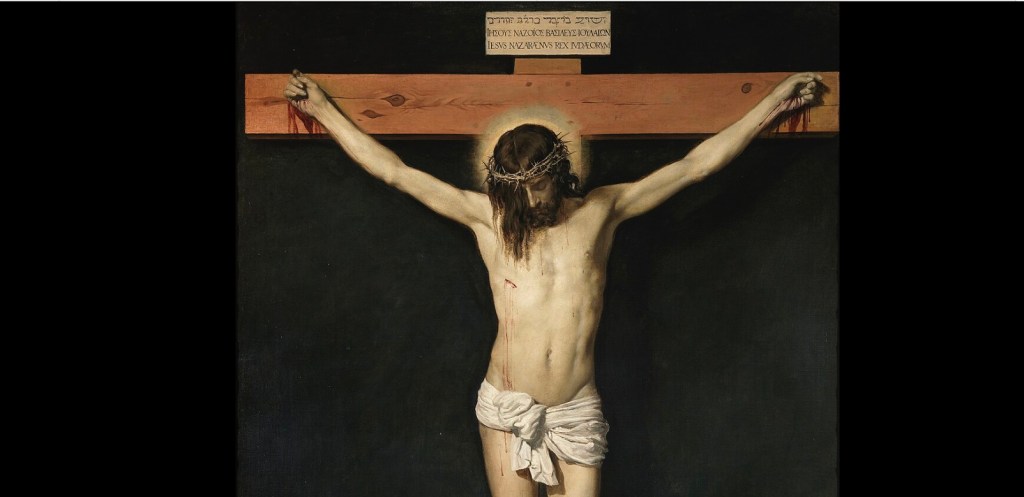
Jesus’ crucifixion was his coronation as Christ the King.

Today is the last Sunday in Ordinary Time. Next Sunday will begin the new liturgical year in the Church calendar as we begin Advent. In today’s Gospel from Luke, Jesus is engaged by two criminals being crucified with him.

The first “reviled” him and demanded Jesus, “save himself and save us!” There was no acknowledgment of his own transgressions. The other criminal acknowledged that they were justly condemned and deserved their fate on the cross. He recognized his sin and crime, and reached out to Jesus with deference, when he said, “Jesus, remember me when you come into your kingdom.”

Jesus replied, “Amen, I say to you, today you will be with me in Paradise” (cf Luke 23:35-43).

This second criminal saw beyond what appeared to many others to be the end of this man, Jesus. Instead, he recognized Jesus as the messiah, the king and that his coronation was happening before his eyes, his crucifixion. Jesus recognized this man’s contrition and welcomed him into his kingdom, for Jesus became the Messiah, the Christ, the King, through his Passion, Death, and Resurrection.

This solemnity is 100 years old this year. It was first instituted by Pope Pius X to counteract the rise of secularism and the atrocities of World War 1. Over and above all philosophies, ideologies, political theories and the like, Jesus is to be our King. Pope St. Paul VI, after Vatican II, thought the solemnity would be more fitting to be placed on the last Sunday of Ordinary Time. This also echoes the intent of Pope Pius. Even though he placed the feast at the end of October to be near the feast of all saints, he wrote in his encyclical, Quas Primas, that the solemnity would  be placed best, “at the end of the liturgical year, and thus the feast of the Kingship of Christ sets the crowning glory upon the mysteries of the life of Christ already commemorated during the year.”

Jesus, the Son of God, came among us to re-orient and to re-align the worldly order. Throughout his public ministry he spoke and acted in the Person of the God of Israel and he did this most profoundly as he allowed himself to be nailed to and lifted up on the cross. Leadership would no longer be about the aggrandizement of the self nor to be lorded over at the expense of others. God was very aware of the suffering of his people. He sent Moses to free his people from slavery from Egypt and he sent his Son to free all humanity from slavery to sin.

Yet this freedom has a cost. Today, we are reminded that we have a choice to make. Who are we to serve? Are we to serve Pharaoh or Moses, Pilate or Jesus, our self or God. If we seek to be free from the shackles of our slavery to sin, the choice is clear. When listen to the voice of the king of the universe, the way, the truth, and the life of Jesus the Christ, the King of the Universe and choose to follow him, we will as did Mary have chosen the better part.

The reign of the kingship of Jesus is about a personal encounter. We serve Christ the King when we are aware of and accompany one another. We are not to be about bringing world peace, ending hunger, providing homes for all in some abstract utopian pursuit. We are to concretely and intimately treat each person we meet with dignity. We are to see Jesus in our midst: “For I was hungry and you gave me food, I was thirsty and you gave me drink, a stranger and you welcomed me, naked and you clothed me, ill and you cared for me, in prison and you visited me” (Mt 25:35-37). Jesus, our king, commands us to act as he lived, to be aware of, to accompany, and to make a difference, one life at a time.

We may feel overwhelmed with our own struggles, let alone the present state of our country or weight of the world, but we do not have to bear the weight alone, nor are we expected to change the world. We just need to begin each day with a commitment to serve Jesus Christ our King. We do so when we resist the temptation to turn inward upon ourselves and instead adjust our attitude and focus outward. God is guiding us already through the love of the Holy Spirit, we just need to slow down and breathe so that we can feel safe enough and remain still long enough to receive his love, and choose to open our eyes to see, our ears to hear, and be willing to follow his will.

We are invited today, on this feast day of Christ the King, to remember who we are and whose we are. Are we willing to allow Jesus to re-orient, to re-align the order of our lives so that we also participate with St. Dismas, the traditional name given to the penitent thief? If so, we need to acknowledge our failures and sins, repent from the ways in which we have turned away from God and each other, and turn back to him. We will then be better able to serve Jesus our king and follow his command to be forgiving, merciful, loving, and to enter into the chaos of another, one person at a time.

When we are willing to be, as St Mother Teresa said, a pencil in God’s hand in our everyday moments, with each thought we entertain, before each word we speak, and before each action we take, and in every encounter we engage in, we follow God’s will. As we surrender to Jesus our king, follow the inspiration of the Holy Spirit, and accept the will of our Father in every circumstance, then with our last breath, we will know Jesus and hear his words, “Amen, I say to you, today you will be with me in Paradise” (Lk 25:43).

——————————————————————-

Photo: Ending the evening in prayer with my Savior and King, my God and my all.
The Mass readings for Sunday, November 23, 2025

The victory of the Cross reveals to us our sin and God’s love.

“In punishment the LORD sent among the people saraph serpents, which bit the people so that many of them died” (Numbers 21:6).

What kind of God would bring poisonous snakes upon his children? When Jesus taught his disciples about prayer didn’t he say, “Is there anyone among you… if a child asks for a fish, will give it a snake? If you then, who are evil, know how to give good gifts to your children, how much more will your Father in heaven give good things to those who ask him” (Mt 7:10).

Is God a loving Father or a harsh taskmaster?

He is a loving Father who not only wants his children to live but to experience life to the full. God freed his people from slavery and was not only leading them to the promised land but also providing for and protecting them on the way. And yet, the people consistently grumbled and then rose up against Moses. In this instance, they not only grumble, but they are rejecting the manna God was giving them by saying, “We are disgusted with this wretched food” (Numbers 21:5). The people were rejecting food from heaven, the bread of life, that God their Father was providing them.

In rejecting life, they were choosing death. God allowed them a stark image of their choice of opposition to him, there choosing to separate themselves from him, by sending the serpents. The imagery of the serpent would have come to mind quickly to the people. For it was the serpent who tempted Eve and Adam and led them to their Fall. It is the ancient serpent that seeks to distract, divert, and destroy. As St. Ephrem the Syrian (306-373 AD) wrote: “The serpent struck Adam in paradise and killed him. [It also struck] Israel in the camp and annihilated them” (Word on Fire Bible, p. 643).

We as Christians interpret the serpent in Genesis as Satan, which in Hebrew means adversary or opposer. Those of the people who rose up against God opposed him as Satan did. God revealed to them who they were serving in their rebellion and also showed them that if they rejected God and his love, protection, and provision, what the consequences to that choice would look like. Apart from God they will die. In repenting from their disobedience, trusting in and following God, even when the desert held no promise, they would live because God not only provides, he is the source of life. “This particular punishment is another way of insisting that negativity necessarily follows from rebellion against God’s will” (Barron, p. 641).

When the people saw and experienced the result of their sin so graphically, they correctly repented: “We have sinned, for we have spoken against the Lord and against you; pray to the Lord, the he take away the serpents from us” (Numbers 21:7). Moses interceded and God provided the healing antidote. He guided Moses to place a bronze image of a serpent on a pole. All who then looked upon it, were cured. In seeing clearly what had led to their poisoning, they could renounce it and receive God’s mercy, forgiveness, and healing. “Somehow, seeing sin for what it is serves to disempower the hold it has upon us” (Barron, p 641).

Jesus, the divine Son of God becomes one with us in our humanity to reveal to us the path to participate in his divinity. When we are willing to see, Jesus shows us our own rebelliousness, pride, our sins that arise when we listen to the father of lies and separate us from God and each other. Jesus has not come to condemn us but to convict and save us. To lead us away and free us from our slavery to sin. Jesus took the sin of the world upon himself as he was lifted up on the Cross. As he shared with Nicodemus, “just as Moses lifted up the serpent in the wilderness, so must the Son of Man be lifted up, that whoever believes in him may have eternal life” (Jn 3:14-15).

This is why we celebrate the feast of the Exaltation of the Holy Cross. What was a wicked sign of oppression and horrific suffering has now become a sign of our salvation. As we look upon the crucifix, upon Jesus who has been lifted up for us, we are reminded of the suffering that Jesus bore. Jesus took upon himself “all the dysfunction of the fallen human race” (Barron, p. 642).

We see graphically on the Cross death, the result of our sins, our choice to separate ourselves from God. We also see love, God’s only Son who took upon himself the sin of the world. On that Cross is where Jesus died for each and every one of us, and in so doing conquered the sin and death brought into the world by Adam and opened up for us the door to eternal life through his resurrection. The Crucifix presents to us a clear choice, what our life looks like apart from God and what it looks like in communion with God. With every thought, word, and action, may we choose Jesus, the Bread of Life, and experience his love.


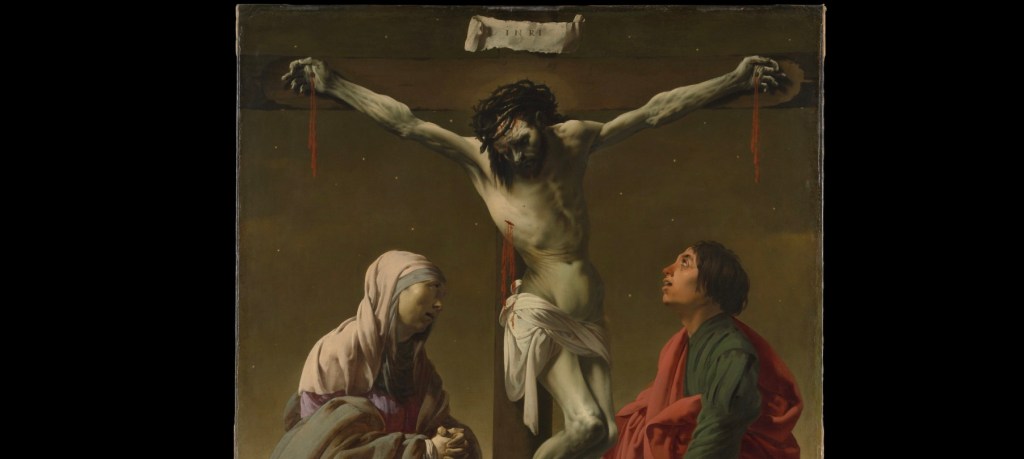
Painting: “The Crucifixion with the Virgin and Saint John” by Hendrick ter Brugghen. Do we see defeat or victory? May we see the horror of our sin and “what it serves” and so repent and turn back to God’s love.

Link for the Mass for Sunday, September 14, 2025

Word On Fire Bible: The Pentateuch. Elk Grove Village, IL: Word on Fire, 2023.

Today is Good Friday because in dying, Jesus conquered death.

Jesus was betrayed, arrested, falsely accused, tried, scourged, and beaten. Jesus carried his cross, was crucified, and with his words, “It is finished” (Jn 19:30), Jesus died. The gift of a crucifix is that it is an icon of the moment of the death of Jesus. Having a crucifix is not a morbid fascination with death, nor is it a rejection of his resurrection. The crucifix is not a magic talisman either, but a sacramental, that helps us to remember the reality of what the Son of God, who became one with us, did. Jesus embraced humanity all the way even unto his death, even dying on the cross and giving his life for us that we might have the opportunity to be born again, to be one with him, to be deified, and live with him forever. Without the crucifixion, there would have been no resurrection.

On this Good Friday, let us spend time in venerating Jesus on the Cross, meditating before a crucifix, before this expression of the most intimate act of Love ever expressed in human history. This icon expresses the wonderful bestowal of the grace of God upon humanity, in that it reminds us that we have a God who has experienced and understands betrayal, loss, suffering, pain, anguish, and even death. Jesus is relevant to our lives because he meets us in the chaos and suffering of our own lives.

In making time to be still and looking upon the cross upon which he died, seeing his body slumped and lifeless, we can call to mind the times we have been betrayed, the struggles, trials, pains, sorrows, and losses that we have or are enduring right now. We can also recall those times we have betrayed and hurt others with our actions or inactions, as well as caused pain and suffering. With each conflict or experience of injustice, we can be comforted in knowing that Jesus understands because he has experienced them all.

Making time to gaze upon the crucifix in times of fear, anxiety, temptation, indecision, and/or in need of forgiveness, can give us the strength and courage to endure or go through what lies before us. Jesus with his arms outstretched represents for us his eternal welcome, that he loves us more than we can ever mess up, that he does not define us by our sins or worst mistakes, and that he loves us more than we can ever imagine.

When we resist running from our trials, our suffering, and our pain, and instead face them, we will find that Jesus is waiting for us with his arms outstretched and wide open, just as he did on the Cross. Jesus meets us in the depths of the whirlwind of our deepest hurts, struggles, and confusion, as well as when and where we need him most.

I still remember thinking, in the final weeks of JoAnn’s life when she was just skin and bones, that her suffering was like watching a crucifixion. Yet, she never lost her dignity, beauty, or her grace. JoAnn radiated love for me, our children, and any of those who helped to care for her in her final days. Jesus held each of us up and drew us closer together. Our twenty-three years and especially those final months together has helped me to be a better priest. God indeed does bring about a greater good from even the worst of circumstances.

This is why we venerate Jesus on the cross today, this is why today is Good Friday, so we remember that death does not have the final word, for Jesus conquered death. This is why we can say with St. Paul, “Where, O death is your victory? Where, O death is your sting” (1 Cor 15:55). Jesus did not leave us orphans when he died on the Cross. Jesus conquered death and became the firstborn of the new creation. We are not alone because as St Irenaeus wrote, “Jesus opened up heaven for us in the humanity he assumed.” Jesus is present in whatever we may be dealing with, now, always, and forever.

——————————————————————–

Painting: Christ Crucified by Diego Valázquez

Link for the Mass readings for Friday, April 18, 2025