
To heal, it is important to reveal our sin and come out of the darkness.

The Lord said to him, “Although you cleanse the outside of the cup and the dish, inside you are filled with plunder and evil. You fools” (Lk 11:39).

Jesus’ harshest critiques were for acts of hypocrisy. He did so to show, in no uncertain terms, how dangerous this was, especially for religious leaders. These men were entrusted with the care of God’s people. They may have observed the proper rituals, spoke, and dressed to match the part but this all meant nothing if their hearts were hardened, and they were closed to the love and will of God. This situation was more perilous when they themselves became obstacles, stumbling blocks to those who sought God. Jesus indicting them as fools meant that they were bereft of the wisdom of God they projected to have.

A recent Pew study tracing religious affiliation from 2007 to 2014 found that approximately 56 million Americans identify themselves as following no religious affiliation. Some have labeled this group as the “Nones”. The context and nuance of why this trend has been on the rise has many components. One ingredient is the unacceptable levels of hypocrisy which has turned many off to organizations and the societal structures including the Church. Reports of abuse of children, women, and at risk adults over the past few decades further adds fuel to this fire. Although, church leadership has done much to correct those abuses and to put policies and practices in place to protect the flock, the damage has been done, the image has been tainted, and there is still much more work to do.

In the depths of our very being, we seek and yearn for the transcendent, the infinite. We are spiritual seekers. We seek God while at the same time we experience suffering, injustice, and hypocrisy at the hands of the very ones who are our leaders in both the religious and political sphere. This is why Jesus convicted those who abused their positions because he knew the significant damage that they could inflict. The good news is that the most recent study has shown for the first time that the rise of the “Nones” has plateaued. This is an affirmation that when we experience life without God, we will recognize that something, some One is missing.

No one is perfect, our leaders nor ourselves. We all fall short of the perfection of Christ, even those of us who seek and aspire to live by the Gospel. If we put anyone up on a pedestal, they, sooner or later, are going to fall, and the higher up they go, the greater the fall. God is to hold priority of place. We are to seek God first. God is to be our foundation, the light shining on the hill, our guide, and source. One way we can sidestep the trap of hubris is by resisting the urge to project all is well and good, that we are fine when we are not. None of us are super men or women. If we think we can go it alone, on our own power and persistence, we will fall sooner or later.

When we turn to Jesus to reveal our weakness and our sin, we can experience his transformative and healing power in our lives. To be vulnerable, to allow Jesus to shine his light into our inner darkness takes courage, but when we open all of our lives to him, we will identify and be able to release our own “plunder and evil”. The Holy Spirit can also help us to trust one another with our weaknesses, faults, and shortcomings.

We are healthier and stronger when we assume a posture of humility and openness and reach out for help. We are better when we entrust ourselves to Jesus and a core group of people we can trust, firmly ground ourselves in the love of God and one another. We grow stronger when we support the unique gifts of each other while at the same time hold each other accountable. Isolated and in the darkness, our sin festers and grows. When brought into the light, sin starves and withers away.

Jesus challenges us to resist projecting an image of perfection when all is not well on the inside. When willing to reveal our weaknesses, sins, suffering, and pain, we can receive help, heal, and let go of carrying the weight of seeking an internal perfectionism. Healed and transformed from being the center of the universe, which we never were or never can be, we don’t have to project any image. We can be free to be ourselves as God calls us to be and radiate his love as we receive his love. Instead of driving people to the nearest exit, we can begin to welcome people back home to be loved, healed, and transformed.


Photo: Rosary walk, Riomar Beach, Vero Beach.
Link for the Mass readings for Tuesday, October 15, 2024

Jesus took our sin upon himself to forgive and free us.

It is interesting to note that in today’s Gospel reading from John, Jesus spoke to those who “believed in him” (Jn 8:31). But the more he talked, the less they seemed to understand who he was: “If you remain in my word, you will truly be my disciples, and you will know the truth, and the truth will set you free.” His listeners balked at the word, “free”, asserting that because they were ancestors of Abraham they have never been enslaved by anybody.

In the United States of America, freedom is also highly valued. Many of us would probably react very much in the same way. We may have different ways of expressing why we feel that we are free, but we would certainly assert that we are not enslaved to anybody or anything.

Jesus’ words ring just as true then as they do today: “Amen, amen, I say to you, everyone who commits sin is a slave of sin.” Jesus shined his light on the truth that many of us do not see, which is our enslavement to sin. If we truly seek to be free, then we need to acknowledge this point. What many of us claim to be freedom, doing whatever we want to do, when we want to and how we want to do it, is not true freedom. We cannot even hear the clanking of the chains or feel the weight of the shackles chaffing at our skin as we raise and shake our fists to assert our freedom of indifference!

Our response to Jesus’ statement: “who commits sin is a slave of sin” ought not to be one of hiding, denying, rationalizing, attacking, or fleeing. It is better to embrace the truth that Jesus is placing before us. In this way, we allow his light to expose the darkness in our hearts where sin speaks, and we realize that we have said yes. Becoming aware of our fault for those things we have done and have failed to do is the first step in becoming truly free. Recognizing with St. Paul that we do what we don’t want to do and do what we don’t want to do, is another step.

When Pope Francis was asked in an interview, “Who is Jorge Mario Bergoglio?” he answered, “I am a sinner, but I trust in the infinite mercy and patience of our Lord Jesus Christ, and I accept in a spirit of penance.” We are all sinners because we all in some form or fashion place idols before God. When we think our life is about us first and foremost and ignore or rationalize our sin then we are enslaved, such that it chokes and threatens to undo us. Then we experience its debilitating effects and succumb or attempt to free ourselves, yet the process becomes likened to a Chinese finger trap. The more we pull to escape, the tighter the grasp.

This is not a negative or defeatist attitude, quite the contrary. We are children of God, created in his image and likeness. We have just forgotten who and whose we are. When we call out our sin in truth, we can be freed from it. Jesus became human, and took our sin upon himself to free us from death and sin.

We become free from our sins by acknowledging that we are sinners. This does mean we are awful people. We are good. It just means that we have fallen for an apparent good instead of the true Good that God wants for us. We also cannot ultimately be freed by our efforts alone. We need to work in collaboration with the mercy of Jesus. We need a savior. Jesus accepts us as sinners, as we are. He loves us as we are and wants the best for us.

We do not have to be perfect or have our house for him to come to be present with us, for he is already waiting for us. We do not need to be worthy, we just need to be willing to open the door when he knocks and invite him into the chaos of our lives so he can forgive and heal us with his grace, love, and mercy. “So if the Son frees you, then you will truly be free.” 

——————————————————————

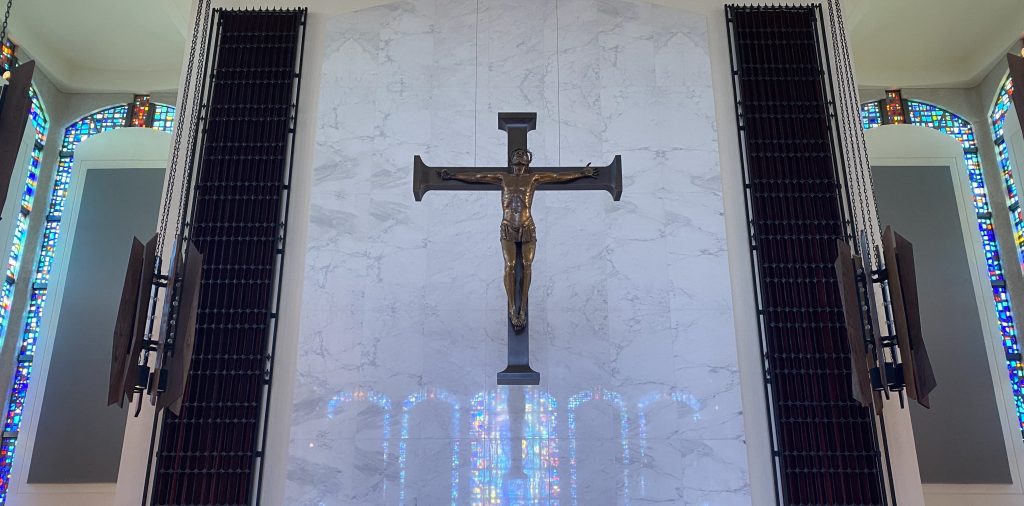
Photo: Crucifix in the sanctuary of SVDP chapel, SVDP Regional Seminary, Boynton Beach, FL.

Link for the interview with Pope Francis from America Magazine, September 30, 2013

Link for the Mass readings for Wednesday, March 20, 2024

The way of Jesus leads to forgiveness.

Today we celebrate the Conversion of St. Paul. Saul, before he was Paul, was a stellar Pharisee and defender of his faith. He learned at the feet of one of the top rabbi’s of his time, Gamaliel, and as he himself said, was “zealous for God”. So much so that he “persecuted this Way to death” (Acts 22:3-4). The Way was the term used early on for those Jewish people who followed Jesus.

The turning point for Saul was his miraculous encounter with Jesus as he was on his way to Damascus to persecute more people of the Way. The phrase that Jesus used when he spoke, “Saul, Saul, why are you persecuting me” (Acts 22:7) was an interesting one. He could have said, “Why are you persecuting my Church, the children of God, your brothers and sisters” or any other choice, but instead he chose, “Why are you persecuting me?”

Jesus is showing the intimate connection that he has achieved through his being born as one of us, suffering and dying and conquering death for each of us, rising and ascending back to the right hand of the Father, still fully human and divine, such that he can come at this point and time to have an encounter with his most zealous of persecutors of the Way.

The encounter with Jesus is enough. Saul is stunned beyond anything he could have imagined. He was not struck by a sword, a smashing blow, or a trip wire across his path. He was stopped by a great light that surrounded him. Jesus, the “light that shines in the darkness” (John 1:5) did not condemn him, nor punish him. He asked a question and then told him what he was going to do next.

It would take another three years for Saul to work out this encounter, but once he did so, he made an incredible 180 degree turn in his life. The Way who he had been persecuting would now become the major focus of his life. He surrendered totally to Jesus and gave everything he had, even his life.

The encounter that Saul had with Jesus offers us a very strong message that we need to allow to sink into the depths of our being. There is nothing that we have done that God will not forgive us for. As Saul said, he was “persecuting this Way to death.” St. Stephen was at least one of those who died at Saul’s command. If anything just came to mind, if just the mere hint of a whisper, “Oh but God will not forgive…” Fill in the blank or blanks. Sorry, that is the voice of the liar, the deceiver, the enemy. That is not God’s voice. Don’t believe it for a minute, for a second. Renounce that thought in the name of Jesus.

God will forgive us. Period. Full stop. As we heard a few days ago. Jesus who was beginning his public ministry said, “This is the time of fulfillment. The kingdom of God is at hand. Repent and believe in the gospel” (Mark 1:15). That is exactly what Saul did and became Paul and a saint. That is what we are invited to do this morning.


Photo: Rosary walk during canonical retreat at Bethany Center, Lutz, FL.

Link for the Mass readings for Thursday, January 25, 2024