gospel-of-mark


Let us receive and tend well the seeds Jesus sows by hearing and allowing them to transform us.
Each of the elements of Jesus’ Parable of the Sower is worthy of meditation and reflection. A very good practice would be to take some time to reflect on each aspect and ask what limits the germination and growth of the seeds God has sown in our lives, and also what helps us to bring about successful growth and a successful yield. When did we experience God’s word but have it almost immediately snatched away; when did we gain an insight, experience joy from his word and guidance, but did not in any way put the learning into practice; how many times have trials, hardship, lack of courage, anxiety, or outright persecution, tempted us from stretching out of our comfort zone, and we instead withdrew, not wanting to risk growth?
Many of us can relate to: “Those sown among thorns are another sort. They are the people who hear the word, but worldly anxiety, the lure of riches, and the craving for other things intrude and choke the word, and it bears no fruit” (Mk 4:18-19). Distractions and diversions pull at us from within and without, from one second to the next. So much seeks to undo us, tear us down, and drive us into states of anxiety, despondency, cynicism, and depression that can lead to times of spiritual desolation.
So many apparent goods and false truths entice us and feed our desires for power, wealth, fame, and pleasure. Material temptations offer promises of fulfillment but shortly after the purchase leave us feeling empty. All the while, there is so much good that needs to be done and so much work to do. Even if we are willing to look beyond ourselves to be of help, we may not even be sure how to serve or where to begin.
Jesus offers us, with the Parable of the Sower, his promise, that when we prepare our hearts and minds to receive his word it is like tilling rich soil. His opening words, “Hear this!” (Mark 4:3) is a call not to just hear his words but to also activate our imaginations, meditate and ponder on what Jesus is saying. The seeds of Jesus’ words will have a better chance to take root, sprout, mature, and to bear fruit when we break into those areas of hard ground and dig out rocks and roots: the hardness of our hearts, prejudgments, and pride. We also need to be willing to cut away the vines and dig up the weeds: anxieties, fears, insecurities, false securities and impulsive behaviors.
When we give ourselves intentional moments to inhale deeply, discern each thought, situation, purchase, and action, meditate, pray and seek God’s guidance, discern with trusted family, friends, colleagues, and classmates, we will weed out our immediate reactions and defensive choices. Pruning happens when we learn from past experiences, are patient with God, ourselves, and each other, and resist giving into past habitual choices, disordered affections, allow ourselves to heal from past experiences, and risk expanding from our comfort zone.
Jesus knows where we need to repent, where are wounds are hidden, and where we need to expand. When Jesus teaches, he is inviting us to listen but: “To hear means far more than to take in with the ears: it means to absorb, to apply deeply into one’s heart, to allow the message to sink in and change one’s whole life” (Healy, 83). May we resist the temptation to just read over these words and be on to the next activity. Instead let us allow ourselves some time to savor this parable, so to better prepare the ground of our soul to receive and be transformed by the words of Jesus sown and: “bear fruit thirty and sixty and a hundredfold” (Mk 4:20).
——————————————————————
Photo: Trees that last send their roots deep into the earth, may we allow ourselves to be rooted deeply in Jesus, his words, and his love for us.
Healy, Mary. The Gospel of Mark. Grand Rapids, MI: Baker Academic, 2008.
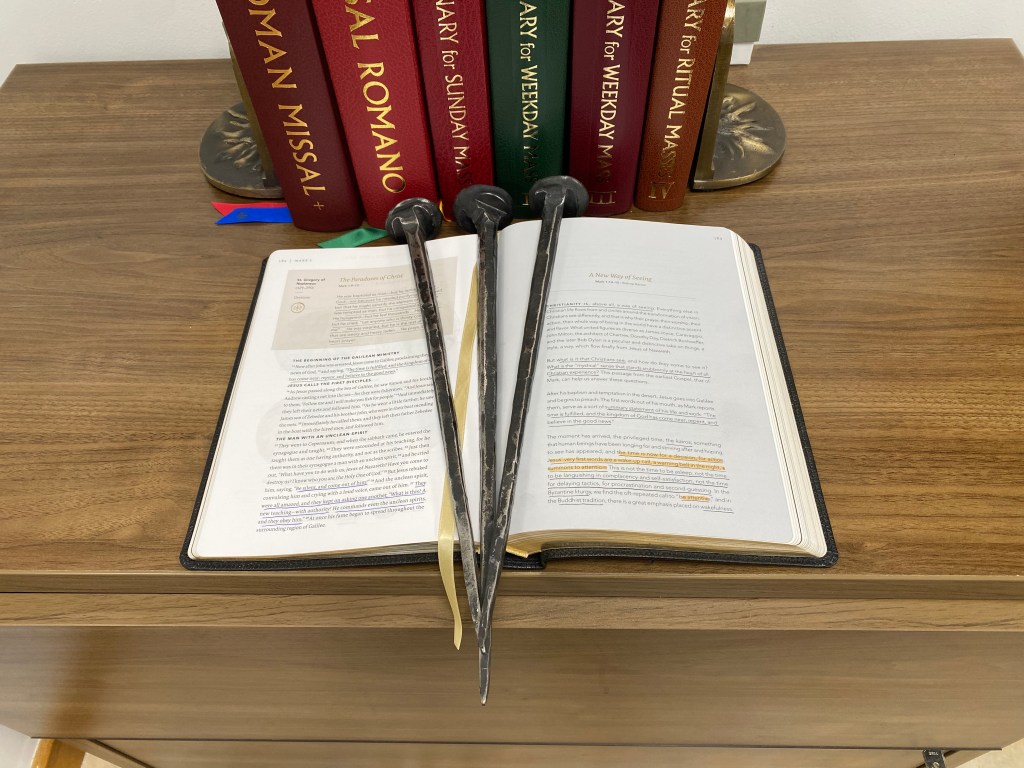
May Mark help us to experience the life of Jesus in our own lives.
Jesus quoted no one. He spoke from his own authority. Nor did he shy away from the attacks of demons.
The Gospel of John picks up the source of Jesus’ authority from the beginning line of his Gospel. “In the beginning was the Word, and the Word was with God, and the Word was God” (Jn 1:1). Jesus is the Word, the Logos in Greek. Who would have more authority to speak about the word of God, than the Logos, the Word, himself?
The authority of Jesus was not only limited to teaching but restoration. Jesus is the light who shines in the darkness. His Father sent him to invite us to receive the restoration of the likeness we have lost because of the Fall. As he was teaching in the synagogue he expelled the unclean spirit of a man when he said, “Quiet! Come out of him” (Mk 1:25)! The unclean spirit would not go easy, but could not remain in the presence of Jesus and the command of his word.
Jesus came to teach in the synagogue and the authority of his teaching identified the evil in the midst of the congregation. “Jesus’ teaching has the intrinsic effect of exposing evil so that it can be expelled” (Healy 2008, 42). His first act to follow his address that the kingdom of God was at hand was to begin to undo the disfigurement of the good that God his Father had created. The time of fulfillment was indeed at hand in the coming of Jesus and he began his work by proclaiming and teaching with authority and exorcising his authority over demons.
If you haven’t read the Bible ever, have not for a long time, have been away for a while, or could benefit from a deeper dive, I invite you to read the Gospel of Mark. Do so with the intention not of reading a history book or novel, but to read, study, and above all pray with Mark’s account. In this way, we come to not just know about Jesus, but know Jesus and experience his authority in our own lives. We will come to experience the same awe and wonder of those who experienced Jesus in person.
A great way to do so is to read along with the Church as we are reading the Gospel daily right now in the lectionary or at your own pace, say five to ten minutes a day. What may be even better is to read a short section at a time, read it over two to three times, and meditate on the passage. Mark is the shortest of the four Gospels, it is quick moving, and action-packed; the James Patterson of the Gospels. The accounts lend themselves particularly well to visualizing, and placing yourself in the reading as if you were watching a movie. Open your heart and mind to what Jesus wants to reveal or communicate to you in the silence of your heart.
We can also receive a word or phrase and carry it with us through the day, such as from today’s account. Jesus can be the light that shines in our own darkness and bring us healing. We may not be dealing with being possessed, but if we are experiencing negativity, temptation, stress, feeling indecisive, or divided we can call on Jesus’ words and speak in his name, “Quiet!”, “Silence!”, or “Peace be still!” and receive through the authority of his word his healing presence. We do not have to ever journey alone. We have the gift of prayer and the Holy Spirit to help to bring the words of Scripture alive. Jesus is present with us, ready to help us and others to be aware that the kingdom of God is at hand!
——————————————————————————–
Photo: A great introduction and resource to reading the Bible is The Word on Fire Bible: The Gospels. (Nails not included.)

