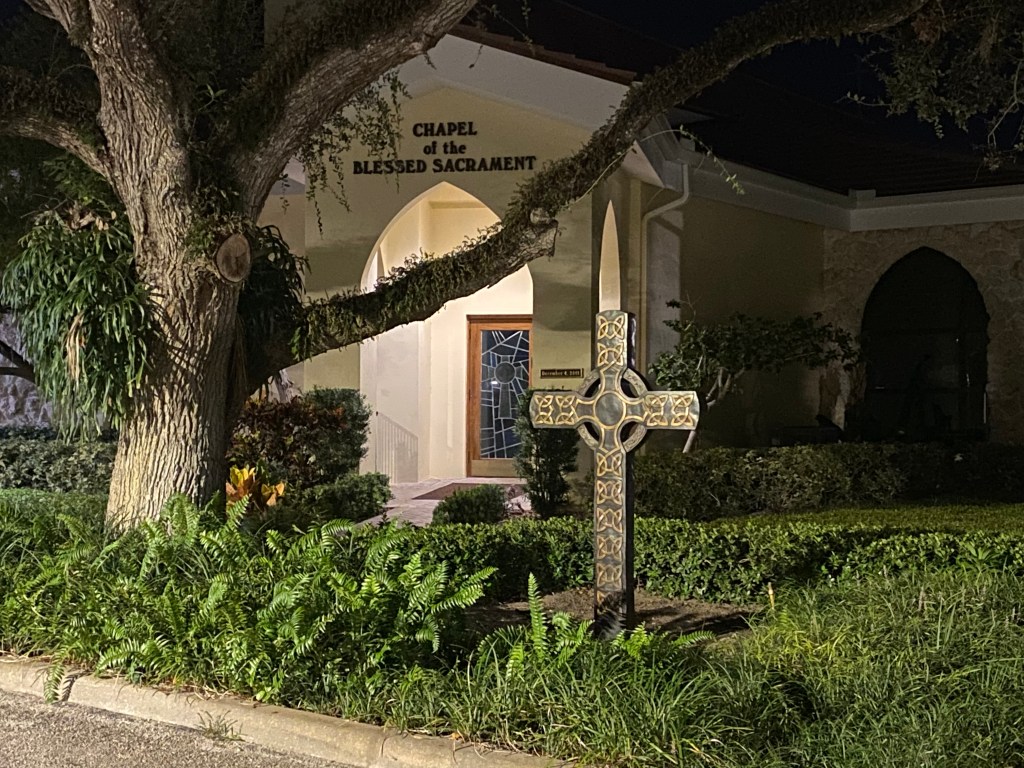
Our Gospel today, may not appear to be related or confusing in the analogies that Jesus is making. Jesus first begins by stating that to be a disciple of his, there is a need to, first hate “father and mother, wife and children, brothers and sisters, and even his own life,” and then be willing to “carry his own cross” (cf Lk 14:26-27). Jesus continues to talk about the wise builder calculating the cost of materials and labor to be sure he has enough to complete his project. In the same way, a king preparing for battle, assesses whether he has enough soldiers to win, and if not, he needs to be honest and prudent enough to “ask for peace terms.”
With each point, Jesus is emphasizing the cost of his discipleship. Nowhere in the Gospels and definitely not here in today’s, does Jesus say, follow me and all will be wonderful, there will be no pain, no suffering, and you will have all the material pleasure this world can offer. There is a cost to discipleship and those who seek to follow him in his time and our’s must pause and be aware of the cost.
Is the cost really to hate our mother and father, family and friends, and ourselves? This is graphic language. It is also an important reminder that each word and phrase we read in the Bible is to be read in the context of the whole Bible, not on its own or in isolation. Dr. Brandt Pitre identifies where the same Greek work miseō translated here in Luke as hate is used in the same context in Genesis 29:31, “When the Lord saw that Leah was hated, he opened her womb…” The way miseō is used in this context in Genesis helps us to interpret Jesus’ usage which is to “prefer one person over another” (Pitre). Jesus is saying, starkly, that we are prefer God over and above anyone or anything else.
Another help to recall where Jesus himself, in Luke 7:27, is emphatic that we are to love our enemies. To say that we are to love our enemies and hate, in the sense of loathing, our family would not make sense. It does make sense in the context of we are to place God first before any other person. This interpretation also aligns with the fourth commandment which is to honor our father and mother. We honor our father and mother best by living out the first three commandments that have to do with putting God first.
Context also helps us to understand that the hyperbolic language used by Jesus is a rhetorical strategy common to rabbis to make a point by waking up their listeners to get their attention. This statement did just that and continues to do so. The Catholic author, Flannery O’Connor, can help us to understand what Jesus is doing in describing her own writing shared that: “To the hard of hearing you shout, and for the almost blind you draw large and startling figures”.
Why? To awaken the listener’s from their spiritual stupor. But even when we step back from Jesus’ hyperbolic language, the message to a first century Israelite, as it is for us today, is still hard to fathom. Jesus is making it clear to the multitude that is gathering around, and letting them know clearly, that if they really want to follow him, there will be a cost. God must be first in their lives before all else, even the closest of family members and most intimate of friends.
Throughout the gospels, Jesus is consistent about the demands of being a disciple of his. A relationship with God is not just knowing about him, but knowing him intimately, and that means transformation. Not only is God to be first before family and friends, God is to be first before even ourselves. Being self-reliant, self-focused, and self-centered will not do. St. Teresa of Avila puts it quite well: “We shall never learn to know ourselves except by endeavoring to know God; for, beholding his greatness, we realize our own littleness; his purity shows us our foulness; and by meditating upon his humility we find how very far we are from being humble.”
Jesus is inviting us today to be his disciple, his student, and to join him in the most wonderful experience and adventure known to humanity. The Son of God who became one with us in our humanity is inviting us to be one with him in his divinity and to share in the communion of love that he shares with the Father and the Holy Spirit. To do so, we need to be as prudent as the wise builder and king. We need to assess the cost that Jesus is demanding of us. We are in the same position in this moment as the young rich man was who asked Jesus, “What do I need to do to inherit eternal life” (see Mt 19:16-22). The man was not willing to accept the cost of discipleship and walked away sad.
We have been created by Love, to receive his love, and to love in return, God, ourselves, and one another. Love is the greatest gift that we can receive and what we all seek in the depths of our souls. Jesus is giving us the key to unlocking the treasure chest and that key is to put God first before family, friends, self, and anything else. The way we put God first is to spend time with him every day. The amount of time is not as important in the beginning. What is most important is to set up a time you can commit to, show up, and let God happen.
If you are not sure what to do when you show up, you can start simply. Make the Sign of the Cross, take three, deep breaths, one for the Father, one for the Son, and one for the Holy Spirit. Continue to breathe slowly and receive God’s love for you and you alone in this moment. Remain until your mind starts to wander, then you can pray one slow and intentional Our Father. One Our Father said with meaning is more important than a thousand rattled of with no meaning. They are just words. When we pray, we are not just speaking words, we are speaking with someone: God our Father, who created us for this very moment: to be loved.
Photo: Spending time with Jesus in prayer each day – priceless!
Dr. Brandt Pitre. “Mass readings explained.” 23rd Sunday in OT
Flannery O’Connor quote accessed from “Listening to Flannery O’Connor” National Catholic Reporter.
 Spiritual Stepping Stones