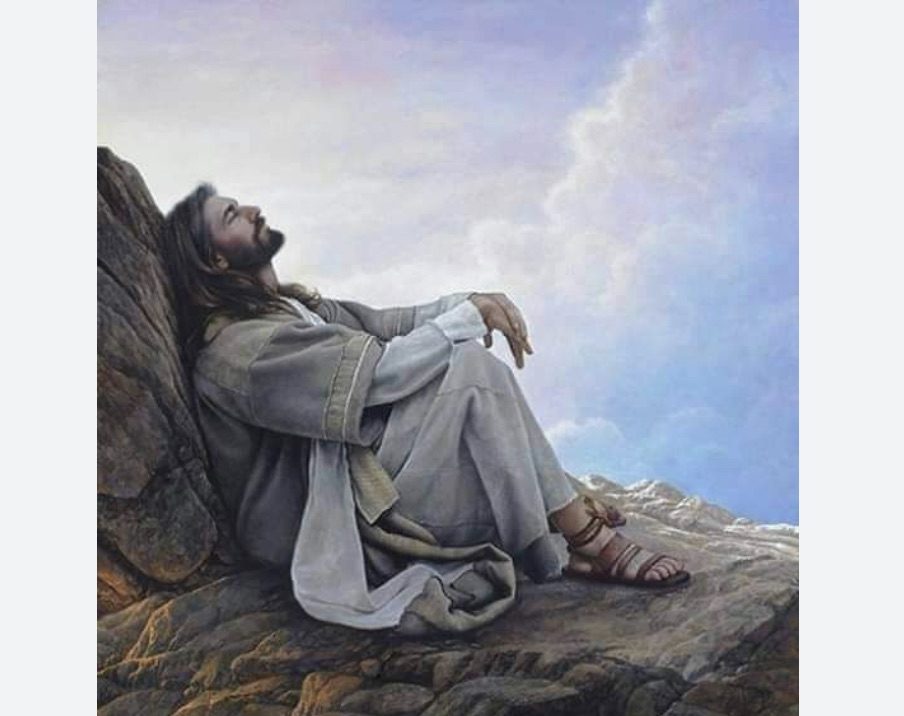
Jesus went up to the mountain to pray, and he spent the night in prayer to God (Lk 6:12).
Jesus spent the whole night in prayer to God. What did that look like? We don’t know. Since the traditional practices of prayer we have learned from Jesus we can speculate that he spent some time in vocal prayer, speaking with his Father. He most likely then spent some time in quiet meditation. But my feeling is that he spent much of his time in contemplation. A deep, intimate communion between him, his Father, and a deep experience of the love between them the Holy Spirit.
We can surmise vocal prayer because when the Apostles asked Jesus to teach them to pray, he taught them the words of the Our Father. He would have also spent some time in dialogue with his Father because when he came down in the morning, he “chose Twelve, whom he also named Apostles” (Luke 6:13). Jesus would have meditated, thought about his choices of who he would have picked, and then prayed, dialogued with his Father for his confirmation. That he spent time in contemplation we can speculate because he knew the Father and the Father knew him. You don’t know someone intimately unless you spend time together.
How about us? Are these forms of prayer possible? Yes. If you want to pray, you have already begun. The desire in and of itself to pray is prayer. The originator of our prayer does not begin with us but is an invitation from God to spend time together. As the desire arises, we are now acknowledging God’s invitation. He will, if we allow him to get through all the noise, distractions, diversions, and temptations leading us away from praying with him, get through.
When we want to learn about something, our first instinct is to read and study about it. A good first step. The danger though regarding reading about prayer is that we think we are praying. In the turning of a page, the completion of a chapter, even reading the Bible, we can feel as if we are accomplishing something, but we are only imagining how prayer can be. “It is tempting to remain in the comfortable theater of the imagination instead of the real world, to fall in love with the idea of becoming a saint and loving God and neighbor instead of doing the actual work, because the idea makes no demands on you” (Peter Kreeft, Prayer for Beginners, 12).
The other trap is when we are praying words, reading the Bible, being present at Mass, but only doing these practices. We don’t do prayer, we speak, meditate, pray, and listen to a Person. We allow God to do, through us. Is God an idea or a real Person? This is a very important distinction. When we pray even the Sign of the Cross, when done properly, we invoke each Person of the Holy Trinity: the Father and the Son and the Holy Spirit. When we pray in this way, we invite God to be with us and in us!
There is a myriad of ways to pray and each practice will match each of our unique personalities and temperaments. The key to prayer is to make a commitment to a time and a place to pray each day, show up at that time and place, then pray. Start with a timeframe, such as five minutes that you know you can do. Depending on the discipline of prayer you practice, your family, school, work, and/or ministerial demands will be indicators as to how much you might be able to increase the time you pray once you have built a consistent practice.
The amount of time that we dedicate to prayer is not as important as our commitment to spend time with God each day. We need to schedule daily our non-negotiables for prayer first and build around that. Again, this will depend on our station in life. Young parents’ non-negotiables are their infant whereas someone who is retired will possibly have some more time.
Mass, the liturgy of the Hours, reading the Bible, sitting or walking quietly outside, at the morning table with a favorite devotional, the Rosary, Chaplet of Divine Mercy, spiritual reading, and imagining ourselves sitting with Jesus on the mountaintop in silent meditation and contemplation are all practices that can help us to grow in our relationship with God. When the Holy Spirit invites us to close our eyes and be still though, is our invitation to listen to God and begin to learn his language of silence.
St Therese of Lisieux offers us a good approach to prayer: “For me, prayer is a surge of the heart; it is a simple look turned toward heaven, it is a cry of recognition and of love, embracing both trial and joy” (CCC, 2559). No matter how we pray, our goal is that we don’t seek to bend God’s will to our’s but to allow our lives to be conformed to Jesus, that we encounter and build a relationship with him and each other, such that our experience of prayer matches St Augustine’s: “True, whole prayer is nothing but love” (Foster, 1). We pray, so we can fall in love with God who made us for himself.
Photo: Heading now to spend some time with Jesus on the mountain praying with our Father. Please join us!
Foster, Richard J. Prayer: Finding the Heart’s True Home. NY: HarperCollins, 1992.
Kreeft, Peter. Prayer for Beginners. San Francisco: Ignatius Press, 2000.
 Spiritual Stepping Stones