We can’t prove God is, but we can experience God, who is.

Asked by the Pharisees when the Kingdom of God would come, Jesus said in reply, “The coming of the Kingdom of God cannot be observed, and no one will announce, ‘Look, here it is,’ or, ‘There it is.’ For behold, the Kingdom of God is among you” (Lk 17:20-21).

Many of the Pharisees were scrutinizing Jesus’ every word and action, unfortunately, with a hard heart. They were closed to the reality present before them because they were looking for ways to accuse him, to catch him, to have cause to show him to be a fraud. They were closed to the actual events happening around Jesus that the blind could see, the deaf could hear, the lame walked, lepers were healed, the dead had arisen, and the poor had the good news proclaimed to them (cf. Matthew 11:5).

They missed the very reality that the Kingdom of God was in their midst. We see this very much today through the mental posturing of “scientism”, the belief that the only reality is that which can be measured empirically, through the five senses. Scientists have brought about many advances and innovations that we enjoy today, yet there is a reality beyond the physical. This is the spiritual, which transcends the three-dimensional reality that we experience through our senses. We understand the world around us better when we embrace both science and theology, the physical and the spiritual, as well as embrace the gifts our reason and our faith.

If our mind is closed to an idea, a reality, and/or a belief we will not only resist believing, we will also seek rationalizations to explain it away as did some of the Pharisees. From a hypersensitivity to accept only the physical, we can brush off acts of synchronicity as mere coincidence. Yet, if we are open to the spiritual reality of our interconnectedness beyond that which we can measure finitely, these incidences can be termed, God-incidences.

We cannot prove God as we would approach a problem to be solved. God is not in the genus of being. There are no words to adequately describe God. We can say more about what he is not than what or who he is! Some of the better attempts we have are that God is an Infinite Act of Existence or to use the phrasing of St Thomas Aquinas and echoed by Bishop Robert Barron, Ipsum Esse Subsistens – The sheer act of ‘to be’ itself, or as God said to Moses, “I am, who am” (Exodus 3:14). God is transcendent, beyond categories, beyond the grasp of our finite minds, and yet we can experience him because God is closer to us than we are to ourselves.

We will not encounter God by forcing him to come to us on our own terms, by attempting to force-fit him into our finite conceptions. God meets us where we are and as we are, on his terms. As we open ourselves to his presence, accept his invitation, he then helps us to expand, to experience more broadly, who we, others, and our world are. We experience this best when we truly love, when we go out from our own self-centered stance to will the good of another. We encounter God through embracing the wonders of his creation!

As Jesus said to Philip, “Whoever has seen me, has seen the Father” (Jn 14:9). The Kingdom of God is among us because Jesus is fully God and fully man. By his very presence, he shows us that there is no opposition or competition but a union between heaven and earth. We will never fully comprehend God, but we can better know him, ourselves, and the world around us when we breathe with both lungs of faith and reason, and embrace our intellect as well as our spirit. As St. John Paul II stated, “Faith without reason is superstition” and as attributed to Albert Einstein, “Reason without faith is boring.”

———————————————————-

Photo: Morning holy hour on the grounds of St. Joseph and Mary Retreat House during my 30 day silent retreat July of 2023.

Each day is an opportunity to experience the miracles and wonders of God.

The feeding of the five thousand that we encounter in today’s Gospel from John is reported in each of the four Gospels. The only other incident that is recorded in all four is the Resurrection accounts. This point is relevant because biblical scholars look to the multiple attestation theory as one means as to whether an account in the Gospel record is more or less plausible. Having the same account present in each of the four is strong evidence in support for that event happening.

From a different perspective, there are those that embrace scientism meaning that they will not believe in anything that cannot be measured, experimented upon, or proven within the realm of the five senses. For those ascribing to this strict interpretation, religion and accounts of miracles are often dismissed as superstition, that if something indeed did happen, there is a scientific explanation to dismiss the miraculous. Even some believers may discount the record of the feeding of the five thousand as more of a symbolic representation of the generosity and service encouraged by Jesus such that everyone gave their small share and there was enough for all, not that he was able to multiply the bread and fish.

These perspectives of downplaying the miracle of multiplication seek to reduce or limit Jesus to just his humanity, but he is so much more. Jesus is human, fully human, yes, but he is also fully divine. Coming to understand the wonder of the unity of the divinity and humanity of Jesus can help us better understand the reality of our world and cosmos. One of the core aspects of who we are as human beings is that we are people of wonder. The physical sciences are tools that we have in our toolbox that we can access to help us to understand our physical realm, while at the same time we also have spiritual tools that aid us in understanding both physical and spiritual realities. The physical sciences actually emerge precisely because of our spiritual pursuit to understand the wonders of God’s creation. In accessing both faith and reason, we come to have a broader picture, more pieces of the puzzle in which to put together and better experience our world.

When we limit or explain away the miracles of Jesus, we rob ourselves of a more accurate picture of the reality of creation. One concrete example of this is when our third president, Thomas Jefferson, took a sharp object and painstakingly cut out verses from the Bible and pasted them to blank pages. He did so in columns of Latin and Greek on one side of the paper and French and English on the other. This eighty-four-page tome is commonly called the Jefferson Bible, but the president titled it: The Life and Morals of Jesus of Nazareth. This text offers a human portrayal of Jesus that dismisses anything divine.

If we remove ourselves from the divine, and 99.9% of our life, experience, interests, and thought is spent in the finite material realm, we will miss a deeper expression of who we are as human beings and disconnect ourselves from much of the joy and gift of life. It stands to reason then why we would find it hard to believe in miracles, the mystical, the spiritual. In the miracles is not a self-aggrandizing move on Jesus’ part, but a move of love and empathy. Jesus is moved, time and again, to reach out in love, to care for and support those who are in need. Even more, the miracles are pointing to our final destination which is beyond the limits of this finite reality! As we read in today’s account of the feeding of the five thousand, Jesus is showing what living life to the full is all about: being in communion with God and one another.

We need to resist the temptation to write off too quickly the miracles of Jesus presented in the Gospels and still happening today. May we also not dismiss the gift and value of the sciences. By approaching our world with a both/and approach, we will get a better understanding of and appreciation for not only the gift and wonder of creation but also who we are as human beings. God has imparted within us the ability to access and develop both our faith and reason, to think critically, and to pray and meditate deeply.

Jesus, as the firstborn of the new creation, embodies the reality of the fullness of who God in the depths of our souls has created us to be, human and divine. Jesus is still present to us today, knocking on the doors of our hearts, minds, and souls. If we only follow the moral and social teachings of Jesus, as did Thomas Jefferson, we will experience some benefit, but we will limit ourselves because we will be cutting out the very life force that sustains those virtues we hope to aspire to. We will access the fullness of all that God the Father offers us when we open the door to his Son this Easter Season, let the Holy Spirit in, and offer the little we have and watch how much he can multiply our simple gifts.

Let us continue to journey together, to read and pray together the Gospels of Matthew, Mark, Luke, and John. May we resist rejecting outright what we do not understand or comprehend, and instead be willing to ponder the wonders of miracles, the gifts of God’s grace that builds on our nature, the reality of God-incidences all around us, and embrace the eternal foundation and ground of our being which is the Trinitarian Love of God.


Photo: Morning prayer back on retreat at Our Lady of Florida Spiritual Center, North Palm Beach, FL.

Link to the Mass readings for Friday, April 12, 2024

When making decisions, prayer and reason are a good place to start.

Who do we want to be? It is so easy to get caught up in being busy, taking care of children, the home, school assignments, work, as well as a myriad of other activities that each of us, experiencing our own unique station in life, can add to this list. These can all be good things, but we can lose ourselves in our busyness and responsibilities such that we slip into a state of survival mode or merely existing. One day can move into one week, into one month, into one year, and then we wake up one morning and wonder where the last ten years went!

We can fall into the trap of being defined by what we do instead of who we are and who God is calling us to be. God has a plan for us with the end result being eternal communion with him in heaven. Living a life of holiness and becoming saints is our call. We need to remind ourselves of this from time to time, more often rather than less actually, by assessing where we are now and being more open to the guidance of God.

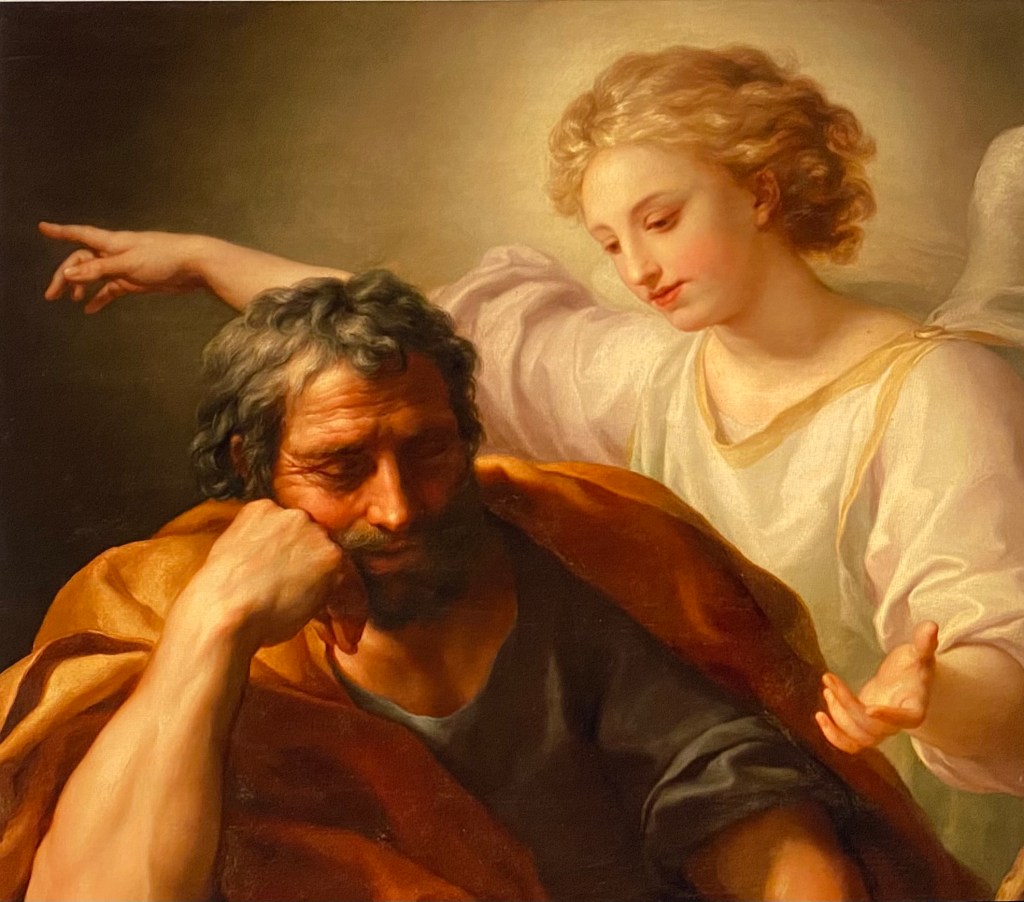
In today’s Gospel, Joseph has become aware that Mary, his betrothed, is with child and he is not the father. We can forget about the humanity of the moment, reading now from so many years removed. I am sure there was some serious anguish that Joseph dealt with even as we read that he is “a righteous man” who follows the law, but is “unwilling to expose her to shame, decided to divorce her quietly” (Mt 1:19). Joseph’s life of righteousness pulls him to follow the law, yet he shows that discernment in matters of the dignity of the person is just as important. Joseph not only was unwilling to make Mary into a public spectacle but was also unwilling to allow the possibility of her to be stoned to death.

Joseph pondered the idea of divorcing her quietly and again no mention of the mental maelstrom, intestinal upheaval, or emotional roller coaster as he pondered. Yet, a very good piece of guidance we can glean from this account. Before he made his final decision, Joseph slept on the matter, which is often a good course of action when weighing such a heavy issue. How many times do we rush into decisions only to regret them later? Because Joseph is willing to wait a bit, he receives God’s direction through the angel of the Lord in a dream.

When Joseph arose that morning, he did not dig in his heels feeling he knew best and then return to his original decision, he did not let fear or anxiety or whatever emotions he may have experienced about the possible scenarios that played out in his mind sway him, nor did the very possible and reality of the difficulties he could envision deter him. Joseph trusted God. With the confidence and assurance of who he was and who God called him to do, Joseph acted on the guidance he had received.

This is why St. Joseph is a model for us. When faced with decisions, we need to remember who we are, whose we are, and who we are called to be. We are children of God. That means we belong to God, a God who loves and cares for us. He has a plan for each of our lives. Every decision and action is a step in fulfilling that plan.

When we are discerning, no matter how large or small, we are invited to gather information, look at the reasonable options available, all the while, continuing to seek God’s guidance. God will guide and accompany us through many means and ways such as a thought, a family member or friend sharing an insight at an opportune time, experiences, through our dreams, as well as many other ways, including angelic support. God granted Joseph not only the guidance he sought but the support to fulfill the commission he received. We can be assured that God will do the same as we discern his direction as well.

St. Joseph, pray for us!

——————————————————————–

Painting: “The Dream of St Joseph” by Anton Raphael Mengs about 1774

Link for the Mass readings for Tuesday, March 19, 2024