Aligned with God’s will, there are no limits.

“Where did this man get such wisdom and mighty deeds? Is he not the carpenter’s son?” (Mt 13:54-55).

Many people wonder what Jesus did from the age of twelve until he began his ministry around the age of thirty. Today’s reading gives us some insight into that question. Most likely, Jesus did nothing extraordinary, he was just as ordinary as any other first-century Palestinian Jew living in the small town of Nazareth, with a population of about 250 to 500 people.

Jesus most likely worked as a carpenter. This was rough, menial work, and as a day laborer, a position that was looked down upon. We can even see evidence of this in the Gospel accounts. Mark describes Jesus as the carpenter, the son of Mary, Matthew in today’s account portrays Jesus as the carpenter’s son, and Luke and John just refer to Jesus as Joseph’s son, leaving out any reference to carpenter altogether. Most scripture scholars believe Mark was written first, so we can see a progression in the biblical tradition moving quickly away from identifying Jesus as a carpenter.

Jesus’ return to his hometown and his teaching was first met with wonder. The question arose, “Where did he get such wisdom and how did he work such mighty deeds?” But wonder soon turned to judgment. Who is he? Isn’t he just the carpenter of Nazareth, no better than any of us. In effect, “Who does he think he is?” Not only does this show that Jesus probably lived a very simple peasant life, but that Jesus’ social status was set in stone.

The people’s hearts and minds were closed to Jesus. THEY KNEW who he was and there was no way someone like him could do what they had heard, so they “took offense at him… And he did not work many mighty deeds there because of their lack of faith” (Mt 13:57-58).

How many times have we judged someone? Have we said to ourselves, “I know who he or she is.” We box them in, not as they are, but as WE see them, as we define or label them. We look at another individual not as a person with dignity, but as a two-dimensional caricature to satisfy our own prejudgments and lack of vision. We also do this to ourselves when we resist God’s invitation to grow and follow his plan for us.

Maybe we have had a similar experience as Jesus did in returning to his hometown, in that we have sought or are seeking to move beyond our particular social status, or follow a dream or career out of the norm of familial or community expectations. No matter our age, through no fault of our own, by pursuing this path some or many may feel threatened.

One day Bruce Lee challenged Stirling Silliphant to run five instead of his usual three miles. Into their fourth mile, Stirling said, “if I run any more, I’m liable to have a heart attack and die.” Bruce then said, “die.” And ran off. Sterling was so mad he finished the five miles, approached Bruce and asked him why he said that.

Bruce replied, “Because you might as well be dead. Seriously, if you always put limits on what you can do, physical or anything else, it’ll spread over into the rest of your life. It’ll spread into your work, your morality, into your entire being. There are no limits. There are plateaus, but you must not stay there, you must go beyond them. If it kills you, it kills you. A man must constantly exceed his level” (p. 23).

Jesus rebukes limiting attitudes and perspectives. God the Father has a plan for all of our lives and invites each one of us to resist limiting ourselves and each other. Jesus, the carpenter, invites everyone to embrace the infinite possibilities that will arise when we participate in his life and the Holy Spirit seeks to free us from the shackles, those limitations imposed from within and without, that bind all of us so that we may be free to receive the fullness of and share the Father’s love.
———————————————————————–
Photo: Paused during Rosary walk to look off into the horizon, Riomar Beach, Vero Beach.

Link for the Mass readings for Friday, August 2, 2024

Stirling Silliphant story accessed from Bruce Lee: The Art of Expressing the Human Body, compiled and edited by John Little.

Parallel Gospel accounts: Mark 6:3, Matthew 13:55, Luke 4:22, and John 6:42
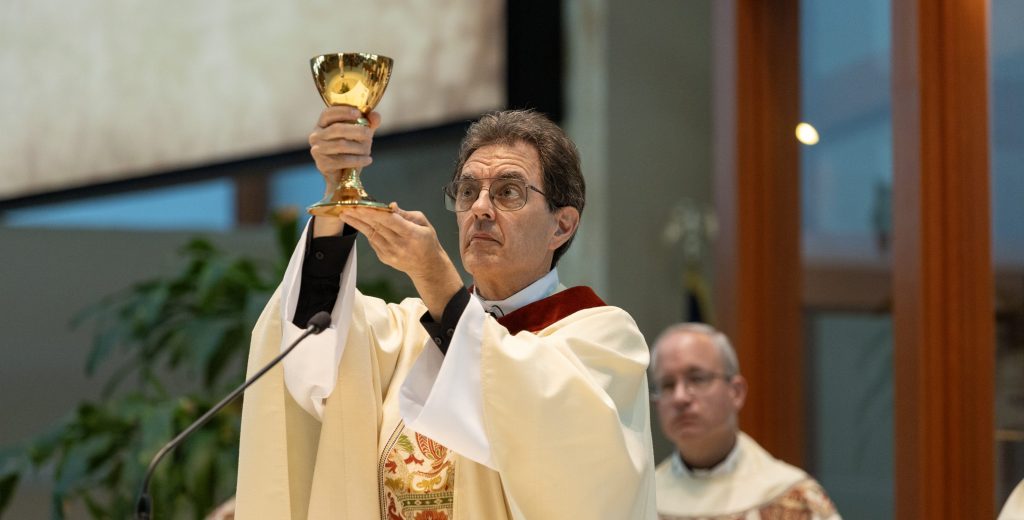
“This is my Body”… “This is my Blood”

This Sunday, and for the next five Sundays we are being invited to participate in an adventure. Each week we will journey together through the pages of Chapter 6 of the Gospel of John. The beauty of this chapter and the road we will walk side by side is one that means everything to us as followers of Jesus Christ. And as we will see, not everyone in the written account, in fact only a few, make it through to the end.

My hope is that each one of us here today not only make it through the journey, but that we are transformed, and our faith is renewed. What Jesus unveils for us with each verse of his teaching is the miracle of miracles, the sign of signs, God from God and Light from Light. Jesus will be sharing with us his Bread of Life discourse. Jesus will reveal that he is truly the Bread of Life come down from heaven. Jesus, the Son of God, becomes one with us in our humanity so that we can become one with him in our divinity. He comes even closer when he gives us himself in the appearance of bread and wine to be consumed.

My invitation for you during these dog days of summer is to get out your Bible, dust it off, if it has been a while since you have pondered its pages, and then slowly, prayerfully, each day over the next month, read, pray and meditate with John Chapter 6 and so come into each Mass even better prepared to receive the miraculous gift that Jesus wants to share with us.

We begin our journey by joining the “large crowd” following Jesus. They have gathered around him because they have seen or have heard about his healings, his exorcisms, and his teaching with authority and they are hungry for more. They are not aware of how hungry they are, and what will truly satisfy their deepest hunger. This is just as true for each of us. As Jesus watches them gather, he wants to not just satisfy their immediate hunger, but also to set the stage to reveal for them the deeper hunger of their soul.

Jesus seeks the same for his Apostles and so asks them, “Where can we buy enough food for them to eat” (Jn 1:5)? Philip is stymied and doesn’t have a clue, but Andrew steps forward to share, “There is a boy here who has five barley loaves and two fish”. I can see Jesus’ eyebrows raise here as he looks to Andrew with some hope in his heart that Andrew is getting it. But then as Andrew continues he also assumes the posture of Philip, “but what good are these for so many” (Jn 1:9). So close, Jesus might have said and then sighed with a smile as he received the loaves and fish.

We know what happens next, Jesus took the five loaves and two fish, gave thanks to his Father, and all ate their fill and with enough left over to fill “five wicker baskets” (Jn 1:13). This miracle transpired with the little that was given, and remember Andrew received this meager amount from a boy.

In the ancient near East, children had no rites. Imagine this boy’s reaction. He was wise enough to bring food for the long trek back for him and his family, and now he had none. He was willing to give away his food and yet how would this be enough? Would he now go hungry too? Instead of running away at break neck speed when Andrew approached him for his food, the boy trusted and gave all he had. Was there something the boy saw in Jesus, just enough of a spark of faith to trust. There must have been because he gave and all were filled because he did so.

With the little that we give Jesus, when we trust in Jesus and let go, as the boy did, and as we surrender to his will, miracles happen. Jesus could have created food out of nothing, as his Father created the universe out of nothing, but he sought the participation of those around him. This happens at every Mass. The bread and wine that are brought to the altar represent the little that we bring to Mass. Our financial offerings yes, but also our prayers, our petitions for ourselves and intentions for others, as well as our deepest hunger.

Jesus receives what we give and multiplies it just as he did with the multiplication of the loaves. The priest takes the bread first and then the wine into his hands and speaks the words of Jesus again and through the power of the Holy Spirit, the bread and wine become the Body and Blood of Jesus. How do we know this to be true? Because Jesus said then and we hear his words again at each Mass:

“This is my Body”.

“This is the chalice of my Blood”.

In the miracle of Jesus multiplying the five loaves and three fish to feed the thousands, he was setting the stage for the miracle we get to experience at each Mass. The appearance of bread and wine remains, but its substance, the reality at the core, has been changed to become the Body and Blood of Christ. This miracle we don’t just read about, but can experience and receive him again and again to satisfy the deepest hunger of our souls.

We are just beginning, the journey continues next Sunday!


Photo: Blessed to be a priest participating in the miracle of turning bread and wine into the Body and Blood of Christ during Mass each day!

Link for the Mass readings for Sunday, July 28, 2024

We are an Alleluia people because death does not have the final answer, Jesus does!

Mary of Magdala comes to the tomb during the wee hours of the morning while it is still dark and finds the stone rolled away. She runs to Peter and John to share with them the news, that: “They have taken the Lord from the tomb, and we don’t know where they put him” (Jn 20:2). Peter and John retrace the steps of Mary, running to find the tomb empty as well. All three are stunned because “they did not yet understand the Scripture that he had to rise from the dead” (Jn 20:9).

How can we blame them? Do we fully understand the reality and fact that Jesus has risen from the dead? Some make the conjecture today that Jesus did not really die, but woke up three days later, aching all over from the excruciating effects of the crucifixion. Others say that the accounts of the resurrection were mass hallucinations, or that the Gospel accounts of Jesus rising from the dead are mere myth. These propositions do not stand up to the fact that Jesus, fully God and fully man died, entered death, and conquered it. In so doing, he then entered a new life, a new reality. Jesus, in becoming the firstborn of the dead, was transfigured from our three-dimensional reality that we all know and experience, such that he now resonates at a higher pitch, in a higher dimensional reality. Jesus is the firstborn of the new creation!

All human history changed in that tomb because of this new fact of the resurrection of Jesus. How this happened is a mystery and seeking to understand, which is good, will fall short and be frustrated if we only approach the mystery of God in the same way that we tackle a problem to be solved. The Apostles and disciples of Jesus struggled to find meaning and understanding regarding how Jesus crucified was now gone from the tomb. They came to understand the mystery of the Resurrection, the same way that they came to understand the mystery that Jesus is fully human and fully divine. Understanding happened in their encounters with Jesus. The mystery of the Resurrection is not a problem to be solved, but a person to encounter, a relationship to embrace, as it was for the Apostles and is so for each of us.

Faith seeking understanding is grounded in having an encounter with a person, Jesus the Christ, the Son of the Living God. Pope Francis writes about this on page nine of his Joy of the Gospel: “The joy of the Gospel fills the hearts and lives of all who encounter Jesus. Those who accept his offer of salvation are set free from sin, sorrow, inner emptiness and loneliness.”

Easter Sunday is the day where this joy first truly became possible, and this joy is needed now more than ever. And yet, as we read in our gospel, Easter Sunday did not begin with a full brass band and banners waving. For: “On the first day of the week, Mary of Magdala came to the tomb early in the morning, while it was still dark and saw the stone removed from the tomb” (John 20:1).

Mary reacted as most of us would. She sought some point of reference. The stone was opened, someone must have stolen the body. When we encounter a mystery, we seek to understand. Jesus, time and again, transcends our comfort zones and the parameters of our finite attempts to seek meaning. When we are willing to seek with our reason, open our minds and hearts to encounter the reality beyond our reason; when we allow ourselves to wonder and allow ourselves to encounter Jesus; our Fridays of pain, suffering, and grief become good, our Saturdays of silence and the between times become holy, and the Resurrection is the fulfillment of the promise that we do not suffer and believe in vain.

Jesus who is the Christ, has truly risen – Alleluia, Alleluia!!!

We are an alleluia people. God has not only loved us into existence, but through his Son, we have also been loved into the promise of eternity, where suffering and death will be no more! A promise I believe even more strongly on this Easter, as I celebrate my fifth one without JoAnn. I hope that she is now celebrating along with Mary and the saints and that she is now where we will one day be rejoicing, because Jesus has opened up heaven for us in the humanity he assumed, death that he conquered, and his Resurrection that we celebrate today! Alleluia!

May God bless each of you and fill you with the peace, joy, and love of Jesus his Son! Happy Easter!!!

————————————————–

Photo: Our last Easter vigil together, April 20, 2019.

Francis. Evangelii GaudiumJoy of the Gospel, Libreria Editrice Vaticana. Frederick, MD: The Word Among Us Press, 2013.

Link for Mass readings for Easter Sunday, March 31, 2024

Acknowledge and ponder that you are a beloved daughter or son of God.

On coming up out of the water he saw the heavens being torn open and the Spirit, like a dove, descending upon him. And a voice came from the heavens, “You are my beloved Son; with you I am well pleased” (Mark 1:10-11).

Jesus was not baptized because he needed to repent. He did so as a foreshadowing of his taking upon himself our sins on the Cross. Just as the heavens were torn open and the Holy Spirit comes down and God the Father speaks, we are on sacred ground ourselves in experiencing the presence of the Holy Trinity.

Jesus in coming to earth “opened up heaven for us in the humanity he assumed” (St. Irenaeus). This imagery of the heavens being torn open is similar to the veil separating the deepest part of the temple, the Holy of Holies, where God was believed to dwell, being torn open when Jesus was crucified.

Because of and through Jesus there is no longer any separation between us and the Father other than what we allow to stand between us and separate ourselves from him. Jesus, being called the Father’s beloved Son, is a reminder to us that we are his beloved children. This is a truth we need to stop and ponder regularly so that we remember who and whose we are.

And when we are dealing with the challenges that arise, John’s words from today’s first reading are for you, “Beloved: Who indeed is the victor over the world but the one who believes that Jesus is the Son of God” (John 5:5).

When we truly believe in Jesus, we can experience the truth that we are the Father’s beloved daughter and son, and we are victorious. Victorious! We need to continue to remember that. The challenge is when we let the whisperings of the enemy rest anywhere near us. As we notice them, we are not to argue or dialogue with the enemy, get down on ourselves, but instead just renounce him and his lies, and open our hearts and minds again and again to Jesus our savior, our healer, defender, and friend.

As we breathe deeply regularly and invite the love of Jesus to fill us, not only does our lung capacity increase, but our faith will also increase. We will also experience and know that we are loved and redeemed! When we rest, receive, and abide in God’s love, acknowledge and accept that we are his beloved children with whom he is well pleased, we will live lives experiencing freedom, peace, and joy.


Photo: Jesus wants to share his love and joy with us, and we will experience these gifts when we are willing to slow down enough to receive them! One of Egret Landing’s residents sharing the light and joy of the Christmas Season, seen while on my Rosary walk a few nights ago.

Link for the Mass readings for Saturday, January 6, 2024