Jesus did not give up on Thomas or Cleopas. He will not give up on us.

We return again to the reading of the Road to Emmaus pericope that we heard less than two weeks ago. This rich record is certainly worth many readings because there is within its telling so much contained in its depths that one, two, or three readings is nowhere near sufficient.
Jesus comes upon Cleopas and another disciple heading away from Jerusalem feeling devastated because not only had their teacher been brutally crucified but their hopes of him truly being the Messiah were also dashed. The interesting points that come up when they begin to talk to Jesus are that “some women…had indeed seen a vision of angels who announced that he was alive.” They also announced to Jesus: “Then some of those with us went to the tomb and found things just as the women had described, but him they did not see.”
Cleopas and the other disciple were certainly close enough to the inner circle of the Apostles to know Mary Magdalene and the Eleven to be in hiding with them after the crucifixion. This also meant that they knew Jesus pretty well. They had to have heard on more than one occasion either from Jesus himself or the other Apostles that Jesus would rise again on the third day.
Why then did they leave after hearing the tomb was empty? Wouldn’t they want to find out if what Jesus said about his Resurrection was actually true? Jesus had told them to wait for him in Jerusalem, not Emmaus. Cleopas and the other are heading the wrong way! Last week we read about how Thomas was away when Jesus reappears to the Apostles. Could he have gone his own way and leave like Cleopas and the other disciple did?
There were those like Mary, Peter, and John who stayed in Jerusalem, while at the same time we know about Thomas, Cleopas, and another disciple who had left, even after hearing about the empty tomb. Jesus was clear in what he taught about his coming back on the third day, just as he was when he told his followers that they would eat his flesh and drink his blood. People left then as well.
How many times have we given up or given in just when what we had been waiting for or working for would have been fulfilled? We may never know. Fortunately, for Cleopas and the other disciple that we read about this week and Thomas last week, Jesus was willing to reach out to them a second time. They heard his words about the Resurrection but they did not grasp or comprehend the full meaning of what Jesus meant.
The same is often true of us. Jesus invites us to follow him as he did the others, as he does with all of humanity, yet we often do not understand or fully appreciate the fullness of what Jesus is offering. Until we are able to relate to and value the deeper meaning and worth of what it means to truly develop a relationship with Jesus, to know, be loved by and love him, and be a follower of his, we will not be willing to invest our time and commitment. The Good News is that Jesus did not give up on Thomas or Cleopas nor will he give up on us. One day we too will also be able to exclaim with joy, “The Lord has truly been raised,” and our life we never be the same.

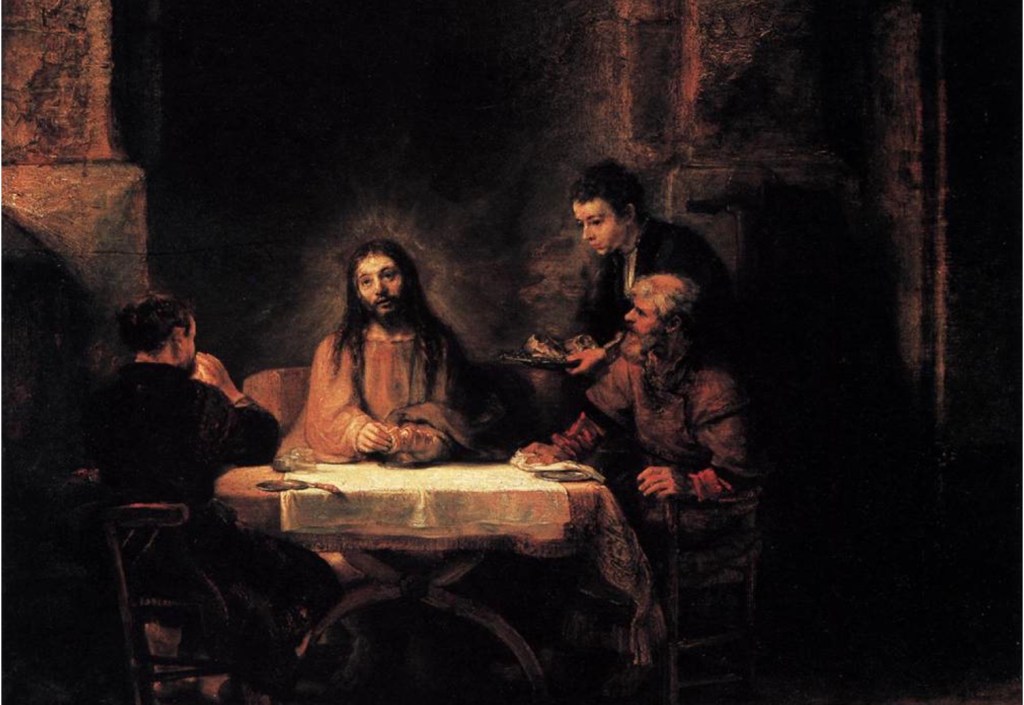
Painting: The Supper at Emmaus by Rembrandt 1648
Link for the Mass readings for Sunday, April 19, 2026


When we encounter Jesus for ourselves, we too will have some good news to share!

Today’s reading from the Gospel of Mark, 16:9-16, is commonly called, “The Longer Ending.” Most ancient manuscripts of Mark end at 16:8. Whether this Gospel ended there or the original ending was lost is not definitively known. Many biblical scholars also recognize in these verses a different writing style, so attribute this longer ending to a different author. This ending recounts that Mary Magdalene and two disciples, presumably the same on the road to Emmaus as recorded in Luke, met the risen Jesus. When both Mary and the this pair share their experiences with the eleven, they are not believed, and then, “later, as the eleven were at table, he [Jesus] appeared to them and rebuked them for their unbelief and hardness of heart”

How many times had Jesus rebuked the Pharisees for being hard of heart? Now he is saying the same to the eleven for not believing the accounts of Mary and the two disciples. We do not have a reason for their unbelief and maybe that is well and good because that gives us the opportunity to ponder for ourselves when has someone brought us a message from Jesus and we responded to them with hard hearts and were unbelieving? Are there certain people we would not believe no matter what good news they had to share with us? Have we brought the good news of our encounter with Jesus and it was met with coldness or even disdain?

Mary a woman and a woman that has had seven demons exorcized from her would not have been considered a credible witness in the ancient near East. And yet, Jesus chose her to appear to first and to bring the message of his resurrection to the Apostles. And that such an “unreliable” source, Mary’s witness, has been retained in all four gospels has something to also say – Mary encountered Jesus, believed, and shared what she saw and experienced and although initially not believe, her testimony was preserved.

Jesus does not belabor the point. His conviction helped them to see that as his followers their hearts needed to be open to him working through others, as he told John when someone was casting out demons in Jesus’ name, “whoever is not against us is for us” (cf. Mk 9:40). He was also preparing them for those who would believe their testimonies.

Christianity is not a secret sect, it is a universal call and proclamation to be shared with all. We are celebrating in this Easter Octave, as we continue to do so each year, the fullness of the Paschal Mystery. Not only did the Son of God became incarnate and live the fullness of a human existence, he suffered, died, conquered death, and rose again, for all of humanity and creation.

This was no mere resuscitation like Lazarus who would die again. Jesus conquered death and became the firstborn of the new creation and he invites us to participate in his reign. He invites us to share in his divinity. The resurrection is the Good News he wanted his eleven to proclaim when he said to them, “Go into the whole world and proclaim the gospel to every creature” (Mk 16:15).

Do we believe the apostolic claim that was first shared by Mary Magdalene, the Apostle to the Apostles, and has been passed on generation after generation? Will we, like those who have gone before us, receive, abide in, and share the love of God? Jesus is calling us to do so not for a select few in our pew, but for all in our realm of influence. We are to build relationships by bringing the light, joy, and love of Jesus to each individual that we meet, person to person. Let us also be open to God working through others and receive his message from them as well! Alleluia!!!Alleluia!!!

———————————————————————

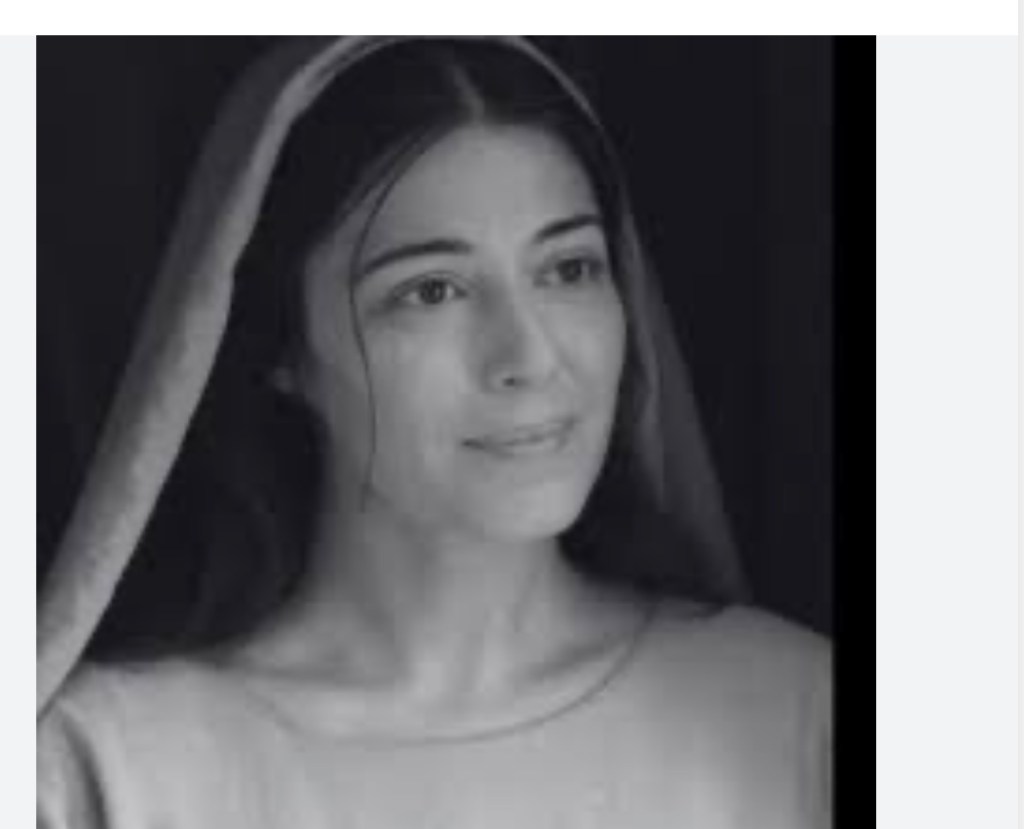
Photo: Elizabeth Tabish, playing Mary Magdalene in the series The Chosen.

Link for the Mass readings for April 11, 2025

May we allow Jesus to open the Scriptures to us!

Despair was creeping in on the pair. The hope of Jesus being the Messiah, the promised one who came to redeem and deliver his people Israel had died a brutal and humiliating death. Even though Jesus sought to prepare his followers for this reality, they could not conceive, believe, or thought possible that the promised Messiah could die.
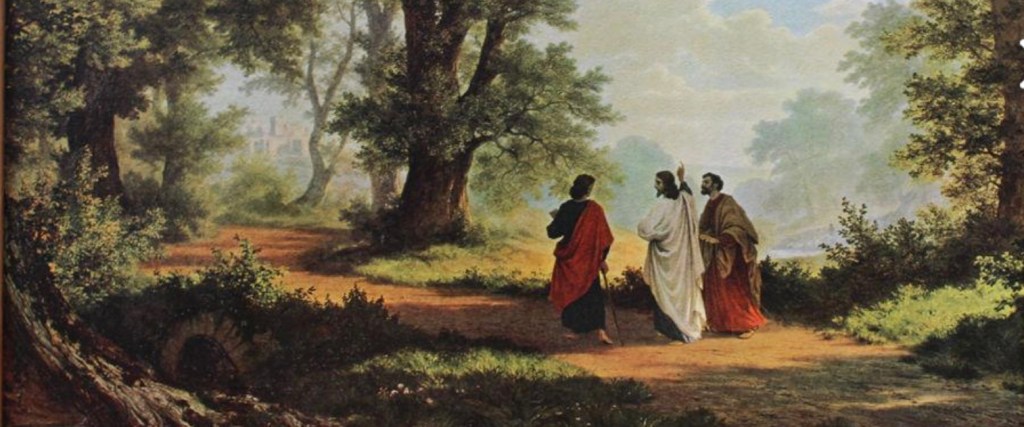
Cleopas and his companion are in mourning as they walk along the road to Emmaus. They have left Jerusalem and are commiserating among themselves about their dashed hopes. They were so sure that Jesus was who he said he was, now what were they to do? Even though they had heard about the empty tomb from the women, they did not believe, and they left Jerusalem. Jesus met them where they were and wove his way into the conversation and their journey.
When the time for them to part arrived, Jesus motioned to them that he was going to continue on. The pair of disciples urged him, “Stay with us, for it is nearly evening and the day is almost over” (Lk 24:29). Jesus did just that and he revealed himself to them “in the breaking of the bread”(Lk 24:35).
The account of the road to Emmaus has significant relevance for our own spiritual journeys. How many times have we had an inaccurate understanding of Jesus in such a way that we felt let down? Have we domesticated Jesus, or limited who he is, seeing only one aspect of his totality, attempted to shape or conform him into our image and likeness? Have we prayed for something and then that petition or intention was not fulfilled in the way we had hoped? Have we sought Jesus and felt that he wasn’t there for us in our time of struggle or during those times that we felt that we needed his guidance most?
Jesus is the Son of God and we are not. He meets us as we are, accepts us as we are, walks with us even when we are walking in the wrong direction, but he also calls us to repent and be transformed. He invites us to stretch out beyond our comfort zones, to let go of our safety nets and take off our training wheels. Jesus invites us to nothing less than being transfigured by entering into the participation of Trinitarian Love. This begins when we resist withdrawing into and curving in upon ourselves, and instead are willing to be loved and to be expanded outward beyond ourselves and so to love in return.
We would do well to spend some time each day reading, praying, meditating and contemplating the wonderful daily readings of the Acts of the Apostles and the Gospels. In doing so, our hearts and minds like that of Cleopas and his companion, may also be set aflame. Once this pair encountered the risen Jesus, they corrected their course immediately and returned to the community of Jerusalem, even though it was evening and not safe.
As we put into practice what we hear and receive, we too will begin to: see Jesus more active in the midst of our everyday activities, recognize him in our daily events and even in the interruptions, be more inspired to share the sacrificial love we have received from Jesus, and come to realize that Jesus is among us, closer to us than we are to ourselves. We just need to invite him to walk with us, even when we are heading the wrong way, we can turn around. When we invite Jesus into our lives God will happen and we will come to believe. Alleluia!!!
————————————————————-
Painting: “Road to Emmaus” by Robert Zünd
Link for the Mass readings for Wednesday, April 8, 2026

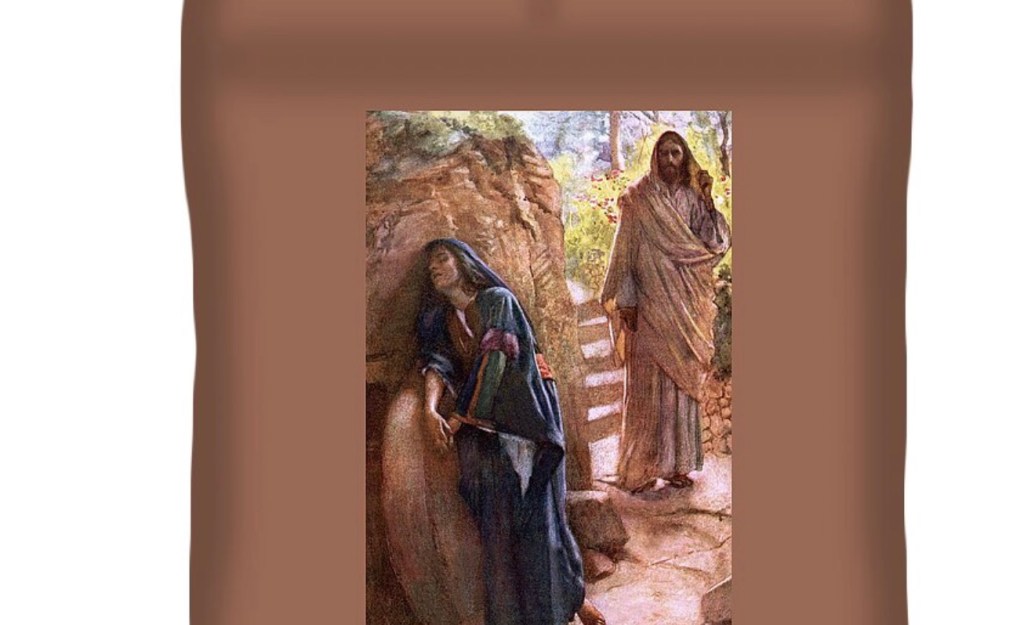
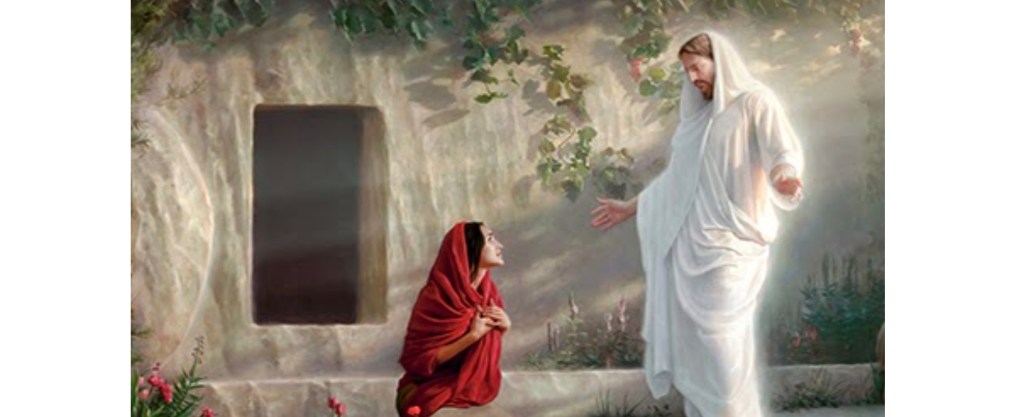
Mary recognized Jesus when he called her by name.

As we continue through the readings for Easter we will be given glimpses of encounters with the risen Jesus. This is good news for us, as the risen Jesus of the Gospels is the same Jesus who we have the opportunity to encounter each day in his word proclaimed, the Eucharist, and in our experience of one another.

Today’s Gospel account from John picks up where Sunday’s account left off. Peter and John have come to the tomb and left. Mary did not return with them after they observed the empty tomb. Mary stayed by the side of the tomb and wept. She then peered into the tomb and witnessed two angels. As she turned back she saw who she believed to be the gardener. Why a gardener? Because the tomb was in a garden. Maybe a hint of Jesus going back to the beginning and restoring what God had planned from the beginning, before the Fall.

Mary questioned the “gardener” as to the whereabouts of Jesus. She was still holding onto the loss and grief of his death and the reason why she most likely came to the tomb in the first place which was to anoint him. To find his body now gone, just added salt to the already wide open wound. When he did not immediately answer, Mary must have turned away, because: Jesus said to her, “Mary” (Jn 20:16)!

Just as a sheep recognizes the voice of its shepherd, upon hearing her name, Mary Magdalene recognized Jesus.

Peter and John left the empty tomb. We do not know why. Maybe they wanted to share with and confirm to the other disciples that Mary was correct about the empty tomb. Mary could have gone back also, but something moved her to stay. It could have been the sorrow that brought her to tears, it could have been her dedication and faithfulness to Jesus to find him, to anoint him as she had come to do that first early Easter morning, it could have been that she did not know what to do next, or there was a sense beyond her understanding that held her in place.

Shortly thereafter, Jesus came to her, she recognized him not at first, but when he called her by name. When she called him “Rabbouni”, Jesus asked her to, “Stop holding on to me”.

What was Mary holding on to? Though mistaking him for the gardener at first, she came to recognize that he had indeed come back to life. But in calling Jesus Rabbouni, teacher or master, Mary was going back to the relationship she had with him before. Jesus was transfigured, he was different than he was before, in Paul’s words, Jesus was now in “his glorified body” (cf. Philippians 3:20-21). Jesus had remained fully divine when he became human, and now having taken another major step to complete his Father’s work through his death and resurrection, he assumed the perfection of his humanity. His mission would not be complete until he returned back to the Father at his Ascension.

There was not only a newness to the appearance of the resurrected Jesus, but his relationship with his followers would also be transformed. He did not return to avenge those who betrayed him. Jesus charged Mary to go to his “brothers”. He no longer called them disciples but his brothers. Once Jesus returned to the Father at his Ascension, he unleashed the power of the divine communion of the love shared between him and his Father, who is the Holy Spirit which his new brothers and sisters received at Pentecost.

We are heirs to the same promise that Mary Magdalene, the Apostle to the Apostles, shared with the Twelve. Jesus has become the firstborn of the new creation and through our baptism in the name of the Father, and of the Son and of the Holy Spirit, we participate in his death and Resurrection as well. We too are his brothers and sisters, we too can be configured and transformed more and more into the Body of Christ, healed, perfected, and divinized, because Jesus shares with each of us the relationship he shares with his Father.

As long as we don’t turn away from Jesus, we have cause for joy and celebration this Easter Season because “the resurrection of Jesus has changed absolutely everything, including the relationship between him and his followers. The disciples such as Mary, can relate to him no longer as an earthly teacher but the risen Lord. Jesus’ order, “stop holding on to me”, is meant in a figurative sense: Mary can no longer hold onto her past notions of discipleship” (Martin and Wright, 337).

I remember while still in seminary praying in the chapel and asking Jesus why I couldn’t feel about him the way I felt about my wife, JoAnn. Jesus said, “You have to let her go.” He did not mean forget about her or our memories together, but to not hold on to her any longer. It took awhile, but in doing so, and no longer grasping, there have been brief moments when I have felt her close. Learning to let go of the attachment I had, even putting her before God while she was still alive, I continue to heal and like Mary better know his voice.


Painting: Like Mary then, we are called to, “Go and announce the Good News of the Resurrection” in our everyday lives! Alleluia!!!

Martin, Francis and William Wright IV. The Gospel of John. Grand Rapids, MI: Baker Academic, 2015.

Link for the Mass readings for Tuesday, April 7, 2026

All agree the tomb was empty, the question is whose story do we believe?

Mary Magdalene and the other Mary were bewildered from their encounter with the angel and the empty tomb. As they ran to get the news to the disciples, they were also dealing with mixed emotions, feeling both “fearful yet overjoyed,” (Mt 28:8) when in the midst of their travel they were greeted by Jesus. Jesus assured them and then sent them to, “tell my brothers to go to Galilee, and there they will see me” (Mt 28:10). Off the pair went to share the message that Jesus had risen!
At the same time, some of the guards who witnessed the event at the tomb took a different way and headed into the city to meet with the chief priests. They relayed the incident about the earthquake and the angel appearing to them and the two women. After deliberating, the chief priests and the elders paid the guards a large sum to perpetuate the tale that his disciples took Jesus away.
Who would be believed, the two women or the guards? Apparently both! Mary Magdalene and the other Mary fulfilled their first apostolic role and passed on Jesus’ message to his disciples. Galilee was where the public ministry of Jesus began. They would all go back to the beginning. The tale spread by the guards would also be believed, because by the time of the writing of the Gospel of Matthew, the community, to which he wrote, were aware that, “this story has circulated among the Jews to the present day” (Mt 28:15).
Did Jesus really rise again from the dead as the angel, Mary Magdalene, and the other Mary claim or was this an elaborate plot by the disciples of Jesus to stage his resurrection, as the guards portrayed? How we answer these questions ought to make a difference in our lives. If we say yes, that we believe in Jesus and that he rose again, do we live our lives any differently than those who say they don’t believe?
We, who follow Jesus who rose again, are to be like the angel and each Mary. We are to be an Alleluia people, allowing the risen Christ to proclaim to and through us to those facing death – the promise of hope and life; to those living in the darkness of sin and addiction – the inviting light of healing and a new direction; to those who are weak and indifferent – that they are not alone, and Jesus will be the source of their strength and through Jesus we and they will overcome. Each day, during this Easter Season, may we become less, so that the risen Jesus, who is the Way, the Truth, and the Life, becomes more.
—————————————————————–
Photo: “Mary Magdalene and the other Mary went away quickly from the tomb, fearful yet overjoyed”. How do we respond to the news that he tomb was empty?
Link for the Mass readings for Monday, April 6, 2026

Jesus is risen! Let us place our hope and trust in him and we will experience his peace and joy!

Mary of Magdala comes to the tomb during the wee hours of the morning while it is still dark and finds the stone rolled away. She runs to Peter and John to share with them the news, that: “They have taken the Lord from the tomb, and we don’t know where they put him” (Jn 20:2). Peter and John retrace the steps of Mary, running to find the tomb empty as well. All three are stunned because “they did not yet understand the Scripture that he had to rise from the dead” (Jn 20:9).
How can we blame them? Do we fully understand the reality and fact that Jesus has risen from the dead? There are conjectures tossed about today such as Jesus did not really die, but woke up three days later, aching all over from the excruciating effects of the crucifixion. Others say that the accounts of the resurrection were mass hallucinations, or that the Gospel accounts of Jesus rising from the dead are a mere myth. These propositions do not stand up to the fact that Jesus, fully God and fully man died, entered death, and conquered it. In so doing, he entered into a new life, a new reality. Jesus, in becoming the firstborn of the dead, was transfigured from our three-dimensional reality that we all know and experience, such that he now resonates at a higher pitch and dimensional reality. Jesus is the firstborn of a new creation!
All of human history changed in that tomb because of this new fact of the resurrection of Jesus. How this has happened is indeed a mystery, but in our seeking understanding, we will fall short and be frustrated if we only approach the mystery of God in the same way that we tackle a problem to be solved. The Apostles and disciples of Jesus struggled to find meaning and understanding about how Jesus crucified was now gone from the tomb. They came to understand the mystery of the Resurrection, the same way that they would come to believe in the mystery that Jesus is fully human and fully divine. This happened when they encountered Jesus again. The mystery of the Resurrection is not a problem to be solved, but a person to encounter, a relationship to embrace, as it was for the Apostles and is so for each of us today.
Faith seeking understanding is grounded in having an encounter with a person, Jesus the Christ, the Son of the Living God. Pope Francis writes: “The joy of the Gospel fills the hearts and lives of all who encounter Jesus. Those who accept his offer of salvation are set free from sin, sorrow, inner emptiness and loneliness” (Francis, 9).
Easter Sunday is the day where this joy first truly became possible, and this joy is needed now more than ever. For in each age there has been darkness in the world. Sin, suffering, violence, division, and death continue to be present in people’s experiences. Yet, because of this day, we celebrate Jesus’ victory over death. We celebrate the truth that the light has overcome the darkness, that suffering and death do not have the final answer, Jesus does. We can place our hope in Jesus so that no matter what challenges we are experiencing he will guide and accompany us.
We are an alleluia people, meaning that no matter what anguish or trial, we are a people endowed with hope in the One who conquered death. God has loved us into existence and continues to love us in such a way that the promise of eternity is real, where suffering and death are no more! Also, Jesus reminds us that he cares, that we are not alone now this side of heaven, and we will persevere and overcome sin, suffering, and even death when we surrender our minds and hearts to him. In that surrender, we will have access to his peace that surpasses all understanding.
Mary of Magdala shared the good news with Peter and John that the tomb was empty and the stone was rolled away. Jesus rolled back the stone, rolled back death, and he opened up heaven for us in the humanity he assumed, the death he conquered, and the resurrection we celebrate today! Alleluia! Alleluia!
May God bless each of you and fill you with his joy and peace! Happy Easter!!!
————————————————–
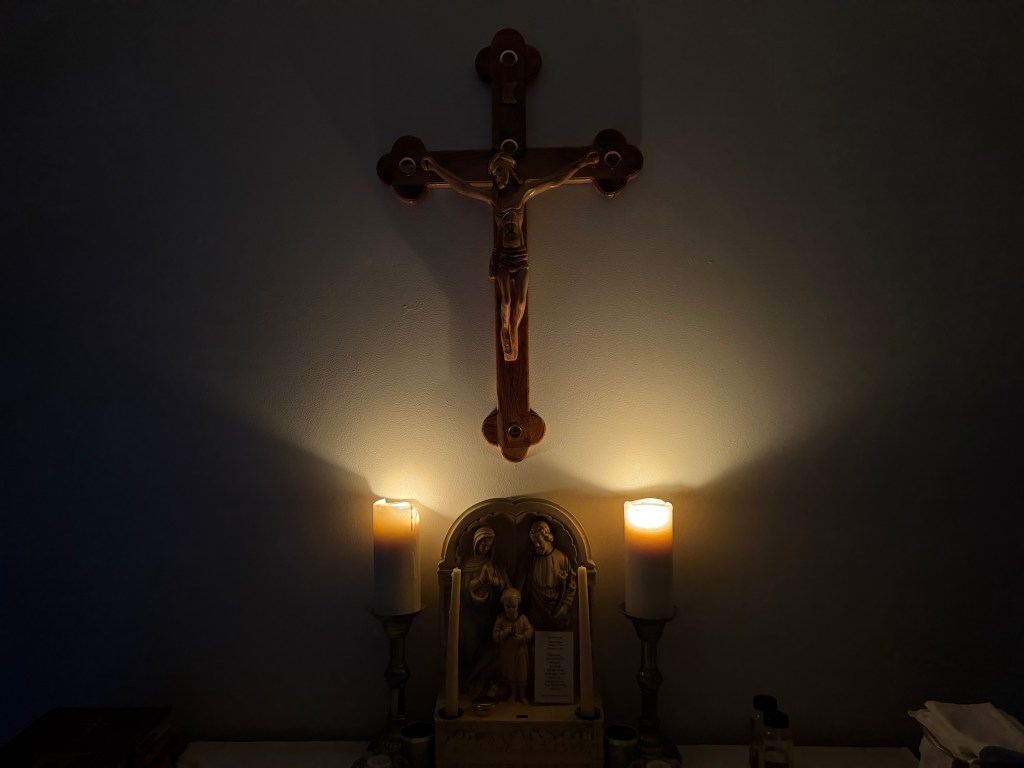
Photo: A quiet holy hour Saturday afternoon preparing to celebrate the Easter Vigil in which I was blessed to baptize 7 and confirm 17 joy filled disciples of Jesus!!!
Francis. Evangelii Gaudium, Joy of the Gospel, Libreria Editrice Vaticana. Frederick, MD: The Word Among Us Press, 2013.
Link for the Mass readings for Sunday, April 5, 2026

“For Jesus, it was more important to conquer death than to cure disease.”

Martha, Mary, Jesus’ disciples, and anyone else who experienced the sickness of Lazarus wondered why Jesus did not go to be with his friend as soon as he received word that he was dying. Jesus had healed and restored so many, why would he delay? Many of us who have experienced the death or in this moment may be accompanying a loved one in their final days and hours, may have asked or may be asking the same thing. Why is Jesus allowing this to happen? Why do so many have to suffer? Why the delay?
Jesus responded to the disciples’ inquiry by saying, “This illness is not to end in death, but is for the glory of God, that the Son of God may be glorified through it” (Jn 11:4). Not sure if Jesus’ response would have helped me if I was among the crowd. Many of us have experienced the death of our family and friends, as did Martha and Mary. What is Jesus up to?
Does Jesus care? Does this Gospel speak to us today? Yes. At the height of the Covid pandemic back in March of 2020, I remember being quarantined at home still on oxygen and watching Pope Francis come out on the steps of St. Peter at the Vatican in the dark and rain and said, Jesus, “more than anyone, cares about us.” Just as Jesus wept when he witnessed the anguish of Martha and Mary, the sisters of Lazarus, he also imagined the anguish of one of his closest friends sick and dying. So he wept and weeps with us in our present challenges, trials, and pain. Still he did not come until four days later. Why?
We may wonder in hearing or reading this account where Jesus is in the midst of our struggles at times, may wonder where he was in past challenges. There is good news here. Jesus had a plan for Lazarus and he has one for us. We need to have the same faith as Martha. Though she did not understand why Jesus had not come sooner, she trusted in him. Martha responded to Jesus when he asked he if she believed that he was the resurrection and the life and she responded: “I have come to believe that you are the Christ, the Son of God” (John 11:27). Just as Jesus was present to Martha, he is present and among us as well. But why the delay?
St. Peter Chrysologos offers a great response to that question, “for Christ, it was more important to conquer death than to cure disease. He showed his love for his friend not by healing him but by calling him back from the grave. Instead of a remedy for his illness, he offered him the glory of rising from the dead.” Jesus followed the lead of his Father to help those who were closest to him to understand that the reign of sin and death was over. Jesus came to usher in a new creation.
I believe Jesus conquered death and it has helped me with my deepest loss. Jesus did not cure my wife, JoAnn, from pancreatic cancer, and yet, it is my hope that he conquered her death, reached out to JoAnn, and led her home to the Father so that she may now be experiencing “the glory of rising from the dead.” But I am getting ahead of myself.
Jesus brought back Jairus’ daughter from the dead as well as the widow of Nain’s only son. The difference between each of them and Lazarus, was they were raised fairly soon after their death within even the same day or days. Lazarus had been dead for four days. Ancient Jews, unlike the ancient Egyptians, did not embalm the dead. By the fourth day, Lazarus’ body would have begun to decompose. In Jesus calling him back to life, and Lazarus rising, the effects of the decomposition were reversed and he walked out of the tomb on his own power, even while still wrapped in his burial cloths.
We need to resist just a complacent passing over of this incredible miracle that Jesus performed. This was beyond anything that anyone had ever experienced, and why, “many of the Jews who had come to Mary and seen what he had done began to believe in him” (John 11:45). Without diminishing the wonder of this event, it was only a forecast of the miracle of miracles to come and why the Church in her wisdom placed this account on the fifth Sunday of Lent. This is but a foreshadowing of the death and resurrection of Jesus.
Lazarus rose in a miraculous way but would die again. Jesus died, conquered death, and rose again never to die again. He was willing to do so for Martha, Mary, and Lazarus, so they could rise with him on the last day and have their souls be reunited with their bodies. The good news for us reading these words at this moment is that Jesus did the same for us today!
The key take away from the story of Lazarus is that no matter how wonderful the raising of Lazarus, a dead man four days in a tomb, was, it was just a foreshadowing of the truly incredible miracle of miracles we are about to celebrate in just a few weeks. The fact that Jesus rose from the dead himself was no mere resuscitation as with Lazarus. Jesus experienced the fullness of death and conquered it becoming the firstborn of the new creation. Jesus would later ascend into heaven and from the right hand of his Father, he would send us the Holy Spirit.
This is why we never need doubt that we are not alone ever, and especially in times of our deepest suffering. Jesus cares and accompanies us in each of our present situations as well as our unhealed traumas of the past. When we weep we can remember, “Jesus wept” also. Why? To teach us that it is ok to weep. Our tears remind us that we are human and that when we have lost a loved one, even if now we know death doesn’t have the final answer, there is a loss none the less.
We will live on, and just as if we experienced an amputation, our living without those that have died will never be the same. As we put our faith in the One who cares for us and loves us more than we can imagine, we will draw closer to him and to each other, we will see the glory of God at work in each of our lives, we will heal, and we will overcome and emerge stronger than before. Our healing happens when we too believe in Jesus the Christ the Son of God.
Our hope in this life is that we are invited to write our final chapter not here but in the new creation to come. “On the last day, Christ will call us forth from our graves as our friend, if we’ve lived in friendship with him. And he will command us as our Lord, the one who made the heavens and the earth, to come out of the tomb and to experience the resurrection of the dead, the new creation, and the life of the world to come” (Dr. Brant Pitre).

Photo: Each time we see the altar, we are reminded that Jesus died for us and conquered death so that death no longer has the final answer, Jesus the first born of the new creation does.
Pitre, Brant. Catholicproductions.com
Link for the Mass readings for Sunday, March 22, 2026

Do we die and that’s it?

The Sadducees present an absurd scenario for Jesus to respond to: a woman’s spouse died leaving her childless. She then successively married her husband’s six brothers who all subsequently died, also leaving her childless. The Sadducees then asked, “Now at the resurrection whose wife will that woman be? For all seven had been married to her.” (Lk 20:33)? The Sadducees sought to have Jesus weigh in on whether or not there was a resurrection of the dead.

The Sadducees did not believe in the resurrection from the dead because they only believed in a literal interpretation of the Torah, the law, or the teachings, which we as Christians today recognize as the first five books of the Old Testament. In the Torah, there is no overt reference to the resurrection. The Pharisees recognized the written Torah, but also acknowledged an oral tradition beyond the written text, and thus acknowledged the resurrection of the dead. A belief in the resurrection of the dead began to gather some support a few hundred years before the birth of Jesus.

Jesus deftly answered the question by keying in on the verse from Exodus, the second book of the Torah: “That the dead will rise even Moses made known in the passage about the bush, when he called ‘Lord’ the God of Abraham, the God of Isaac, and the God of Jacob; and he is not God of the dead, but of the living, for to him all are alive” (Lk 20:37-38).

Jesus pointed out that God was not a God of the dead but of the living. He also granted a glimpse into the heavenly realm: “The children of this age marry and remarry; but those who are deemed worthy to attain to the coming age and to the resurrection of the dead neither marry nor are given in marriage. They can no longer die, for they are like angels; and they are the children of God because they are the ones who will rise” (Lk 20:34-36).

Heaven is a different reality than we experience here on earth, a different dimension beyond the temporal time as we know it. We will no longer marry because we will be living eternally, there will be no death, so there will be no more need to procreate. We will be “like angels” in that we will be eternal beings. That said, we will not be nor do we become angels. Angels are finite, eternal, spiritual beings with no body. We are finite, eternal, human beings consisting of a soul and a body.

Our bodies are separated at our death from our soul, as Jesus pointed out with Abraham, Isaac, and Jacob in sharing that God is a God of the living, but will be reunited at the end of time when the new age that Jesus has ushered in with his death and resurrection comes to fulfillment. Until that time in heaven those who have gone before us are experiencing what we hope to experience. God face to face. A deeper and more intimate communion with the living God.

Many would scoff and say, “That’s it?” I am sure there is more, but if that was all, there would be more joy, more acceptance, more totality of being than we could ever imagine or embrace in just a second of that eternal gaze. As the psalmist wrote: “Better one day in your courts than a thousand elsewhere” (Psalm 84:11).

Definitively speaking, heaven is a mystery, and yet, the Mystery of God is not a problem to be solved but a reality and relationship to experience and develop. Looking to the things of heaven, in which we will eventually experience the fulfillment of our deepest longing, helps us to realize that what we experience here on earth is not all there is and as we allow ourselves to be open to the things of heaven, we can experience a foretaste even now.

We may be taken aback when Jesus shared that there is no longer marriage in heaven, but he is revealing the promise of deeper and more intimate relationships, even more intimate than the marital, sexual embrace. We will know one another more deeply because we will be free from that which puts up barriers between us, the wounds, insecurities, and attachments we engage in here.

In heaven, we will be free from any stain of sin, healed from emotional, psychological, and physical wounds. We can simply be. We can experience the freedom of resting in God’s loving gaze and embracing who we are and who God has created us to be for all eternity. We will also experience one another in the same way, with the same unconditional love. The greatest joy we have experienced in this life will be far surpassed by an eternal present and ever growing consolation from the infinite outpouring of God’s eternal love for us and our eternal and unconditional love shared with God and one another.


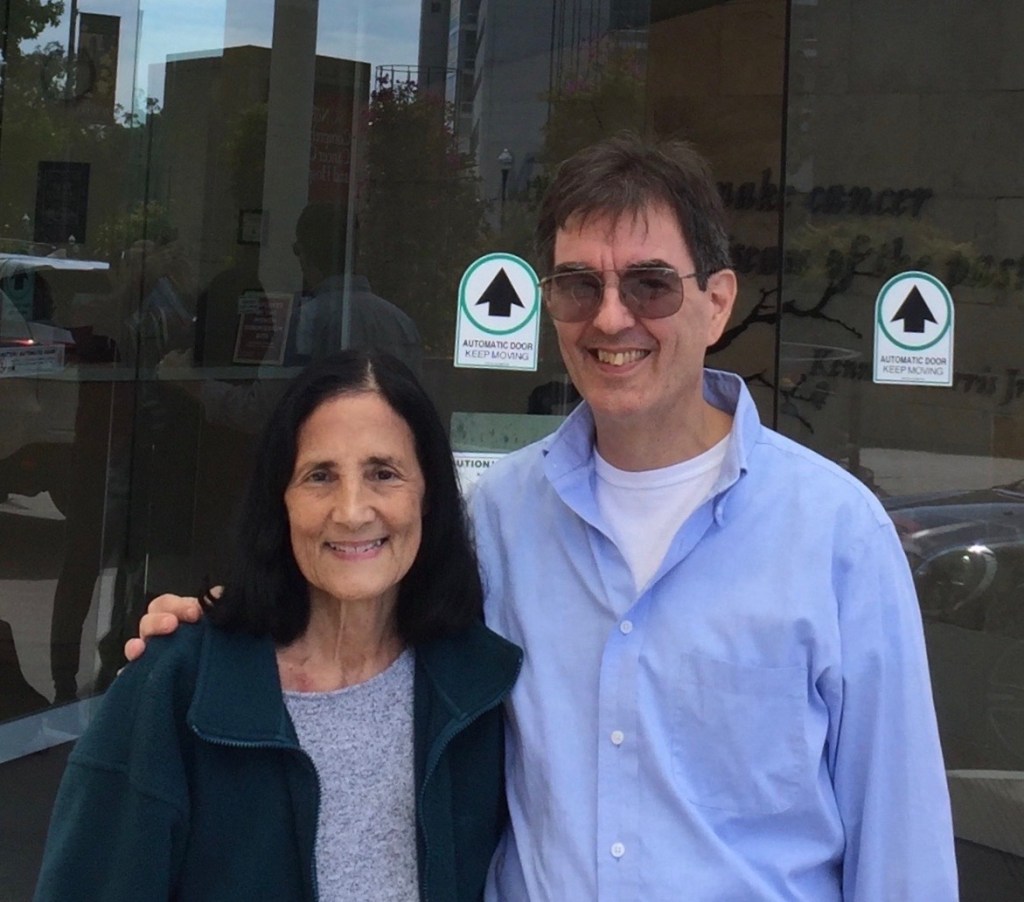
Photo: Visiting JoAnn Wednesday. She is where I will one day be. Not just in the ground 😉

Link for the Mass readings for Saturday, November 22, 2025

The will of God is that all of humanity will be saved through his Son, Jesus.

“For this is the will of my Father, that everyone who seeks the Son and believes in him may have eternal life, and I shall raise him on the last day” (Jn 6:40).

This is our hope and what we believe, that we who encounter Jesus, believe in, know him, and follow him shall have eternal life. God’s will, what he created all of us for, is to be in communion with him and one another in this life and the next. A word of assurance that I often lean on is from the book of Wisdom from our first reading today, “The souls of the just are in the hand of God, and no torment shall touch them. They seemed, in the view of the foolish, to be dead; and their passing away was thought an affliction and their going forth from us utter destruction. But they are in peace” (Wisdom 3:1-3).

The miracle of Jesus raising the daughter of the Roman official, Jairus, embodies these verses from Wisdom. As Jesus entered the home of the official many were “making a commotion” and Jesus dismissed them stating: “Go away! the girl is not dead but sleeping.” He was ridiculed by the crowd but paid them no heed. He went to the girl, took her hand, “and the little girl arose” (cf. Mt 9:18-26).

Jesus assured his followers as he assures us today that the will of his Father is that all will be saved. Experiences like the raising of Jairus’ daughter, the son of the widow from Nain, and Lazarus, were not only seeds of hope planting the promise of his resurrection to come but a foretaste of the raising of humanity on the last day. His disciples witnessed Jesus’ actions and words, and not only kept these experiences in their hearts but shared them.

Through the Gospels we are able to enter into and experience the encounters Jesus experienced with others again and again. We also experience Jesus each time we pray, participate in the sacraments, communal worship, and in our willingness to love one another through concrete actions of sacrifice and service. In each of these moments, we are conformed and shaped into who we have been created and called by God to be in this life and the next.

This All Souls Day we celebrate the gift that Jesus was victorious over sin and death, not only for himself but for all of us. Unlike those he raised from the dead and died again: “We know that Christ, raised from the dead, dies no more; death no longer has power over him” (Romans 6:9). The difference between All Saints yesterday, and the commemoration of all souls today, is that we pray for those who have died still in need of the purifying fire of God’s love. Just as “gold in the furnace” (Wisdom 3:6) is purified, so God purifies those in purgatory. Let us pray for them today that they may be freed from any stain of sin so to also join the communion of Saints!

“Merciful Father, hear our prayers and console us. As we renew our faith in your Son, whom you raised from the dead, strengthen our hope that all our departed brothers and sisters will share in his resurrection, who lives and reigns with you and the Holy Spirit, God, forever and ever” (Prayer for All Souls, from the Liturgy of the Hours).


Photo: For All Saints, we ask the saints to pray for us, for all souls, we pray for them that they may be saints. I pray for JoAnn and many each day. Who are you praying for?

Link for the Mass readings for Sunday, November 2, 2025

Jesus continues to proclaim the Gospel today, and is inviting us to join him.

But he said to them, “To the other towns also I must proclaim the good news of the Kingdom of God, because for this purpose I have been sent” (Lk 4:43).

Jesus himself, the Son of God incarnate, fully divine and fully human, is the foretaste of heaven. His work of preaching, teaching, healing, and casting out demons, shows that the divine flow of the Father’s Love is infused into our fallen human condition. Jesus came to restore unity to that which had been divided and once he began his public ministry, he was ever on the go.

Through our Baptism, we have been conformed to and indelibly marked by Christ and for Christ. We are nourished by his Body and Blood in the Eucharist and we’re empowered through the laying on of hands by the bishop at our Confirmation. We have been divinized, grafted into the life of God through our participation in the life of Jesus the Christ. We too then are priests, prophets, and kings as we participate in his life. We also are, to preach and teach the same Gospel, to be his healing and comforting presence, to make Jesus present to those in our midst, and yes we too are called to cast out all demons, and to shine the light on negativity, dehumanization, and division in his name. As James teaches, we are to “submit [our]selves to God. Resist the devil, and he will flee” (James 4:7).

Jesus did not travel very far during his three and a half years of public ministry, yet his teachings have touched the corners of the world. That is because of those who have encountered him, said yes to his invitation, submitted to the will of his Father, and continued to spread his teachings and life in each generation. We too are called to experience “a resurrected new life”, just as the mother-in-law of Peter did. And what did she do once she was healed? Out of gratitude, she immediately rose and served him. She mirrored Jesus in her willingness to serve (cf. Gadenz, 107).

Moment by moment, in each circumstance, we are invited to surrender to the will of his Father, and follow the gentle guidance of the Holy Spirit. Each yes to the guidance of the Trinity is an embrace of the gift of the unique vocation we are called to put into practice. The time of fulfillment is now because Jesus is present in our midst, he is at hand. So let us repent and believe in the Gospel, (cf. Mk 1:15), and follow the lead of Jesus that we read about each day.

These are not just nice stories. They are invitations for transformation and participation. By reading, praying, and meditating with these scriptures, we deepen our relationship with Jesus and begin to experience the love of the Holy Spirit and we are given clearer sight about what to let go of that holds us back from a more intimate union with the Father. Each day is a new opportunity to learn from Jesus, follow his guidance, and be advocates of his love and healing in the unique expression he would have us share! Let us like, Peter’s mother-in-law, arise and serve.


Painting: The Exhortation to the Apostles by James Tissot

Gardens, Pablo T.. The Gospel of Luke. Grand Rapids, MI: Baker Academic, 2018.

Link for the Mass readings for Wednesday, September 3, 2025