trust
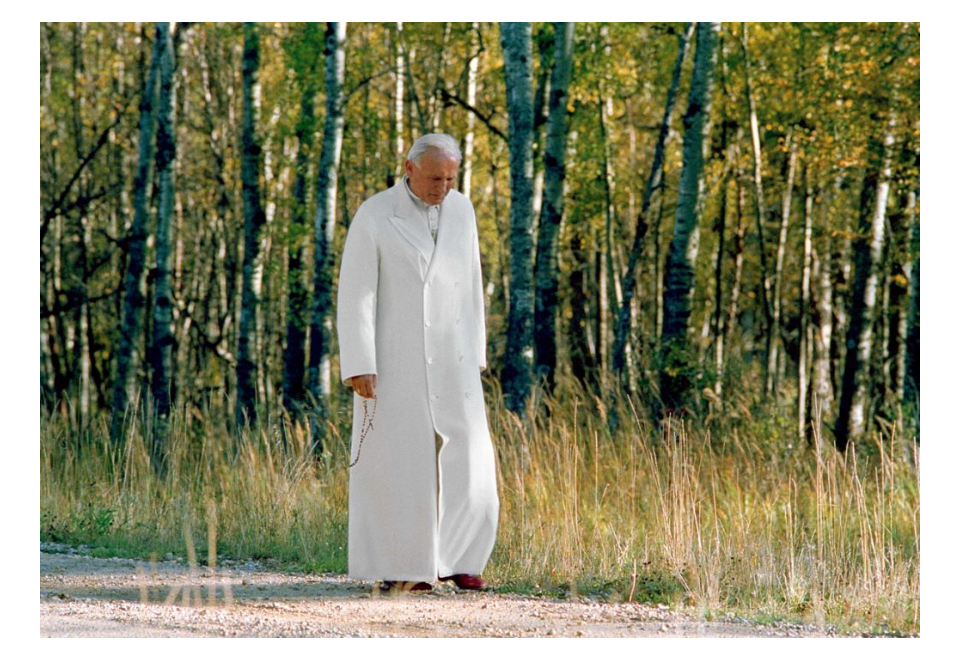

Can we trust God so as to also give as extravagantly, as generously, as radically?
Last week Jesus challenged us with the great commandment which is to love God with all our heart, soul, mind, and strength and to love our neighbors as ourselves. Our readings this week give us two radical examples of how to do just that. We begin by trusting in God.
We are to trust as did the widow of Zarephath from our first reading and the poor widow giving her last two coins to the temple treasury in the Gospel,“…she, from her poverty, has contributed all she had, her whole livelihood” (Mk 12:44). Each of these women were practicing a spiritual physics and being generous that defied what appeared to be the reality before them. Each had barely anything, one her last meal and the other her last two coins, yet they gave all they had, trusting that God would provide for them. They trusted in God’s providential care.
Each of us, the baptized, are the Church, and as we gather together each week to worship, we receive encouragement, seek to learn and grow deeper our faith, become transformed by the Body and Blood of Jesus made present again in the Eucharist, and pray for the needs of our world. This is a good way to build a foundation of loving God, self, and neighbor.
As people of faith we are to aspire to care for one another and creation, to resist the temptation to divide, demean, and define people as other and instead see each other as God sees us, as brothers and sisters. Elijah and the widow of Zarephath saw each other as human beings not people of different ethnicity or faith traditions. Each were in need, trusted in God, and supported one another.
St. Mother Teresa often recounted a story in which she brought a cup of rice to a Hindu woman because she knew how hungry her and her children were. As soon as the woman received the rice, she poured half into another container and left. When she came back Mother asked her where she went. The woman said, “They are hungry too.” “They”, were her Muslim neighbors.
Are we willing to have the kind of trust as these three women did? Do we have the courage to give not out of our excess but out of our need? On our own, most likely not. That is why God invites us to pray and spend time with him in our communal worship so we experience Jesus’ radical gift of himself in his word proclaimed and Body and Blood shared for us. He was willing to give himself, all of himself, holding nothing back.
Jesus gave his life for each one of us, what are we willing to give in return? Often we hedge our answer to this question because we are placing our trust not in God but in something else. For where our treasure is, there our heart lies. We would do well to meditate upon the accounts of the widow of Zarephath, the woman with two coins, and the Hindu woman this week. Meditating upon how each were willing to give the little they had, each expressing extravagant generosity, each trusting in God may help us to open our hearts and minds to the extravagance and generosity of God’s love for us so that we can trust him more and give as he invites us to give.
Painting credit: The Widow’s Mite by James Christensen
Link for the Mass readings for Sunday, November 10, 2024

To heal, it is important to reveal our sin and come out of the darkness.
The Lord said to him, “Although you cleanse the outside of the cup and the dish, inside you are filled with plunder and evil. You fools” (Lk 11:39).
Jesus’ harshest critiques were for acts of hypocrisy. He did so to show, in no uncertain terms, how dangerous this was, especially for religious leaders. These men were entrusted with the care of God’s people. They may have observed the proper rituals, spoke, and dressed to match the part but this all meant nothing if their hearts were hardened, and they were closed to the love and will of God. This situation was more perilous when they themselves became obstacles, stumbling blocks to those who sought God. Jesus indicting them as fools meant that they were bereft of the wisdom of God they projected to have.
A recent Pew study tracing religious affiliation from 2007 to 2014 found that approximately 56 million Americans identify themselves as following no religious affiliation. Some have labeled this group as the “Nones”. The context and nuance of why this trend has been on the rise has many components. One ingredient is the unacceptable levels of hypocrisy which has turned many off to organizations and the societal structures including the Church. Reports of abuse of children, women, and at risk adults over the past few decades further adds fuel to this fire. Although, church leadership has done much to correct those abuses and to put policies and practices in place to protect the flock, the damage has been done, the image has been tainted, and there is still much more work to do.
In the depths of our very being, we seek and yearn for the transcendent, the infinite. We are spiritual seekers. We seek God while at the same time we experience suffering, injustice, and hypocrisy at the hands of the very ones who are our leaders in both the religious and political sphere. This is why Jesus convicted those who abused their positions because he knew the significant damage that they could inflict. The good news is that the most recent study has shown for the first time that the rise of the “Nones” has plateaued. This is an affirmation that when we experience life without God, we will recognize that something, some One is missing.
No one is perfect, our leaders nor ourselves. We all fall short of the perfection of Christ, even those of us who seek and aspire to live by the Gospel. If we put anyone up on a pedestal, they, sooner or later, are going to fall, and the higher up they go, the greater the fall. God is to hold priority of place. We are to seek God first. God is to be our foundation, the light shining on the hill, our guide, and source. One way we can sidestep the trap of hubris is by resisting the urge to project all is well and good, that we are fine when we are not. None of us are super men or women. If we think we can go it alone, on our own power and persistence, we will fall sooner or later.
When we turn to Jesus to reveal our weakness and our sin, we can experience his transformative and healing power in our lives. To be vulnerable, to allow Jesus to shine his light into our inner darkness takes courage, but when we open all of our lives to him, we will identify and be able to release our own “plunder and evil”. The Holy Spirit can also help us to trust one another with our weaknesses, faults, and shortcomings.
We are healthier and stronger when we assume a posture of humility and openness and reach out for help. We are better when we entrust ourselves to Jesus and a core group of people we can trust, firmly ground ourselves in the love of God and one another. We grow stronger when we support the unique gifts of each other while at the same time hold each other accountable. Isolated and in the darkness, our sin festers and grows. When brought into the light, sin starves and withers away.
Jesus challenges us to resist projecting an image of perfection when all is not well on the inside. When willing to reveal our weaknesses, sins, suffering, and pain, we can receive help, heal, and let go of carrying the weight of seeking an internal perfectionism. Healed and transformed from being the center of the universe, which we never were or never can be, we don’t have to project any image. We can be free to be ourselves as God calls us to be and radiate his love as we receive his love. Instead of driving people to the nearest exit, we can begin to welcome people back home to be loved, healed, and transformed.
Photo: Rosary walk, Riomar Beach, Vero Beach.

The indissoluble union of the sacrament of Matrimony is to mirror the loving union of the Trinity.
The Pharisees approached Jesus and asked, “Is it lawful for a husband to divorce his wife?” They were testing him (Mark 10:2).
Among the Pharisees, there were different schools that arose from following the teachings of their rabbis. They sought how best to interpret the Torah, the Law or Teachings of Moses. Allowance for divorce was one of those debates. A stricter interpretation was found by the school of Shammai, in which he taught that the only grounds for divorce was infidelity. On the other end of the spectrum fell the school of Hillel which found that a man could divorce his wife if he felt she cooked a bad meal or with the school of Akiva, a divorce was permissible if the man found another woman more attractive.
The Pharisees that were approaching Jesus were not really looking for him to wade into the debate and get his insight. As Mark wrote, “They were testing him.” They were seeking to divide his support just as they would do in a few chapters when they asked whether it was permissible to pay the Roman tax. In both cases, they thought they had a good plan to trap Jesus and gain support against him. If he assented to paying taxes to Rome, the Jews would surely turn against him and if he said not to pay the tax, the Pharisees could turn him in to the centurions for going against Caesar. Jesus turned their question on its head when he said to pay to Caesar what belonged to Caesar and to God what belonged to God (Mark 12:14-17).
Jesus refused to take the bait with divorce as well. Instead of picking one of the Pharisaical school’s interpretations, Jesus did what he did when tempted by the devil in the desert. Jesus referred to the source, the Torah, and went back to the beginning in Genesis. God instituted marriage to be indissoluble for “what God has joined together, no human being must separate” (Mark 10:9).
Jesus also clarified that Moses allowed for the provision of divorce because of the hardness of the people’s hearts. Moses made such provisions to help to prevent a worse tragedy, such as a husband killing his wife so he could remarry.
When pressed further by his disciples afterward, Jesus did not water down his point, he instead remained on target and put both husbands and wives on the same standing. Husbands who divorce their wives and remarry as well as wives who divorce their husbands and remarry both committed adultery. Then as if on cue people bring their children to be blessed. The disciples attempt to turn them away, and Jesus said, “Let the children come to me, do not prevent them, for the kingdom of God belongs to such as these.”
Jesus seeks to restore the sacredness of marriage that God set in place so that we might be free to fulfill God’s plan for us to be in relationship with him and one another. Marriage as a monogamous and indissoluble union mirrors in the physical realm what the Trinity and divine communion of Father, Son, and the Holy Spirit reveal in the heavenly realm.
God the Father gives all that he is to the Son holding nothing back. The Son returns all that he has received from the Father, holding nothing back. This infinite exchange between the Father and the Son is the Holy Spirit, the love shared between them. In marriage, “a man shall leave his father and mother and be joined to his wife, and the two shall become one flesh.” In this union, there is the possibility of a third. The child that is conceived between the love and sacrifice shared between the husband and the wife.
This side of heaven, life and relationships are messy, they are not perfect, and unfortunately, relationships rupture. There are many reasons for this, there is much pain and suffering in those relationships that end in divorce or an annulment. Even so, Jesus will remain faithful to the Church, his bride. Just as Eve was “built” out of the rib of Adam, the Church was built out of the water and blood that flowed from the side of Jesus.
Jesus gave his life for his bride, and he will always remain faithful, and he will not lower the bar for his expectations of Marriage. Nor ought we settle for anything less. We remain faithful ourselves when we seek his help. Let us not give up on marriage, the gift of children, or each other.
Jesus’ teachings on marriage as well as the others that we have been receiving this summer are challenging. Many of us may feel that we cannot measure up, that they are too hard. When we feel this way, we are not to give up or to seek concessions. We are to trust in and seek help from Jesus.
Apart from him, we cannot fulfill what Jesus calls us to do, but with him, all things are possible. His teachings are hard, only because we are far from him. As we trust and rely on him and not ourselves alone, we come closer to his outstretched arms awaiting to embrace us. Jesus helps us to understand the truth of God’s divine laws, he gives us the grace to fulfill them, forgives us when we fall short, and encourages us to begin again.
This is why Jesus taught that we are to be like children. We must place all our trust and depend on God the Father, just as Jesus does. When we are willing to follow God’s guidance as his children and are willing to place our trust and total dependence on him, when we let go of what he reveals to us to be untrue, when we renounce the distortions of the father of lies who seeks only to divide, disrupt, and destroy us, we will inherit the kingdom of God. This is our birth rite and who we have been created to be, let us not lose it. We have been created to be in an intimate communion with God and one another. Let us not settle for anything less.
Photo: Jesus brought us together, and helped us to grow closer to him and to each other.

God cares more than we might think.
Job through all his sufferings, trials, and tribulations was faithful to God and coming to the end of the story, he gets an actual hearing from God himself. God speaks to him “out of the storm” (Job 38:1), though does not answer Job’s questions. God, in two speeches, asks Job questions that deal with the reality that Job is a finite human with the limitations that entails and yet gives Job a vision of the ordering of the whole of the cosmos and our created world.
From this amazing encounter, Job speaks in but a whisper: “I have dealt with great things that I do not understand; things too wonderful for me, which I cannot know” (Job 42:2-3). Job repents, he is willing to accept the gift that God gave him, of seeing how small he really is in the greater scheme of the vast cosmos and even in the ordering of this planet and the created beings upon it. God’s questions cut to the heart of Job’s limited point of view regarding the grand scheme of God’s plan and Job was willing to accept God’s guidance.
In the Gospel, Jesus receives the seventy-two he had commissioned to heal and exorcize demons in his name. They returned rejoicing at the wonders that they experienced in their service and Jesus invited them to see that what was more amazing was not so much that “the spirits are subject to you, but rejoice because your names are written in heaven” (Luke 10:20).
What is the most amazing of both accounts from Job and the Gospel of Luke today, is that God, even cares about us. God cares about us personally and intimately. God knows each of us by name and knows us better than we know ourselves. Even though God does not need us, God yearns for relationship with us and has planted that very desire to be in relationship with him in the very depths of our minds, hearts, and souls. God also wants us to participate in his plan of salvation history and has a particular part for us to play.
When we give ourselves some time to take this in, to rest and stop, to breathe, really take some deep and slow breaths, and ponder not only how much God loves us, but actually give ourselves time to rest in and receive his love. Wow! You’ll never breathe or see the world in the same way again.
You might hesitate or question whether God cares because he allowed something to happen or not to happen. You may not care about having your name written in heaven, for what’s the point of having an eternal relationship with someone who doesn’t care enough to listen. Even if you may not want to make the time to read about Job’s angst and encounter with God, maybe start with taking a few steps toward trusting God, who really does know what he is doing and knows what is best, even if you don’t believe that yet.
Just taking a moment to be still, and to bring our questions to God is a good first step. For God is the best one to answer them. We just need to be prepared that he may answer our question with more questions. As long as we are willing to enter into the conversation, we are moving in the right direction.
Photo: Rosary walk, Holy Cross Catholic Church, Vero Beach, FL.
Link for the Mass readings for Saturday, October 5, 2024

Humility, contrition, and confession are the pillars for forgiveness, love, and peace.
Logistically, to our modern minds, the setting of this verse may appear confusing. How could this “sinful” woman be standing behind Jesus such that her tears would fall on his feet? When we think of someone sitting and eating, we imagine them doing so by sitting in a chair. Thus, the feet would be toward the front of the person.
During the time period Jesus lived, the customary practice when eating was not to sit at all but to recline. Thus, the woman was standing behind the feet of Jesus as he reclined, and her tears fell on his feet. She then knelt down, dried his feet with her hair, and then anointed Jesus’ feet with the ointment she brought for him.
She did not rationalize, deny, ignore, or come grudgingly nor wait for Jesus to call her out, she came not asking for healing but with true contrition for her sins. Being in the presence of Jesus, when we are open to his love and experience his compassion, we are pierced to the heart with our own sorrow for the hurt we have caused others through our sinful actions.
Those quick to point the finger at other’s sins, like Simon who judged this woman, are less apt to be aware of the depth of their own sin and thus “the one to whom little is forgiven, loves little” (Lk 7:47). We are not forgiven less because God is not willing to forgive but because God will not go against our free will. If we are unaware or unwilling to bring our sins forward in a contrite manner, we are cutting ourselves off from the healing forgiveness God wants so much to share with us. But if we, like the woman in today’s Gospel account, are willing to bear our soul with humility and sorrow we will not only be forgiven but experience a deeper outpouring of God’s love. The one who confesses truthfully, fully, and contritely is forgiven more and thus will love more.
We are offered the same gift of grace and forgiveness as she received. What if instead of hiding from, being in denial of, rationalizing, or justifying our sins, we acknowledged them and sought the healing forgiveness of Jesus as she did? In opening our hearts and minds to the forgiving and purifying love of the Holy Spirit there is pain, as there is in any healing, but there is also freedom. When we trust Jesus as she did with our deepest and darkest sins, we too can be forgiven, healed, and freed of the shackles that bind us and experience his love.
Don’t believe the lies of the enemy. God loves us more than our worst mistakes and sins. When we trust him, are contrite, confess, and willing to atone for our sins, the truth will set us free, and we will experience God’s love more fully and his peace more deeply.
Photo: Good to be still, quiet, breathe, and examine our lives from time to time.
Link for the Mass readings for Thursday, September 19, 2024

Jesus is calling and sending us as he did his Apostles.
“I was no prophet, nor have I belonged to a company of prophets; I was a shepherd and dresser of sycamores. The Lord took me from following the flock, and said to me, Go, prophesy to my people Israel” (Amos 7:14-15).
Amos is pushing back against Amaziah, the priest of Bethel, who told him to no longer preach in Israel. He was saying basically, if you want to preach, go back to where you came from, to Judah and preach to your people there. Amos wasn’t going anywhere. He was not there for profit nor did come through the company or guild of prophets or was he the son of a prophet. This was no profession for him, he came to Israel to share God’s message of repentance because God sent him to do so.
The Gospel message from Mark shows Jesus doing the same. He, the Son of God, who was sent by his Father, was now sending the Twelve who he had called and taught. They too, like Amos, were to rely solely on the providence of God, to trust him to give them what they needed for their ministry of going out, to evangelize; to share the good and what may be for some, the bad news.
They were to share the goodness of God the Father’s mercy, grace, forgiveness and love, while at the same time challenge the people to reform and change their lives, to repent from that which they were doing that was going against God’s will. The beauty of this both/and is outlined in Psalm 85: “Kindness and truth shall meet; justice and peace shall kiss. Truth shall spring out of the earth, and justice shall look down from heaven” (Psalm 85:11-12).
Too many times we can fall into an overemphasis on one or the other creating an either/or. A heavy-handed emphasis on justice and forgetting the tender compassion of mercy, or an overemphasis on mercy at the expense of justice. Jesus is the incarnate expression of the balance of both justice and mercy as presented in Psalm 85.
St. Paul outlines the richness of this balance in Jesus to the Church at Ephesus. For he writes, it is in Christ that we receive our blessing, in him: we receive our redemption and are forgiven, we hear the truth of his will, and we are chosen by God in Christ – before time began! We have been chosen to be holy, set apart by God for a unique purpose. We can reject or accept this offer for God loves us so much that he is willing to risk our, “No.”
Amos seemed to be saying to Amaziah that he was quite satisfied being “a shepherd and dresser of sycamores.” Yet, he assented to God’s call and went north. I understand. I was content in my teaching position and contemplating an earlier retirement, but when I asked God what he wanted me to do, he had another idea. I, like Amos, said, “Yes.”
The Apostles said, “Yes” as well and Jesus sent them out two by two. He was sending them out of their comfort zones and without the security of the material support. He was not sending them out unprepared, even though they were not to taking anything on their journey but the tunic they wore, their sandals, and a walking stick. Jesus sent them out with his authority and the commission, to preach repentance, cast out demons, anoint and cure the sick.
They were to trust and completely depend on God’s mercy and providence as they went out to evangelize. To evangelize, Jesus did not mean to advertise and convince. They were sent to share the Gospel and not worry about whether it was to be accepted or rejected. If accepted, they would stay with those who were hospitable and not leave if a better offer of lodging came along. If they were rejected, they were to “shake the dust off their feet.” They would move on. As St. Mother Teresa likewise taught her sisters, they were not sent by Jesus to be successful, they were sent to be faithful to what Jesus was sending them to say and do.
Jesus is calling us as well to repentance, so we can receive more of God’s love, be drawn closer into relationship with him, so that we can know and fulfill our own unique role in his plan of salvation history. This is a call that will stretch us beyond our comfort zones, it is a call to let go of the security in anything material and to rely and depend instead upon God first and foremost. We will face rejection and ridicule or worse, and yet, we will experience fulfillment, meaning, joy, and a love beyond anything we can ever imagine. Each day is a new opportunity to say yes to the invitation Jesus shares with us and he will provide what we need to follow him as we walk upon the path of our journey of discipleship one step at a time.
Photo: Spending some time with Jesus and the Apostles during my holy hour in our adoration chapel yesterday afternoon before celebrating the 4:30 Mass at Holy Cross Catholic Church, Vero Beach.
Link for the Mass readings for Sunday, July 14, 2024

May we also trust and have courage to reach out to Jesus in our need.
“If only I can touch his cloak, I shall be cured.” Jesus turned around and saw her, and said, “Courage, daughter! Your faith has saved you.” And from that hour the woman was cured (Mt 9:21-22).
Just to touch his cloak may seem a small and insignificant act, but by doing so, this woman showed tremendous courage. Suffering from hemorrhaging for twelve years, broke from spending all her resources to be healed, she risked. She could have been severely punished, beaten, or stoned for this small act. Under the Levitical code, her condition deemed her unclean, in the same category as a leper, a pariah. Touching someone else in that condition would then make them unclean. Yet, in that small touch, that great act of courage, “power had gone forth from him” (Mk 5:30), and she was completely healed. Not only did the woman exhibit the courage to touch Jesus, but to admit she had done so when Jesus questioned who had touched him.
In calling the woman who touched him out, Jesus was not condemning her, Jesus was acknowledging her faith and restoring her to the community from which she had been ostracized. Jesus restored her dignity. How many women today still feel and experience the pain of exclusion, not having access to the full and equal benefits of society and the Church? How many people are still considered outcasts and pariahs in our communities?
Pope Francis in his general audience from August 31, 2016, stated: “Once again Jesus, with his merciful behavior, shows the church the path it must take to reach out to every person so that each one can be healed in body and spirit and recover his or her dignity as a child of God”. We too then are to treat each person we encounter, in-person and online, with dignity, love, mercy, and respect.
The courage and persistence of the woman with a hemorrhage from today’s Gospel led her to reach out to touch Jesus even though she was crossing social norms. Jesus affirmed her move. May we also place our trust in Jesus, have the same courage to reach out to Jesus for our needs, when in our weakness, and to seek his guidance. While at the same time, may we be available and willing to allow Jesus to work through us to provide healing and support for those in our realm of influence who are in need.
Painting: James J. Tissot, The Woman with the Issue of Blood (1886-94)
Link for the Mass readings for Monday, July 7, 2024

Let us harden not our hearts, instead let us trust in Jesus, and put on new wineskins.
“Rather, they pour new wine into fresh wineskins, and both are preserved” (Mt 9:17).
Mark, Matthew, and Luke all record Jesus’ reference of pouring new wine into fresh wineskins. What Matthew adds is, “and both are preserved.” Luke adds: “[And] no one who has been drinking old wine desires new, for he says, ‘The old is good.’”
The Gospel authors are reflecting on the tensions of those who would reject Jesus and those who would follow him and his new way. The new wine is to accept the Gospel, the Good News of the kingdom of God in their midst, and to do so means to change one’s mind and heart. “The tension, and often incompatibility, between the old and the new is part of every religious tradition and attends every change within that tradition. Matthew and Luke wrestled with it and adapted it to their community situation. Contemporary Christians have no less a challenge” (The Gospel of Mark, Donahue, SJ, p. 109). Matthew shared with his community that Jesus is the new Temple, for the old one had been destroyed in 70 AD. Following him in fact meant that both the old and new covenants would be preserved. Jesus did not come to abolish the law and prophets. Instead, he came to fulfill them and even raise the bar and challenge his followers even more.
We are invited to wrestle as well. The Church is called to change, to be transformed by the Living God. Many say the Church needs to change this and that, not realizing that we are the Church, the People of God, the Body of Christ. If the Church is to mature and grow each of us needs to embrace Jesus’ offer of the transforming love of God and be willing to be made anew through the guiding presence of the Holy Spirit. This invitation is a call to let go of those disordered affections, physical and emotional attachments, habits, lifestyles, behaviors, mindsets, and addictions that are weighing us down or worse holding us in bondage and slavery. To cling to that which is not of God keeps us separated from God. Much of the material and finite things we hold onto prevents us from receiving the new life God wants to pour into us.
Jesus has come to set us free from the old wine that will lead us astray. He is introducing some new wine. We are invited to sip and savor his teachings and actions as recorded in the Gospels. Even when they might be challenging, we do not have to be afraid of the change and transformation Jesus is calling us to experience. God wants the best for us, and he will give us the strength and discipline to move forward step by step, for as St. Irenaeus wrote: “The glory of God is man fully alive!” Jesus is inviting us to live our lives and live them to the full!
To become new wineskins, Jesus invites us to soften our hearts. Let us resist the temptation to harden them and dig in our heals because we are afraid that what God may be asking of us will be too hard or make us miserable. Jesus calls us to trust. As we take a breath or two, and trust him, we will begin to feel safe and be able to let go of those selfish and sinful inclinations that keep us constricted and rigid. We will also be able to step out beyond our comfort zones, ones that may have truly been good but were not intended to be the end goal.
As we learn to trust, we will also learn to love as Jesus loves. We will then expand and open our minds and hearts more to receive the new wine Jesus wants to pour into us. We are called to go beyond the foundation of our identities that we have found safety and comfort in and become free to be people of integrity. Our identity gives us roots but our integrity gives us wings to fly.
It was hard for me to think of living my life without JoAnn after she died. It was hard to let go of teaching, first at Rosarian Academy and then at Cardinal Newman, and it was hard to leave, even after the intensity of the past two years of seminary, but Jesus was leading me to put on a new wineskin yet again. I am typing away, now as a priest, in my new office. I have been welcomed and blessed by the new wine poured out through the hospitality and kindness of Fr. Tom, the staff, clergy, and parishioners here at Holy Cross Catholic Church.
Each time we have the courage to come to God in stillness, he will reveal to us that which distracts and diverts us from going deeper. As we trust Jesus and cut away the ties that bind us, as we are willing to be more and more conformed to Jesus, as we trust him and let go of our biases, prejudices, and fears, we expand and become more of our authentic and true selves and grow to be truly who Holy Spirit is leading us to be with his tender chords of love.
Photo: Celebrating my first Mass of Thanksgiving at St. Peter Catholic Church.
Donahue, John R. S.J., and Daniel J. Harrington, S.J. The Gospel of Mark. Vol. 2 of Sacra Pagina, edited by Daniel J. Harrington, S.J. Collegeville, MN: Liturgical Press, 2002.
Parallel Scriptural accounts: See Mark 2:22, Matthew 9:16-17 and Luke 5:37-39
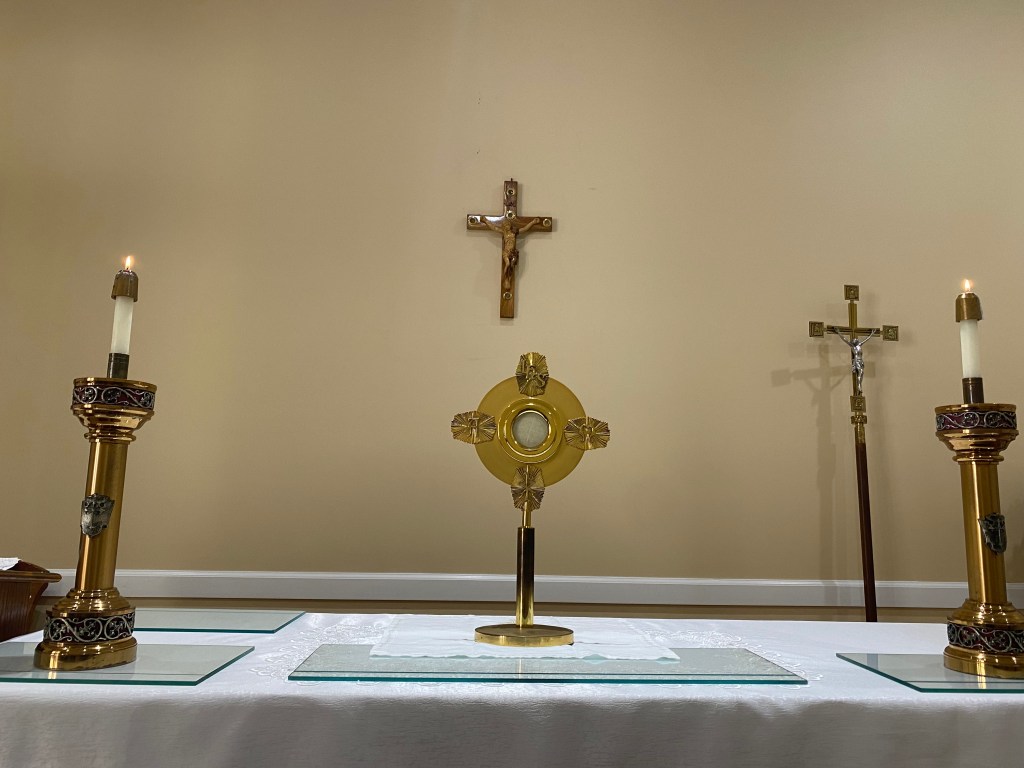
Slow down, breath, stop, and trust in Jesus.
Our days are so full of activities, conflicts, health issues, technological stimulation, 24/7 news cycles, social media interaction, and the mix of our own personal unique daily challenges. If we do not have the proper foundation and orientation, we can feel stretched, hollow, and/or fatigued at best. One day can seem to blend into another, and another, and another. The image of being on a hamster wheel or an unending treadmill can fall afresh in our mind’s eye when we actually do take a minute to breathe. Anxiety, worry, stress, fear, prescriptions, and addictions all appear to be on the rise and swirling out of control.
Is there an answer to this hyper pace or are we doomed to just keep going until the wheels fall off? The opening verse in today’s reading provides an antidote when we are feeling any or all of the above.
Jesus said to his disciples: “Do not let your hearts be troubled. You have faith in God; have faith also in me” (Jn 14:1).
We are invited to place our trust in God through his Son, Jesus. By putting them first does not mean that the externals to our life will take an abrupt turn for the better, but what it does mean is that we will have support and divine assistance. It means that we are not alone in our struggles. The disciples found this out when in the midst of a sudden sea squall. Their boat was taking on water as the waves grew higher they were terrified and so, called to a sleeping Jesus. Jesus awoke and with a word, he calmed the sea (cf. Mk 4:35-41).
Jesus may or may not calm the sea of our trials and tribulations, but what he will do is be present with us through our storms in life and we can trust in him that he will guide us through. As we grow more confident in our trust in Jesus we will come to be assured that no matter who or what comes at us, he will be there to assist us. We will experience more peace and calm within ourselves. The ultimate assurance that Jesus provides is that when we surrender our life to him, we belong to him, we are not alone or orphaned. He gave his life for us, to redeem and save us so that we can be assured of our home for eternity.
If we are struggling at any level and are seeking to build our trust and faith in Jesus, we do need to realize that this takes time. We need to remember to daily ask Jesus for help, seek his discernment about where we can make changes in our life, and make periodic efforts to stop in our day to be still. This time does not need to be lengthy, three to five minutes to start can do wonders. On the surface level, by stopping for five minutes to pray and breathe more deeply and consciously, we get off the wheel, we step out of survival and reaction mode, so we can then make more intentional decisions, and we can come to see that we truly have options, but more importantly, we begin to develop a relationship and intimacy with Jesus so to begin to recognize his voice that is calling out to guide us.
Author Wanda E. Brunstetter, wrote, “If you are too busy to pray, you are busier than God wants you to be.” There is a lot of truth in her statement. I have had busy days, weeks, and months, where I have wondered if taking the time to pray and meditate was really the most sensible choice. Time and again it has been. At the beginning of these two years of seminary when my workload was larger than I anticipated, I barely prayed much for a few days and realized that was a mistake. Making time for consistent prayer each day became my priority and doing so has made a tremendous difference.
Daily Mass, praying with the Liturgy of the Hours, reading and meditating on passages of the Bible, reciting the Rosary are great tried and true practices from our tradition that I find helpful. If any seem too much, especially if you are just starting, begin with Night Prayer in the Liturgy of the Hours each night before bed, or a couple of verses each day from the Bible or one decade. One slowly and well said Our Father and some quiet time to listen or just a few minutes of breathing slowly and opening our heart to Jesus can be transformative.
Consistent moments of stopping and being still and intentionally lifting our hearts and minds to God each day is a tremendous gift to help our hearts to learn to rest and trust in Jesus. Each of these practices offer us a few of the many ways to stop the madness, to slow down, simplify, and connect with the power, the love, and the grace that Jesus yearns to share with us such that no matter the external or internal upheaval, and even if life is going pretty well, we will experience his peace and security which is what we all truly long for.
—————————————————–
Photo: Quiet time before the Blessed Sacrament this past Tuesday while on silent retreat at Casa San Carlos, Delray Beach, FL.
Link for the Mass readings for Friday, April 26, 2024

