“But who do you say that I am” (Mt 16:15)?
This question is just as important to us today as it was when Jesus asked his disciples the same question some two thousand years ago. The answer is wide and varied as attested to in the many books written about Jesus and the many people within and without of denominations who claim to follow him. There is also a vast array of pictures, paintings, documentaries, and movies.
Through each medium, we are given a view of the Jesus of history or the Christ of faith, some emphasizing more the humanity of Jesus and others more the divinity of Jesus, and some a balance of both the human and the divine. Debate has continued around whether Jesus was or is God, was/is he only human, only divine, or both, and even more recently, did he ever really exist at all?
When I taught fifth and sixth-grade students at Rosarian Academy, each Easter Season, I assigned my students the task of drawing a picture of the Resurrected Jesus. I quickly noticed a common characteristic of those first artistic renditions: Jesus consistently did not have a beard. At first, I started to hand back the pictures to say they needed to add a mustache and beard but I quickly stopped myself. I realized I had made a mistake. This is how they saw Jesus from their perspective at their age.
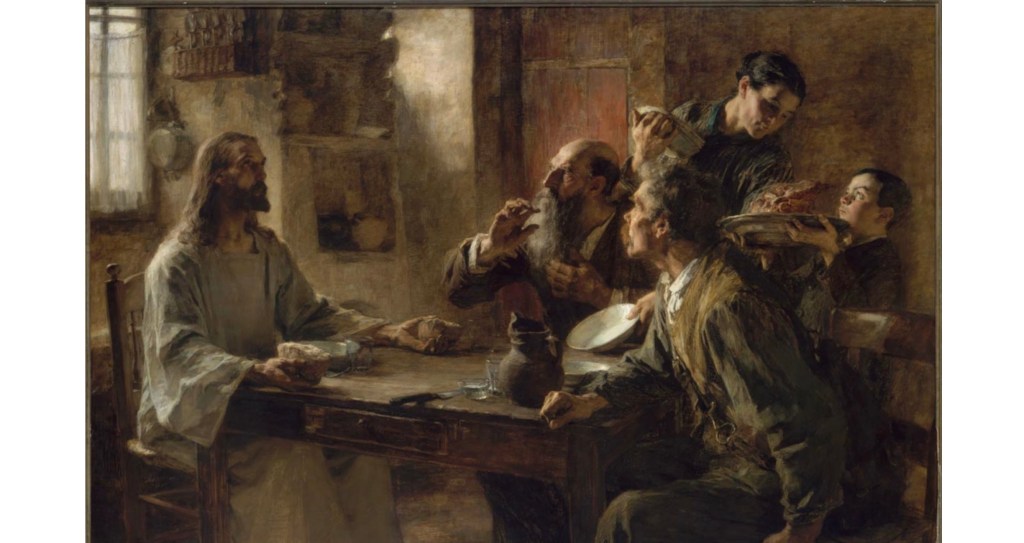
The way we talk about and express Jesus may actually say a lot more about us than Jesus. The painting I posted is very similar to the more famous head image Warner Sallman painting he titled, “Head of Christ” that came out later. The Sallman image was one I grew up with. Neither representation is of the historical Jesus. Yet, it was a picture that touched me in my youth. Many artistic representations of Jesus are not historical. What draws people to continue to share them is such a vast variety of ways, is that their representations provide a connection and relevance, which then touches others.
Presently, there has been no picture or representation of Jesus that captures my imagination and I have looked at many. Finding the new painting by L’hemitte (posted) was fun and I will enjoy praying with it, although I find myself less moved by artistic representations these days. Even when I meditate and pray with the Gospel accounts, Jesus feels closer at times than others. When I attempt to focus too tightly on his appearance, that becomes a distraction and diversion. What has become more consoling has been, not what he looks like, but instead the experience of his presence, his peace, and his love.
Debates regarding who Jesus is will continue, even though the Church has given the definitive answer in the Apostle’s and Nicene Creed. It echoes Peter’s, “You are the Christ, the Son of the living God” (Matthew 16:16). Jesus is fully God and fully man. He is God, the second Person of the Trinity, who has become one with us in our humanity so that we can become one with him in his divinity. This is not just a wonderful truth to proclaim each Sunday together.
Answering Jesus’ question, “But who do you say that I am?” (Matthew 16:15) is an important question to meditate upon and pray with daily, in our times of uncertainty and unrest, as well as during our times of peace and rest and everywhere in between. Speaking, even believing this truth, is not enough. Jesus invites us to experience the truth of his reality and presence, to trust him with everything and in every situation. Doing so, will help us to experience his love and he will become real and relevant in our lives.
Painting: Above: Leon-Augustin L’hermitte “Friend of the Humble” (Supper eat Emmaus)”, 1892. Warner Sallman’s “Head of Christ” came out in 1940 and bears a striking resemblance to L’hermitte’s.

