Jesus asked his disciples about who people said that he was and Peter, through the revelation of God answered, “the Christ of God” (Lk 9:20). Jesus then responded that “The Son of Man must suffer greatly and be rejected by the elders, the chief priests, and the scribes, and be killed and on the third day be raised” (Lk 9:22).
If you might be thinking that these verses sound familiar, it is because we heard proclaimed or read the parallel account found in Mark 8:27-35 two Sundays ago on September 15. This point never gets old. As we grow in our relationship with Jesus, we come to a deeper understanding of Peter’s words.
Jesus is indeed the Christ, the Messiah, the Son of the Living God. Yet, that meant many things to many people who were awaiting the coming of the Messiah. For most, they were hoping for a military leader to come to lead them and overthrow their Roman occupiers. As soon as Peter made his statement, Jesus clarified what kind of Messiah that he would be, a suffering servant.
As our first reading from Ecclesiastes offered, “there is an appointed time for everything” (Ecclesiastes 3:1). Even a time for suffering. Peter had trouble with understanding this and he represents us as well. One of the points of faith many of us struggle with is the same as Peter, why did Jesus have to suffer?
Jesus was willing to be sent by his Father to become human and to experience all of humanity, even the suffering of our humanity, because only that which Jesus assumed could he redeem. Also, in Jesus experiencing our suffering, even unto death, we can know without hesitation or doubt that Jesus understands our struggles and anguish. And that means we are never alone in our suffering.
The reality is that the Messiah, the Christ, the Anointed One, is Jesus. He is the suffering servant, the One willing to give his life on the Cross for all of humanity and creation. Jesus did not do this in some abstract way. He died for each and every human being that has lived, is now living, now reading these words, or ever will live. He died for you because he loves you.
To be a disciple of Jesus, we are invited to love in return. This means being willing to suffer and sacrifice for one another. Our discipleship will be ultimately expressed in love, in our willing the good of each other. We must be willing to let our hearts be moved with compassion and as St. Mother Teresa taught by, “Giving until it hurts.”
To give until it hurts means that we are willing to allow our hearts to be open to love. For our hearts to be open to the pain of another means that we must be willing to be healed. We are invited to allow the Divine Physician to remove our hearts of stone and replace them with hearts of flesh. This divine surgery happens at the Cross when we are willing to bring our suffering to Jesus whose arms are wide open and ready to embrace us.
The Suffering Servant understands our pain, experiences our pain, and can help us to experience instead of run from our pain. There is no way to cover up, go around, sidestep, and/or deny, our suffering. We must face it and experience it head on. But we don’t have to do so alone, nor can we. For what Jesus has assumed he can and will redeem. When we are ready and at the pace, we are willing to go, Jesus will heal us. For “there is an appointed time for everything.” Including our healing.
———————
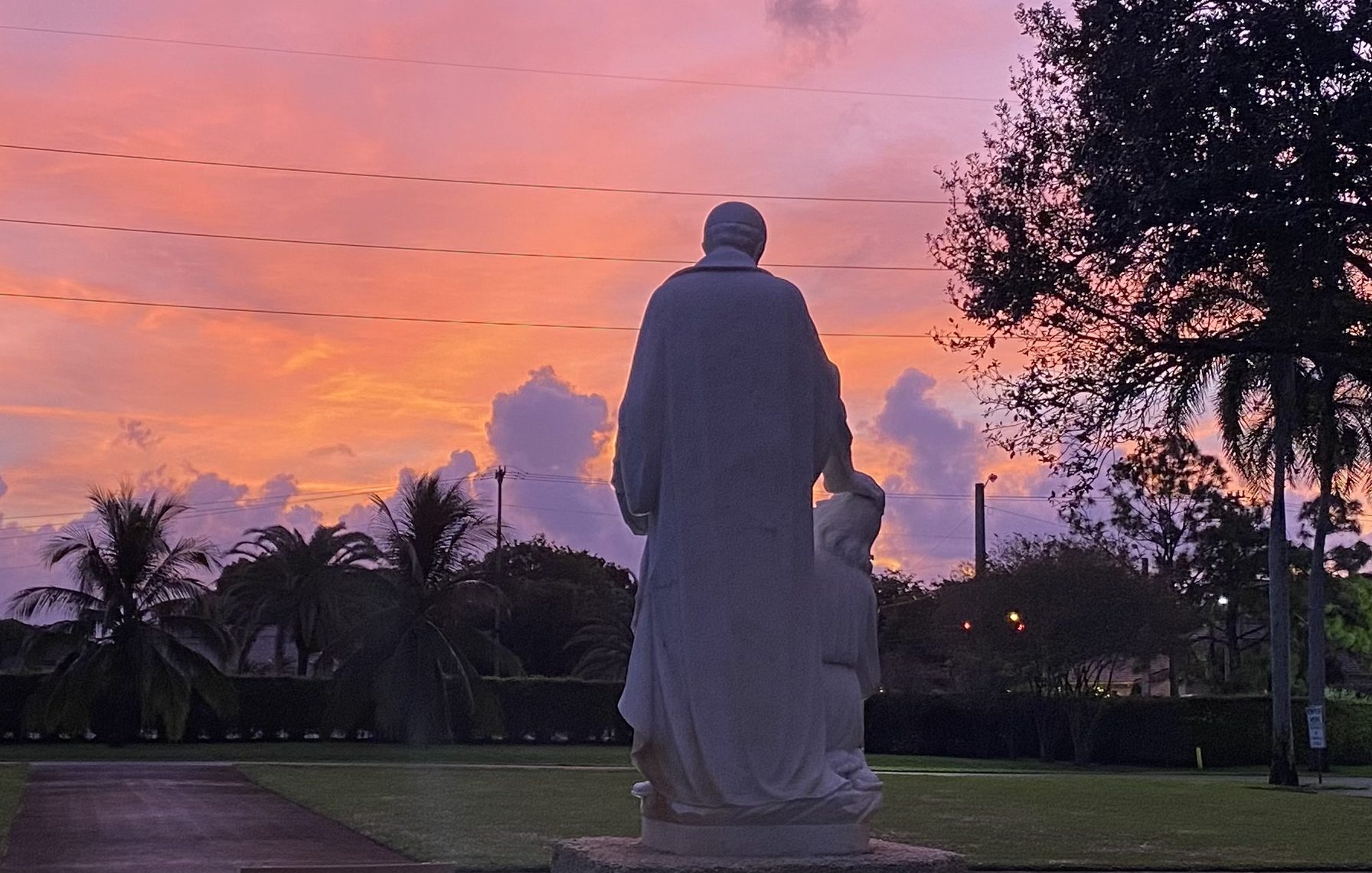
Photo: Feast day of St Vincent de Paul, who allowed Jesus to remove his heart of stone and replace it with a heart of flesh, pray for us. St. Vincent de Paul Regional Seminary, Boynton Beach, FL.
Link for the Mass readings for Friday, September 27, 2024
 Spiritual Stepping Stones