Praying with Jesus and Mary helps us to embrace our suffering and experience God’s healing.

When Jesus saw his mother and the disciple there whom he loved he said to his mother, “Woman, behold, your son.” Then he said to the disciple, “Behold, your mother.” And from that hour the disciple took her into his home (Jn 19:26-27).

During the summer of 1991, I joined the Franciscans of Holy Name Province for my pre-novitiate year and was stationed at the Holy Cross Friary in the Bronx. My ministry for that year was working in the adjoining parish of Holy Cross. Shortly after entering, one of the friars, Br. Paul Goldie, died. He had been serving at the friary since 1953 and had been a friar for 54 years. Myself and my cohort were blessed to have gotten to know him a bit. A practice among the friars was to pass on personal items to those in the community when one of their own passed away.

I was honored to have been given a picture of St. Francis and a rosary of Br. Paul’s. The picture I have carried with me all these years since and hangs in my room in the rectory of another Holy Cross, now in Vero Beach, Florida.

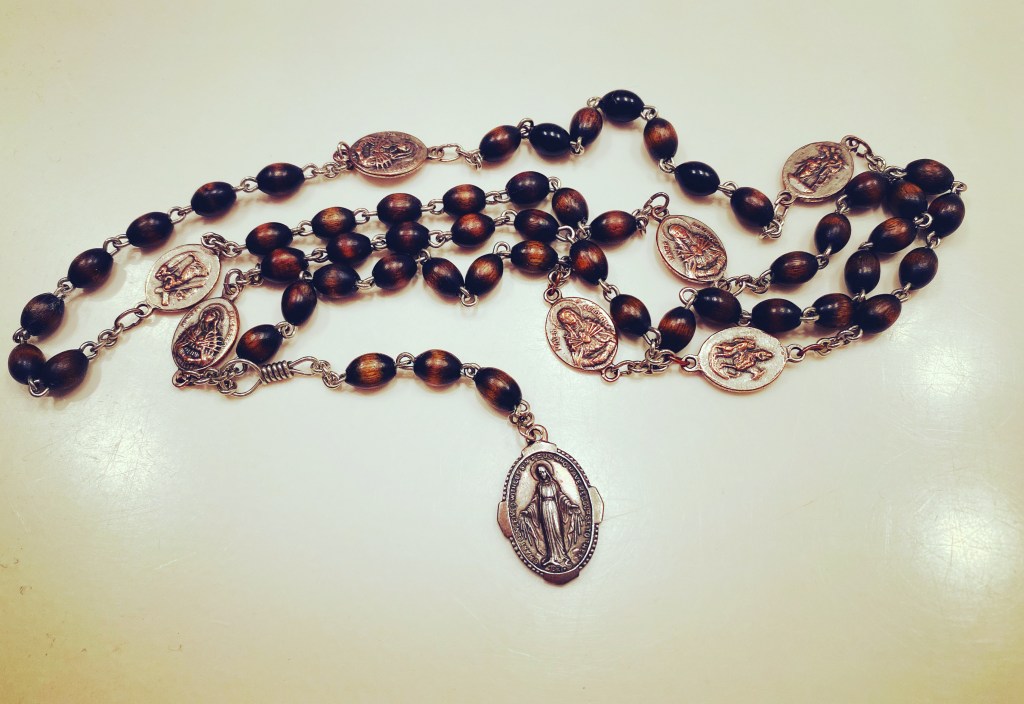
When I first looked at the Rosary, it was clearly worn with use. It was very well made and durable. It was also different from others that I had seen before. I didn’t ask any of the friars, most likely because I already felt self conscious about how little I knew about Catholicism at the time I entered. Instead of a crucifix it had a Miraculous Medal, instead of five beads there were three beads leading to the decades of beads, and instead of five decades of beads, there were seven groupings of seven beads. In between each of the series of seven beads there was a small medal. On one side was a picture of Mary pierced in the heart seven times, and on the back of each medal was a different scene.

I would find out some time later that this was a Rosary of Our Lady of Sorrows. The depictions on the back of the seven medals represented Mary’s seven sorrows: Simeon announces the suffering destiny of Jesus, Mary escapes into Egypt with Jesus and Joseph, Mary seeks Jesus lost in Jerusalem, Mary meets Jesus as He carries his Cross to Calvary, Mary stands near the Cross of her Son Jesus, Mary receives into her arms the body of Jesus taken down from the Cross, and Mary helps place the body of Jesus in the tomb.

The fifth mystery, Mary stands near the Cross of her Son Jesus, is from our Gospel reading today. For Mary to witness her son dying such an agonizing death, it must have been the most sorrowful of the seven. Yet, Mary did not run from the pain, she embraced his and her own pain. The piercing of the lance must have pierced her own heart, into the depths of her own soul. Mary, though free of sin, was not free of the pain of a fallen world. In fact, Mary, like Jesus, felt it more deeply.

When we are willing to love, we risk experiencing and entering into the pain of those we love. So many times we run from love, because we do not want to experience the pain relationships entail. We are finite and fragile beings, and so we will let each other down, we will make mistakes, say the wrong things, do hurtful things, we will get sick or deal with chronic illness and need care, we will lose patience, we will sin, and those we care about will die. Jesus though calls us, like he did with Mary and John present at the Cross, to remain present to one another. We are not to walk away when life gets hard, we are to love, to provide comfort and support, and as we do so, we will experience the fruit of a deeper relationship which is grounded in the unimaginable love that God the Father has for us.

Love is the bond of communion that gives us the strength to move through the crossroads and upheavals of life. Love is the bond of commitment that draws us out from our selfishness, and allowing God to love us in our weakness and anxieties, will help us to grow stronger together, and to be present to one another. Where there is an authentic relationship, there is love at its foundation. When we love one another, we participate in the communion of the Holy Trinity, we participate in the very same divine communion of the Father, and the Son, and the Holy Spirit.

Is there risk of rejection in loving another? Yes. Is there pain in love? Yes. Is there conflict in relationship? Yes. Yet to be fulfilled, to be fully alive, for love to be real, we must be willing to take the risk to love and be rejected, just as God does with us. As we enter relationships or strive for better authenticity in our present relationships, Jesus calls us to love, to commit, be present, to sacrifice and share our pain and experience another’s pain. Jesus strengthens us, when we turn to him, to stand by each other in our imperfections as well as be humble and willing to offer and seek forgiveness and reconciliation.

We cannot come close to imagining what Mary and John experienced with Jesus at the climax of his crucifixion. Each of them embraced horrific pain and sorrow at the foot of the cross, yet they remained, and so they were able to mourn, heal, and experience the full joy of the Resurrection. At the coming of the Holy Spirit at Pentecost, they also experienced the divine communion of love between the Father and the Son and shared that same love and commitment with the community of Jesus’ followers and those who had never met him.

Br. Paul’s Rosary of the Seven Sorrows, is a reminder for me of the brotherhood I shared with the friars for the year and a half that I was with them. It is also a reminder that there will be pain and struggles in this life but that I am not alone. Mourning JoAnn’s death from 2019 and recovering from Covid and double pneumonia in 2021 are realities that I am continuing to heal and learn from. Not running away from those challenges, but like Mary and John, seeking strength and guidance by following Jesus’ guidance.

We can trust Jesus and Mary, as well as John and the apostles, and turn to them when we are faced with challenges and suffering. Praying with the mysteries of the Rosary or the Seven Sorrows can be of great help. When we resist merely reciting but instead slowly praying and pondering the mysteries, we can experience with Jesus and Mary how they were able to face their suffering. They in turn will gently guide us to experience and face our own and provide comfort, healing, and direction through.


Photo: Br. Paul’s Seven Sorrows Rosary.
Link for the Mass readings for Tuesday, September 15, 2026

Jesus offers us the sign of Jonah.

“An evil and unfaithful generation seeks a sign, but no sign will be given it except the sign of Jonah the prophet” (Mt 12:39).

Jonah is the prophet best known as the one who spent three days and nights in the belly of a whale, great fish, or sea monster, depending on your scriptural translation. Jonah ended up in that predicament because he refused to follow God’s direction to speak his message of forgiveness to the sworn enemies of Israel, the Ninevites. It would be like God asking one of us to fly out to the Middle East to meet with members of ISIS or Al-Qaeda and invite them to repent. Not only would we not believe they would want to repent, would we want them to even if they would? Also, whether they did or didn’t, would we be able to return from such a meeting with our heads intact?

These were probably some of the issues running through Jonah’s mind when he refused to follow God’s will. After swimming to shore, Jonah overcame his resistance and followed the command of the Lord, kept his head on his shoulders, and the people of Nineveh repented. Happy, happy, joy, joy! Not exactly. At the repentance of his enemies and God’s expression of mercy and forgiveness, Jonah said to God, “This is why I fled at first to Tarshish. I knew that you were a gracious and merciful God, slow to anger, rich in clemency, loathe to punish” (Jonah 4:2)”. Jonah shows his hardness of heart in that he did not want to go to Nineveh because he did not want his enemies to receive God’s forgiveness!

The scribes and the Pharisees asked Jesus for a sign and the sign of Jonah is what he gives them: The Ninevites, Gentiles, non-Jews, were willing to repent at the word of Jonah, and those scribes and Pharisees questioning Jesus, God’s chosen, were not willing to repent at the urging of one greater than Jonah, the Son of God, who was in their midst.

Jesus announced his ministry, as recorded in Mark 1:15, with the words: “The kingdom of heaven is at hand. Repent and believe in the Gospel.” That is again our invitation today, to examine our conscience by asking God to help us to recognize his presence among us, then reflect on what good God has done in our lives and give him thanks. Review the last day or two to see where God has called us to act. Where did we answer his call, where did we, like Jonah, resist or refuse?

Someone greater than Jonah, is Jesus the Christ. May we allow his love, mercy, and forgiveness to fill us and to soften our hardness of hearts. Jonah spent three days in the belly of the whale and was saved, Jesus spent three days experiencing death and rose again. Once we repent and die to our self-sufficiency and surrender our pride, we will experience the love and mercy of Jesus flow through us to all those we meet in person and online. Even, and especially, those for whom we would rather not: those who get under our skin, grate on our nerves, and/or those who mirror to us our own biases and prejudices.

Suffering is a very concrete and harsh reality. That is something we all agree on whether we believe in God or not. The question is, how do we respond to suffering, especially the hurt caused by another? We can harden our hearts, slip into denial, despair, or wish our problems away, but none of these work very well for the long term. Jonah found that out when he hardened his heart against forgiveness and refused to follow God’s will. Jesus followed the will of God to the cross, forgave those who crucified him, and experienced new life.

Let us not run away from God, his will, or his offer of forgiveness. Forgiveness stops the bleeding from the original wound received. When we forgive, we will not be alone. Jesus waits for us with his arms wide open to embrace us and journey with us each step of the way. Jonah hardened his heart, but still was willing to repent and follow God’s will to preach repentance to his enemies who did just that. When willing to forgive, we open our hearts and minds to God’s love which opens the door for healing, mercy, and reconciliation.

—————————————

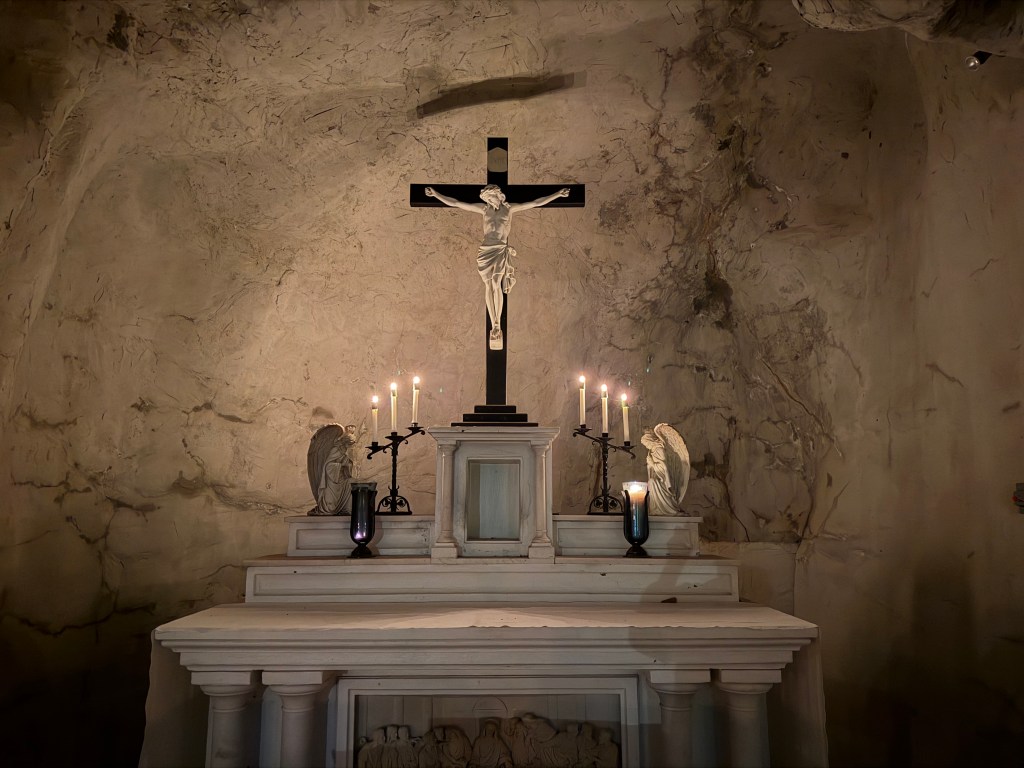
Photo: There is no resurrection without the cross. There is no healing without forgiveness. There is no suffering without God’s consolation.

Link for the Mass readings for Monday, July 20, 2026

“A bright cloud cast a shadow over them…”

Our life can be an experience both of sadness and joy, desolation and consolation, doubt and hope. We can experience an ebb and flow where we suffer from trials and also celebrate triumphs. The key to living a life of faith is to seek God in either experiences. Jesus today provides an opportunity for Peter, James, and John, the inner circle of the Twelve, to experience an expression of his divinity for he was transfigured before them; his face shone like the sun and his clothes became white as light. (Mt 17:2). Jesus revealed his divine nature to his disciples in a powerful display to prepare them for the Passion that he was about to endure. The experience is also a foreshadowing of his Resurrection.

Jesus, in this living word proclaimed or read today, invites us to experience the Transfiguration, the Passion, and the Resurrection in our own lives. We can miss a transfigured moment when we assume a posture of pride, not acknowledging God’s leading by believing we achieved or arrived at our present station in life on our merits alone. We can experience moments of transfiguration when we acknowledge that God breaks into our lives at that moment when we need him most and recognize the assistance he has given us, and/or when he has revealed to us the path and direction we were to take. The natural response is to offer prayers of thanksgiving, recognizing that we don’t go it alone, that God and those he sends to help us are a tremendous support.

Jesus is also present in our desolations. Many of us run from our suffering, we are afraid of the Cross. But it is through the Cross that we come to experience the Resurrection. We may not be aware, but when we run away from our suffering, we are running away from Jesus who awaits us with arms wide open to embrace us; to comfort us, heal us, and transform us. To experience the embrace of Jesus, we need to be willing to face our suffering.

Jesus cares from the deep place of understanding in experiencing his own tremendous suffering. He in the Garden of Gethsemane sought another way than the Cross, he asked for the cup of his death to be taken away, but he chose his Father and his will. He obeyed and set his face firm and accepted the upcoming suffering and death. In doing so, he then was also to experience his Resurrection and Ascension. Jesus now in his glorified body can be there for all of us, to lead us through our sorrows and trials.

The older I get, the crucifix becomes more of a consolation. This icon of Jesus, his body broken, emptied out for us on the cross, represents how he entered the full range of our human condition. He assumed our sin, our anxiety, fear, and selfishness, and transformed the worst of our fallen nature through his love such that we are offered the opportunity to be forgiven and redeemed. The crucifix is not a sign of despair, but of hope and transfiguration, for it reminds us that no matter what we go through, what trial that we may be in the midst of at this very moment, Jesus understands and is present with us.

Looking and meditating upon Jesus on the Cross has provided me moments of transfiguration, granting me the courage that I did not have to face various conflicts, challenges, and trials, which has only increased in my first year and half as a priest. And in facing each challenge for myself as well as those I pray for, Jesus has been by my side. As he looks down from the cross he loves us despite our sins, our weaknesses, and failures and is willing to lead and accompany us through the ups and downs of life, so that we too may be renewed and transformed.

The transfiguration was for Peter, James, and John a preparation for the glory of Jesus’ crucifixion. Their experience strengthened them as they witnessed the horror of their teacher and friend’s death and the struggles they would face in their the ministry. May we spend some time mediating and praying with the words of today’s gospel, experience again the glory that Peter, James, and John did, and savor that gift. May we breathe in deep the radiant light of the Father shining through the clouds and experience the love of the Trinity so that we too may face with Jesus, what rises before us. All is grace, as long as we bring all we experience to Jesus, and follow his guidance.

________________________________________

Photo: “This is my beloved Son, with whom I am well pleased; listen to him.”

Link for the Mass readings for Sunday, March 1, 2026


As we allow Jesus to heal us of our pain, we can love and help others.

Jesus asked his disciples about who people said that he was and Peter, through the revelation of God answered, “the Christ of God” (Lk 9:20). Jesus then responded that “The Son of Man must suffer greatly and be rejected by the elders, the chief priests, and the scribes, and be killed and on the third day be raised” (Lk 9:22).

If you might be thinking that these verses sound familiar, it is because we heard proclaimed or read the parallel account found in Mark 8:27-35 two Sundays ago on September 15. This point never gets old. As we grow in our relationship with Jesus, we come to a deeper understanding of Peter’s words.

Jesus is indeed the Christ, the Messiah, the Son of the Living God. Yet, that meant many things to many people who were awaiting the coming of the Messiah. For most, they were hoping for a military leader to come to lead them and overthrow their Roman occupiers. As soon as Peter made his statement, Jesus clarified what kind of Messiah that he would be, a suffering servant.

As our first reading from Ecclesiastes offered, “there is an appointed time for everything” (Ecclesiastes 3:1). Even a time for suffering. Peter had trouble with understanding this and he represents us as well. One of the points of faith many of us struggle with is the same as Peter, why did Jesus have to suffer?

Jesus was willing to be sent by his Father to become human and to experience all of humanity, even the suffering of our humanity, because only that which Jesus assumed could he redeem. Also, in Jesus experiencing our suffering, even unto death, we can know without hesitation or doubt that Jesus understands our struggles and anguish. And that means we are never alone in our suffering.

The reality is that the Messiah, the Christ, the Anointed One, is Jesus. He is the suffering servant, the One willing to give his life on the Cross for all of humanity and creation. Jesus did not do this in some abstract way. He died for each and every human being that has lived, is now living, now reading these words, or ever will live. He died for you because he loves you.

To be a disciple of Jesus, we are invited to love in return. This means being willing to suffer and sacrifice for one another. Our discipleship will be ultimately expressed in love, in our willing the good of each other. We must be willing to let our hearts be moved with compassion and as St. Mother Teresa taught by, “Giving until it hurts.”

To give until it hurts means that we are willing to allow our hearts to be open to love. For our hearts to be open to the pain of another means that we must be willing to be healed. We are invited to allow the Divine Physician to remove our hearts of stone and replace them with hearts of flesh. This divine surgery happens at the Cross when we are willing to bring our suffering to Jesus whose arms are wide open and ready to embrace us.

The Suffering Servant understands our pain, experiences our pain, and can help us to experience instead of run from our pain. There is no way to cover up, go around, sidestep, and/or deny, our suffering. We must face it and experience it head on. But we don’t have to do so alone, nor can we. For what Jesus has assumed he can and will redeem. When we are ready and at the pace, we are willing to go, Jesus will heal us. For “there is an appointed time for everything.” Including our healing.

———————

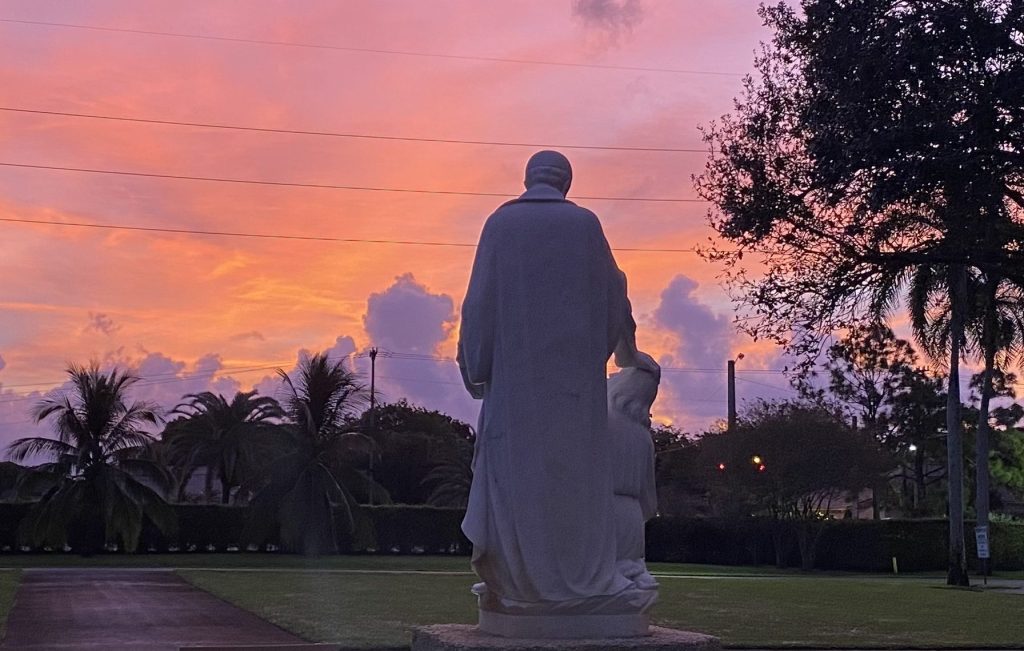
Photo: Feast day of St Vincent de Paul, who allowed Jesus to remove his heart of stone and replace it with a heart of flesh, pray for us. St. Vincent de Paul Regional Seminary, Boynton Beach, FL.

Link for the Mass readings for Friday, September 27, 2024

“Who do you say that I am?”

Jesus asked, “Who do people say that the Son of Man is” (Mt. 16:13)?

Peter answers Jesus by saying that Jesus is: “The Messiah, the Son of the Living God” (Mt: 16:16).

What does Peter’s response have to do with our lives? Does he really care about our everyday challenges, struggles, and tensions? Yes, he does because Jesus is the Christ the Son of the living God. Jesus is Emmanuel, God with us. Jesus is one with us. The infinite reality of God is present within each human being that exists because Jesus became one with us in our humanity so that we can be one with him in his divinity.

We have been created in God’s image and likeness and this is true from the moment of our conception through each stage of life until natural death. The unfortunate effects of Orignal sin are that our image has been distorted and our likeness to God has been lost. We have not been totally corrupted but we have been wounded and we need to be healed and restored.

Jesus experiences our suffering personally. Whatever we may be going through, whether it be a temporary or chronic illness, loss of job, conflict and tensions with family, friends, colleagues, and/or classmates, as well as experiencing feelings anxiety, confusion, and/or lack of direction, mourning and grieving over the death of those we hold close to our hearts: Jesus feels our pain and suffering.

The suffering of humanity is not something abstract for Jesus because Jesus knows each and every one of us intimately and uniquely. He knows us better than we know ourselves and is the one who cares about us and what we are experiencing. Also, he is no stranger to suffering.

Jesus not only cares, he loves us and will walk with us no matter what we may be facing right now. Jesus is inviting us this morning and this Lent to trust in him, to allow his light to shine in those places of darkness, those places where anxiety and fear have a hold, and those places where we need to let go because we give them more priority in our lives than we do God.

A good question to ponder and meditate on this morning is: Who is Jesus for us and are we willing to invite him into our situations and allow God to happen in our lives?

—————————————————————————–

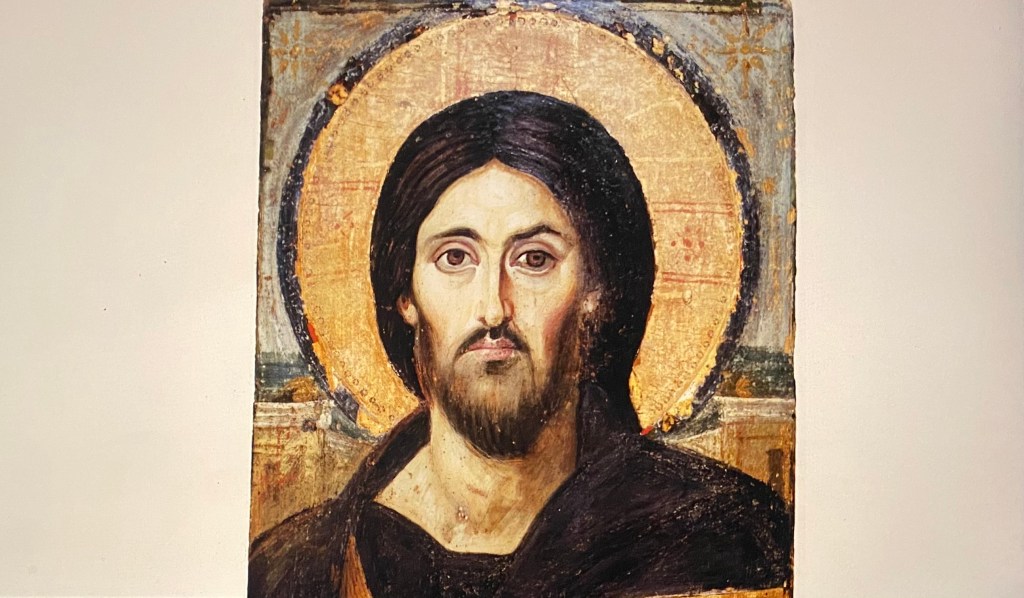
Photo: Closeup of a 6th century icon of Jesus from St Catherine’s Monastery.

Link for Mass readings for Monday, February 22, 2024