Jesus is recorded, a few verses before (cf. 7:37-39) today’s Gospel, speaking about quenching the thirst of those gathered around to listen to him. The thirst he is talking about fulfilling is spiritual thirst, that thirst which we all desire to be refreshed by, that which we have been created to receive; the thirst to belong, to be in communion, to be loved and to love in return. A thirst that is satiated in experience the truth that we are never alone as long as we remember that God is our Father. God cares for and is present to us in all our needs.
Jesus speaks of coming to those who thirst to be refreshed with: “Rivers of living water [that] will flow from within” (Jn 7:38). Jesus spoke of the day when he would send the Holy Spirit to well up from within the soul of each person who would follow him. All who participate in the life of Jesus would come to experience also the love shared between God the Father and God the Son, who is God the Holy Spirit.
Some who heard Jesus speaking in this way were deeply moved, they believed him to be the Prophet, others believed him to be the Messiah. Yet, there were those who could not see past their own preconceived notions. They heard his teaching, may have even been moved as well but said, “The Messiah will not come from Galilee, will he” (Jn 7:41)? Remember Nathaniel’s first reaction when Philip had told him that they had found the Messiah? Nathaniel asked if anything good could come out of Nazareth (cf. Jn 43-47). Jesus was also rejected by many in his hometown of Nazareth! He was just a simple tekton, a carpenter or a day laborer.
Why the region of Galilee, the town of Nazareth itself, would be disparaged is a matter of speculation. Those Pharisees that were not believing in Jesus, sought a scriptural basis that the Messiah would not come from Galilee but from Bethlehem, the house and line of David. They would state that, “No prophet arises from Galilee” (John 7:52). Although, Jonah is mentioned in 2 Kings 14:25 coming from Gath-he’pher, which is in the lower region of Galilee.
The fact was that there were those, unlike Nathaniel, that could not see past their initial prejudices. Even though Jesus spoke and taught with authority, even though the Temple guards who were sent to arrest him said, “Never before has anyone spoken like this man” (Jn 7:46), and even when Nicodemus spoke out rationally, requesting they hear Jesus out in accordance with the Law, (Deut 19:15-19), allow for an investigation, and give him the opportunity to make his case, they could or would not hear Jesus. They closed themselves off to the invitation to receive the gift of the love of God that Jesus offered. Their charge was that he was not from Bethlehem, he was not of the line of David, case closed.
Our ingrained, prejudicial attitudes and our limitations of thought can prevent us from seeing as God sees. If we are not willing to follow Jesus’ invitation to repent, we run the risk of cutting ourselves off from the living water Jesus provides and so become like a stagnant pool. Many of our daily routines, habits, livelihoods, health, and very lives can be shaken in an instant with unexpected news. A catastrophic medical diagnosis, layoff, weather event, the consequences of a sinful choice can come crashing down. We can react out of fear and feel debilitated on one hand or with the other we can brashly deny the reality of the situation. Aristotle wrote that virtue is the means between two extremes. Courage is the means between being paralyzed with fear and excessive reckless abandon.
We can face head on what arises, feel what emotions come, offer them to and place our trust in the Jesus. I have had a few experiences with unexpected news. I have done much better when I have leaned on Jesus and trusted in him. In doing so, I have not only survived the external storms and internal storms of anxiety, I have gone through them feeling his presence. In relying on Jesus and less on my own strength, I experienced his peace and grew from the challenges. In times of trial, we can also be tempted by the question: Does Jesus care, why would he do this to me, or does he even exist?
The words of Pope Francis in his Ubi et Orbi message at the height of Covid are still helpful. He said that Jesus, “more than anyone, cares about us.” Jesus cares. His hand is held out before us. We can reject it or receive it, the choice is ours. Jesus is the source of living water, he is the eye in the midst of any storm, he is the light leading us through the darkness. When we choose to breathe more and react less, we will be more likely to recognize and accept the offer of Jesus’ hand as Peter did when he was sinking in the storm at sea. By taking his hand and allowing him to lead us, we will act with more prudence, be more present and mindful, and better prepared to face any challenge.
———————————————————————————-
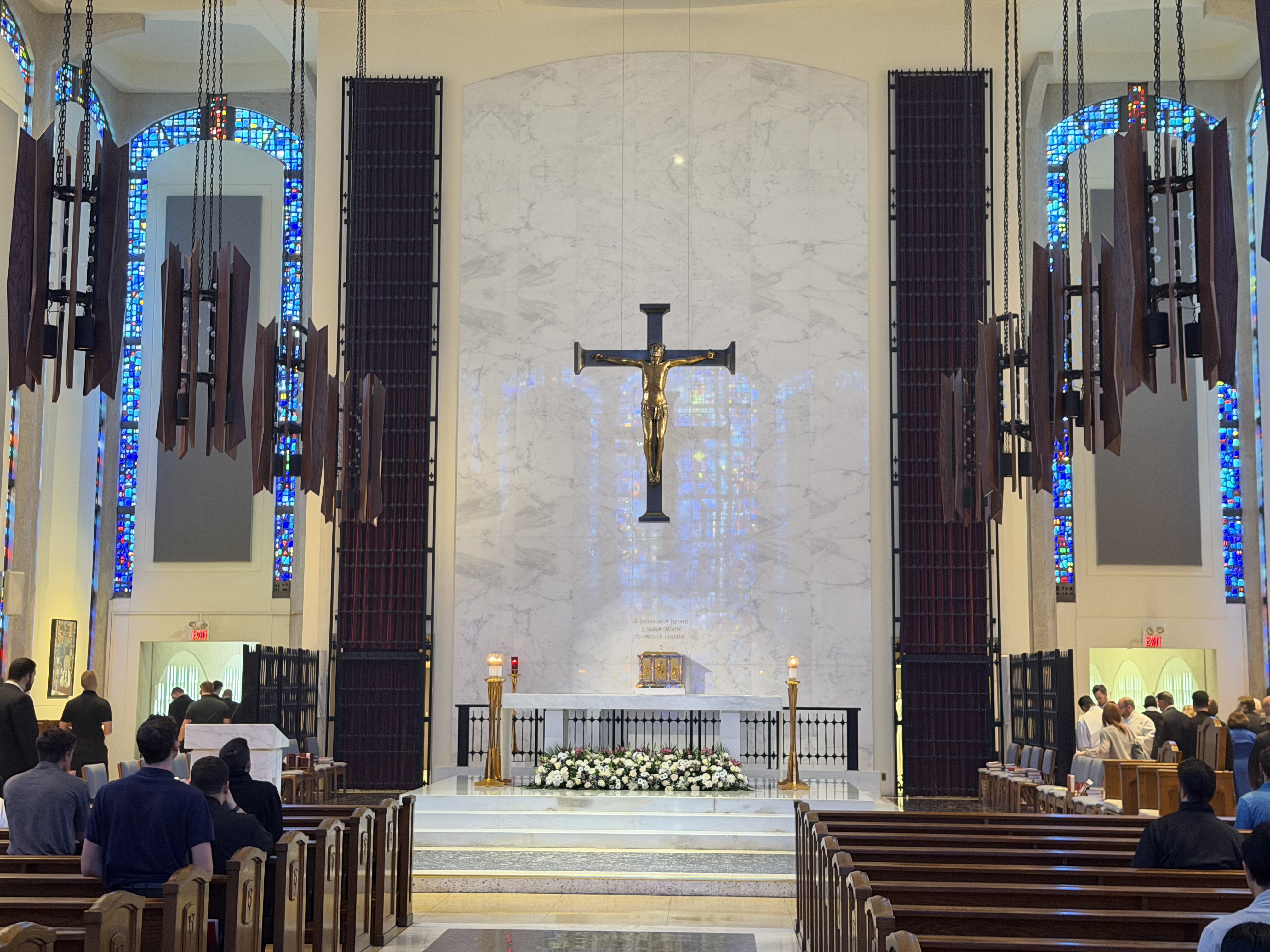
Photo: Blessed to be back at SVDP Regional Seminary Chapel where I was blessed to spend many holy hours and Masses getting to know Jesus and learning to be and serve as his priest.
 Spiritual Stepping Stones