Praying today

Praying today for those who lost their lives on September 11, 2001. Praying for those first responders who gave their lives seeking to save others as well as those who lived and are suffering from the physical, emotional, and psychological effects of that day. Praying today for those still grieving and mourning the loss of those they love.

Praying for the people of our country and our leaders at the local, state, and federal levels. Praying that we see each other as human, as fellow citizens that can embrace our differences and diversity, praying that we can work together to welcome the stranger, provide for the various needs of each other in every area of our nation, urban and rural, and seek for ways to empower and lift each other up. Praying that each person is willing to play their part no matter how small so that we can be one nation under God united in a common purpose that respects the dignity of everyone from the moment of conception throughout every step of life until natural death. Praying that each of us may learn to be better, learn to forgive, learn to heal, and learn to breathe, rest, receive, and abide in God’s love and from that space think, speak, and act.

Praying.


Photo: Veteran’s Memorial Island Sanctuary where I will often walk and pray.

Material happiness is fleeting but the joy fueled by Jesus is eternal.

Blessed are you when people hate you, and when they exclude and insult you, and denounce your name as evil on account of the Son of Man” (Lk 6:22).

The Beatitudes are contrary to much of what too many of us are tempted by when seek our satisfaction, security, and fulfillment in what St. Thomas Aquinas calls the substitutes that we put in place of God: power, fame, wealth, and pleasure. What is more, we may resist Jesus’ teachings because we do not agree, there are behaviors we may not be willing to let go of, we don’t understand them, or we find them too hard.

In today’s Gospel account from Luke, Jesus taught his disciples how to attain the kingdom through five blessings and four woes. Jesus’ message is a universal message, an invitation to and for all who have ears to hear and a heart open to receive. These teachings though challenge us to place our trust, not in the things of this world but in Jesus. That which is finite and material are fleeting and passing and cannot fulfill us. We will always be wanting more and we are never satisfied. In placing our trust in Jesus, he will lead us to his Father, and it is in building that relationship that we will experience true happiness and fulfillment for the deepest core of our being is made to be in communion with God and only he can fulfill our deepest need.

This is an inviting offer, yet when putting Jesus’ teachings into practice in our everyday lives we will receive opposition from those in our lives and from ourselves from within. Another word for blessed is happy. Can we really be happy if we are as Jesus said, poor, hungry, weeping, and when people insult and hate us? Yes. When we seek to live out these beatitudes with the help of Jesus, we will find that we are indeed happier when we are not attached to material goods, when we are more moderate in our consumption, and when we are not attached to outcomes as we want them fulfilled and when we are not seeking immediate gratification. We will experience much more joy and freedom if we are not gauging our every thought, word, and action based on what others think and instead be free to live our lives by following God’s will.

To be blessed, happy, and fulfilled in this life can be fleeting, like trying to catch the wind, if we seek to do so by acquiring more material things and having things our way as we want it, when we want it, on our terms alone. We will experience true happiness and deeper joy when we are willing to let go of our attachments to the things of this world and instead, place building a relationship with Jesus as our primary practice.

If we are serious about being his disciples, then a good place to start is learning and living the beatitudes. This is no easy task but as we come to better understand what they require, we are willing to let go and allow the Holy Spirit to heal and work through us, “we will rejoice and leap for joy” (Lk 6:23)! Joy because we can experience the good things that God wants to give us.

When we can see the difference between God’s gift of grace, the very gift of his life he wants to impart in us, and the apparent glittering of goods and false truths we have been seeking to provide for our security and foundation, we will be less apt to be ensnared by them. Slowly and surely, step by step, making time each day for prayer, reading and meditating upon what we learn in scripture, struggling with them, yet trusting in Jesus and putting them into practice, we will experience the love of Jesus, the eternal source of our joy, and we will drink from the well that never runs dry!

————————————————-

Photo: Fireworks this past July 4. They have passed, but the joy in serving at Holy Cross continues to grow!

Link for the Mass readings for Wednesday, September 11, 2024

As we pray consistently with Jesus, our lives will change.

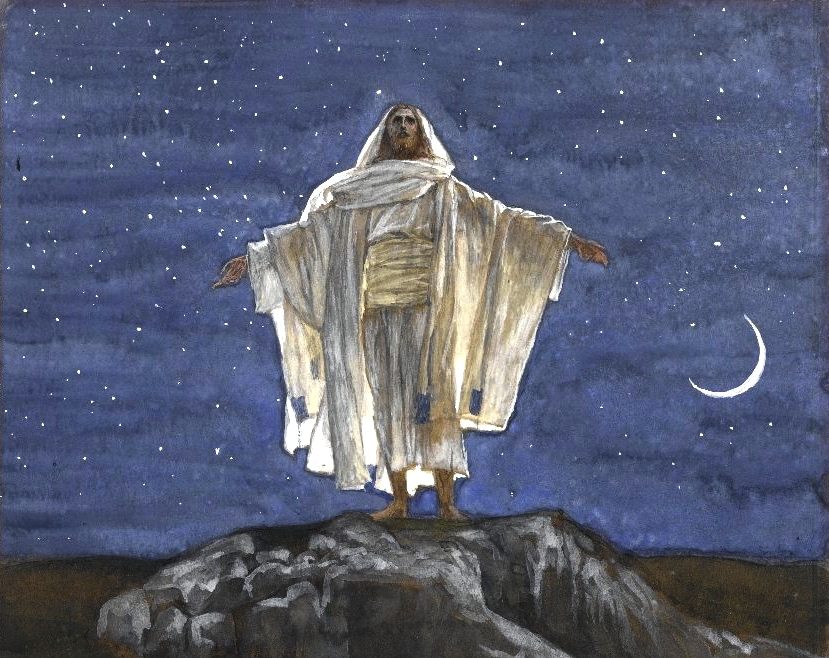
Jesus departed to the mountain to pray, and he spent the night in prayer to God (Lk 6:12).

In the midst of a busy ministry, Jesus spent time alone with God in prayer. In Luke’s Gospel, Jesus often did so before making important decisions, as in today’s reading that recorded the choosing of his Apostles. Prayer is an important, foundational principle to experiencing and knowing God as well as discerning his will for living a fully human life.

The Mystery of God is not a problem to be solved. In our language today, we often use mystery and problem interchangeably, as, “I lost my keys, it is such a mystery.” Strictly speaking, the loss of keys is a problem that can be solved. We can backtrack our steps, and through a process of elimination, the problem becomes smaller until we solve the whereabouts of the missing keys.

We cannot solve or prove God exists as if he is a problem to be solved. This is because God is not a being, not even the supreme being. God is a mystery that transcends any finite dimension of reality. We have nothing to measure him by, we cannot prove his existence, nor can we solve him as we would a problem.

Yet we can come to know God intimately just as Jesus did. Even though God is transcendent, beyond our reach and comprehension, he is at the same time closer to us than we are to ourselves. We come to know God through his invitation, and as we enter into the mystery of his reality through developing a relationship with him, as we come to know him. He does not become smaller, but vast, always beyond our comprehension and reach. His mystery is luminous as if we were in a completely dark room and someone turned on and shined a flashlight into our eyes. We wince from its brightness, yet in time, our eyes adjust and we eventually are able to see what was beyond our ability apart from the light. Jesus wants us to experience and embrace the mystery of the radiance and warmth of his Father’s light and love.

Jesus called each apostle by name. He calls us by name too. When we accept the call to be a follower of Jesus, when we are baptized, receive our first Holy Communion, and are confirmed, when we participate in the Mass at least weekly and Confession regularly, when we pray, read the Bible, and serve others, our lives will no longer be the same.

We will begin to experience the life of Jesus within us. We will begin to see also what is incompatible. What thoughts and behaviors we may have allowed for ourselves in the past, in the light of Christ, we now see for ourselves that which is no longer acceptable because it separates us from the love of God. We come to see our lives apart from God and with God. We are given the freedom to choose death or life.

Jesus meets us in the chaos of our lives and invites us to something better, a life that is real. Jesus loves us in this moment and does not lower the bar but empowers us to reach the height of his truth and divine law. Jesus is there for us and we remain close to him when we are consistent in prayer, in reading and meditating upon and putting into practice his word. Breathe upon breathe, day after day, we will be drawn ever deeper into the mystery of the Trinity and experience the intimacy of communion and relationship with God that we have been created for.

————————————

Painting: James Tissot – Jesus Goes Up Alone on a Mountain to Pray, 1886-1894

Link for the Mass readings for Tuesday, September 10, 2024

We don’t have to go to the ends of the earth to help. We can start right where we are.

The scribes and the Pharisees watched him closely to see if he would cure on the sabbath so that they might discover a reason to accuse him (Lk 6:7).

This is an unfortunate and sad scene in the Gospel. What is even worse is that this is not an isolated incident for some of the scribes and Pharisees. They are often watching him closely not so that they may learn and come to know how to live their lives better, but to accuse him. Accuse Jesus of what? Of not honoring the sabbath and breaking the law of God. There is quiet anticipation as Jesus calls a man with a withered hand up to him.

Jesus knows the hearts and minds of his would-be accusers, he also knows what is at stake regarding what he is about to do but because he is more concerned with the condition of the man and not his standing in the community. Jesus seeks to express the will of God and not impress those in his midst he asks aloud: “I ask you, is it lawful to do good on the sabbath rather than to do evil, to save life rather than to destroy it” (Lk 6:9)? Jesus did not wait for an answer but told the man to stretch out his hand. The man did so and was healed.

These two phrases coming from Jesus in today’s Gospel are not only good to commit to memory and meditation but to also put into practice, for they are foundational principles regarding how we ought to interact with one another. First, whenever we wonder whether we ought to help someone, we need to ask ourselves, “Is it lawful to do good or evil, to save life or destroy it?” If more of us ask this question, we might be more ready, willing, and available to help those in need. Would that our law makers ask this question as they are enacting laws.

Second, “Stretch out your hand”, is another phrase we can take to heart. Maybe we will not heal a man’s withered hand, but we can provide a smile, a cup of water, food, some money, our presence, volunteer in our places of worship and/or with groups who are already engaged in causes that we believe in. We can write to and impress upon our congressional leaders the importance of supporting the dignity of the people they represent, at every stage of development from conception until natural death.

We can learn a lot from St. Peter Claver, who left his home country of Spain to settle in Cartagena, one of the chief centers for the slave trade in the sixteen hundreds. He arrived with the sole purpose of taking care of the slaves from the moment they arrived in the port city under horrific conditions. He would immediately board and minister to those who survived the trip. Then as the West Africans were herded into nearby yards, he would walk among them and provide them with food, medicine, and the most calming salve of all, he assured and reminded them of their human dignity and God’s love for them.

We may not heal as Jesus did. We may not be called to leave our country to serve as St. Peter did. But we can do as St. Mother Teresa recommended for those people who appeared at the Mother House door in Calcutta. She encouraged them to go back home and begin with those closest to them. We can begin with our family and friends, in our work places and our schools, our places of worship and our communities. When we are willing to be still, to breathe, rest, and receive the love of God and abide there, we will then be moved to share the love we have received in the unique way that God sends us.

We may not be able to cure a withered hand, but we can certainly reach out a helping hand.

———–

Photo credit: Rosary walk, Merrill P. Barber Bridge, Vero Beach.

Link for the Mass readings for Monday, September 9, 2024

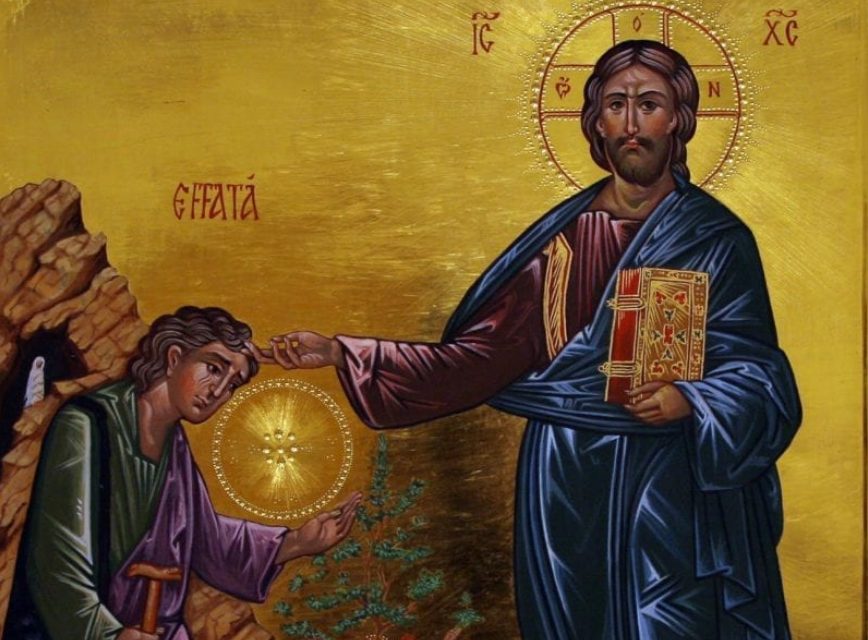
“Ephphatha!”

With that Aramaic word preserved by Mark (Mk 7:34) who most likely received it from Peter, we are invited to experience an incredible miracle in which a man without the ability to hear at all or speak was able in that instant to do both clearly. Jesus has again shown the importance of the individual person. He could have healed with a word among the crowd and moved on. Instead, he takes the man off to the side.

When Jesus healed, he did so for a specific purpose. First and foremost, to address the deepest need of the person specifically and individually. But there is also a deeper reality he wants to reveal, a deeper spiritual truth to convey, as well as to show that he truly is God by doing only those things that are possible for God alone.

Hopefully, we can see the direct fulfillment of Isaiah’s prophecy in Jesus’ healing of this man whose ears are now “cleared” and that“the tongue of the mute will sing.” Throughout the Gospel accounts, Jesus has been healing the blind and the lame as well. Yet this miracle is even more extraordinary in that this man is instantly able to speak. For those who have experienced infants grow, they wait for just under or over a year for those first words to be spoken. If you have ever attempted to learn a new language, it definitely does not happen in a moment or a month!

That this man can hear and speak in an instant is amazing and wondrous! The graphic nature in the way that this is done is also curious. Jesus is not seeking to gross out his onlookers. He is doing something very specific. In sticking his fingers in the man’s ears, looking up to God, and spitting on his fingers and touching the man’s tongue, Jesus is imparting upon him his divine life. He is also enacting what God did in creating Adam from the dust of the earth and breathing life into him.

Jesus is showing again the intimacy of our being created in the image and likeness of God out of an outpouring of his love for us. God is willing to come so close in creating man from the dust of the earth, as a potter forms a bowl from clay, with this important distinction. Unlike the potter, God breathes his very life into Adam’s being. At the appointed time, he sent his Son to do the same. In this act of healing, Jesus is also showing his divinity. For there were miraculous healers at the time and still are today, but nothing like this.

Jesus then requested that the man and the others do not say anything about this miracle because he knows that the sensationalization of the event is what will be given priority. The miracle certainly wakes up those who have been blind, but Jesus wants to lead them deeper into spiritual reality, deeper than the physical signs of healing. As he would tell Philip later, “Philip if you have seen me, you have seen the Father” (cf. Jn 14:8). The visible act of this miracle as with all of Jesus’ miracles are signs pointing to the invisible. It is the physical sign that is pointing the spiritual reality.

This is what we believe as Catholics is happening with the sacraments, which are physical signs revealing spiritual realities. Jesus did not come to heal everyone physically. He did come to heal all from spiritual blindness and deafness so that we can see each other with God’s eyes, as St. James points out. We are not to see each other with our prejudice and partiality but to instead see each other as brothers and sisters in Christ.

Just as Jesus took this man “away from the crowd” he invites us to do the same at each Mass.  We are to step away from our everyday to enter the sacred space of church to receive a word of life he has prepared to give us.  May we be willing to listen and to hear that individual word or phrase that God is waiting to share with us for our particular situation in life. A unique gift presented to convict or comfort, to console or encourage.

May we be willing to see with the eyes of faith the Body and Blood of Christ substantially present for each and every one of us in the acceptable presence of the simplest of elements, bread and wine. In the words we hear, “The Body of Christ”, may we hear and know this is Jesus made present again for us individually that we may be healed and have life.

This is not only true in the Eucharist but in Baptism as well. The one baptized appears to be the same before and after, but in baptism we have spiritually died with Christ and are born again and are now a unique part of his new creation, made new and now a part of the Body of Christ. The miracle of the Sacrament of Reconciliation is even more profound than a dead person being brought to life because in Reconciliation we experience a spiritual resurrection. We are cleansed of that sin which separates us from our union with God, and we are not only purified but empowered by God’s grace. A person brought back to life physically but not spiritually could actually be in a worse situation. Just read Stephen King’s, Pet Cemetery, if you would like a taste.

This physical pointing to the invisible is true for all of Jesus’ miracles as well as each of the sacraments he instituted. Jesus is revealing a deeper spiritual wisdom and reality that goes beyond mere physical hearing and sight. If we are leaving Mass each week remembering not one word or phrase from any of the prayers, readings, the music, or the homily; if we aren’t even sure if we really received the Body and Blood of Jesus in the Eucharist, we are like this man in need of healing.

The good news is that Jesus came not for the righteous and the perfect, he came to heal those in need. If we are humble enough to acknowledge we need his healing touch, are willing to be led by Jesus, and to be still and silent long enough for him to say to us, “Ephphatha! – be opened!”, we too can be healed, we too can hear with spiritual ears God’s word proclaimed, see with spiritual eyes the Eucharist we consume as his Body and Blood, and experience the grace of God’s forgiveness received in the words of absolution that we have heard.

Having received the healing touch and experienced the closeness of Jesus, may we see each other not through the darkened lenses of partiality and prejudice, but through the new lenses of God’s love. May we open our ears and really listen to God when he shares, “I love you, you are my beloved daughter, or, you are my beloved son.” And really sit with and ponder that truth.

By doing so, we may be more willing to pray for one another’s healing, as well as be willing like Jesus to come close, to sit with, listen and hear one another when we disagree, in our pain, and in our struggles. And then, just maybe, like the man with a speech impediment, we too can begin to speak. We can speak the good that people need to hear: “I am sorry.” “Please forgive me.” “I need help.” “What do you need. How can I help?” “I understand.” “I hear you.” “I forgive you.” “I love you.”


Photo: Icon of Jesus healing the deaf and mute man, public domain.

Link for the Mass readings for Sunday, September 8, 2024

Is the lord of the sabbath, the Lord of our lives?

Then he said to them, “The Son of Man is lord of the sabbath” (Lk 6:5).

As the disciples were traveling with Jesus, they gathered food where they could. In today’s Gospel, they picked heads of grain and rubbed them in their hands to make them easier to chew. The critique of those Pharisees, presumably, walking along with or close by to Jesus, was that his disciples were breaking the sabbath law by working and thus not keeping it holy.

The reason for this was that pious Jews would often practice what is called, building a hedge around the Torah, meaning that they would institute practices beyond the original law so that there would be no way of breaking it.

There is a prescription in Exodus 23:19, that states that you should not cook a kid (baby goat) in its mother’s milk. So as not to even come close to breaking this law, observant Jews developed the practice, which continues today, to not cook any meat and dairy together; thus, the idea of building a hedge around the Torah.

The hedge in today’s reading had to do with what did and did not constitute work to keep the sabbath rest intact and keep the Sabbath holy. For the Pharisees, the disciples “picking heads of grain” was considered reaping and there “rubbing them in their hands and eating them”, was considered to be winnowing. Each of these activities were considered work and so not allowed on the Sabbath. Jesus settled the matter by claiming that he was the Lord of the Sabbath, greater even than King David, who entered the house of God and with his companions ate the showbread that was reserved only for the priests.

The Lord of the Sabbath needs to be the Lord of our lives. We live in a fallen world, and even at its best, we live in a finite and fragile world. We as human beings can only do so much on our own. Jesus will help us to resist complicating and to instead discern clearly God’s will and direction. In this way of trust, we will have access to the spiritual resources that he offers to us in our everyday affairs, especially when tragedy strikes.

Jesus needs to be the Lord of our lives, in and out of season, during our trials as well as our joys and celebrations. As we lean on him and each other all things are possible and what may seem incomprehensible or hopeless in the moment, God will bring about a greater good through his will and timing. Today is a new beginning, a new hope, let us trust in Jesus and follow him to experience together what lies before us.

 —————————–

Photo: Spending some time of stillness praying the Rosary and meditating on the life of the Lord of the Sabbath. Merril P. Barber Bridge, Vero Beach, FL.

Link for the Mass readings for Saturday, September 7, 2024

The old may be good, but the wine Jesus offers is so much better.

And no one who has been drinking old wine desires new, for he says, ‘The old is good'” (Lk 5:39).

Many of us can relate to holding on to the old. It is more comfortable, it is proven to be tried and true. A favorite wine, a pair of broken-in jeans or shoes, a favorite book read time and again, these are all part of the simple pleasures of life. In Jesus’ parable, he is challenging us to go deeper though. He is inviting us to recognize those things that we are holding onto that may be preventing us from growing in our relationship with him. He is also challenging us to discern the difference between apparent goods and the real good.

We have created patterns in our lives that may appear and feel safe, but in actuality may be holding us back from a deeper and fuller experience in life. They may also be compensating for unhealthy behaviors or vices, or defense mechanisms that may have initially been necessary in overcoming a stressful or traumatic situation, yet we are in a place where we can let go and heal now.

We may be influenced by cultural or social tremors that may dictate to us that we are too old, that we are too young, that to do this or that is too much of a risk… Each of these examples can be challenging on the material plane of existence, yet while Jesus seeks the best for us in our everyday activities, at the same time, he is calling us to go even deeper spiritually.

God the Father is infinite and inexhaustible. Though the Gospel remains the same, there are always new ways, new means to hear the message, to go deeper, so to better be able to practice and share what we have learned. Each generation has to claim the deposit of faith passed on for generations as its own. Our faith is not some inanimate artifact passed on but an organic relationship that matures and deepens age after age.

About two and a half years after JoAnn had died, I decided to explore what my life going forward without her was going to look like. She had recommended putting everything on the table and so I did. I whittled eight viable options down to two. I remember the talk with God like it was yesterday.

Standing in our bedroom, I was discerning between taking a year or more off, collapsing, and then maybe doing some reading, writing, and just living simply and quietly. I just wanted to rest and regroup. The other option, pursue the priesthood. I asked God what he wanted me to do. Priesthood. My body sank but my soul soared. After two years of drinking the new wine of being a seminarian, no easy journey, I am just getting up and running as I begin my fifth month as a priest. Thankful that I accepted that first sip of new wine!

What is the old wine that you are holding onto because you are not willing to take a risk at sipping from the new bottle that Jesus is holding out for you? Accepting his invitation is not so much like taking our hand off the wheel or the handlebars, but it is allowing Jesus to work in and through us. A life surrendered to Jesus, lived in collaboration with him, is ever new, and to be engaged in a new way that we haven’t experienced before!

————–

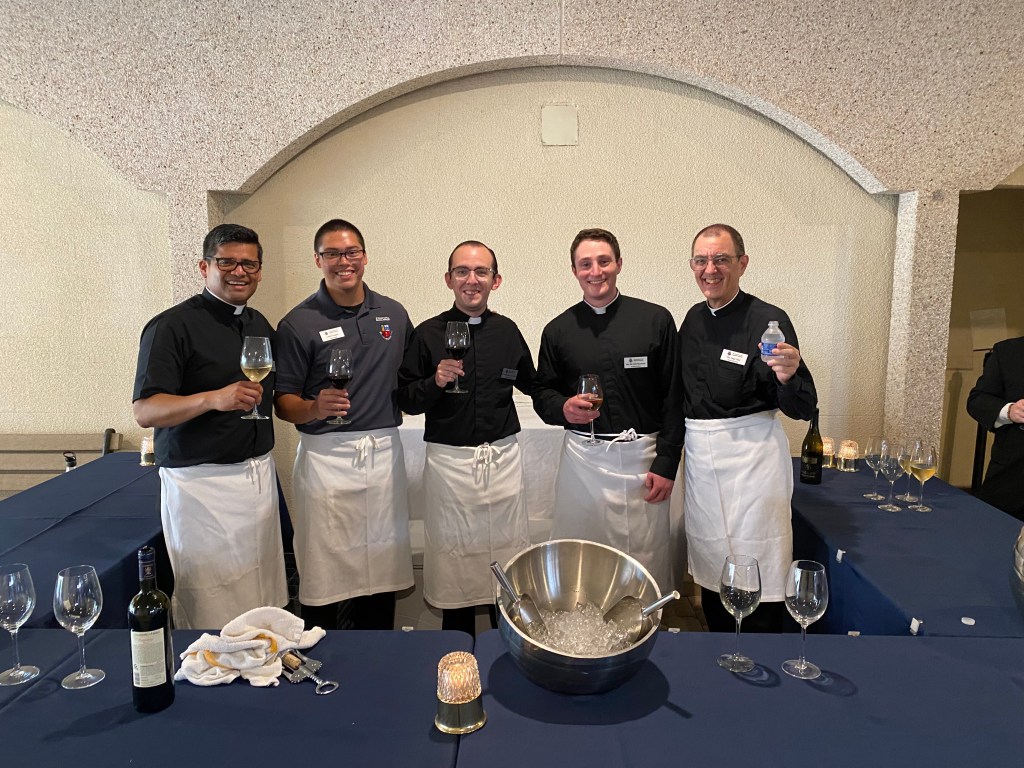
Photo: Serving parent’s weekend with my brothers last September. As you can see, I am the only one who has not turned my water into wine!

Link for the Mass readings for Friday, September, 6, 2024

Trust in Jesus to go into the deep.

After he had finished speaking, he said to Simon, “Put out into deep water and lower your nets for a catch.” Simon said in reply,” Master, we have worked hard all night and have caught nothing, but at your command I will lower the nets” (Lk 5:4-5).

Faith is to trust in God and believe that what he tells us is true. On our own initiative and will power we are limited as finite beings as to what we can understand and do. Today’s Gospel reading provides an example of this. Simon had been fishing all night with no results. Simon Peter follows Jesus’ command to go back out and put into the deep, and Simon not only accomplishes what he originally set out to do, but he also did so beyond anything he could have ever imagined! When we follow God’s direction and initiative all things are possible for us as well and beyond our wildest imaginings!!!

God’s initiative and grace enter our lives daily as Jesus entered Simon’s boat. Do we have eyes to see, ears to hear, and a willingness to listen and follow the initiative of Jesus? Remember the rich man who had followed all the commandments, but when Jesus invited him to sell all and come and follow him, he could not do it? Simon the magician saw the works of Philip, Peter, and John and wanted to buy the power of the Holy Spirit to heal but was rebuked. Turning away from Jesus’ invitation or seeking to manipulate Jesus for our own personal gain will not bring us the fulfillment that we seek.

We will do better to follow instead the example of Mary. When the archangel Gabriel shared God’s message with her that she was to bear a child, even though she did not understand how this could be, Mary trusted. She conceived in her womb, through the overshadowing of the Holy Spirit, the God-Man, the incarnate Son of God, Jesus the Christ. Joseph also trusted. After hearing the news from Mary, he had decided to quietly divorce her. Gabriel also spoke to him in a dream and Joseph trusted and remained Mary’s husband.

May we also follow such examples as Peter, James, and John, who said yes to lowering their nets, even though they did not see the point. They followed and were amazed. Then led by Peter’s humility and contrition, they “left everything” and followed Jesus. They went on to announce the Gospel of the Lord and caught people for the Kingdom of heaven.

Jesus has a plan for us, as he did for Mary, Joseph, and the Apostles. He will give us the means to accomplish what he calls us to do. In a quiet place in our soul, in the stillness of our hearts, Jesus is inviting us to follow him, to put out into the deep water. What we may hear may seem unbelievable, or insignificant, we may even experience anxiety, fear, or trepidation. Do we have the humility and willingness to follow Jesus, even when we may feel or see no point in his request?

About seventeen years ago, I explored the idea of teaching in a Catholic school and looked for a substitute teacher position and received no bites. JoAnn recommended that I reach out to Rosarian Academy. Like Peter, I initially hesitated, resisting because of the time of the commute but JoAnn persisted. I followed her lead and was hired as a long-term, first grade substitute teacher, and then full time at the middle school for another wonderful eight years. This decision opened the door to entering the permanent diaconate program, Cardinal Newman HS, the seminary for the last two years, ordination to the priesthood this past May and I am blessed to now be serving at Holy Cross Catholic Church in Vero Beach.

Jesus can guide us directly as he did with Peter or he can guide us through others as he did with me through JoAnn. When we allow our hearts and minds to be open to God’s word and where God is leading us, we will not only experience joy, but we will find fulfillment and meaning in our lives, which will overflow to others.


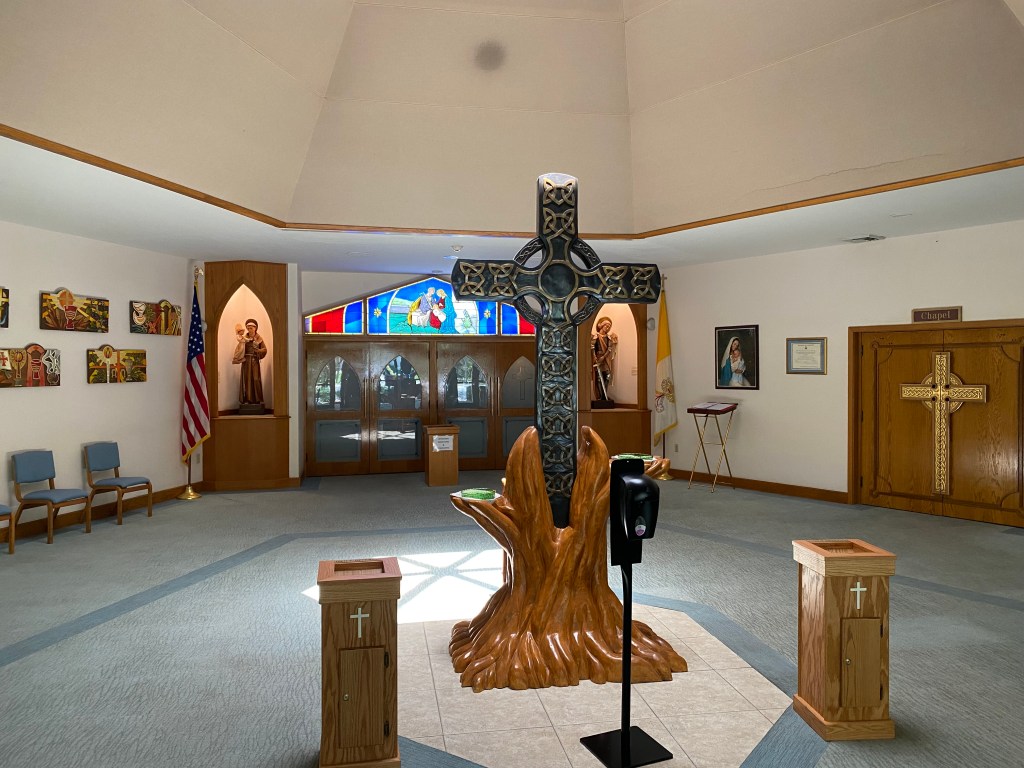
Photo: Vestibule of Holy Cross Catholic Church, Vero Beach, FL., my new home and going deeper still.

Link for the Mass readings for Thursday, September 5, 2024

We are to be one with and continue the work of Jesus.

But he said to them, “To the other towns also I must proclaim the good news of the Kingdom of God, because for this purpose I have been sent” (Lk 4:43).

Jesus himself, the Son of God incarnate, fully divine and fully human, is the foretaste of heaven for he himself is the kingdom of heaven at hand. His work of preaching, teaching, healing, and casting out demons, is the restoration of the Father’s Love in our fallen, human condition. Jesus came to heal and bring unity to that which had been divided and once he began his public ministry he was ever on the go.

Through our Baptism, we have been conformed to and indelibly marked by Christ and for Christ. We are nourished by his Body and Blood in the Eucharist, and we’re empowered through the laying on of hands by the bishop at our Confirmation. We have been grafted into the life of God through our participation in the life of Jesus the Christ in a powerful way through the sacraments.

By our baptism and the sacraments, we too then are priests, prophets, and kings as we participate in his life. We also then are to: preach and teach the same Gospel, be his healing and comforting presence for others, radiate the light and truth of Jesus to those in our midst, and yes we too are called to cast out all demons, and to renounce any negativity, dehumanization, and division in his name. When we claim the authority of our baptism in Jesus’ name, we, “submit [our]selves to God. Resist the devil, and he will flee” (James 4:7).

Jesus did not travel very far during his three-and-a-half-year public ministry, yet his teachings and healing power has touched all the corners of the world. This has happened because those who have encountered him, have said yes to his invitation, repented, submitted to the will of his Father, have been forgiven, healed and have been transformed to be his saints.

We are called to surrender our life to Jesus moment by moment, in each circumstance and situation, so that we may also build up our relationship with him, and embrace the gift of our unique vocation. Let us ponder what Jesus’ inaugural message means to us: “This is the time of fulfillment. The kingdom of God is at hand. Repent and believe in the Gospel” (Mk 1:15).

We cannot share what we do not have. By developing a life of prayer and meditation grounded in his living word, we find in the Bible, we deepen our relationship with Jesus and begin to experience the love of the Holy Spirit and are more able to let go of that which holds us back from a more intimate union with God. Renouncing that which seeks to divert us away from God and surrendering ourselves to the love of the Holy Spirit, we let go of that which leads us to separation and death and instead receive the one who offers us eternal life.

Each day is a new opportunity to learn from, be empowered by, and not only follow Jesus but as he did, proclaim the kingdom of God in the unique expression we have received and in the way God calls us to share!


Photo: Let us be “like a tree planted by still water, that yields its fruit in due season; its leaves never whither; whatever he does prospers.” (Psalm 1:3).

Link for the Mass readings for Wednesday, September 4, 2024

The light of Jesus will free us from our own darkness.

Jesus returned to his hometown of Nazareth, as we saw in yesterday’s reading, and that did not end so well, with his fellow Nazoreans running him out of town (Lk 4:29). In today’s reading, Jesus continues without looking back to teach as his Father sent him to do. As he is teaching in the synagogue at Capernaum, the initial reaction to his words were similar in both accounts; the people were “amazed” and “astonished” with his  teaching. But no one in either group makes the bold statement that arises today: “I know who you are – the Holy One of God” (Lk 4:34)! This phrase was professed by a demon in attempting to taunt Jesus.

From the very beginning of Jesus’ ministry opposition was present. In Nazareth, the fallen nature of our humanity reared its head. The people he grew up with were unwilling to see beyond the ordinary Jesus they always knew. Wasn’t he just the son of Joseph, just the carpenter? Jesus was safe when he merely worked a quiet life, participated in the life of the synagogue, even when he returned from surrounding territories amidst words of praise, and even stepping up to read in the synagogue from the words of Elijah: he was the hometown boy making good.

But once Jesus began to equate himself in the line of the prophets and share how God was working beyond the people of Israel, with his accounts of Elijah going to the Gentile widow, and Naaman, another Gentile, going to Elisha, highlighting that God worked beyond the people of Israel, even his own had enough. Jesus had to go (Lk 4:29).

In today’s account, another source of opposition is the taunting demon. Jesus rebuked the demon immediately and called him out of the man. Jesus faced time and again the fallen nature of humanity, disbelief, lack of faith, as well as the opposition of demons, and soon the failure of religious and civic leadership. Sound familiar?

Where do we find our self in the scenes of Jesus’ ministry and teaching, in our own time today? Following Jesus is a day-to-day commitment and we must be willing to face the same challenges that he and his disciples did. In doing so, we will also encounter our weaknesses, woundedness, and our own shortcomings. As long as we are honest with them and bring them into the light of Jesus, he will strengthen and help us to conform our lives to the will of his Father.

Having the humility to confront the darkness and sin within ourselves, we don’t have to worry about expending energy in defending and rationalizing where we fall short of the glory of God. Healing happens and our intimacy with Jesus grows, as we are willing to repent, to turn away from our sin and back to God who is the source of our life.

It is important to resist dismissing Jesus’ encounter with the demon in today’s Gospel too quickly. Demons do exist and play a role in the principalities and powers that influence us and our world. We ignore this reality to our own peril, for they will tempt and subtly attack us at our weakest and most vulnerable points. This is not a cause for anxiety and fear. The weakest Christian is stronger than the devil but we must be aware and vigilant. When faced with temptation by Satan or his demons, a simple prayer of renunciation, such as, “In the full authority of Jesus I renounce this temptation, name it.” By calling on the name of Jesus in the authority he has given to us by our baptism, the father of lies and those of the dark will flee from the radiant light of Christ. This is why it is so important to regularly examine our conscience, to be aware of, and to confess our sin. In doing so, we will be free from their corrosion, otherwise, they can and will be used against us.

The closer we grow in our relationship with Jesus, the more we experience his light and the more of our own sin we will see. This is not a cause to fear the light and love of Jesus, to run and hide, but to humbly embrace the truth so that our healing will be possible. As we are freed from our own darkness within, we will see more clearly the dark influences that have tempted us, and be better able to resist them going forward.

Let us reject feeding our own selfishness, embracing our own pride, and turning away from the protective covering of God’s love, but instead, place our faith in Jesus today and each day, spend time meditating upon and praying with his word, examine our conscience, and be willing to be led by him to serve one another, speak up for one another, and stand strong against the temptations and darkness of our fallen world.

When we fall short and fail, as we all will, as did the apostles, we need to follow, not Judas, but Peter: repent, confess our love for Jesus, and begin again. Together, with God our Father and the love of the Holy Spirit, may we not condemn but hold one another accountable, support, and lift one another up in love. Jesus is at our right hand so that even when we find ourselves in our darkest moments, we can turn to and trust in Jesus and his light will reveal to us the way.

———————————————–

Photo: Rosary walk, storm clouds gathering, but the light is not overcome but the darkness.

Link for the Mass readings for Tuesday, September 3, 2024