“Our hearts are restless, until they rest in you.”

Jesus took Peter, James, and his brother, John, and led them up a high mountain by themselves. And he was transfigured before them; his face shone like the sun and his clothes became white as light. (Mt 17:1-2).

Peter, James and John experienced Jesus’ profound teachings, his powerful signs and wonders, his healings, casting out demons, love and mercy, all of which were leading those of his followers to believe in the reality that Jesus was the Son of God. I imagine Peter, James, and John, though acknowledging Jesus as the Messiah, still pretty much looked at Jesus as an amazing man, but human. In the encounter of Jesus transfigured, Jesus revealed to his inner circle of Apostles not only a foretaste of what was to come in heaven but a glimpse of his actual divinity.

Jesus is not 50% God and 50% human. He is fully God and fully man. This is the Mystery of the Incarnation; the reality that the second Person of the Trinity took on flesh and became human while remaining fully God. This is an important reality, because in this very act of Infinite Grace, the Son of God assuming humanity, Jesus, the Godman, opened up heaven for us in the humanity he assumed. The Son of God became one with us in our humanity so that we can become one with him in his divinity. Through our participation in the life of Jesus Christ we are deified, becoming like God as we deepen our relationship with his Father.

“By revealing himself, God wishes to make [us] capable of responding to him, and of knowing him, and of loving him far beyond [our] own natural capacity” (Catechism of the Catholic Church 1997, 52). This reality of the invitation to experience communion with the Loving God and Father of all creation is for everyone. Our joy and fulfillment are achieved through developing a relationship with the God of Jesus Christ.

Many may say they are happy and living a good life without having a relationship with Jesus Christ or apart from God or his Church, and I would not disagree with them. I would only add that if we are honest with ourselves, there is more to life than the mere material and finite reality we see and experience with our senses. When we slow down enough, when we are actually, still enough, we can experience a deeper yearning for more as well as a deeper healing needed. We become in touch with the fact that nothing of material reality will ever truly satisfy us.

Even with great achievement, mastery, honor, and accumulation, there is still a lingering question, “Is this all there is?” We experience consciously or unconsciously a restlessness, we continually search to fill this unease, feeling satisfied for the moment, but eventually in short order, we are left empty, time and time again. This unease is our soul’s yearning, our transcendent nature longing for more, and that longing is for the infinite that the finite cannot provide. St Augustine of Hippo (354-430) articulated this desire and yearning so well in the opening chapter of his autobiography, Confessions: “You move us to delight in praising You; for You have made us for Yourself, and our hearts are restless until they find rest in You.”

The Feast of the Transfiguration is an invitation, not to reject our humanity, but to embrace the fullness of what it means to be human, as the Son of God did through the Mystery of his becoming one with us. We are invited to embrace the fullness of our humanity; the reality that we are physical, emotional, intellectual, while at the same time, spiritual. Our fulfillment and joy come from a balance of nurturing each aspect of who we are in participation with Jesus.

Peter, James and John, as well as Augustine and the saints, embraced the invitation of Jesus and that has made all the difference. God invites us also to experience the wonder, to explore the full breadth, depth, and width of all that our reason and faith can open for us, and go even further, to embrace the yearning of our soul, that we may draw ever deeper into the intimacy of a loving relationship with God, ourselves, and each other. May we say yes to that same invitation today, tomorrow, and each day going forward, to continue to go deeper, to experience the fullness of our humanity and through participation in Christ, our divinity!
———————————————————————–

Photo: God reveals himself through the gift of his creation as he does through his Son.

Link for the Mass readings for Tuesday, August 6, 2024
Time to rest and pray.

When Jesus heard of the death of John the Baptist, he withdrew in a boat to a deserted place by himself (Mt 14:13).

This is not the first nor the last time that Jesus withdrew to a deserted place. Unfortunately, his effort for some alone time ended abruptly, for when he got off the boat, he was immediately met by people seeking him.

Making time for quiet may seem like a waste of time, just a simple act, but it is one that is very necessary. As busy as Jesus was, Jesus would make time to pray. Though the “deserted place” was full of people by the time his boat reached the shore, he did have some quiet, alone time before he disembarked. Jesus showed no frustration for having his plans interrupted, in fact, his “heart was moved with pity for them” (Mt 13:14).

Often, we lose our patience when we are interrupted. When we are cut off or cut short by someone else, we may react in a negative way internally or externally. Most of the times our hearts are not moved with pity, nor do we show compassion for those who may consciously or unconsciously come to us in need.

If we find that we are constantly impatient, short with others, one reason could be that we do not give ourselves time to stop and be still, we do not make time to pray, we do not sit still, internally as well as externally, even for a few moments and breath. We just keep moving, on the phone, on our apps, on the computer, working, studying, interacting with others, completing this activity believing that once we finish we will be all caught up. Hyped up on caffeine to keep up the pace we have set, we then wonder why we are consistently anxious or on edge, if we are even aware!

Jesus sought some downtime possibly to process the death of John the Baptist, and in today’s Gospel, we read that he did not get the amount of time he set out to have. Though he did get a brief respite on the boat before he reached the shore. When he saw the people, he did not whisper to himself, “Oh no, here they come again.” He instead was moved with compassion to serve their needs.

One way we grow in our faith and improve our health, is to put into practice the actions and teachings of Jesus. Giving ourselves, even a few minutes of quiet time as Jesus did in today’s Gospel can be of great help. I found this to be true one November afternoon during my first year back at seminary. I was attempting to get some reading done for a class when my head began to bob. I don’t drink coffee or caffeine drinks and usually would just push myself through. Instead, this time I felt led to try something new.

I set the alarm on my phone for fifteen minutes. I was out within thirty seconds and didn’t move again until the alarm went off. Unlike feeling groggy and disoriented when I had taken longer naps in the past, I felt a bit more refreshed. I got back to the reading and got more done in less time because I was more alert. This became a regular pattern in which most days at 3:00, I would stop, pray the chaplet of Divine Mercy, and then take a fifteen-minute nap.

Some days I did so at different times or on occasion not at all but this became a regular practice and made a big difference. Jesus invites each of us in our own unique ways to be still, pray, and rest daily. The time that we commit to need not be for a long period, five to ten minutes a day can work wonders. What matters more is being consistent and giving our mind and bodies time to reset and renew. Doing so will make not only a big difference in our lives but also in the lives of those we interact with on a regular basis.


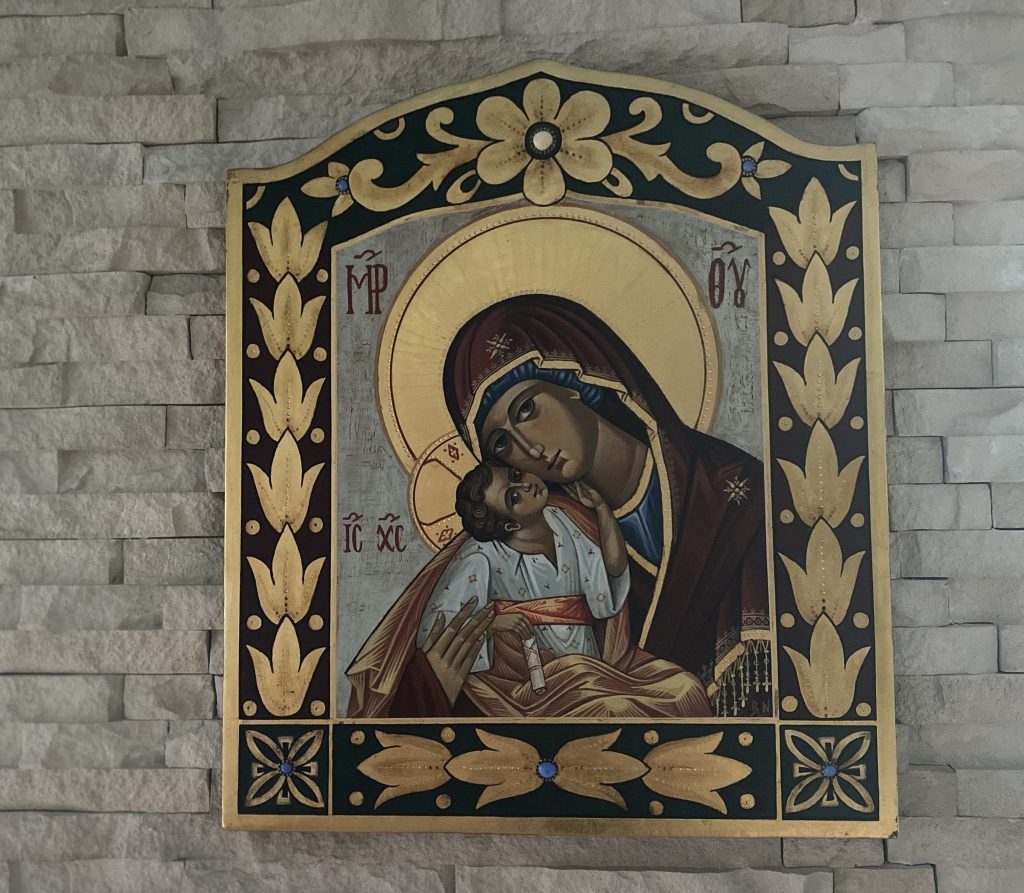
Photo: My favorite icon. It hangs behind the altar in St. Mary’s Chapel at St. Vincent de Paul Regional Seminary. This chapel was a wonderful place to get away and pray for awhile.

Link for the Mass readings for Monday, August 5, 2024

Ready to dance with the Bread of Life?

If you are reading these words, hopefully, you joined in reading last Sunday’s reflection as well and are back to continue the journey through John 6 that we started last week. If just joining, you can go back to last Sunday’s post, July 28, read, and catch up. I also hope that you spent or will spend some time, slowly, meditatively, and prayerfully engaging with the words of John 6 at your own pace.

We left off last week with the crowd that had gathered around Jesus feeling amazed to have experienced, witnessed, and have eaten their fill from the miracle of Jesus multiplying the few pieces of bread and fish available from a boy’s willingness to give of what he had. We join the crowd this week having come to realize that Jesus had left them in the evening in a surprising way. They witnessed the disciples crossing Galilee in a boat but not Jesus. They get into boats themselves and follow. Seek him out and find him on the other side they did.

Having satisfied the physical needs of the people, they want more, and Jesus is going to build on the miracle of the multiplication to present them with the more they aren’t even aware of how hungry that they are for. The seed of the teaching of the spiritual food that he wants to nourish them with, he actually planted with his apostles earlier when they first asked him how to pray.

In the prayer he taught them, what we well recognize as the Our Father, there is an interesting line that relates to today’s discourse. This prayer we recite at every Mass, and which has been passed on generation after generation since the time of Jesus has the familiar phrase: “give us this day our daily bread” (Mt 6:11).

The translation of daily from the Greek ton arton ton epiousios, several Church Fathers have translated as, super, substantial bread. Jesus was teaching his disciples then as well as each generation up to an including us today, to ask his Father to give us super, substantial bread. This is the bread that has been transformed, that has been transubstantiated, bread that at its very core is no longer bread, but the Body and Blood of Jesus. This is the Eucharist we receive at each Mass. Jesus was paving the way for his disciples in teaching them this prayer and building on it as he guided the crowd in today’s reading when he said to the thousands gathered around him, “I am the bread of life”.

The bread that the people consumed from Jesus’ multiplication sustained them physically. Jesus is now moving beyond the physical to their deeper spiritual hunger as he tells them not to seek food that perishes but to seek food that “endures for eternal life” (Jn 6:27). The people then referred to the manna that Moses provided for their ancestors in the desert and asked what sign he would give. Jesus clarified that God provided for those in the desert and he would do so again. “For the bread of God is that which comes down from heaven, and gives life to the world” (Jn 6:33).

They asked Jesus to give them “this bread always.” And Jesus is more than willing to oblige as he begins the pivot of pivots when he said to them, “I am the bread of life; whoever comes to me will never hunger, and whoever believes in me will never thirst” (Jn 6:35). The reaction of the people to this statement we will explore next week.

What we want to meditate upon this week is the gift of this super, substantial bread that we are blessed to receive at each Mass. Through the gift of the Mass we are able to participate in the divine dance of love that has always been, is, and ever will be danced. This is the divine communion of the Father giving all that he is to the Son, the Son receiving and returning back to the Father all he has received and is, and this infinite sharing between them, the love given and received between them is the Holy Spirit.

All that we are and have is a gift from God. In the Mass we give a little bit of what we have received, represented in the bread and wine given to the priest at the altar, represented in the gift of the money we offer, the prayers and intentions we bring. We give our little to the Father and he receives what we have given. He then through the words of the Son spoken at each Mass by the priest and the sending of the Holy Spirit gives to us his Son made present again on the altar as the bread and wine become the Body and Blood of Christ.

We then receive Jesus and consume him, are transformed by him, such that we become what we eat. We become Christified, deified, we become one with Jesus in his divinity. Having received the Bread of life, we meditate on the gift of this miracle and then when we are sent at the end of Mass to continue this dance of love. We are sent out to give to others the love we have received.


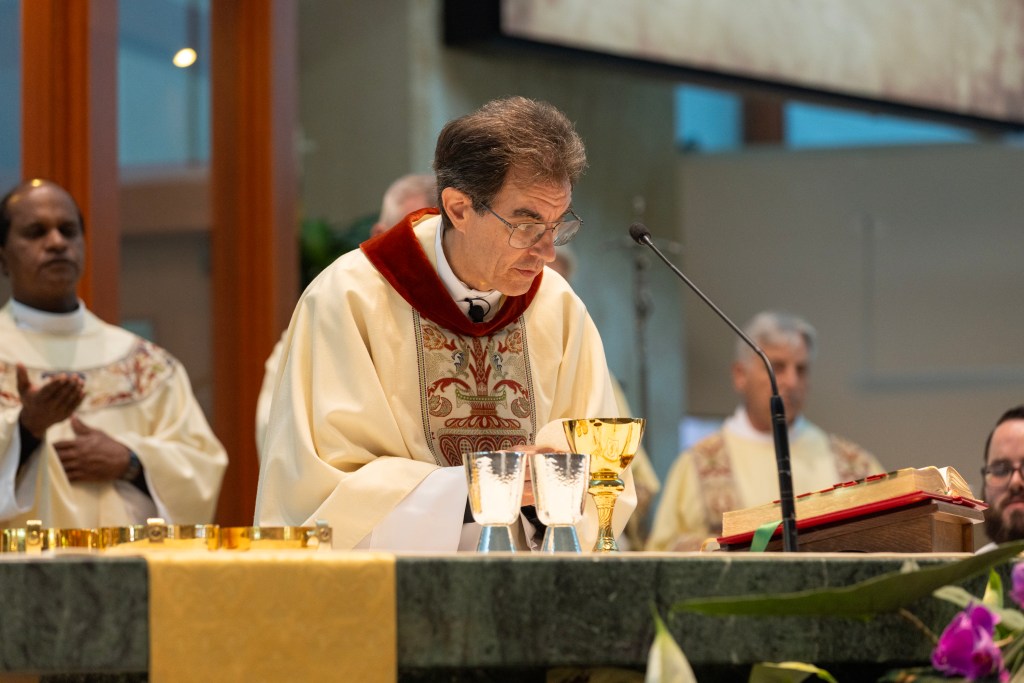
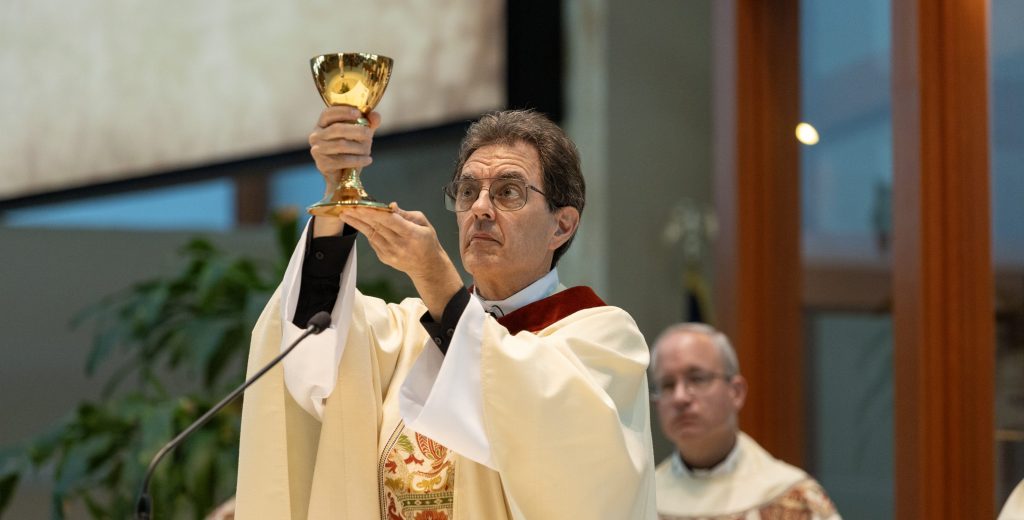
Photo: “Take this, all of you, and eat of it, for this is my Body, which will be given up for you.” I am blessed to say these words of Jesus and participate in the dance of the Trinity as I celebrate Mass each day!

Link for the Mass readings for Sunday, August 4, 2024

Who has our heart?

Herod the tetrarch heard of the reputation of Jesus and said to his servants, “This man is John the Baptist. He has been raised from the dead; that is why mighty powers are at work in him.” (Mt 14:1-2).

After the death of Herod the Great (4 BC), one of his sons, Herod Antipas, was given a portion of his father’s kingdom by the Roman Emperor Augustus. Thus, Herod Antipas was the tetrarch, or prince, of Galilee and Perea from 4 BC to 39 AD. Herod, like, Pontius Pilate, held power as long as he was a faithful servant to Rome.

News of the ministry of Jesus got back to Herod and he believed Jesus to be John the Baptist raised from the dead. What followed in today’s Gospel were some reasons why Herod arrested and unjustly beheaded John the Baptist. John was killed for speaking truth to power, as happened often in the long line of prophets before him. What we heard almost happened to Jeremiah in our first reading as he is calling the people of Jerusalem to repent.

After hearing the news of John’s death John’s he began his ministry, also calling for repentance, “This is the time of fulfillment, the kingdom of Heaven is at hand, repent and believe in the gospel” (Mk 1:15). And yet he promised so much more. John was the voice, Jesus is the Word spoken. Both would suffer capital punishment, at the hands of Herod Antipas and Pontius Pilate. The Apostles and martyrs of the early Church followed John and Jesus, lived the truth publicly and courageously, and were bold witnesses of their faith.

How are we living our faith today? Are we faithful to the Gospel values that Jesus and the Apostles taught and were willing to die for? Do we serve Herod Antipas and Pontius Pilate or Jesus the Christ? Do we assume a defensive posture or open ourselves to love? Are we putting our identity first or our integrity? Most of us are somewhere in between. The hope is that each day we surrender a little more to Jesus, dedicate ourselves to prayer and practicing our faith, and loving one another as we have been loved, a little more.

It is important to stop and reflect on questions such as these, to examine our thoughts, words, and actions and determine to whom have we given our heart, to whom are we truly serving. It is not easy living the teachings of Jesus. We will fall short, but we must remember that God loves us more than we can ever mess up. When we are humble and willing to see our mistakes, failures, and sins, be contrite, confess, and rectify them, we will experience God’s forgiveness and mercy, we will be transformed, and grow.

What’s more the relationship we have been created for strengthens. Embraced by and participating in the Trinitarian Communion of love, let us recommit ourselves today to living as Jesus’ disciples, seek to better hear his word and follow his path, so to better live and speak his truth by promoting the forgiveness, justice, love, mercy, and reconciliation we have received in and out of season.
———————————————————————–

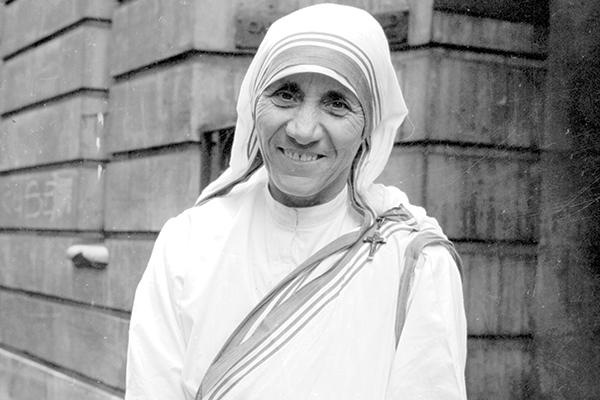
Some great guidance from St. Mother Teresa: “Let the love of God take entire and absolute possession of your heart; let it become to your heart like a second nature.” Photo credit: Press Association

Link for the Mass readings for Saturday, August 3, 2024

Aligned with God’s will, there are no limits.

“Where did this man get such wisdom and mighty deeds? Is he not the carpenter’s son?” (Mt 13:54-55).

Many people wonder what Jesus did from the age of twelve until he began his ministry around the age of thirty. Today’s reading gives us some insight into that question. Most likely, Jesus did nothing extraordinary, he was just as ordinary as any other first-century Palestinian Jew living in the small town of Nazareth, with a population of about 250 to 500 people.

Jesus most likely worked as a carpenter. This was rough, menial work, and as a day laborer, a position that was looked down upon. We can even see evidence of this in the Gospel accounts. Mark describes Jesus as the carpenter, the son of Mary, Matthew in today’s account portrays Jesus as the carpenter’s son, and Luke and John just refer to Jesus as Joseph’s son, leaving out any reference to carpenter altogether. Most scripture scholars believe Mark was written first, so we can see a progression in the biblical tradition moving quickly away from identifying Jesus as a carpenter.

Jesus’ return to his hometown and his teaching was first met with wonder. The question arose, “Where did he get such wisdom and how did he work such mighty deeds?” But wonder soon turned to judgment. Who is he? Isn’t he just the carpenter of Nazareth, no better than any of us. In effect, “Who does he think he is?” Not only does this show that Jesus probably lived a very simple peasant life, but that Jesus’ social status was set in stone.

The people’s hearts and minds were closed to Jesus. THEY KNEW who he was and there was no way someone like him could do what they had heard, so they “took offense at him… And he did not work many mighty deeds there because of their lack of faith” (Mt 13:57-58).

How many times have we judged someone? Have we said to ourselves, “I know who he or she is.” We box them in, not as they are, but as WE see them, as we define or label them. We look at another individual not as a person with dignity, but as a two-dimensional caricature to satisfy our own prejudgments and lack of vision. We also do this to ourselves when we resist God’s invitation to grow and follow his plan for us.

Maybe we have had a similar experience as Jesus did in returning to his hometown, in that we have sought or are seeking to move beyond our particular social status, or follow a dream or career out of the norm of familial or community expectations. No matter our age, through no fault of our own, by pursuing this path some or many may feel threatened.

One day Bruce Lee challenged Stirling Silliphant to run five instead of his usual three miles. Into their fourth mile, Stirling said, “if I run any more, I’m liable to have a heart attack and die.” Bruce then said, “die.” And ran off. Sterling was so mad he finished the five miles, approached Bruce and asked him why he said that.

Bruce replied, “Because you might as well be dead. Seriously, if you always put limits on what you can do, physical or anything else, it’ll spread over into the rest of your life. It’ll spread into your work, your morality, into your entire being. There are no limits. There are plateaus, but you must not stay there, you must go beyond them. If it kills you, it kills you. A man must constantly exceed his level” (p. 23).

Jesus rebukes limiting attitudes and perspectives. God the Father has a plan for all of our lives and invites each one of us to resist limiting ourselves and each other. Jesus, the carpenter, invites everyone to embrace the infinite possibilities that will arise when we participate in his life and the Holy Spirit seeks to free us from the shackles, those limitations imposed from within and without, that bind all of us so that we may be free to receive the fullness of and share the Father’s love.
———————————————————————–
Photo: Paused during Rosary walk to look off into the horizon, Riomar Beach, Vero Beach.

Link for the Mass readings for Friday, August 2, 2024

Stirling Silliphant story accessed from Bruce Lee: The Art of Expressing the Human Body, compiled and edited by John Little.

Parallel Gospel accounts: Mark 6:3, Matthew 13:55, Luke 4:22, and John 6:42

“Drawn to the Path”, will we go our own way or follow?

Jesus said to the disciples: “The Kingdom of heaven is like a net thrown into the sea, which collects fish of every kind.” (Mt 13:47).

The invitation of God is universal, and we are all lured by his invitation of love and intimacy. We long to belong, our very substance and essence as human beings is the reality that our ultimate fulfillment can only be reached in communion with the God who created us. Yet, though drawn, we resist being caught.

St Augustine (354-430), bishop of Hippo, came to a point in his life when he realized that the flame of his desire for wealth, fame, and pleasure was dimming. He felt moved toward “one reality that cannot decay, from which all other realities are derived.” Though he was caught in God’s net and being pulled in, Augustine still sought to wriggle free, for: “Though drawn to the Path, who is my savior, I shied from its hard traveling” (Augustine 2008, 161).

How many of us could echo Augustine’s dilemma? We have experienced God in our lives and feel the invitation to go deeper, and yet, we still seek to wriggle free. We are attracted to God while at the same time there are other things that have a stronger pull. We may also buy into the thought that God’s path is too hard. It is. Anything that has been worthwhile in our lives, haven’t we found that we have needed to be disciplined to obtain or even maintain it? Also, when we allow ourselves to be yoked to Christ, our load is lighter.

Mixed metaphors aside, it is harder and takes more effort to work against God’s will, just read the Book of Jonah! May we instead surrender to the current of the Father’s Love and allow ourselves to be caught in the net of his Grace. At first, anxiety and fear may arise, because the pull may appear too strong, his love too pure. Yet, when we align our discipline and effort with his will, the anxiety will wane, we will begin to feel safe, and we will indeed be free to swim again. This time with more exhilaration and joy than we had ever experienced before.

———————————————————————–

Photo: Following Mary’s lead, Rosary walk through Vero Beach.

Link for the Mass readings for Thursday, August 1, 2024

St Augustine. Confessions. Translated by Gary Wills. NY: Penguin Books, 2008.


There is a treasure of great value hidden and yet in our midst.

Jesus said to his disciples: “The Kingdom of heaven is like a treasure buried in a field, which a person finds and hides again, and out of joy goes and sells all that he has and buys that field” (Mt 13:44).

God is hiding in plain sight. God is in our midst, present to all of us, a wonderful treasure just waiting to be found. God’s eternal love and grace is ever reaching out to us. Our soul hungers, yearns, and seeks for that love, whether we know it or not. It is when we seek satisfaction, filling this deepest of our desires in material and finite pursuits alone, that we miss the true treasure. When we sin, create idols, seek the allure of apparent goods, we block our access to the very union we seek, we are not satisfied, and our desire increases all the more because we are seeking to fill that deepest void with everything but the one who wants to fill us to overflowing.

The saints and the mystics are those who have found the treasure of God’s will in their lives, they have experienced his love and mercy, and they have given themselves fully to God. They have encountered the living God in the mundane events of their lives and given all to be immersed in his communion. They “are amplifiers of every person’s more hidden life of faith, hope, and love. Their lives help us to hear the interior whispers and see the faint flickers of divine truth and love in ourselves and others. The Christian mystics point the way to fully authentic human life by illustrating what it means to be a human being, what life means: eternal union (which begins here) with the God of love” (Egan 1996, ix-xx).

God speaks in the silence of our hearts. Setting aside regular time to be still will help us to hear his whisperings. Opening our hearts and minds to God and seeking him in all things will help us to recognize those faint flickers and God-incidences present in our daily experiences. We can also experience Christ by reading and meditating on his Word, as well as reading the lives of the mystics and the saints, those who have found the treasure of Jesus’ presence and want to share it: St Francis of Assisi, St Teresa of Avila, St John of the Cross, St Therese of Lisieux, St Mother Teresa, and so many others are leading and urging us on to experience the rich encounter of the loving God of Jesus Christ.

Another who found this great treasure was St. Ignatius of Loyola (1491-1556), whose memorial we celebrate today. “While reading the life of Christ our Lord or the lives of the saints, he would reflect and reason with himself: ‘What if I should do what St. Francis or St. Dominic did?'” (Luis Gonzalez, The Liturgy of the Hours, vol III, 1975, 1566).  Might we ask this same question and so find the great treasure in our midst which is to experience the love of God in the depths of our souls, to love as Jesus loves us, as we continue our journey to become saints.

St. Ignatius, Pray for us!
———————————————————————–

Photo: Rosary walk Riomar Beach, Vero Beach.

Egan, Harvey D. An Anthology of Christian Mysticism, Second Edition. Collegeville, MN: Liturgical Press, 1996.

Link for the Mass readings for Wednesday, July 31, 2024

No darkness will overcome the love of the Holy Spirit.

“Explain to us the parable of the weeds in the field.” He said in reply, “He who sows good seed is the Son of Man, the field is the world, the good seed the children of the Kingdom. The weeds are the children of the Evil One, and the enemy who sows them is the Devil.” (Mt 13:36-39).

In this parable of the wheat and the weeds, Jesus is addressing the ancient question of why God allows evil and how are we to deal with it. Why do bad things happen to good people? As a starting point, we need to recognize that God is God, and we are not; meaning that we are not capable of reading the mind of God. Any answer to explain how and why God allows suffering will be insufficient. A second reality is that the Devil exists, though he is a created being. An angelic being, yes, but not equal in any way to God.

God is not a being. At best we can say he is Infinite Act of Existence, he is, or as God told Moses, “I am who am” (Exodus 3:14). God did not create evil, he only created good. “God looked at everything he had made, and found it very good” (Genesis 1:31). The Devil, Satan, the one who opposes, was created good also, as a high archangel, Lucifer, yet he chose to turn away from the will of God, and those angels who followed him are demons. God is greater than the Devil and his demons, and his good is greater than the evil they sow.

Evil is not so much a created thing, but a deprivation, or distortion of the good. God does not create evil, but he does allow it, and even though we cannot understand the reasons why God allows or permits evil or suffering, it is not a sufficient reason to say that God does not exist. This is especially true if we are seeking to grasp spiritual realities and truths from purely physical and rational means alone. We are indeed rational beings, who seek to know and to understand that which is good, but we are so much more. As human beings, we are physical AND spiritual, so need not limit ourselves to the merely sensate and empirical realm alone.

To better be guided by God, to hear his voice in the silence of our soul, to be fulfilled, our hearts and minds need to be open to the will of the Holy Spirit working in our lives. We are called to be people of prayer. As we mature spiritually and deepen our relationship with God, we will come to experience God as did Job: “I know that you can do all things, and that no purpose of yours can be hindered. I have dealt with great things that I do not understand; things too wonderful to me, which I cannot know” (Job 42: 2-3). In essence, Job acknowledged and accepted that God was in control, and he was not, and though he could not grasp everything, he trusted in the will of God for his ultimate good.

How do we deal with evil then? We need to surrender our pride and control over to God and acknowledge that he is in charge and knows what is best for us. We need to choose to put God first above ourselves and everything and everyone else. Our fundamental option, our telos, our end goal, is to embrace the reality that we are striving to be in a relationship with God. From the moment of our conception, we are a living, craving, hunger, and desire to be one with God and one another. This is true of the atheist and the mystic alike, whether we believe it or not. As we embrace this reality, put God first and focus on him, no matter what arises, we will begin to experience his presence in not only our everyday lives but begin to feel his presence with us in the midst of our suffering. We will come to know that he is stronger than any pain or evil, his grace is greater than any of our sins, and he will guide us through and give us what we need to endure.

Our loving God and Father has given us the means to understand suffering and evil especially in sending his Son to enter into our humanity, to suffer with us, even suffering his own unjust death on the cross. Our deepest prayer is when we willingly offer up our suffering and enter into the Mystery of the Passion of Jesus. Jesus, the pure and innocent one, beaten and crucified, understands our pain and agony, our cry for the horrors of injustice, and he understands the presence of evil. Jesus himself, asked not to be crucified, though he relinquished in saying, “Not my will but yours be done” (Lk 22:42).

In that acknowledgment, Jesus faced the utter evil, horror, betrayal, and injustice of humanity, his crucifixion. In taking upon himself the sin of the world on the Cross, he even felt his separation from his and our Father. Through his complete surrender into God forsakenness, into his death, and descent into hell, Jesus made the Resurrection possible. He conquered suffering, evil, and death forever, he brought about a greater good, through the evil of the crucifixion. No matter what trials we face, our Father has the last word over sin, suffering, and even our death.

We may not receive a sufficient answer or justification to suffering but we can experience the challenges we face with our hope intact by trusting that God hears our prayers and is present in our trials and tribulations. We receive help best when honest in our prayer, even when we are angry, afraid, doubtful, or frustrated. We will not find Jesus when we deny or run from our challenges. We will find him with his arms wide open and waiting for us when we are willing to ask and accept his help, and then enter into, face our suffering and pain.

We are not alone in our suffering. When we resist running from our pain, denying, or trying to distract or divert ourselves, and bring what we are going through to Jesus, he will provide a way and accompany us through every twist and turn. He understands what we are going through because he experienced the worst of human sin; he was betrayed, beaten, crucified, and died. We experience hope because Jesus has already won the battle and he sends us the Holy Spirit to give us the strength to endure.

No darkness can or will overcome the love of the Holy Spirit. Aligned with God we will be victorious even in the face of the greatest evil that confronts us. Let us trust in Jesus and each other, face whatever storm that arises with confidence and courage as did Jesus when he set his face toward Jerusalem. Empowered by the Holy Spirit we shall overcome.
———————————————————————–

Photo: Prayer connects us to the Light that shines in the darkness and is not overcome by it. Rosary walk North Hutchinson Island looking back at the mainland, Vero Beach, FL.

Link for the Mass readings for Tuesday, July 30, 2024

May we embody the boldness and faith of St. Martha.

Enough of waiting. They had sent word to Jesus while Lazarus was dying but still alive, and he did not come. Now Jesus is close to their home, and Martha does not wait for him to come to her but “went to meet him” (Jn 11:20). She went boldly, and most likely, did not hold back any of the full range of her hurt and pain.

Martha’s words expressed her anguish. “Lord, if you had been here, my brother would not have died” (Jn 11:21). She believed in Jesus, knew of his power to heal, but could not understand why he did not come. She could not understand because she could only see the loss of her brother which was right in front of her. He was dead and now in a tomb.

It is true that Jesus came too late to heal his friend, it is also true that he felt the pain of his friends. What Lazarus had to go through in his death and what Martha and Mary were experiencing in their grief. That is why he wept. But Jesus came with a purpose, and what he came to do was beyond their wildest imaginings. Jesus came to restore Lazarus to life.

What is so amazing is that as Martha speaks with Jesus, she is not aware of what Jesus is about to do. And when Jesus asks her if she believes that he is the “resurrection and the life” she says without missing a beat: “Yes, Lord, I have come to believe that you are the Christ, the Son of God” (Jn 11:27). Martha believed Jesus was the Christ before the raising of her brother and even while still experiencing the rawness of her grief.

Martha’s boldness and faith give us a model of how to face the challenges in our lives. We are to go to Jesus with them directly and believe that he is the Christ the Son of God. What may at first appear to be hopeless is not. Our loving God and Father will always bring about a greater good, even when it does not seem possible in the moment of our trials and tribulations. And even death, our own or of our loved ones, no longer has the final say, Jesus does. For those of us who die with Christ will rise with him because Jesus opened up heaven for us in the humanity he assumed.

Let us begin and continue our day ahead with the boldness and faith of Martha. We, like her, will not be free of the pain and suffering of life this side of heaven but we will not have to go through any of it alone as long as we believe in and turn to Jesus.

————————–

Icon: Close up of Icon of St. Martha, Monastery Icons.

Link for the Mass readings for Monday, July 29, 2024

“This is my Body”… “This is my Blood”

This Sunday, and for the next five Sundays we are being invited to participate in an adventure. Each week we will journey together through the pages of Chapter 6 of the Gospel of John. The beauty of this chapter and the road we will walk side by side is one that means everything to us as followers of Jesus Christ. And as we will see, not everyone in the written account, in fact only a few, make it through to the end.

My hope is that each one of us here today not only make it through the journey, but that we are transformed, and our faith is renewed. What Jesus unveils for us with each verse of his teaching is the miracle of miracles, the sign of signs, God from God and Light from Light. Jesus will be sharing with us his Bread of Life discourse. Jesus will reveal that he is truly the Bread of Life come down from heaven. Jesus, the Son of God, becomes one with us in our humanity so that we can become one with him in our divinity. He comes even closer when he gives us himself in the appearance of bread and wine to be consumed.

My invitation for you during these dog days of summer is to get out your Bible, dust it off, if it has been a while since you have pondered its pages, and then slowly, prayerfully, each day over the next month, read, pray and meditate with John Chapter 6 and so come into each Mass even better prepared to receive the miraculous gift that Jesus wants to share with us.

We begin our journey by joining the “large crowd” following Jesus. They have gathered around him because they have seen or have heard about his healings, his exorcisms, and his teaching with authority and they are hungry for more. They are not aware of how hungry they are, and what will truly satisfy their deepest hunger. This is just as true for each of us. As Jesus watches them gather, he wants to not just satisfy their immediate hunger, but also to set the stage to reveal for them the deeper hunger of their soul.

Jesus seeks the same for his Apostles and so asks them, “Where can we buy enough food for them to eat” (Jn 1:5)? Philip is stymied and doesn’t have a clue, but Andrew steps forward to share, “There is a boy here who has five barley loaves and two fish”. I can see Jesus’ eyebrows raise here as he looks to Andrew with some hope in his heart that Andrew is getting it. But then as Andrew continues he also assumes the posture of Philip, “but what good are these for so many” (Jn 1:9). So close, Jesus might have said and then sighed with a smile as he received the loaves and fish.

We know what happens next, Jesus took the five loaves and two fish, gave thanks to his Father, and all ate their fill and with enough left over to fill “five wicker baskets” (Jn 1:13). This miracle transpired with the little that was given, and remember Andrew received this meager amount from a boy.

In the ancient near East, children had no rites. Imagine this boy’s reaction. He was wise enough to bring food for the long trek back for him and his family, and now he had none. He was willing to give away his food and yet how would this be enough? Would he now go hungry too? Instead of running away at break neck speed when Andrew approached him for his food, the boy trusted and gave all he had. Was there something the boy saw in Jesus, just enough of a spark of faith to trust. There must have been because he gave and all were filled because he did so.

With the little that we give Jesus, when we trust in Jesus and let go, as the boy did, and as we surrender to his will, miracles happen. Jesus could have created food out of nothing, as his Father created the universe out of nothing, but he sought the participation of those around him. This happens at every Mass. The bread and wine that are brought to the altar represent the little that we bring to Mass. Our financial offerings yes, but also our prayers, our petitions for ourselves and intentions for others, as well as our deepest hunger.

Jesus receives what we give and multiplies it just as he did with the multiplication of the loaves. The priest takes the bread first and then the wine into his hands and speaks the words of Jesus again and through the power of the Holy Spirit, the bread and wine become the Body and Blood of Jesus. How do we know this to be true? Because Jesus said then and we hear his words again at each Mass:

“This is my Body”.

“This is the chalice of my Blood”.

In the miracle of Jesus multiplying the five loaves and three fish to feed the thousands, he was setting the stage for the miracle we get to experience at each Mass. The appearance of bread and wine remains, but its substance, the reality at the core, has been changed to become the Body and Blood of Christ. This miracle we don’t just read about, but can experience and receive him again and again to satisfy the deepest hunger of our souls.

We are just beginning, the journey continues next Sunday!


Photo: Blessed to be a priest participating in the miracle of turning bread and wine into the Body and Blood of Christ during Mass each day!

Link for the Mass readings for Sunday, July 28, 2024