When we take the time to be still, we will see and believe.

Jesus Christ is born for us. Jesus Christ dies for us. Jesus Christ conquers death and rises again for us. Because of our place in time, December 27, 2025 AD – Anno Domini, In the year of our Lord, we are capable of experiencing his life, suffering, death, Resurrection, and Ascension into Heaven. The important question we need to answer is, “Does this new fact, this new reality in human history, make a real difference in our lives?”

Christmas did not end two days ago. We are still in the Octave of Christmas. The Church celebrates two octaves in the Church liturgical calendars, Christmas and Easter. These eight days are celebrated to impress on us the solemnity of the event of remembrance. From the vigil celebration of Christmas Eve on December 24 to January 1, the Solemnity of Mary the Mother of God, we celebrate the significant event of the Incarnation, the Son of God, the second Person of the Trinity, becoming one with us in human history.

“And the Word became flesh and made his dwelling among us” (John 1:14). The Masses celebrated within the Octave of Christmas, as well as the readings of Evening Prayer in the Liturgy of the Hours, reflect the celebration of Christmas Day each day for the eight days. It is like having a week-long birthday party. More importantly, we are invited to meditate and ponder this wonderful gift, that God has come close to dwell among us.

If we are solely focused on gifts, the returning of gifts, and celebrations apart from the celebration of Jesus’ birth; if we are removed from the liturgical cycle and rhythm of the Church, it is easy to fall into the daily harried pace again and post-Christmas blues may creep in because it can feel like everything is done but the returning of gifts and getting a good after Christmas deal. Christmas music has been alive and well on many radio channels for weeks, but at some point on Christmas Day and often the following day, they stop. They stop at the time when they ought to begin!

The material and finite, no matter how wonderful, even our closest relationships, will never satisfy our deepest hunger and thirst. If you are experiencing any post-Christmas blues, today is a great opportunity to let go of the material for a bit and enter into the gift of silence, and to spend some time meditating and contemplating on who will satisfy our deepest longing. The greatest gift that we have been given, we began to celebrate again two days ago.

The Son of God changed human history through his conception and birth and we are invited to participate in God’s great theodrama of human transformation. Today’s Gospel reading is a fast forward from this birth we are celebrating and the gift that keeps on giving, the reality of the purpose of the incarnation.

Jesus was born to die. He obeyed and trusted his Father at every stage of his life, even in the garden and on the cross. He died and experienced our greatest fear: death. That Mary, Peter, and John, “saw the burial cloths there, and the cloth that had covered his head, not with the burial cloths but rolled up in a separate place” was not just a random detail. Grave robbers would not have taken his body without the cloths of the corpse. When Lazarus was called out of his tomb, he shuffled out still tied in his burial cloths and his head still covered. Lazarus was resuscitated but would die again. “Something radically different has happened to Jesus” (Martin and Wright, 333).

The Holy Spirt overshadowed Mary at Jesus’ conception, helped Jesus conquer death and rise again, and through the Holy Spirit again, Jesus is made present through the priest at each celebration of the Mass. Mary Magdalene was the first to experience the empty tomb and shared this good news with the apostles. Peter and John ran to see. John arrived first. John remained outside, possibly out of respect, to allow Peter to go first. Peter saw the empty tomb except for the burial clothes. When John entered, “he saw and believed” (Jn 20:8).

Are we willing to take the time to ponder as John did? To pause and to be still. To allow God to speak to us in the silence of our hearts? John, Mary, and Peter’s lives were changed and transformed because they encountered Jesus, and no matter the challenge, gave their lives to him. We are invited to do the same. We were created to be in relationship with Jesus and our hearts will be restless until we allow ourselves to slow down, embrace the gift of silence, be led by the Holy Spirit, and so that in his presence in the Eucharist, we too may experience him, see, and believe.

————————————————————–

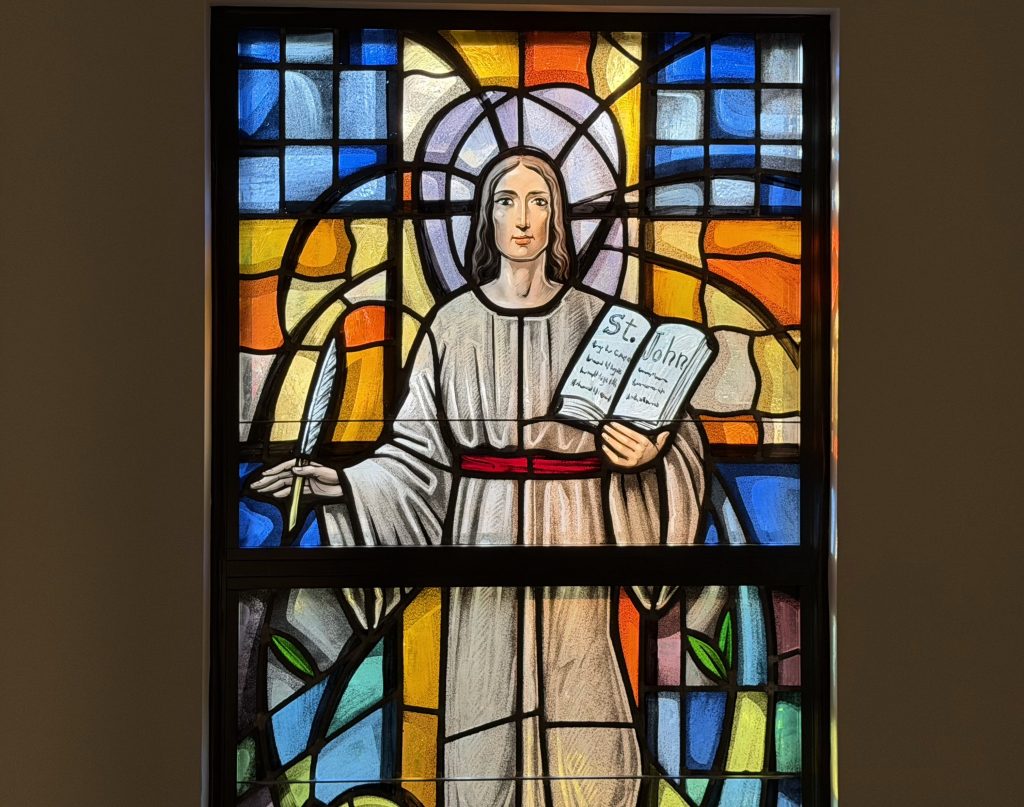
Painting: St. John stained glass window from Holy Cross CC, Vero Beach, FL

Link for the Mass readings for Saturday, December 27, 2025

May we trust the guiding light of God and follow his lead.

The Gospel of Luke and today’s first reading from the Book of Judges both continue the theme of divine intervention through angelic messengers and the message they convey is new life. The wife of Manoah, not named, and Zechariah, the husband of Elizabeth, both receive the message of an impending birth. The miraculous claim here is that both women are beyond child bearing age. These accounts also bring to mind the blessing of the conception of Isaac in the womb of Sarah, wife of Abraham.

For women of ancient Israel, being barren was a tremendous cause for shame; for many women, their worth was defined by their ability to bear children. This was in evidence in the words of Elizabeth. When she was aware she had conceived she said, “So has the Lord done for me at a time when he has seen fit to take away my disgrace before others.” (Lk 1:25). Her shame and anguish, her long period of barrenness, through the words of Gabriel were coming to an end.

Many women today feel similar anguish and shame in that they desire to have a child and are not able to. There are many reasons for infertility, but there may also be a plan that God has in place that is not readily apparent at the time. One may be God’s timing, for Mary it was too soon! For Manoah’s wife and Elizabeth it was about time! But in each case God had his plan and timing in mind. For some women there may be another way of serving other than being a birth mother.

Adoption or foster parenting of children who are in desperate need of safe, stable homes are direct options. Some more indirect ways could be assisting in caring for nieces and nephews, cousins, teaching catechesis or working with youth groups. Other ways to serve could be through more time consuming active ministries, vocations, or jobs. There can also be underlying medical conditions as well as the stress of trying too hard. I know of two occasions in which each couple adopted, shortly thereafter, both couples were blessed to conceive a child. I cannot imagine wanting to give birth to my own child and not be able to do so, nor can I imagine the inner anguish that may cause. I do believe that God has a plan for each of us and when we align ourselves with his will we will truly be happy and fulfilled.

Advent is a time of waiting and anticipation. There are periods of waiting in all of our lives and we can certainly feel impatient with God and ourselves. We have certain expectations, intentions, and plans that we would like to see fulfilled, but often are not capable of seeing far enough down the road to notice if those plans are apparent or actual goods. The light at the end of a tunnel could actually be a train!

When we remain faithful like Manoah’s wife, Elizabeth, and Mary, and resist the temptation to go off on our own, while seeking to understand God’s will, we will find fulfillment and joy better than we could ever imagine on our own. Each of us are called in our own unique way to bear Christ to a worn and weary world desperately in need of new life!

We will also enjoy the time of waiting more when we believe that God has our best intentions in mind and that following his will is the best course of action. In the remaining days of Advent, let us trust that God is preparing us for something even greater than we can ever hope for or imagine!

———————————————————————–

Photo: God will give us enough light to see a few steps ahead. When we walk those steps, he will offer some more light for the next few.

Link for the Mass readings for Thursday, December 19, 2025

“You may go; as you have believed let it be done for you.”

The centurion said in reply, “Lord, I am not worthy to have you enter under my roof; only say the word and my servant will be healed” (Mt 8:8).

After Jesus finishes his Sermon on the Mount, he comes down from the mountain. In the opening of chapter eight, we see two hearts open to God, a leper (who is not included in today’s reading but you can see his encounter with Jesus by reading Mt. 8:1-4.) and a centurion. The centurion may or may not have been a Roman but he certainly was a Gentile. He, a member of an occupying army, was aware of the animosity many Jews felt toward him. Yet he, like the leper, approached Jesus.

Jesus saw in the leper, not revulsion, and in the centurion, not an enemy, but first and foremost, human beings in need, two persons with faith and belief. Reading on we see that Jesus also heals the mother-in-law of Peter and many who are possessed. Jesus reached out to them with a simple touch of his hand, with his healing words and in so doing brought to each of them the healing they sought. Jesus shows us that the kingdom of his Father is open to all who have faith and believe.

Jesus said to the centurion, “You may go; as you have believed let it be done for you” (Mt. 8:13). Do we have the same belief as the leper, the centurion, and Peter’s mother-in-law? Each of them believed in Jesus and experienced healing.

We are all wounded by sin and also in need of experiencing physical, psychological, and/or spiritual healing.  Jesus is just waiting for us to ask, and to open our hearts and minds to him, so that we too may be healed and transformed by his forgiveness, love, and mercy. We, like the centurion and Peter, can approach Jesus on behalf of others who are also in need of healing. Let us resist the temptation to judge anyone as unworthy to receive the grace, love, and mercy of Jesus but be willing to see others in need and bring Jesus to them.

As God brings people into our lives, let us receive them as Jesus did: as fellow human beings, first and foremost, created in his image and likeness. May we be healed from any revulsion, prejudice, or temptation to define others with labels and instead be willing to allow Jesus to reach out through us to share his healing word or extend his healing touch to one another. Let us believe in Jesus, be healed and help to heal others!


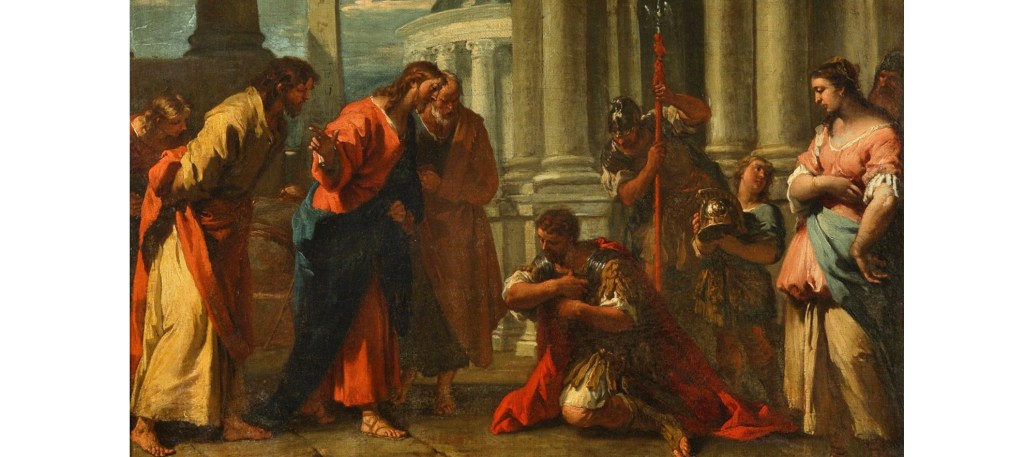
Painting: Sebastiano Ricci, “Christ and Centurion”, 16th century, Italy

Link for the Mass readings for Saturday, June 28, 2025

We accomplish the work of God by trusting and believing “in the one he sent.”

One of the best ways to celebrate the Easter Season is to continue to conform our lives to the one who gave his life for us that we may experience and be engaged in our life to the full. We can accomplish this better by putting into practice what we read in the Gospels as well as being open to encountering God in our daily experiences and one another.

Today’s Gospel reading continues after Jesus not only fed the 5,000 but also after he had walked across the Sea of Galilee and guided his disciples safely to the shore. Those who had eaten as a result of the multiplication of the loaves and fish, got in their own boats to follow Jesus to Capernaum as well.

When the crowd found and gathered around Jesus, he continued to teach them, guiding them to “not work for food that perishes but for the food that endures for eternal life, which the Son of Man will give you.” The people asked him what they could, “do to accomplish the works of God?” Jesus answered and said to them, “This is the work of God, that you believe in the one he sent” (cf: Jn 6:27-29).

To believe in the one he sent. The response of Jesus may not appear to fit the request of how to accomplish the works of God. But to believe is not passive. Belief is to be followed by action. If we say that we believe in Jesus, we are invited to pray with him, worship him in communion with fellow believers, sing songs praising him, give to and serve one another by practicing the corporal and spiritual works of mercy.

Believing in the one God the Father sent, believing in his Son, also means that we allow Jesus into our minds and hearts, we allow his light to shine in our places where there is darkness and pain, where we are in need of confessing and healing. When we believe in Jesus, we are willing to submit our will to his will. The good news is that Jesus knows what is the best for us, what will truly fulfill us and give our lives meaning. The challenge is, are we willing to trust Jesus with the direction and path of our lives?

To accomplish the work of God, we must believe in the one whom he sent. To believe in Jesus, we need to trust him. As we spend time reading, meditating upon and praying with the recorded accounts of Jesus in the gospels, are lives become transformed when we then put what he has taught us into practice.  We will accomplish the work of God by trusting, learning from, and following his Son, Jesus, who the Father sent to be one with us in our humanity so that we can become one with him in his divinity.

——————————————————-
Photo: Blessed to be following Jesus and serving him each day as his priest for the past year!

Link for the Mass readings for Monday, May 5, 2025

Let us repent and believe.

“This is the time of fulfillment. The Kingdom of God is at hand. Repent, and believe in the Gospel” (Mk 1:15).

With these words as recorded by Mark, Jesus begins his public ministry in time and space and we in 2025 begin the first week of Ordinary Time together. Whether we are in the season of Christmas, Easter, or Ordinary Time, each day is an opportunity to be thankful and celebrate our life for this continues to be “the time of fulfillment”. The Kingdom of God is still at hand because Jesus is still present with us.

We are not alone on our journey. The Son of God became human, as we just celebrated this Christmas season, and as we will celebrate in Easter, he died and rose again. This was no mere resuscitation like with Lazarus who rose and died again. Jesus conquered death and became the firstborn of the new creation. Ordinary Time is the season in which we not only study the life and teachings of Jesus but hopefully continue to be willing to be more conformed to his Body and the will of his Father through the love of the Holy Spirit.

One of the things that may hold us back from embracing the gift of the Kingdom of God in our midst is that we have often chosen to place our focus on other distractions or diversions or placed ourselves first before God and others. Jesus calls us to reorient our lives in urging us to repent, to turn away from the false reality that we are the center and author of our own lives, such that we come to realize the truth that God is our true author and director. To repent also means to open ourselves to his love, to place our trust in him, and to be assured that God accepts us as we are, right now at this very moment.

We do not repent so that God will love us. We do not have to do anything or act perfectly or say the right prayer for God to love us. We just need to “move the Lord out of the category of ‘polite company’ and into that of intimate friend to whom one can tell everything” (Barry 1987, 55). To repent means to turn back to the God whose arms are wide open ready to embrace us. We are given the opportunity to see where we have turned away from God. Let us run into his waiting embrace and receive the forgiveness, mercy, and love that he offers us.

The call to repent that Jesus accentuates is a continuation of the preaching of the prophets and John. What he adds to repentance is to believe. To believe is to “trustingly accept and yield to what God is doing in him. The kingdom is near enough that anyone who so chooses can reach out and lay hold of it through faith (Healy 2008, 42). As we turn back to God, reorient our minds to his guidance and direction, reflect on how much he has blessed us, we will better make an ascent to believe.

To “repent and believe” is a good way to begin our journey into Ordinary Time together. May we resist the temptation to hold anything back and share more with our Father and grow closer to God each day. Let us trust in Jesus who encourages us to resist limiting God and the possibilities he places before us. Instead of attempting to bend his will toward ours, may we allow the love of the Holy Spirit to expand our hearts and minds such that we will believe in and trust God more so to be like a pencil in his hand.


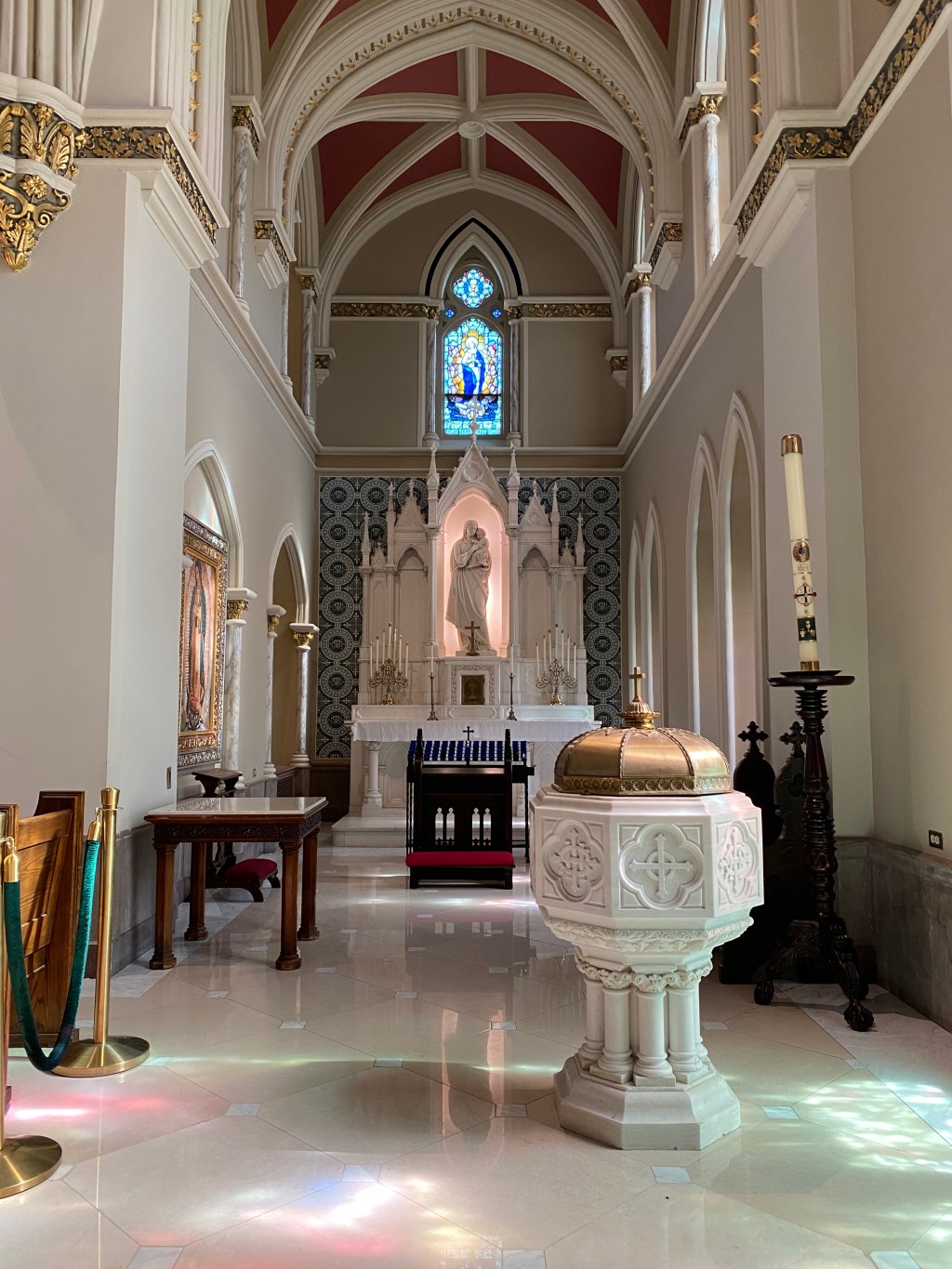
Photo: A good way to reorient our minds and hearts to the will of God and to believe is to slow down and make time to pray. Doing so at the side chapel in the Cathedral of Charleston this past June.

Barry, S.J, William A. God and You: Prayer as a Personal Relationship. NY: Paulist Press, 1987.

Healy, Mary. The Gospel of Mark. Grand Rapids, MI: Baker Academic, 2008.

Link for the Mass readings for Monday, January 13, 2025

“Blessed are you who believe.”

If you attend Mass daily or pray with the daily Mass readings, you may wonder, “Didn’t I just hear or read this account?” You would be correct, as this was the same Gospel reading as Saturday morning’s daily Mass. The difference comes in with the other readings.

The first reading from Micah may seem a bit obscure and we might be moved to question what does this have to do with getting ready for the coming of Jesus? Bethlehem would be our first clue. Bethlehem is the city of the birth of David. Micah shared that, “from you shall come forth for me one who is to be ruler in Israel; whose origin is from of old, from ancient times” (Micah 5:1). Micah is prophesying that the messiah will be no mere shadow of David, nor a mighty judge like Samson. This one has his origins “from of old”, beyond time. This messiah will be God with us. Both Matthew and Luke pick up on this in their nativity accounts (Matthew 2:1-2 and Luke 2:4-20) that we will read on Christmas.

So what about Ephrathah? Jews from the time of Jacob until those practicing today would pick up the reference to Ephrathah right away as being the burial place of Rachel the mother of Joseph and Benjamin, and beloved wife of Jacob. Though not the birth mother of the twelve sons of Jacob, Rachel was considered the matriarch, the mother of Israel. Jacob’s name, after wrestling with the Lord all night, was changed to Israel.

Echoes of Rachel being the mother of Israel also arose from the prophet Jeremiah when he wrote of her by name as weeping over her the fall of Jerusalem at the hands of the Babylonians. And yet, God sends comforting words through the prophet: “There is hope for your future – oracle of the LORD – your children shall return to your own territory” (Jeremiah 31:15-17).

We can see with the early Church Fathers that David was the premier king of Israel while at the same time he was foreshadowing Jesus the one “from of old” as Micah predicted. Rachel is a foreshadowing of Mary, the mother of Jesus, the mother of the Twelve Apostles, the fulfillment of the gathering in of the lost twelve tribes of Israel and the mother of the Church. She, like Rachel, would also suffer at the death of her children, but also be the intercessor for them through her suffering.

Mary is the new Rachel and also the new Eve because Mary’s obedience unties the knots of Eve’s disobedience. As we learned in the second reading to the Hebrews, God has no pleasure in sacrifice but takes pleasure in those doing his will. God delights not sacrifice but obedience. Mary, before becoming the mother of the Messiah, the mother of God, was obedient with her “yes” at the Annunciation. As Jesus said, the one who does the will of his Father was his mother (cf. Matthew 12:46-50). Who followed the will of the Father better than Mary?

Very soon after her “yes”, and the conception of Jesus in her womb, Mary went in haste to see Elizabeth. Each celebrating the gift of new life in each of their wombs. And how is Mary greeted by her elder cousin? With reverence, which was unheard of. The youth revered the elder family members during Jesus’ time. After hearing the words of Mary’s greeting, experiencing her son leaping in her womb, Elizabeth is moved by the Holy Spirit to proclaim blessing upon Mary: “Blessed are you among women and blessed is the fruit of your womb” (Luke 1:42). Elizabeth does so with great joy, “crying out in a loud voice.” 

May Elizabeth and Mary’s joy reach into the depths of our souls. May we be open to believe.

May we believe that Jesus is the Son of God who became man. That Jesus came into the world not just to be a great rabbi and teacher, not just to perform miracles and cast out demons, nor just to be the messiah, that Jesus came not just to live, but that he came to die, to give his life for us, and in so doing become our savior. This birth we are about to celebrate was just a foreshadowing of his impending death.

As Bishop Fulton Sheen wrote, “He was laid in a stranger’s stable at the beginning, and a stranger’s grave at the end… He was wrapped in swaddling bands in His birthplace, He was again laid in swaddling clothes in His tomb… It was not so much that His Birth cast a shadow on His life, and thus led to his death; it was rather that the Cross was there from the beginning, and cast its shadow backward to his birth…” (The Life of Christ).

Jesus, as the fulfillment of the law and the prophets, is inviting us in these final days of Advent to do as he, Mary, and Elizabeth did, to follow the will of his Father. What joy we too will experience when we open ourselves up to the reality of the gift that God has given us, his Son, and so rejoice with Elizabeth and Mary that we too have a part to play in salvation history!


Photo: May these words and picture help you to experience some quiet time to pray and ponder about the connection between the birth and death of Jesus and the life he has called us to live.

Source for Bishop Sheen quote and background information from Dr. Brant Pitre, Mass Readings Explained, The Fourth Sunday of Advent Year C, Christmas and the Cross

Link for the Mass readings for Sunday, December 22, 2024

Believe in the One who God has sent, Jesus, the Bread of Life!

Yesterday and today’s Gospel readings from John are laying the groundwork for the discourse of Jesus to come. In yesterday’s account, Jesus shared with the people who gathered about him, those who had already received the miraculous multiplication of bread, that they were not to “work for food that perishes but for the food that endures for eternal life” and Jesus also shared that they were to “believe in the one [God] sent” (see Jn 6:27-29).

In today’s account, the people are asking for a sign, just as Moses gave to their ancestors in the desert. Jesus reminds them that his Father had given them the bread from heaven, and also added: “My Father gives you the true bread from heaven. For the bread of God is that which comes down from heaven and gives life to the world” (Jn 6:32-33). Certainly, this offer is appealing, and so the people not only want some of this bread also, they want an endless supply of it. Now Jesus moves from the subtle foundation he has been building to the substance of his point: “I am the bread of life; whoever comes to me will never hunger, and whoever believes in me will never thirst” (Jn 6:35).

Jesus encouraged his listeners to pursue the food that “endures for eternal life” to believe in the one his Father sent, then he shares how his Father gives them the true bread from heaven “for the bread of God is that which comes down from heaven and gives life to the world.” Jesus is the one his listeners are to build their relationship with, for he is the very presence of God in their midst. Jesus is the promise of eternal life. Jesus is the one sent by his Father to give life to the world. Jesus is the bread of life!

We are a living craving, hunger, and desire to be one with God and each other, and this is true for the atheist and the believer alike. That which God has created, he has created good, but the material and finite will not fulfill us. We, in short order, experience the limitations of the finite and seek something more. This is how we are wired, because ultimately, our deepest desire, that which we seek to fulfill us, is eternal. The One to satisfy this eternal hunger which we can never exhaust is the bread of life, Jesus Christ.

Do we believe this to be true? Do we believe that Jesus is the bread of life, that he is the source and sustenance, the very foundation of our being and existence? Are we tempted and diverted by other things and so miss receiving the Eucharist at Mass or is making time to go to Mass and receive the Eucharist our reason to miss other things?

If we have been caught up: in the business of life, in the mere existence or survival mode of the day-to-day, or stuck in our sin, addiction, brokenness, or disillusionment, if we feel like we are just running on empty, and/or if we have just taken this reality for granted, then let us “believe in the one who God sent”, commit or recommit ourselves and our very lives to the one who is our source and sustainer, and let us come to receive Jesus, the Bread of Life in the Mass, at least each Sunday.

——————————————————————-

Photo: Praying by the tabernacle in the chapel at Bethany Retreat Center, Lutz, FL during my priestly canonical retreat back in November.

Link for the Mass readings for Tuesday, April 16, 2024