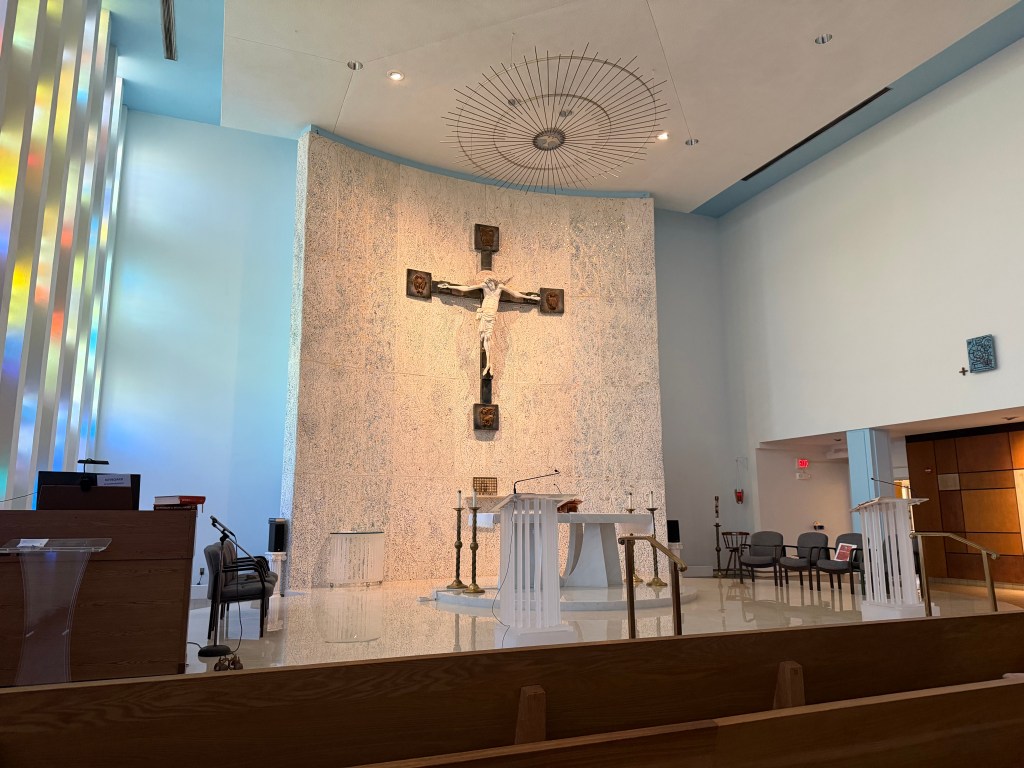
As we walk with Jesus through the narrow gate, we heal and remember who we are.

“Enter through the narrow gate; for the gate is wide and the road broad that leads to destruction, and those who enter through it are many. How narrow the gate and constricted the road that leads to life. And those who find it are true” (Mt 7:13-14).

Jesus meets us where we are in our present state of life. He accepts us as we are at this very moment. At the same time, Jesus does not want us to just settle and to merely get by, surviving day by day. Instead, he encourages and guides us to be fully actualized. He calls us to perfection, to holiness, to be saints! He sees in us, as he did in his disciples and apostles, the promise that God has placed in our souls and knows the heights to which his Father calls us to ascend. We each have a unique gift or gifts to offer to the world, each and every one of us.

One way of interpreting entering the narrow gate is that we need to say no to everything. When, in fact, Jesus invites us to a no to anything or anyone that leads us away from fulfilling our promise and who we are as God’s beloved daughter or son. He invites us to say a firm no to those apparent goods that we find initially inviting but soon realize that they are empty promises, can burden us, weigh us down, and worse lead us to attachment, addiction, and enslavement.

To pass through the narrow gate, is a yes to that which is truly good, will bring us happiness, fulfillment, and authentic freedom. Each yes to God is a moment of growth and grace. It is also a death to supporting our false ego, turning the focus away from turning in upon ourselves, constricting, and instead receiving God’s love and his expanding our hearts and minds draws us to will the good of and accompany others.

Jesus will help us in seeking and discerning his will. Spending time in silence and prayer can often reveal the sources of our worry, anxiety, or fear; pride, judgment, or prejudice; sinful actions, harmful habits, and/or addictions. We need not deny or run from them. Instead, acknowledge whatever arises with Jesus, and then allow him to provide healing and transformation. Jesus offers us a clearer vision so that we can choose with more freedom. This will not be a one-time, done now for all activity, but a daily, disciplined commitment and practice of discernment and examination of our conscience.

We need to continually welcome the Holy Spirit and he will give us the courage to discern between apparent and authentic goods. A good meditation is to imagine placing our hand in Jesus’ hand as if we were a small child and allow him to lead us through the narrow gate. As we go through all that is not of him, all the excess that we carry, will fall away, and in passing through we come face to face with who we always have been, a beloved daughter or son of our loving God and Father. What has fallen away, let us resist picking up again.

———————————————————————-

Photo: As we grow closer to Jesus, as we heal, as we are restored and redeemed, we return to and experience our original innocence.

Link for the Mass readings for Tuesday, June 23 2026

Our hearts, thoughts, words, and deeds can dehumanize and depersonalize or provide healing and give life.

As was presented yesterday, Jesus made it clear that he did not come to abolish the law or the prophets, but he came to fulfill them. In his Sermon on the Mount as recorded by Matthew, Jesus offered practical ways in which we can find fulfillment and happiness by properly ordering our lives by following his way. In today’s account, he introduces the first of six antitheses. With these apparent contrasting statements, beginning with, “You have heard that it was said” followed by, “But I say to you”, Jesus provided for his disciples the way to avoid the trap that some of the religious leaders of his time fell into: “I tell you, unless your righteousness surpasses that of the scribes and Pharisees, you will not enter into the Kingdom of heaven” (Mt 5:20).

The scribes and Pharisees that Jesus pointed out were those who believed that they were following the letter of the law and/or commanding that others do so, but their hearts were not changed. They may have been adhering to the external provisions, but there was no transformation, their hearts were hardened, they were focused more on their own access to honor and power. They were also imposing strict adherence to the law without providing the support or means for others to achieve what the law imposed. The law became more important than the dignity or value of the person. Jesus recognized the law but also realized that it was in place to help to provide guidance and discipline so one could better resist the temptations of our fallen nature. The law was to be a foundation to be built upon, not the end goal in and of itself.

This and the five antithesis to follow, outlines how: “Jesus calls his disciples to a higher standard than that of the scribes and Pharisees and he brings out the true meaning of the law. External conformity to the law is not enough. The law must be interiorized so that it penetrates one’s heart and leads one to live according to God’s ultimate intentions” (Mitch and Sri, 96).

Just as children need clear boundaries and structures in place to provide a clear path toward healthy development, this is also true for those of us growing and maturing spiritually. We need to learn to crawl, to build strength and balance before we can take those first wobbly steps. With continued support, we are then able to walk and soon run. Jesus is not only providing the means to go through each of these stages in our faith life, figuratively teaching each of his disciples and us today to not only crawl, walk, and run but to also be able to fly as we seek to reach the heights that Jesus is willing to raise us to!

The Beatitudes and six antitheses are challenging when we take the time to read and ponder them because each one of them goes counter to much of the way the structure of our fallen world has been governed for centuries. If we are to catch the fire that Jesus has come to set, we need not only to read, pray, meditate, and contemplate upon on the teachings of the Sermon on the Mount that we are working through, we need to also see their relevance and practicality to our time and place today, not dismiss them but begin to put them into practice. As Christians, our faith ought not to be shaped and informed by our culture, but we are to be shaped and conformed by the Gospel of Jesus the Christ, so to shape and inform our culture.

Today we start with the first antithesis: “You have heard that it was said to your ancestors, You shall not kill; and whoever kills will be liable to judgment. But I say to you, whoever is angry with his brother will be liable to judgment, and whoever says to his brother, Raqa, will be answerable to the Sanhedrin, and whoever says, ‘You fool,’ will be liable to fiery Gehenna (Mt 5:21-22). The seeds of anger begin to sprout in our mind from our knee jerk reactions to a perceived or actual threat, from our hearts hardened by prejudgments, prejudices, and/or a reflection of our level of spiritual immaturity.

Jesus addresses the known provision against murder. He then builds a hedge around the Torah. Building a hedge is a common practice in which if one does not want to break the law, another law is imposed so as to protect one from even getting close to breaking the first. If we can resist the temptation to react and instead step back for a moment, take some deep breaths, pray, and seek the guidance of the Holy Spirit, we will be less likely to criticize, judge, demean or dehumanize another, and then there is much less chance for our anger to grow into wrath, that left unbridled could lead to murdering someone.

Jesus is also saying that our words matter, that they have the power to destroy or to create. Calling someone Raqa, Aramaic for a blockhead or idiot, and then calling someone a fool, would “be liable to fiery Gehenna” (Mt 5:22). How much more egregious are we today? How polarized we have become inside and outside of the Church because of the level of demeaning words, tone, and language that is spoken, condoned, and justified? This has a ripple effect that poisons our children and each of us. We wonder why we are more in a state of anxiety and stress where we see our own leaders no longer speaking with respect but in dehumanizing ways. We can then fall into the same pattern which poisons our family, relationships, politics, and it has even poisoned the Church with growing divisive rhetoric, overt expressions of prejudice, and depersonalization.

Instead of settling for two-dimensional caricatures of one another, we can go deeper when we are willing to spend time with and get to know each other. Jesus challenges us to slow down and see the person before us with dignity and respect. When we resist reacting, giving in to our biases, and prejudgments, and instead recognize the value and dignity of each person, we will have a better chance of building relationships and saying only the good things that people need to hear. We will also be more apt to reform policies and structures that respect the dignity of each person in the womb, after birth, and at each stage and condition of life until natural death.

May we all take some time today to reflect on Jesus’ teaching about how we think, speak to and about, as well as act toward one another. May we examine our consciences and seek forgiveness for those times we have thought, condoned, or justified thoughts, words, and/or actions that have been belittling, dehumanizing, and demeaning directly or while with others. In this way, we can ask God to heal our hearts. “[O]nly peaceful hearts can build a world of peace… The heart is the source of peace: there we must learn to meet rather than clash with each other, to trust and not mistrust, to listen and understand instead of closing ourselves off to others” (Pope Leo XIV, xiv). 

Jesus, please heal us and infuse us with your justice, love, and mercy so that we will be inspired to live out your teachings daily. Help us to encounter each other with mutual respect and understanding as our brothers and sisters, no matter our race, ethnicity, creed, and/or gender, and to commit to building a culture of life and dignity for all, not in some abstract utopian way, but in the concrete moments, one person, one encounter, and one thought, word, and action at a time.

——————————————————————–

Photo: Making time to breathe, receive, rest, and abide in God’s love will help us to better discern our thoughts, words, and actions and allow the Holy Spirit to transform our hearts and minds.

Mitch, Curtis. The Gospel of Matthew. Grand Rapids, MI: Baker Academic, 2010.

Leo XIV, Pope. Peace Be With You!: My Words to the Church and to the World. Dublin, Ireland: Harper On, 2026.

Link for the Mass readings for Thursday, June 11, 2026
The Son has come down from heaven, to show us the way to heaven.

Jesus continued to teach Nicodemus and with these words, “No one has gone up to heaven except the one who has come down from heaven, the Son of Man” (Jn 3:13), Jesus expressed the truth about who he is, the Son of the Living God. He called himself the Son of Man back in the first chapter when he described how angels will be ascending and descending on him, how in his very person, he opens up heaven for humanity (John 1:51). Jesus is the Son of God and the Son of man. From all eternity and for all eternity the Son is begotten not made. The Son has always existed with the Father and at the appropriate time, the Father sent his Son to be one with us in our humanity so that we can become one with him in his divinity.

We have been loved into existence, along with all of creation, by the outpouring of the love shared between God the Father and God the Son, who is God the Holy Spirit. The Son came to invite us back to restore our relationship with his Father, to show us where we have strayed, so that we may correct the course of our journey and return back to who we have been created to be. We have been created to be in communion, in an intimate relationship with God and one another.

Jesus, the Son of God became incarnate, took on flesh, and entered into our human condition that we would be deified, transformed into the very likeness of God by our participation in the life of Christ. This is why Jesus tells Nicodemus that we are to be born from above because through our baptism we are born again as daughters and sons of God our Father. The one who has come down from heaven has, as St Irenaeus wrote, “opened up heaven for us in the humanity he assumed.”

It is important to make time each day to savor the truth that we have been loved into existence. As we do so, we will realize that our lives are gifts from God and we have been created to receive God’s love and love others in return. During these present, uncertain times, we are given an opportunity to be more aware of what is important to us as well as Who and with Whom our true stability lies. It is in times like these that we are given a chance to appreciate and grow closer to God, our family and friends, as well as begin to be more aware of those who are in dire need around us.

The gift of all life is precious. May we resist taking this precious gift for granted, and love others today in our own special and unique way. Jesus has loved us from the beginning, more than we can ever imagine and more than we can ever mess up! Just as the sun shines on the good and bad alike, so God loves each one of us with a love that is beyond all our understanding. The flow of our lives as disciples is to receive and share the love of God.


Photo: With each sunrise, may the Son of God rise in our hearts!

Link for the Mass readings for Tuesday, April 14, 2025

In coming to know Jesus as a person, we can better know ourselves and each other.

In the Gospel reading today, Jesus is accused of being an agent of Beelzebul, the prince of demons, because he was exorcising a demon from a man that was mute. Jesus addressed the critique and showed the polarizing nature of the onlookers who were unwilling to see the healing before them for what it was. Jesus then stated the obvious: “Every kingdom divided against itself will be laid waste and house will fall against house” (Lk 11:17).

If Jesus was an agent of the prince of demons, he was not a very good one. Satan seeks to sow discord and division. Jesus seeks to bring about unity. Now it is true, that five verses later in the Gospel of Luke, Jesus is recorded as saying: “Do you think that I have come to establish peace on the earth? No, I tell you, but rather division” (Lk 12:51). Anyone feeling a bit confused? Welcome to the wonderful world of the Bible and discipleship!

To understand Scripture, we need to understand the context of the whole of Scripture, not just isolated verses. To be a disciple, we need to know and trust Jesus, even when we hear something that does not upon first hearing make sense. Throughout the ministry of Jesus, he seeks the unity that all may be one as he and the Father are one (cf. John 17:21), yet he has consistently experienced those that rejected his message as well as not acknowledged the source of his healings and exorcisms as witnessed in today’s Gospel account. Because of their hardness of their hearts, some among the witnessing crowd were unwilling to acknowledge that Jesus is the Son of God and so there must be a reason for how he performs exorcisms and miracles.

The reason is that Jesus drives out demons, “by the finger of God” (Luke 11:20). His listeners would have picked up on this referential term, for the Pharaoh’s magicians and sorcerers made this same statement when they could no longer produce the effects of Moses and Aaron’s plagues after their infesting the land with gnats (Exodus 8:19). So just as Moses and Aaron were operating through the will, the finger of God, so too was Jesus.

In following the will of God, Jesus demands a choice. Then and now. We need to decide if we are either going to be for him or against him (cf. Lk 11:23). The division Jesus is talking about results from those who choose not to recognize that Jesus is who he says he is and reject him and those who accept him for who he is and follow him. This choice continues to cause division within households, families, and friends even today, even among those on both sides that say they are following Jesus!

The greater take away from this verse and Jesus’ teachings as a whole, is that when we are unified, embracing the gift of our diversity, we are stronger than when we are divided by limiting ourselves to mere labels, curving in upon ourselves. In our modern context, labels, such as liberal and conservative are not helpful, whether they are being used in a political or religious context. Life is not as black and white as many would like it to be. It is certainly easier to cast labels, but interactions with people and developing relationships are much more nuanced. We are not mere cardboard cut outs, or caricatures.

To better understand the essence of who we are as human beings demands greater time and experience of each other than an outward appearance or isolated statement may portray. Many more of us, if we shake off any label for a moment, could honestly admit to believing in and supporting issues that are important to us from both sides of the so called left or right. That stated, I am also not stating in a reductionist way that there is no objective truths. There is. The foundational truth of reality is that Jesus is the Son of God and we are his beloved daughters and sons. If we can begin from that truth, we will be off to a better start I our dialogue.

Many times, once we have cast a label, we believe that we have “defined” the person. They are classified in their box and tied up in a neat and pretty bow, and woe to the person who resists being boxed and bowed. I remember reading from one of the books from the tracker, Tom Brown, Jr., in which he described how many people when seeing a bird, such as a blue jay, robin, or crow, are often satisfied with the label, the naming of it, and move on from that sighting self-satisfied. They think that in that simple identification they now have come to understand all that there is to know about that particular species of bird. So much of the essence and majesty of one of God’s amazing creatures is missed by such a simplistic and limiting classification!

Unfortunately, we do the same with each other. We can prejudge, as did some of the crowd who said that Jesus cast out this demon because he was in league with Beelzebub instead of through the power of God. We can also falsely believe we know everything there is to know about a person or group we prejudge. This is a very limiting and divisive approach. Jesus invites us to encounter people, to spend time, get to know one another, and break bread with each other just as Jesus did. In spending time with one another and sharing experiences, the caricatures can be filled in with some substance and we can come to know a little better the person beyond the prejudgment.

If it walks like a duck and quacks like a duck, it may very well be a duck, but the duck is also so much more than its classification. This is much truer for us as human beings created in the image and likeness of God.

———————————————————————————

Photo: Spending quiet time with Jesus helps us to experience and know him and to better experience others as he knows them.

Link for the Mass readings for Thursday, March 12, 2026