Nourished by the living bread of life, we will find rest in God’s love and know who we are.

Jesus said to the Jewish crowds: “I am the living bread that came down from heaven; whoever eats this bread will live forever; and the bread that I will give is my flesh for the life of the world” (Jn 6:51).

Jesus is the bread that came down from heaven. He is to be our nourishment, source of refreshment, and very life. Like a tree that is planted near the streams of living water (see Psalm 1:3) we are refreshed in all seasons, when all is tranquil as well as when we are immersed in our unique challenges and struggles, as long as our roots remain tapped into the well spring of the life of Jesus.

We are to look to the things of heaven for our foundation, not the things of this earth. For the things of this earth are passing away as many of us know all too well. This does not mean we aren’t to enjoy the blessings that God has given us. All that God has created is good and to be enjoyed as a gift of his grace. It is more a matter of perspective. 

We are not to be attached to the things of this world, even to those closest to us, because we are finite and imperfect and so we will never be fully satisfied because we seek the eternal in the depths of our souls. With God as our center and our refuge, we have a stability that is not only unshakable but eternal so cannot be exhausted. We know that no matter what, we are accepted, we belong, and we are loved. We renew, heal, and grow in wholeness as we receive him most intimately and concretely in the Eucharist, the bread from heaven, but also in resting in him, his creation, spending time with good friends and family as well as those he calls us to serve.

And we can do this more authentically and purely when nothing or no one else, including ourselves, but Jesus is the center of our lives. Letting go of our attachments takes time and effort but is well worth it because when we ask Jesus to reveal to us that which we place before the Father he will do so.

When we collaborate with our Loving God and Father to let go, this practice leads to a freedom and peace that we would otherwise not experience. We will still encounter the pain of loss, but it will not be as debilitating. In putting God first and deepening our relationship with him, we receive his love, we start to see ourselves as he sees us and grow in his wholeness which overflows into our relationships because instead of attempting to be something we are not just to fit in or get along, we experience the relief and rest of being simply ourselves. 

As we experience God’s love, we will slowly and surely come to identify ourselves not by what we do, who we think we are or who we think others think we are supposed to be, and/or others tell us to be, but rest instead in the truth and identity of being his beloved daughter or son. Our anxieties and fears will have less power over us, we will become less insecure and more confident, pride will weaken because we no longer place ourselves first. We will also begin to experience the maturing of the fruit of the Holy Spirit. We become more loving, joyful, peaceful, patient, kind, generous, faithful, gentle and able to practice more self-control. 

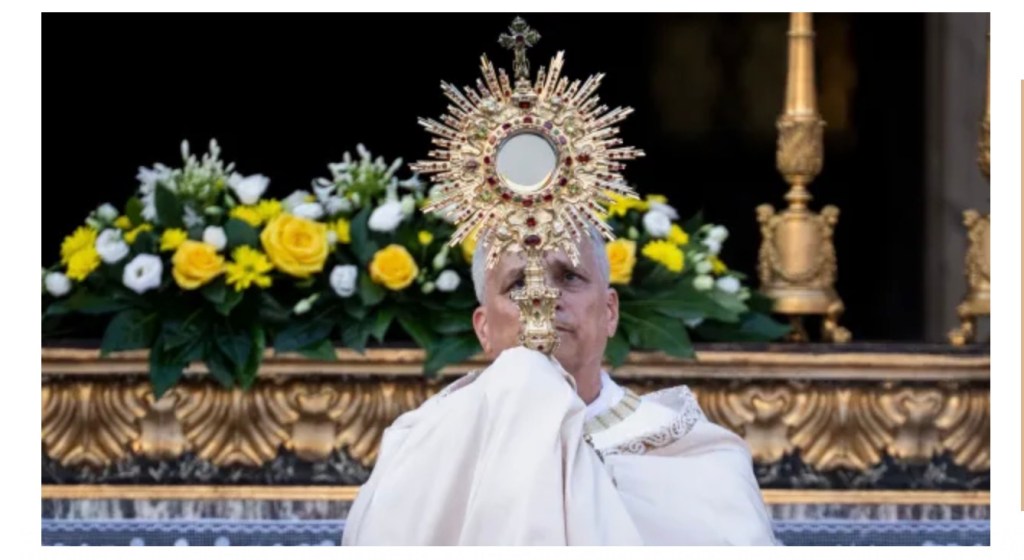
During this Corpus Christi Sunday then, may we recommit to the truth and reality that Jesus is with us in a special and unique way as the “bread of life” in the gift of the Eucharist. He will nourish and lead us deeper into relationship with his Father so we may experience the intimate love of the Holy Spirit.  “Strengthened by the food that God gives us, let us bring Jesus to the hearts of all, because Jesus involves everyone in his work of salvation by calling each of us to sit at his table. Blessed are those who are called, for they become witnesses of this love!” – Pope Leo XIV Homily, June 22, 2025


Photo: Pope Leo leading procession, June 22, 2025, taken by Antoine Mekary – Aletia.
Link for the Mass readings for Sunday, June 7, 2026

When there appears to be no way, trust in Jesus the Way.

Luke records how Jesus had been teaching and healing a large crowd of five thousand men. As the day was drawing to a close, the Twelve approached him and said, “Dismiss the crowd so that they can go to the surrounding villages and farms and find lodging and provisions; for we are in a deserted place here” (Lk 9:12). The disciples appear to show concern for the many gathered. Yet the response of Jesus may reveal otherwise.

When Jesus tells them to, “Give them some food yourselves” (Lk 9:13), the disciples are stymied, for all that they had, five loaves and two fish, would barely be just enough to feed themselves. The disciples first sought to send the people away, then could see nothing but the limited resources they had, they saw lack.

What follows is the miracle of the multiplication of the loaves and the fish such that everyone present had enough to eat. “They all ate and were satisfied. And when the leftover fragments were picked up, they filled twelve wicker baskets” (Lk 9:17). This miraculous account is recorded in all four Gospels. Time and again, throughout the Gospel accounts, Jesus is  able to provide a way where there appeared to be no way.

It is interesting as well that the word the disciples used, deserted, for we are in a deserted place, is erēmos in Greek. The immediate allusion is to the Hebrews who Moses had freed from Egypt. They too were in the deserted place, the wilderness. They also say their lack and constantly grumbled to Moses that they didn’t have enough and yet, God consistently provided for them bread from Heaven, the manna. Each day they did have enough to eat.

Erēmos can also be translated as lonely, a lonely place. One thing that is common among all of humanity is that we all experience loneliness. This is partly true because we separate ourselves from the deepest desire and hunger of our soul, our hunger to be loved by God. When we allow anyone or anything to be placed before our relationship with God, we will always experience a lack because only our relationship with God will truly satisfy us. Even the best of relationships, the best of things are finite, and will not last. In establishing and developing our relationship with God, all our other relationships and appetites can be properly ordered.

The next time, we feel like we can’t, we want to give up, we feel alone or are experiencing desolation, let us turn to our loving God and Father who will provide for our needs. He provides for us at every Mass the opportunity to experience his Son, the true miracle of bread and wine becoming the Body and Blood of Jesus the Christ. We can be nourished weekly, even daily, by the “source and summit of the whole Christine life” (Lumen Gentium) so that we can have the strength to persevere, that we can persevere, we know that we really and truly are never alone, and our desolation can be transformed into consolation by experiencing the love of the Holy Spirit.

Let us not buy into the lie of lack. Where his disciples saw lack, Jesus saw a way provided for by trusting in his Father and he multiplied the five loaves so the 5,000 all had their fill. We are finite human beings living in a finite world, yet we are not alone. Jesus, fully human and fully divine, continues to still be with us, present to us, just as he was with his disciples. As with them, when we trust in Jesus, all things are possible. When there appears to be no way, Jesus is the way. “When we give ourselves to Him, we receive a hundredfold in return. Yes, open wide the doors to Christ – and you will find true life” (Pope Benedict XVI in his inaugural homily, Sattler). Trust in Jesus today!


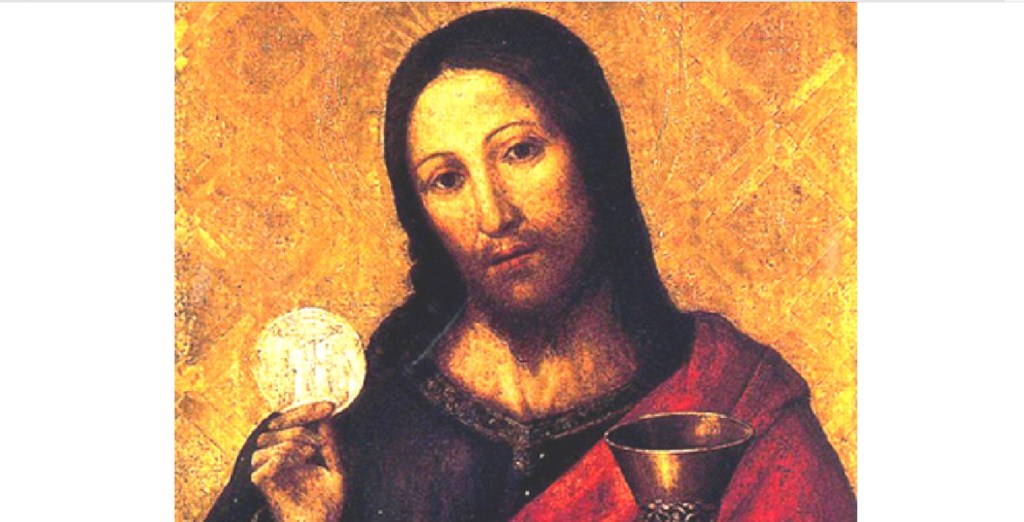
Photo: “Christ with the Host” by Paolo da San Leocadio

Link for the Mass readings for Sunday, June 22, 2025