We are all invited to the feast. How will we respond?

The Parable of the Wedding Feast (Mt 22:1-14) continues with a similar tone to The Parable of the Tenants presented last Sunday (Mt 21:33-43). An invitation is offered that is followed by rejection, death, and harsh judgment. We need to remember that these are parables, not specific historical accounts, in which Jesus is seeking to reveal something significant. Jesus would have also shaped this parable, as well as others, depending on the audience he was speaking to, a common practice in oral tradition. This can be a possible reason for the similarity and differences in the account of the same parable given in Luke (14:15-21).

Jesus often shared table fellowship with many, we see consistent evidence of this. Jesus also “used meal imagery to depict the eschatological banquet or final salvation” (Meier, 271). The imagery of the great wedding feast in this parable conveys to the listeners then and us reading today, that all are invited to participate in the kingdom of heaven. Jesus first sought to gather the scattered people, once united under King David as the twelve tribes Israel, yet there were those who ignored, were indifferent to, rejected, and even rebelled against his invitation.

They, as the chosen people of God, were to be a holy people, a faithful witness to the one God. Jesus sought to reignite their original purpose, yet there were those who refused and so he shared in this parable that others would be invited. Jesus’ invitation as a universal message echoes that of Isaiah: “On this mountain the LORD of hosts will provide for all peoples a feast of rich food and choice wines, juicy, rich food and pure, choice wines” (Isaiah 25:6).

As with the Parable of the Tenants, Matthew emphasizes not only the rejection of the invitation, but includes the violent images of the abuse and death of the servants sent by the king, and the king’s punishment, by putting them to death and then the burning of their city. Some biblical scholars see this as a possible allusion to the destruction of the Temple in 70 AD. Luke does not include the abuse of the messengers or the king’s punitive justice. Matthew was emphasizing that there will be accountability to the way in which one responds to the invitation.

We do not know the time or the hour, so we must not delay in our decision. “In the concrete context of his ministry, at any given time Jesus would have spoken this parable to this or that group of his fellow Jews as a salutary warning not to ignore his urgent final message, lest they suffer the consequences on the last day… Decide now, or soon it will be too late and your place will be taken by another” (Meier, 272). This message was directed to all who heard it. Each person then and now needs to make a decision.

Jesus, the Son of God, in the humanity that he has assumed, in his willingness to give his life for us, opened up heaven for us. This act of love and grace is a free gift and we are invited to participate. We can choose to be indifferent, receive, or reject the invitation. Many of those who have said yes, have followed the same path to martyrdom by sharing the message they have received and lost their life and now wear the white robes at the great wedding feast in heaven.

The invitation has been given to us today. We may not all be asked to give our lives but we are called to give witness to our faith in the unique way God calls us. Will we ignore, make excuses, or say yes?

Paul’s letter to the Philippians gives us encouragement that what we can depend on. We are to remember that Jesus Christ, who was raised from the dead assures us that, “God will fully supply whatever [we] need, in accord with his glorious riches in Christ Jesus.“ (Philippians 4:19).


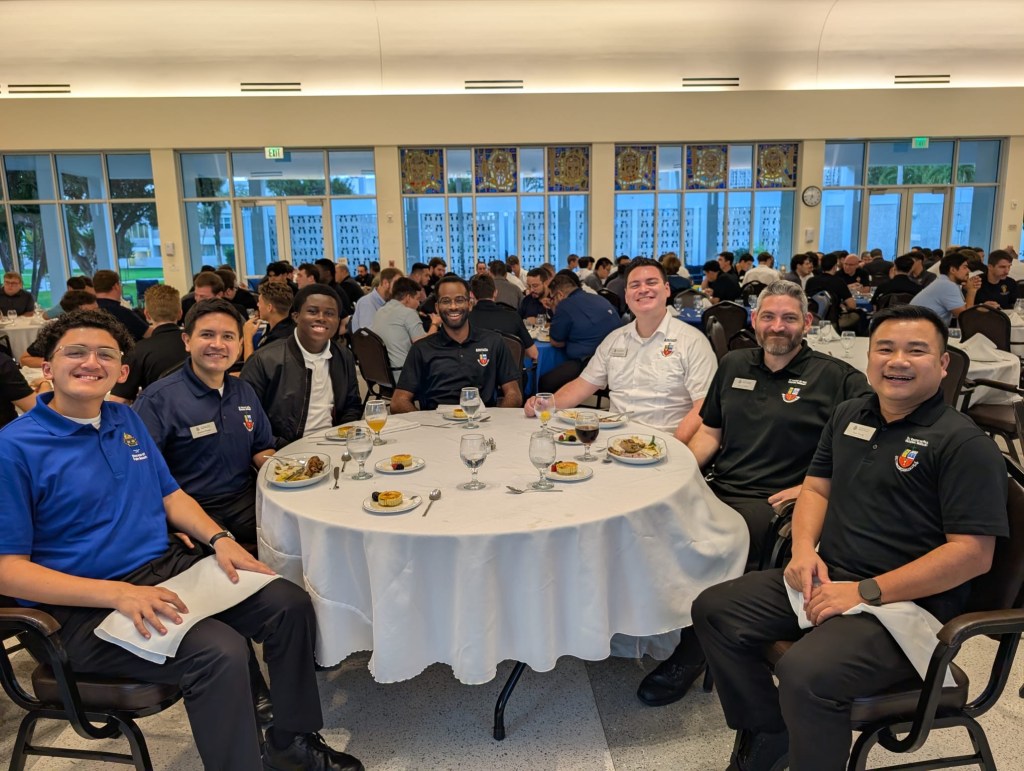
Photo: Seminarians who have said yes and united for a day at St. John Vianney College Seminary in Miami! Please keep in prayer our seminarians from the Diocese of Palm Beach.

Meier, John P. A Marginal Jew, vol 5, Probing the Authenticity of the Parables. New Haven: Yale University Press, 2016.
Link for the Mass readings for Sunday October 11, 2026

“Offering no resistance to one who is evil” is possible when we are grounded in God’s love.

Today we receive the fifth antithesis, in which, Jesus said to his disciples: “You have heard that it was said, An eye for an eye and a tooth for a tooth. But I say to you, offer no resistance to one who is evil” (Mk 5:38-39). The Mosaic law, an eye for an eye, that Jesus first addressed was originally an attempt to curb the emotive response of revenge. If someone had killed a clan or tribal member, there would have been those who would choose to retaliate by inflicting as much carnage as possible to the people responsible, even up to and including the death of the whole clan or tribe, even the women and children. The rationale behind this was that there would then be no one to come back for revenge. The idea of seeking instead an eye for an eye was to temper the retribution to a more measured and proportionate response.

Jesus though is saying that “an eye for an eye” does not go far enough, and raises the challenge of being his disciple to a higher level, being that even the thought of revenge is not to be considered. Jesus is not just seeking to lessen the cycle of violence, he is giving us the means to end it. Forgiveness is the cornerstone of the teachings of Jesus. Instead of seeking revenge, Jesus is commanding that we seek to forgive those who have harmed us. We who pray the Our Father or the Lord’s prayer, are to take to heart and be mindful of the words we pray each and multiple times each day: “forgive us our trespasses as we forgive those who trespass against us.“

The urge for revenge is powerful and primal. Revenge is wired into our survival instinct to protect ourselves. Jesus invites us to grow beyond our mere instinctual responses and survival instincts. He is calling us to move the bestial and to be a people who do not merely survive, but thrive. Jesus is seeking to infuse us with his divine life so that we will be transformed. This is true not only for ourselves but for those who would seek to do us harm. Instead of striking back with revenge, we are to be flexible and adept enough to instead appeal to their conscience. We are to take all that others throw at us, and meet them with the courage to stand and receive their worst, and disarm them with the blinding light of the love and forgiveness of Jesus.

This is no easy task, especially when we experience ongoing injustice and needless loss of life. To put into practice such teachings as the turning of the other cheek, we need to start small. We need to resist the immediate thoughts of revenge that arise for the smallest of offenses. When someone makes a snide remark, and/or offers demeaning or dehumanizing comments directed at us or others, we resist retaliation. We hold them accountable by not adding more fuel to the fire. Our hope is to receive the offense and mirror back to them what they have done such that their conscience may be convicted. By loving them instead of striking back in kind, we may win back a brother or sister.

To be a disciple of Jesus means we need to be contemplatives in action in the face of cruelty, division, and dehumanization. We need to ground ourselves in the word of God as we return to these challenging teachings of the Beatitudes and antitheses often, believe in them, meditate and pray upon them, keep them at the forefront of our minds and, with the courage and guidance of the Holy Spirit, put them into practice. Doing so will then help us to be centered and intentional when conflict arises. Instead of responding with a knee-jerk reaction, we can breathe and seek the Holy Spirit’s guidance and then choose how best to respond.

Some would say this is naive and impossible. It is true that we will not be able to resist thoughts, words, and acts of revenge and walk the path of forgiveness on our willpower alone. We need to surrender our ego and pride to Jesus, who as the Son of God became one with us in our humanity, experiencing our humanity at its worst, so that we can become one with him in his divinity and become human at our best. As we receive his love, forgiveness, and mercy, he will begin to transform us and forgive and love others through us.

———————————————————–

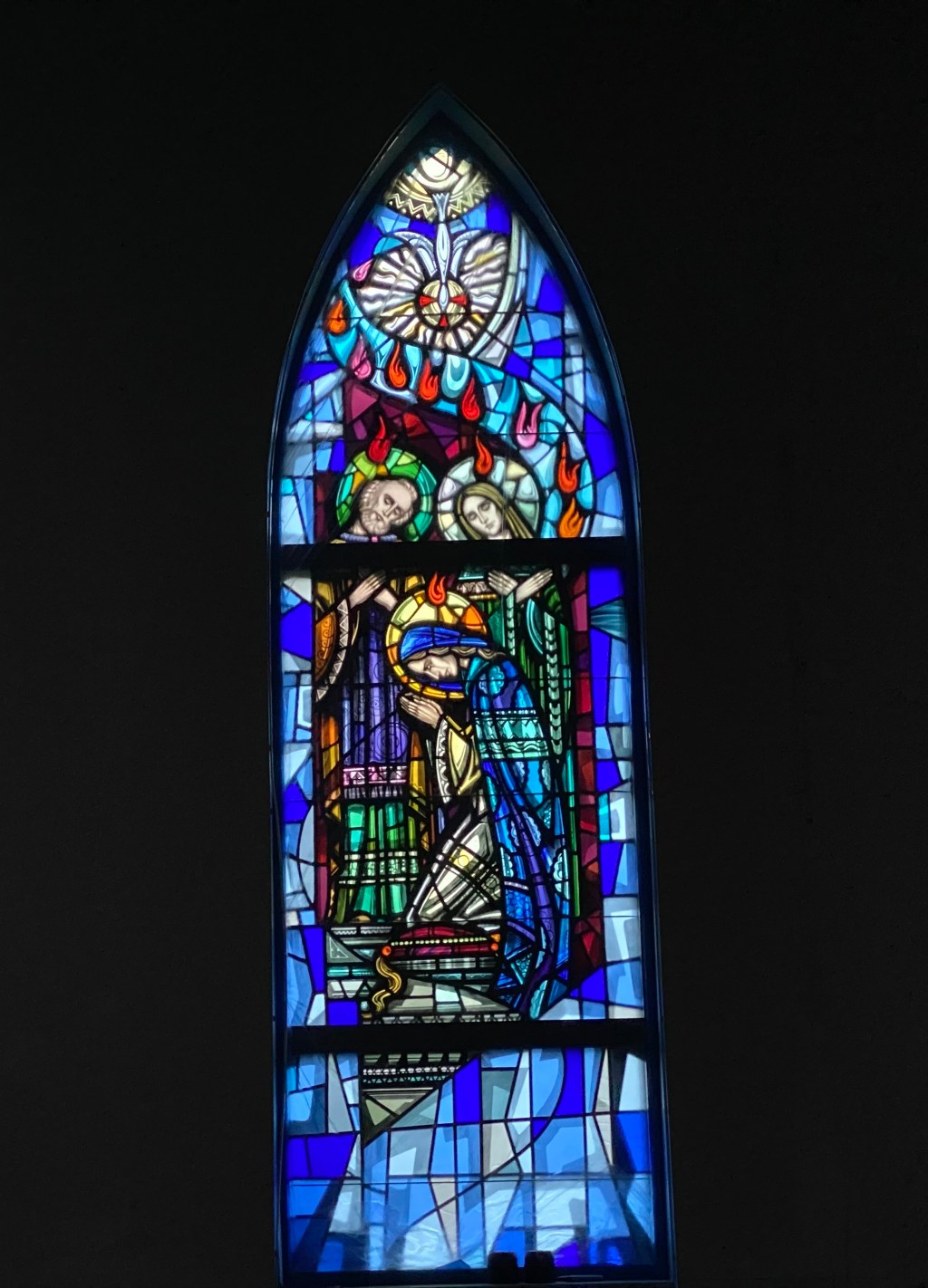
Photo: The only way we can be transformed by Jesus’ love and put into practice his teachings is to follow the lead of Mary and the Apostles and spend time in mediation and prayer everyday. Stained glass window at Holy Cross Catholic Church, Vero Beach.

Link for the Mass readings for Monday, June 16, 2025