The Body of Christ

All that Jesus has been building up to, in his Bread of Life Discourse, and in each of the daily Mass readings this week, is now coming to a climax. Any silent shock of disbelief or quiet murmuring has now escalated. The Jews quarreled among themselves, saying, “How can this man give us his Flesh to eat” (Jn 6:52)? Jesus hears the growing concern and disbelief. If he was speaking in a figurative or symbolic way, this would be the moment to clarify.

Jesus speaks, but he does not walk back or qualify his comments. Jesus doubles down: “Amen, amen, I say to you, unless you eat the Flesh of the Son of Man and drink his Blood, you do not have life within you” (Jn 6:53). Jesus does not only repeat that his disciples are to eat his Flesh, but he also insists that they are to drink his Blood. Drinking or even eating meat with the blood of an animal was inconceivable for devout Jews. Also, the Greek used here in John’s Gospel for eat is trogein, which is used to describe how an animal eats, by gnawing and tearing at the flesh. The imagery that Jesus is using here is more graphic than the customary use of phagein, which would be used for chewing, as a human would chew their food.

Jesus continues to make his point that whoever does eat his Flesh and drink his Blood, will not only remain in him, but also Jesus will remain in them, and they will have eternal life. A wonderful end goal, but would any be able to make the leap of faith to get there? In tomorrow’s Gospel reading we will be able to see the response to Jesus’ claims.

Almost two thousand years later, we continue to have the opportunity to celebrate daily the person of Jesus in our midst. This happens through participating in the source and summit of our faith, the Mass and sharing in Jesus’ sacrifice and the Eucharistic banquet. Our hearts have the opportunity to be set on fire as we hear the word proclaimed during the Liturgy of the Word, and then Jesus is made known to us in the breaking of the bread in the Liturgy of the Eucharist. We are invited to experience an intimate encounter with the Son of God, as we consume him, Body, Soul, and Divinity.

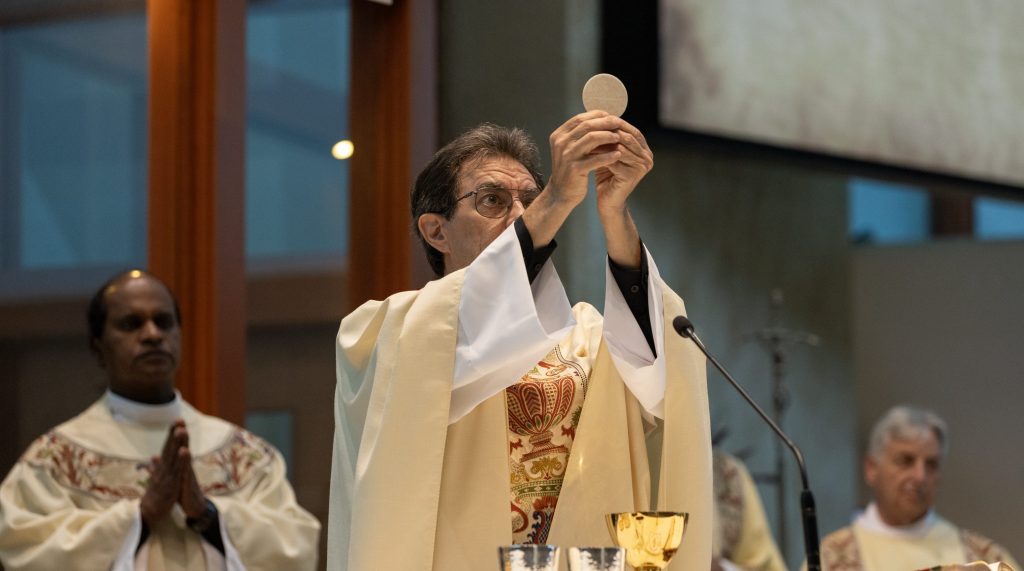
That we are to eat the Flesh and Blood of Jesus may sound just as bizarre as it did to Jesus’ followers. The term we use for this miraculous transformation of bread and wine is transubstantiation. What happens at the calling down of the Holy Spirit and the words of institution which are invoked by the priest is that the substance, the reality, of the bread and wine is transfigured into the Body and Blood of Jesus, while the accidental form or appearance remains the same. We consume Jesus’ unbloody, acceptable sacrifice which still appears to be bread and wine.

Jesus is giving all of who he is corporally, fully, holding nothing back of himself so we can receive all of him. In consuming Jesus, we become more divine as he permeates our whole being. We are then dismissed at the end of the Mass to go, like Mary, to bear Jesus, to love others as Jesus loved us. By giving ourselves to others, we will also experience Jesus in each other. For what we do to the least of our brothers and sisters, we do to him (cf. Mt 25:40).

Jesus is risen, he has risen indeed, and he has not left us orphans but remains with us now and for all ages! We can have life and have it to the full when we consume the Bread of Life and so he lives within us as well as among us! Amen. Alleluia!

——————————————————–

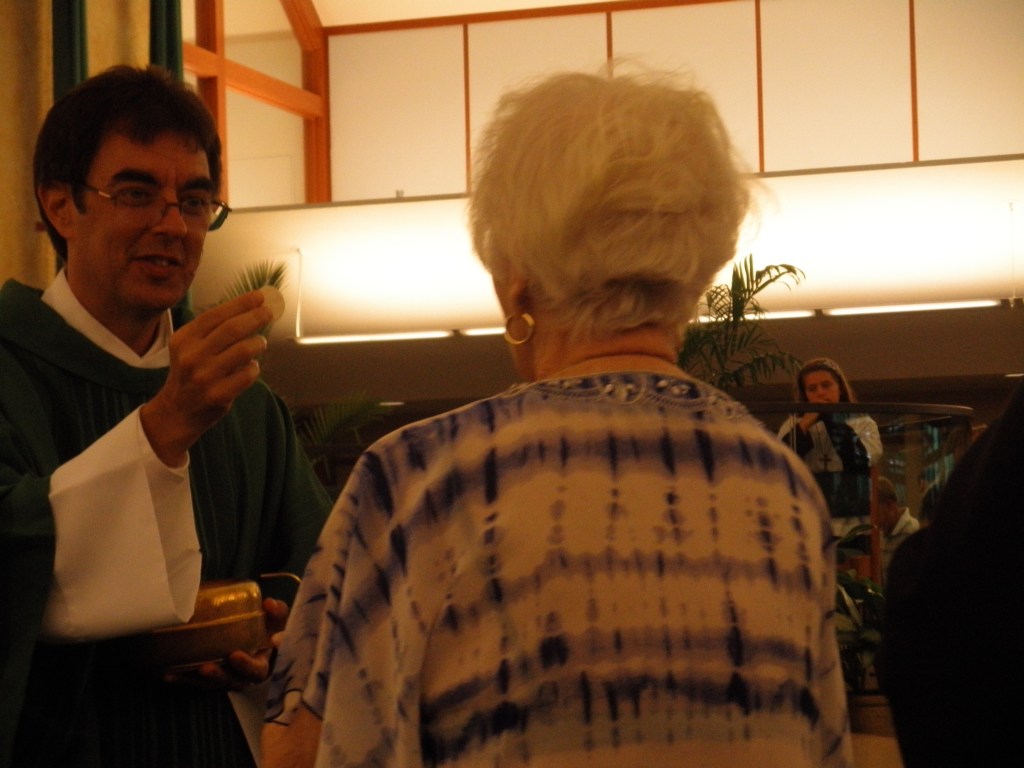
Photo: The first time distributing the Body of Christ at my first Mass as a deacon. Looking forward to doing so as a priest soon!

Link for the Mass readings for Friday, April 19, 2024

Believe in the One who God has sent, Jesus, the Bread of Life!

Yesterday and today’s Gospel readings from John are laying the groundwork for the discourse of Jesus to come. In yesterday’s account, Jesus shared with the people who gathered about him, those who had already received the miraculous multiplication of bread, that they were not to “work for food that perishes but for the food that endures for eternal life” and Jesus also shared that they were to “believe in the one [God] sent” (see Jn 6:27-29).

In today’s account, the people are asking for a sign, just as Moses gave to their ancestors in the desert. Jesus reminds them that his Father had given them the bread from heaven, and also added: “My Father gives you the true bread from heaven. For the bread of God is that which comes down from heaven and gives life to the world” (Jn 6:32-33). Certainly, this offer is appealing, and so the people not only want some of this bread also, they want an endless supply of it. Now Jesus moves from the subtle foundation he has been building to the substance of his point: “I am the bread of life; whoever comes to me will never hunger, and whoever believes in me will never thirst” (Jn 6:35).

Jesus encouraged his listeners to pursue the food that “endures for eternal life” to believe in the one his Father sent, then he shares how his Father gives them the true bread from heaven “for the bread of God is that which comes down from heaven and gives life to the world.” Jesus is the one his listeners are to build their relationship with, for he is the very presence of God in their midst. Jesus is the promise of eternal life. Jesus is the one sent by his Father to give life to the world. Jesus is the bread of life!

We are a living craving, hunger, and desire to be one with God and each other, and this is true for the atheist and the believer alike. That which God has created, he has created good, but the material and finite will not fulfill us. We, in short order, experience the limitations of the finite and seek something more. This is how we are wired, because ultimately, our deepest desire, that which we seek to fulfill us, is eternal. The One to satisfy this eternal hunger which we can never exhaust is the bread of life, Jesus Christ.

Do we believe this to be true? Do we believe that Jesus is the bread of life, that he is the source and sustenance, the very foundation of our being and existence? Are we tempted and diverted by other things and so miss receiving the Eucharist at Mass or is making time to go to Mass and receive the Eucharist our reason to miss other things?

If we have been caught up: in the business of life, in the mere existence or survival mode of the day-to-day, or stuck in our sin, addiction, brokenness, or disillusionment, if we feel like we are just running on empty, and/or if we have just taken this reality for granted, then let us “believe in the one who God sent”, commit or recommit ourselves and our very lives to the one who is our source and sustainer, and let us come to receive Jesus, the Bread of Life in the Mass, at least each Sunday.

——————————————————————-

Photo: Praying by the tabernacle in the chapel at Bethany Retreat Center, Lutz, FL during my priestly canonical retreat back in November.

Link for the Mass readings for Tuesday, April 16, 2024