“I will come and cure”.

The centurion said in reply, “Lord, I am not worthy to have you enter under my roof; only say the word and my servant will be healed” (Mt 8:8).

After Jesus finishes his Sermon on the Mount, he comes down from the mountain. In the opening of chapter eight, we see two hearts open to God, a leper and a centurion. The centurion may or may not have been a Roman but he certainly was a Gentile. He, a member of an occupying army, was aware of the animosity many Jews felt toward him. Yet he, like the leper, approached Jesus.

Unlike the leper, the centurion came for another. He did not seek to come because of his family members or his soldiers was suffering, he came for his servant. He, like the leper, showed boldness and faith. He might have even a few days before thought this Jewish man was beneath him, and yet, he approached Jesus because he believed that he could heal his servant. It is also curious that the centurion who is used to giving orders does not order Jesus to heal his servant, he doesn’t even ask him to heal his servant. He just states the fact that his servant is suffering, which shows even more trust that Jesus will do something about it, but Jesus’ terms not the centurion’s own terms.

“I will come and cure him.” Jesus’ response is a little lost in the translation. “Jesus acknowledges the boldness of the centurion’s request in his response, which is better translated as an exclamatory question: ‘Shall I come and cure him?’ With the emphatic ‘I,’ it is as if Jesus is saying, ‘Shall I, a Jew, come to your home?'” (Mitch and Sri, 126). The centurion acknowledges then his unworthiness to have Jesus enter his home. He who has been used to ordering others has the humility to say that he is not even worthy to have Jesus come, he can just speak and he believed that his servant would be healed.

Jesus saw in the leper, not revulsion, and in the centurion, not an enemy, but first and foremost, human beings in need, two persons with boldness, belief, and deep faith. Jesus also healed the mother-in-law of Peter, who did not ask to be healed. He saw her need, her illness, and again was willing to come close to touch her. Many who were possessed also came and Jesus reached out to them with a simple touch of his hand or authority in his words. The kingdom of his Father is open to all who have faith and believe.

We, like the leper, are wounded and in need of the healing words and touch of Jesus in our lives. Jesus draws close to us as well and is only waiting for us to ask to be healed and transformed by his love and mercy. We, like the centurion, can approach Jesus on behalf of others in need of healing. We can even assume the posture of Peter’s mother-in-law and be open with our hearts and minds to receive Jesus’ healing invitation.

Jesus has come to remind us of the truth of who we are – daughters and sons of our Father, and our inheritance is to receive the love of the Holy Spirit. From a new posture of abiding in God’s love we will better resist the temptation to judge anyone as unworthy to receive the same grace, love, and mercy we have received. We are all unworthy of God’s love which he offers as a gift. God loves us not by anything we do but because we are his children. This is why we state the words of the centurion just before we receive Jesus in the gift of his true presence in the Eucharist. As we acknowledge our unworthiness, Jesus comes close to us in such an intimate way, to be consumed, so that we will be healed.


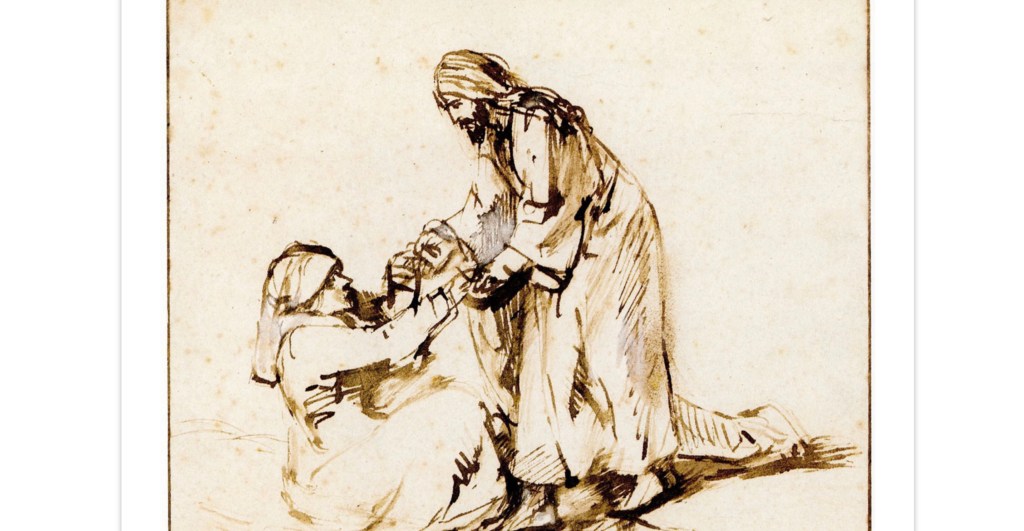
Drawing: Rembrandt’s The Healing of the Mother-in-Law of Saint Peter

Link for the Mass readings for Saturday, June 27, 2026

Jesus has come close not to fix us or solve our problems but to love us.

“Lord, if you wish, you can make me clean.” He stretched out his hand, touched him, and said, “I will do it.  Be made clean” (Mt 8:2-3).

Jesus could have healed the man with a word from a distance. Instead, he chose to come close, to reach out, and touch the leper. In doing so, he risked contamination, risked being deemed ritually unclean. Jesus came close anyway and touched the man. Jesus was not contaminated nor did he become unclean, the man was healed. The Son of God, consubstantial with his Father, beyond all space and time, was sent by his Father in a certain time and place, to come close. While remaining fully divine, he took on flesh in the womb of Mary and became fully human. He became one with us in our humanity so we could and can become one with him in his divinity.

God did not make us machines nor are we mathematical formulas. God created us to be human beings with emotions, senses, dreams, desires, and souls. He created us physical and spiritual. So when life gets bumpy and we suffer, we want an answer. We have to be careful where we seek though. We are not machines to be fixed, nor problems to be solved. We are human beings created in God’s image to be loved. The healing that Jesus offers the leper is not a fixing or a solving, but a loving of his brother. He was willing to come close, touch the man, love him. Do we seek only a physical solution or a deeper communion?

Much of our suffering in our world today is a result of our not willing to come or allow another to come close. By keeping others away, we keep Jesus away. We may not say it in the same words, but aren’t there those we consider unclean and so deemed to be kept at arm’s length? When we do so, we cut others and ourselves off from intimacy with one another AND God. We then believe the stirring negative thoughts swirling around in our minds about the other person or persons. Instead of getting to know some-one, a human person, with their imperfections yes, but also their gifts, we judge. We keep others as other, at a distance and in doing so reduce people to two dimensional caricatures.

Getting to know someone beyond first appearances or prejudgements happens when we spend time together. There is a lot more to who we are than the caricatures we may have had imposed upon us or we have imposed upon others. This is also true regarding our relationship with God. We so often attempt to reduce God to what we can understand, to attempt to understand him as a problem to be solved. God is not going to be solved and is not about limitation but expansion. He comes close to us in his Son so through Jesus we can get to know the love of the Holy Spirit shared between them and once we have experienced this love we can begin to heal and expand beyond our finite limitations.

Jesus continues to come close, to touch and heal us as he did the leper in today’s Gospel. If we are willing, he seeks to be intimately a part of every aspect of our lives. He seeks to accompany us in our fears, struggles, suffering, and pain. He also celebrates with us when we overcome, repent, experience joy, and especially when we love one another. When we close the gap and draw close, willing to be a conduit of accompaniment and reconciliation, we will begin to see healing in ourselves, our families, communities, and beyond our bubble wrap of comfort. The question is: Are we, like the leper, willing to allow Jesus to come close and like Jesus, willing to draw near?


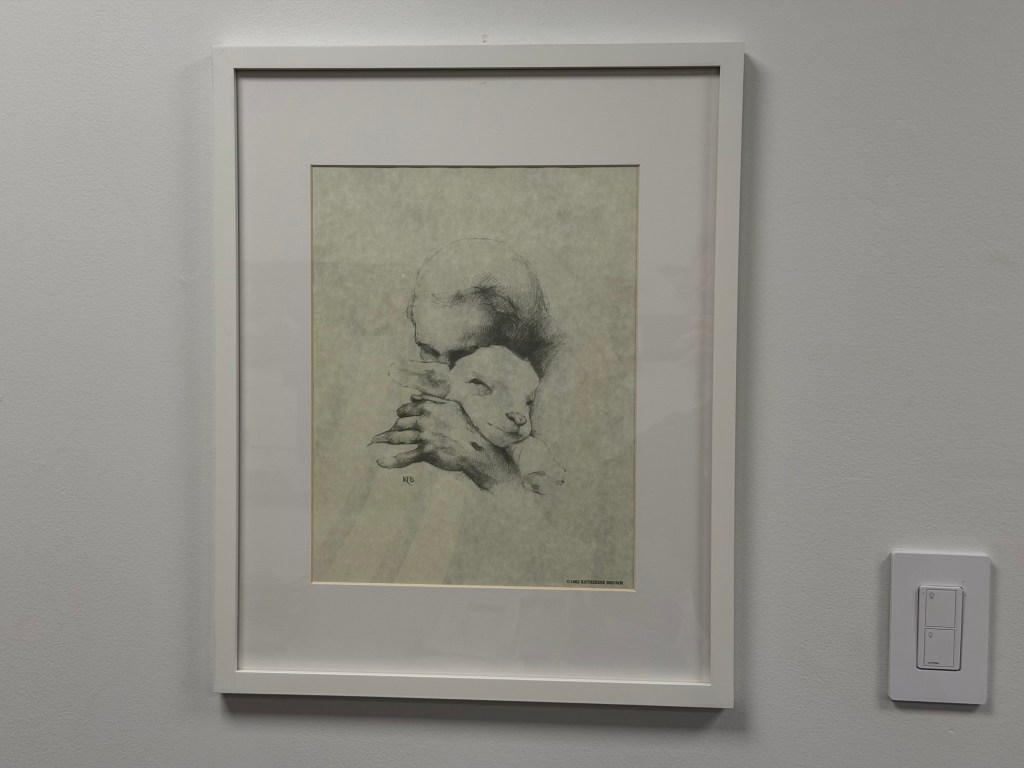
Photo: “Jesus has to enter into the drama of human existence, for that belongs to the core of his mission; he has to penetrate it completely, down to its uttermost depths, in order to find the ‘lost sheep,’ to bear it on his shoulders, and to bring it home” (Pope Benedict XVI, p. 26).

Ratzinger, Joseph: Pope Benedict XVI. Jesus of Nazareth: From the Baptism in the Jordan to the Transfiguration. New York: Double Day, 2007.

Link for the Mass readings for Friday, June 26, 2026

We are invited, and then invited to invite others.

One of those at table with Jesus said to him, “Blessed is the one who will dine in the Kingdom of God.” He replied to him, “A man gave a great dinner to which he invited many. When the time for the dinner came, he dispatched his servant to say to those invited, ‘Come, everything is now ready'” (Lk 14:15-17)

Judaism was far from unified during Jesus’ time. The Sadducees, Pharisees and scribes, Samaritans, Zealots, and Essenes all felt they were the authentic expression of Israel. Jesus not only addressed this division by sitting down to break bread with as diverse a population as possible but he also shared parables around the same idea of the invitation to share in the celebration of a feast, as we read today.

Jesus is the man who was inviting people to a great dinner, his servant, is the one who is sent, an apostle, to invite others to share in this great banquet. Those invited in the first wave were those of the Israelites that were rejecting Jesus’ invitation, the second invitation were for those of the people of Israel that were within, but at the same time on the outside:  the poor, cripple, blind, and the lame. The final invitation went out to those outside of Israel, meaning the Gentiles. Thus, Jesus’ invitation of salvation and participation in the eternal banquet to come is to all of humanity, first to the Chosen People, and then to the Gentiles. Only those who rejected the offer would not be admitted.

Each encounter that we are blessed to partake in is an invitation to experience relationship. We have the opportunity to engage in person, face to face, or through the myriad of social media outlets. We can choose to demean, degrade, dehumanize, gossip, and defame or we can embrace the opportunity to treat each other with dignity, respect, kindness, and understanding, and yes, even when we disagree.

We all have wounds. Each of us have suffered or are suffering, and we have or are experiencing anxieties, overwhelm, and/or insecurities in some form or fashion. We all seek to belong, to be a part of, and to be accepted. We need God and each other. When we acknowledge these, and turn to God with them, we begin to heal and can also be more understanding. Yet, as Fr. Greg Boyle, SJ, wrote, “If you’re a stranger to your own wound, then you’re going to be tempted to despise the wounded.”

When we are willing to see our own wounds, and offer them in our poverty to Jesus, he will help. When others are not respectful, we can be less reactive, breathe, and resist reacting in kind. When someone serves up harsh words, we can resist the defensive retort and instead ask if there is any way we can help. To will each other’s good does not mean that we condone the inappropriate act or word, it means we genuinely seek their good and their healing. When we can be advocates of healing, we can then be God’s servants of invitation.  Jesus invites us to the feast of community and sharing, to prepare us for the eternal feast. Are we willing to attend and are we willing to invite others?

———————————————————————–

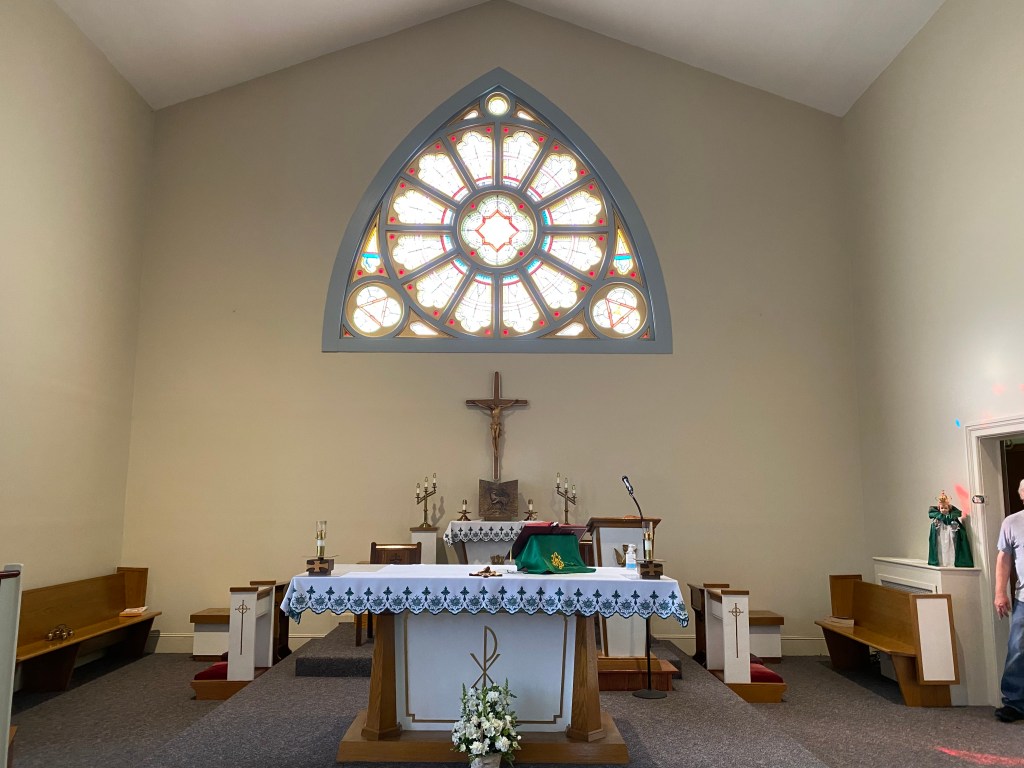
Photo: As we heal and experience the light of Jesus, we can receive his light and reflect it to others!

Link for the Mass for Tuesday, November 4, 2025

Jesus invites us to participate in his life and the communion of the angels and saints.

He promised that he would be there so that she would not have to die alone. The hospital called that her time was closer while the priest was visiting another ill parishioner. He finished up as fast as he could, and unfortunately ran into traffic, and too many lights turning red instead of staying green. And although he pushed the speed limit, when the priest arrived at the nursing station and asked for the name of the woman, the nurse informed him that he was too late, she had already passed.

He felt horrible because he promised her that she would not die alone. As he was mulling over the unfortunate timing, the nurse continued. “An interesting thing happened. An orderly came in with another patient, and I had no order for her to be in this room. This woman looked at your friend and asked if she could have her bed closer to hers, then reached out her hand. They held hands while the orderly and I left to check into the matter. When we returned, your friend was dead. The orderly then moved her bed out. The funny thing is that I have been checking since they left and found no record of this orderly or his patient being in the hospital.”

She did not die alone after all. Was this a visit from two angels?

Today we celebrate the feast of the archangels, Michael, Gabriel, and Rafael. Angels are eternal, spiritual beings. They are not human but can take on human form in their appearance. Also, when we die, we do not become angels. We are human beings, and as such we are human and spiritual.

One of the possible reasons that Satan, who is the archangel, Lucifer, and the other angels, now called demons, rebelled against God was because in our participation in the life of Christ, we become higher than the angels. That was too much for them to take and so choosing their pride over God, they rebelled.

Jesus, fully God and fully man, is infinite and eternal as Son, while at the same time finite as human. In Jesus coming close to be one with us in our humanity, we are offered the opportunity to participate with him in his divinity. Like the angels, God has given us the ability to reason and the freedom to choose. We can choose to grasp at divinity on our own terms through our pride, as Satan and his minions, or we can receive the gift of God’s love, participate in the life of his Son, and become like God. The Father and the Son and the Holy Spirit are divine by their very nature, whereas we are given the grace to participate in their divine nature.

We don’t lose ourselves and become absorbed by God, we remain distinct and experience the fullness of our humanity in our participation in the divinity of Jesus. In his resurrection and ascension, Jesus has assumed his glorified Body. He is the first born of the new creation and through our baptism we participate in his life and through him, the life of the Trinity. As we surrender our lives to God, take up our cross, die to ourselves, and follow Jesus, we grow in holiness. We join in the new creation Jesus has won for us. With each faithful step we draw closer to the heavenly Jerusalem, and we become more united to the Body of Christ.

The wonderful reality we can ponder today is that in God’s order of creation, with each breath we take, we can rest in the truth that we belong to an incredibly extended family of Father, Son, and Holy Spirit, Jesus, Mary, and Joseph, the angels, and the saints. We can rest in the reality that no matter what challenges we are going through, we all have a significant part to play in God’s plan, we are all interconnected, and we are not alone. We are loved, we are in communion with many in heaven and on earth who are not only cheering us on but loving us, willing our good, and guiding us on our journey.


Photo: Each unique ripple reflects the brilliance of the rays of the sun, making for a beautiful symphony. Much like each angel and saint in heaven and us here below.

Link for the Mass readings for Monday, September 29, 2025

God has made us for communion and relationship.

Accompanying him were the Twelve and some women (Lk 8:1-2).

A simple statement but significant regarding how Jesus again is showing us how to live our lives as his followers, his disciples. Jesus is fully human and fully divine. What he has done and continues to do as the Son of God incarnate is to draw close to us in our humanity, as human beings, so that we can enter into a relationship with him and his Father through the love of the Holy Spirit, thus becoming one with him in his divinity.

From the beginning of his public ministry, throughout his time walking this earth, and continuing on after his resurrection and ascension into heaven, he  invites people to participate in his life and the kingdom of Heaven which is at hand in his very presence. Jesus does so by building relationships. This is how Luke can write the verses that Jesus was accompanied by the Twelve and Mary Magdelene, Joanna, and Susanna. These were real people with whom Jesus developed real and intimate bonds.

Christianity is not a Lone Ranger religion, it is not the survival of the fittest, and Jesus did not teach us to pull ourselves up by our own bootstraps. We are created by God to be in communion, to be in a relationship with him and each other, to experience his love and love one another. That means we need to ask for help from God and each other when in need and to come to the aid of, accompany, empower, and support one other.

We are invited to welcome, engage with, and make time for each other by exchanging in the stories of our tragedies and our triumphs. We need to resist the temptation of withdrawing into our own bubbles. Instead, let us take the risk to be vulnerable and trust. Relationships are not perfect, they will be messy, and conflicts will arise. By making a commitment to God and each other, being willing to be honest even when we are tempted by our fears to be otherwise, keeping an open heart and mind, and being willing to be understanding, kind, and forgiving, we can grow closer together.

Jesus chooses each one of us to accompany him and to forge relationships grounded in mutual respect, where no one is last and where no person is left behind. Our prejudices only survive when we keep people at a distance. When we are willing, like Jesus, to come close and spend time with one another, our biases can fade and friendships can grow. Even when it appears sometimes that our country and our world is about to tear apart at the seams, reconciliation and communion is what our faith is all about. This is why we are a joyful people and an alleluia people!

————————-

Photo: After concelebrating Mass at St. Catherine’s Catholic Church in Broad Brook, CT. Enjoyed spending time with and getting to know some of the parishioners afterwards.

Link for the Mass readings for Friday, September 20, 2024

The Body of Christ

All that Jesus has been building up to, in his Bread of Life Discourse, and in each of the daily Mass readings this week, is now coming to a climax. Any silent shock of disbelief or quiet murmuring has now escalated. The Jews quarreled among themselves, saying, “How can this man give us his Flesh to eat” (Jn 6:52)? Jesus hears the growing concern and disbelief. If he was speaking in a figurative or symbolic way, this would be the moment to clarify.

Jesus speaks, but he does not walk back or qualify his comments. Jesus doubles down: “Amen, amen, I say to you, unless you eat the Flesh of the Son of Man and drink his Blood, you do not have life within you” (Jn 6:53). Jesus does not only repeat that his disciples are to eat his Flesh, but he also insists that they are to drink his Blood. Drinking or even eating meat with the blood of an animal was inconceivable for devout Jews. Also, the Greek used here in John’s Gospel for eat is trogein, which is used to describe how an animal eats, by gnawing and tearing at the flesh. The imagery that Jesus is using here is more graphic than the customary use of phagein, which would be used for chewing, as a human would chew their food.

Jesus continues to make his point that whoever does eat his Flesh and drink his Blood, will not only remain in him, but also Jesus will remain in them, and they will have eternal life. A wonderful end goal, but would any be able to make the leap of faith to get there? In tomorrow’s Gospel reading we will be able to see the response to Jesus’ claims.

Almost two thousand years later, we continue to have the opportunity to celebrate daily the person of Jesus in our midst. This happens through participating in the source and summit of our faith, the Mass and sharing in Jesus’ sacrifice and the Eucharistic banquet. Our hearts have the opportunity to be set on fire as we hear the word proclaimed during the Liturgy of the Word, and then Jesus is made known to us in the breaking of the bread in the Liturgy of the Eucharist. We are invited to experience an intimate encounter with the Son of God, as we consume him, Body, Soul, and Divinity.

That we are to eat the Flesh and Blood of Jesus may sound just as bizarre as it did to Jesus’ followers. The term we use for this miraculous transformation of bread and wine is transubstantiation. What happens at the calling down of the Holy Spirit and the words of institution which are invoked by the priest is that the substance, the reality, of the bread and wine is transfigured into the Body and Blood of Jesus, while the accidental form or appearance remains the same. We consume Jesus’ unbloody, acceptable sacrifice which still appears to be bread and wine.

Jesus is giving all of who he is corporally, fully, holding nothing back of himself so we can receive all of him. In consuming Jesus, we become more divine as he permeates our whole being. We are then dismissed at the end of the Mass to go, like Mary, to bear Jesus, to love others as Jesus loved us. By giving ourselves to others, we will also experience Jesus in each other. For what we do to the least of our brothers and sisters, we do to him (cf. Mt 25:40).

Jesus is risen, he has risen indeed, and he has not left us orphans but remains with us now and for all ages! We can have life and have it to the full when we consume the Bread of Life and so he lives within us as well as among us! Amen. Alleluia!

——————————————————–

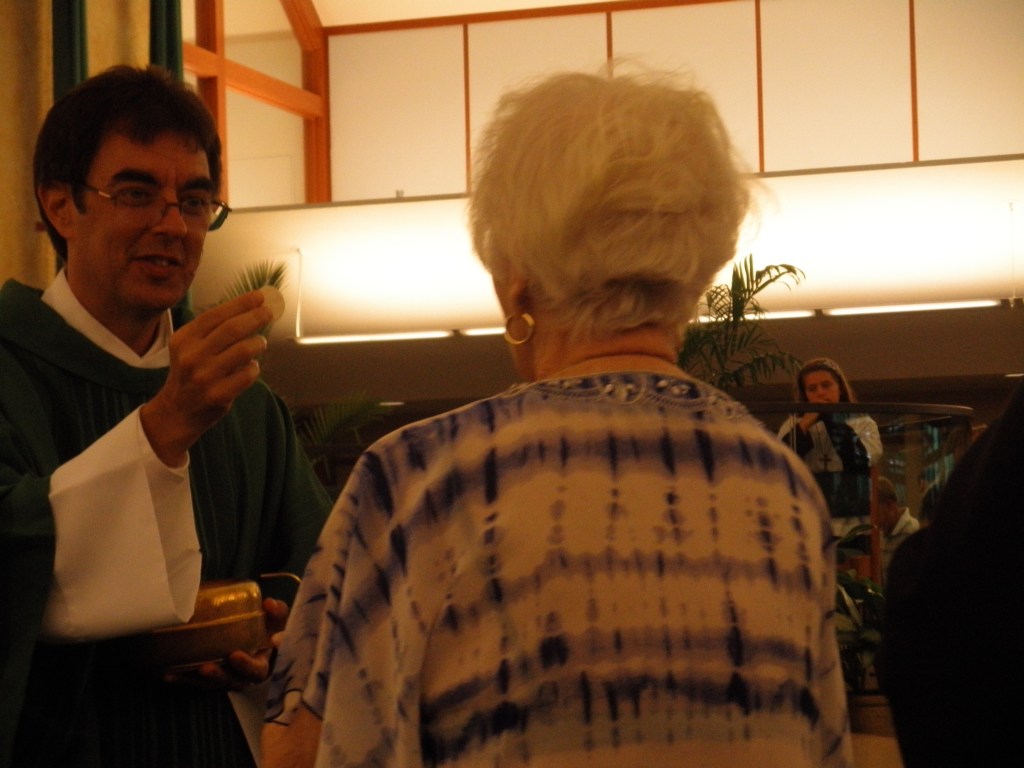
Photo: The first time distributing the Body of Christ at my first Mass as a deacon. Looking forward to doing so as a priest soon!

Link for the Mass readings for Friday, April 19, 2024