
Today in the liturgical calendar of the church we begin the nine days before Christmas as we do each year with Matthew’s account of the genealogy of Jesus. Jesus, the Son of God, is fully divine, while at the same time he is also fully human. Matthew gets us started in the home stretch with the lineage of Jesus’ human line from Abraham to his father Joseph (foster father, in that Joseph was not Jesus’ biological dad, but no one would not have made that distinction in Jesus’ time.) and his mother Mary.
Jesus was part of a people and a family, he was born at a particular time and in a particular place. If you go through this genealogy with a fine-tooth comb, there are gaps, but Matthew was more concerned with the line of faith than a strict historical account. Matthew also included women in this listing, which was not common in ancient patriarchal societies. This was also not common in ancient Jewish genealogies, “which traced lineage from father to son” (Mitch and Sri, 38). Looking at their stories in Scripture will also show that most listed were not the most morally upright, but more importantly, God was still able to work through this imperfect line of humanity and so the genealogy ends with, “Jacob the father of Joseph, the husband of Mary. Of her was born Jesus who is called Messiah” (Mt 1:16).
Though Jesus was conceived in Mary who was a virgin and immaculately conceived, he came from a line that was far from perfect. As Catholics and Christians, this is our heritage as well. We are spiritual Semites. Genealogies have become more popular in recent years as can be seen by the different advertisements for DNA test kits. There is a natural instinct to reach out for these because we want to belong and to be a part of.
To understand who we are and where we have come from, and to continue forward, it is helpful to reach behind. Jesus belonged to the people of Judah. He is a part of the succession from Abraham and his clan, to the twelve tribes of Jacob, to the unified nation of Israel under David. That did not change even as the fall from grace beginning with David, continued with his son Solomon, and most of the other kings.
Joseph was the heir to the thrown that in this imperfect line of succession went underground when Jerusalem was conquered by the Babylonians. This promise of the return of the messiah, the king in the line of David remained even while under occupation for the next five hundred years under Babylonians, Persians, Greeks, and at the time of Jesus’ birth, the Romans. When Joseph died, Jesus was next in line. Jesus’ leadership would become and continues like no other before him or that will ever come again. Jesus brought God’s movement of grace, the seeds of which were planted by some of the prophets like Isaiah, beyond the nation of Israel to fulfill the promise that they be a light to the nations, a universal invitation for all.
Another piece that a careful reading of the genealogy uncovers is that Jesus does not come from a purely Jewish lineage. As mentioned above, women were included in this list of ancestors. The common denominator of each of these four women, Tamar, Rahab, Ruth, and most likely Bathsheba was that each of them were Gentiles. “Gentile blood flowed into the royal line of David. This underscores God’s concern for Gentiles, demonstrating that he brought them into the story of Israel even in the Old Testament” (Mitch and Sri, 39).
God’s invitation of relationship with him was intended from the beginning, and step by step through salvation history God continued to thirst for his children and sought to woo them back, drawing them with his tender chord of love. This would come to fruition in the incarnation. The Son of God became one with us in our imperfect and sinful human condition to set right a world that had gone wrong.
Through our Baptism, we become part of the royal lineage and line of Jesus. No blood test needed. We are not alone, no longer estranged, no longer separate, or on the peripheries. We belong to the Body of Christ. Yet many, even those who profess their belief in Christ, are missing his greatest gift of faith, which is developing a relationship with him now. Let us not be complacent and settle for Christian in name only or walk away from our birthright.
In these final days of Advent, may we set aside a little more time to spend with Jesus. As our schedule revs up, may we bring Jesus into our busy. The Son was willing to draw close to us in the incarnation that we are about to celebrate, let us draw close to him. We all have the same amount of time in our days. Deciding to set aside some time of quiet, to take some deep and slow breaths, and accept the invitation to draw close to Jesus who is at hand will help us to engage better with the time we have and those walking with us.
Those brief moments are a powerful reset. In those moments of turning our hearts and minds to Jesus, we can receive the rest and renewal we desperately need. We can receive his love and invite him to walk with us in all that we think, say, and do. We can yoke ourselves to Jesus so that we do not travel these days alone. Jesus is more than willing to share our burdens, and he will give us the strength to carry on.
By our baptism we are part of the royal line of Jesus. More importantly, Jesus is present in each moment. We just need to remember to turn to him. Each intentional, deep breath will bring our shoulders out of our ears, help us to react less, and experience greater clarity in our choices and decisions. We will also see each other a little different than before, with more understanding, patience, and love.
As we celebrate the birth of “Jesus who is called Messiah”, even in the imperfections and messy moments, Jesus’ light will shine through. We are invited this season to be the calm in the storm of the chaos. “Peace be still.”
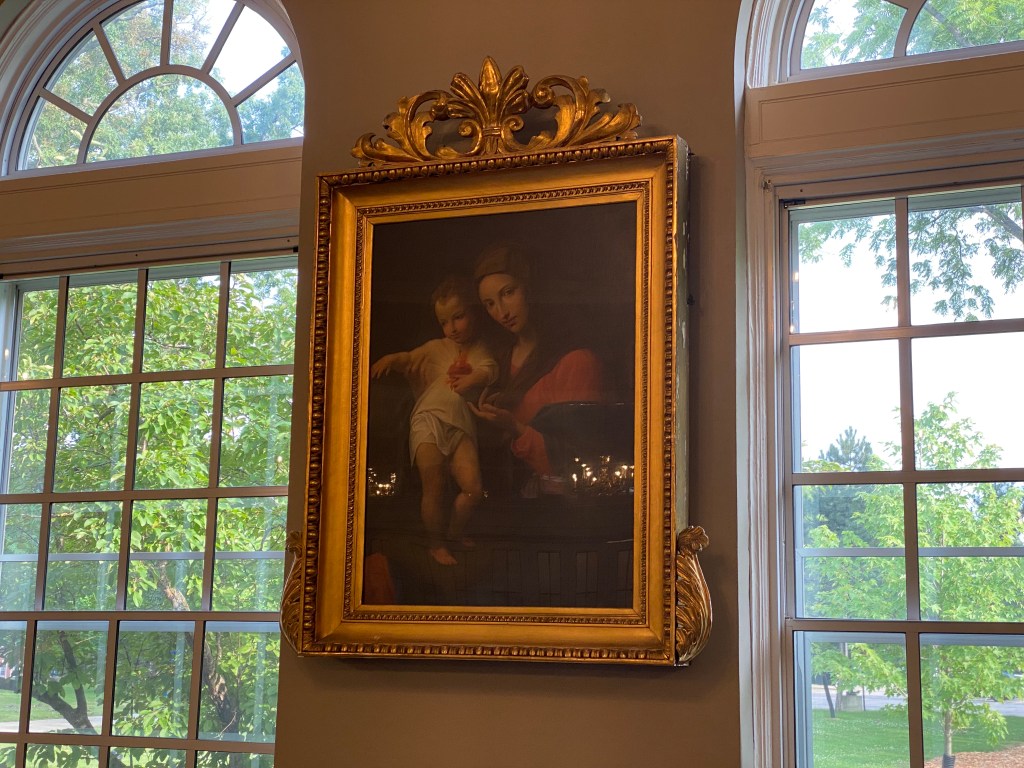
Photo: In times of silence we will experience how close Jesus really is.
Mitch, Curtis and Edward Sri. The Gospel of Matthew. Grand Rapids, MI: Baker Academic, 2010.
 Spiritual Stepping Stones