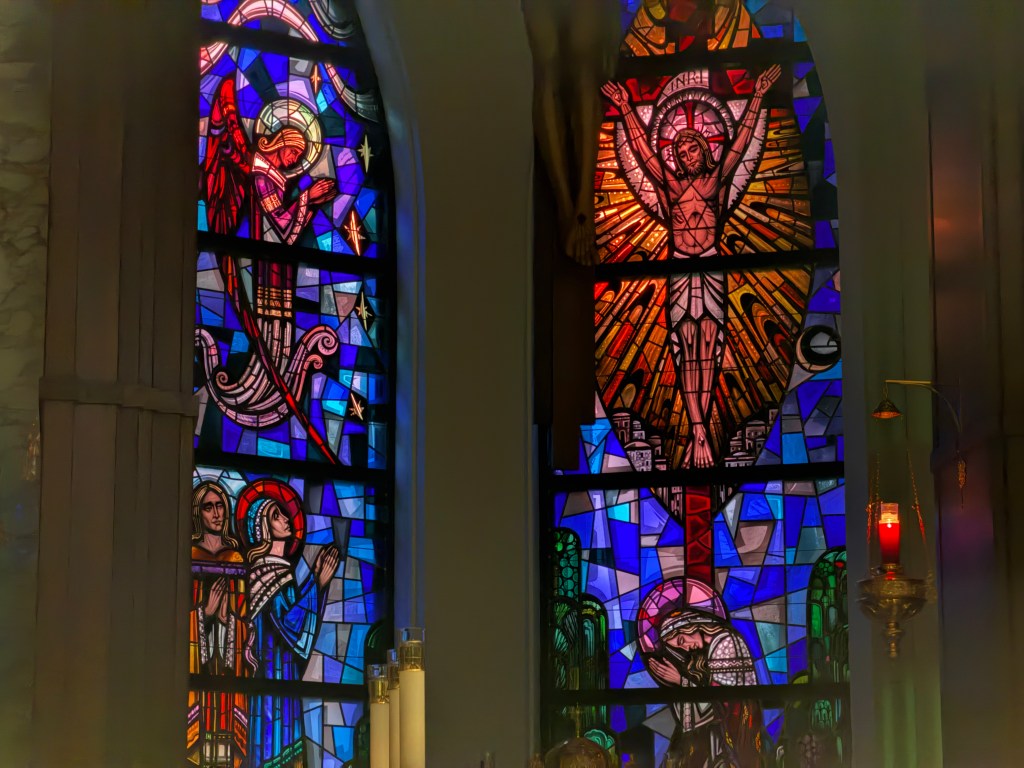
Jesus has sent us the Holy Spirit to lead us to experience rest and peace grounded in his love.

What is common to all of us is that we experience some expression of loneliness to varying degrees, sometimes consciously but mostly unconsciously. We are social beings, we want to belong, to be part of, and this is why we are communal. We may do, say, or turn a blind eye to behaviors that go against our conscience just to be accepted, acknowledged, and/or noticed. This behavior further feeds our loneliness, because though we may be “accepted”, we become more alienated from our true self. We are not accepted for who we are but who we portray ourselves to be.

At the core of our being, what we all seek is to be loved, and to love in return. We strive from the moment of our conception not only to exist but to actualize the fullness of who God is calling us to be. Through our time of gestation, we are not potential human beings, we are human beings actualizing out potential. A difference between me typing this now and when I was in my mother’s womb is that before my birth, I was smaller and more vulnerable.

We as human beings are a living, craving hunger and desire to be in communion with God and one another from the moment of our conception until our natural death and continuing on into eternity. This is true to the believer and the atheist alike. Until we embrace this deepest of needs and desires, we will be restless, anxious, and unfulfilled. We can feel isolated and alone, even in the midst of a hundred people or daily likes on social media. St. Augustine in the introduction to his autobiography said it best: “You have made us for yourself, O Lord, and our hearts are restless until they rest in thee.”

God has made us for himself and constantly invites us to be in a relationship with him and with each other because he is the foundation and source of our being. Sin is the turning away from that invitation, a curving, or caving in upon oneself away from God and others. It is also the unwillingness to bother or to care, to reach out toward another in need. For what we do to the least of our brothers and sisters, we do to Jesus. We are not just to be pro-birth though, we as Catholics are to be pro-life, and we are invited to promote a consistent ethic of life.

Jesus became human in his Incarnation. He too, as we did, developed in the womb of Mary to show the importance of the dignity of the person and that our dignity is grounded in our relationship with God our Father, meaning we are all brothers and sisters. We are his beloved daughters and sons, just by who we are not by what we do. Jesus was not a plan B, but he was always the primary plan. In the fullness of time, when God so willed, he sent his Son to become one with us in our humanity so that we can become one with him in his divinity. 

Jesus is the face, hands, and body of God. He came that we might see and experience God. Jesus experienced all we experience except for sin because he never, in any thought, word, or deed, rejected or said no to his Father. His whole life was a, “Yes” to the will of God. Jesus is the bridge, the way to love and be loved, authentically.

In today’s Gospel, Jesus continues preparing his disciples for the reality that he will be returning to the Father. Though he will ascend to the Father, he will not his apostles nor has he left us alone. He has and will continue to be with us for all ages. This is so because as the Son of God made man, in his Ascension, he returned to the Father not just in his divinity as the Son, but also in his humanity. God created all of humanity and his creation as interconnected, and because of that, we all experience this transcendent act of the Ascension when Jesus returned to the Father in his glorified, human body.

Jesus shared with his disciples: “When the Advocate comes whom I will send you from the Father, the Spirit of truth who proceeds from the Father, he will testify to me. And you also testify, because you have been with me from the beginning”(Jn 15:26-27). Jesus is talking about the Holy Spirit, the third person of the Trinity, the infinite Love experienced and shared between the Father and the Son. We become sharers in this divine love and communion of the Holy Trinity through our participation in the life of Jesus.

As we experience the love of the Holy Spirit, develop a relationship with him, we begin to feel alive, we begin to heal and to feel whole, because we have experienced the love we have been made for. We have experienced being loved for who we are and as we are. We no longer have to say, do, or accept those actions that we don’t agree with or that go against our conscience, to belong. St. John Henry Cardinal Newman has stated that our conscience is the “Aboriginal Vicar of Christ”. Jesus dwells within us, to guide and lead us, to help us to develop a well-formed conscience. He encourages us to also say, “Yes” to his Father as he has and continues to do.

We share in the trinitarian love when we grow our relationship and participate in the life of Jesus. This great gift of grace will continue to grow as we testify to this love and share it with others. The greatest gift of God, the love that he gives us, expands as we receive and give his love away. The more we give, the more we will receive. That does not mean fixing others or their problems. We are called to be present, to accompany, and journey with others, meeting them as Jesus met others and meets us, as and where we are. We are to laugh with, cry along, encourage, empower, and support, but above all to be present, to allow the love of the Holy Spirit to happen through us.

Jesus has not left us as orphans. Jesus cares, even if we believe or feel like he is not listening. His return to the Father through his Ascension has given us a greater and more intimate access to the Holy Spirit. By trusting in his love, we will begin to heal from and free ourselves from the tendrils of doubt, fear, and anxiety.

We are not alone. We will heal, and expand when we say, “Yes”, to God’s will and allow ourselves to be drawn in by the tender chords of his love to grow in our relationship with him. Allowing ourselves to experience and receive more of God’s love, helps us to slow down more so that we will better listen, be more aware of and present to our needs and the needs of each other. Once identified, we can choose with the guidance of the Holy Spirit how best to proceed.

As we strive to actualize and become truer to ourselves, and who God us has created us to be, and then rest there, we will experience that peace that surpasses all understanding and develop relationships with others based on authenticity and integrity, regardless of external pressures and internal stirrings. To know we are loved and to love in return, which is what we all seek, is an unbreakable foundation. A foundation upon which we can find the rest we have been created for, in God, in ourselves, and we can just be.

——————————————————————————–

Photo: Come Holy Spirit, fill the hearts of the faithful and kindle in us the fire of your love!!!

Link for the Mass readings for Monday, May 11, 2026

Even though Jesus was hated and persecuted, he chose to love and so can we.

When Jesus said to his disciples: “If the world hates you, realize that it hated me first”, Jesus was not proposing an-us-verses them mentality. It can be easily taken that way and certainly has been lived out in many ways in our society and world. Yet, an-us-verses them mentality is usually a defensive posture assumed by those who often feel or are actuality being persecuted. It is an understandable posture. It is just not the stance that Jesus proposes us to take. We are to love our enemies, we are to love those who hate us. Impossible? Yes, on our own will power alone, for apart from Jesus we can do nothing, but with him all things are possible.

Jesus makes it plain to his apostles. They need to be prepared, for the same persecution that has been happening to him will happen to them. They will be persecuted, mocked, imprisoned, and give their lives just as Jesus did. The gospel message is a challenge. We are challenged to have a change of mind and heart, to be conformed to the love of Jesus the Christ. This means that our focus must shift from that of self-focused, self-first and foremost, as well as I – me – mine. Instead of curving in upon ourselves and constricting, we are to look up and out beyond ourselves and put God first. With God holding priority of place in our lives we will expand and heal.

We know that we are putting God first instead of our fallen nature when we react less and love more. Reactions are based on survival instincts, which can be exacerbated with an-us-verses them mentality. “They” are responsible for the state I am in, it is all “their” fault, “they” made me do it… These are all reactive thoughts that can lead to more divisive and uglier statements and actions. Jesus invites us to assume the disposition of mindful action not reaction.

To resist reacting, we need to be willing to slow down and pay attention to our interior voices. We can slow down when we experience an emotional reaction, by breathing into the emotion, feel it instead of reacting or denying it, and then see if we can hear the thought or thoughts that are feeding the emotion(s). Spending time to recollect, just to breathe and allow our minds to settle, helps us to get in touch with our emotions and thoughts. Then bringing them to Jesus, he can help us to identify them and instead of reaction being our default position, we can begin to choose if we want to react or not. Instead of reacting, we can choose how Jesus is inviting us to respond. 

Much of our reactions comes from our harried pace, keeping us from being in touch with our deep-seated anxieties, suffering, and fears. Instead of running from the mirror Jesus holds up to us, may we stop and pray with him regularly. In this way, we can see our wounds, not just our sins and unhealthy choices, but the reasons why we are choosing to do what we don’t want to do instead of what we want to do. Healing begins when we allow ourselves to take some deep breaths, ask Jesus to be present with us in daily quiet moments and receive the light of his love. We can then see those hidden places that we have not wanted to face, those areas that rumble when a trigger is tripped, when our impatience starts to swirl, and/or our reaction begins to form. 

Since we are not machines to be fixed, we only need to allow ourselves to be loved by Jesus in the places that we have been afraid to let anyone see for fear of being rejected or abandoned. As we daily begin to breathe, receive, rest, and abide in Jesus’ love, we will become more patient, understanding, truer to who he calls us to be: People of love, willing the other’s good, accepting and encountering each other as fellow brothers and sisters on our journey together. In seeking to understand someone instead of reacting, we can then choose to listen and love as our first response, and come to recognize that the common denominator for each of us is that we are all wounded, imperfect, experience loneliness, and that we just want to belong and be loved.

May we allow the love of the Holy Spirit to guide and flow through us, so as to dissolve walls of hate and division, and instead build bridges of dialogue and healing. Instead of a tit for tat approach to contempt, hate, and dehumanization, we can choose instead to pause, breath, and turn again and again to Jesus for the strength to resist the easy and impulsive reaction so as to not act in kind but instead respond with acts of understanding, empowerment, and love.

Please let us take good care of ourselves and each other today.

———————————————————————————-

Photo: Wanting to learn how to slow down? Stop and look up and breathe slow. Doing just that in Woodstock, GA this evening.

Link for the Mass readings for Saturday, May 9, 2026

Jesus radiates the light of peace to dissolve the clouds of division, violence and war.

Why so much violence? So many countries are and have been consistently embroiled by the ravages of war. Many countries, including our own, were founded on the taking of lands by force and oppression of aboriginal peoples. Too many of our youth and citizens die from gun violence and mass murders. So many examples of road rage, domestic abuse, human trafficking, terrorism – foreign and domestic, and the myriad of random acts of violence that continue daily.
We may hear goodwill speeches shared after each atrocity, participate in the petitions and intercessions ringing from our ambos and pulpits in our places of worship, and pray personally and in prayer groups, participate and/or witness demonstrations, marches, and votes for change. All the while, there are those working in the trenches of communities throughout the world, putting their own lives at risk, matching their words and prayers with their deeds. And yet, do any of these efforts make a difference?
There is a constant temptation of cynicism and despair biting at our heels, but let us never give in. There is a light the shines in the darkness of our fallen world. There is hope for a better day. We can experience both light and hope when we read and/or hear, pray with and rest, in the words of Jesus: “Peace I leave with you; my peace I give to you” (Jn 14:27).
This peace that Jesus promises to leave with his apostles is a peace that is not of this world, a peace that surpasses all understanding (cf. Philippians 4:7), and this peace has been and continues to be offered to us as a gift. Many have indeed said, “If there is a God, well then, why doesn’t he do anything?” God did and continues to. God sent his Son, the King of kings and the Prince of Peace. The peace that God shares through his Son and the love of the Holy Spirit is offered to one person at a time. This is why when Jesus rose he only appeared to those he chose and not the whole world.
Jesus is to be encountered and his relationship is built one person at a time in each generation. Each of us have the invitation to accept or reject his invitation to believe in him, but so much more. Jesus invites us to be his disciples. This means more than just putting into practice his teachings, as did the original apostles and saints who in each generation have done just that. We will experience his peace when we come to know Jesus. We do this best when we surrender our minds and hearts and the very depths of our souls to the love and peace that Jesus offers and teaches and allow him into the places of poverty, pain, and suffering where we are most in need.
Our world will not change until we change, until we allow ourselves to spend time each day breathing, receiving, resting, and abiding in God’s love. Until we are willing to be loved, until we are willing to confess our sins, and until we are willing to admit we need God’s help, we will continue to slip into survival mode and engage more in reaction and retaliation. When we do allow Jesus in, to be loved, forgiven, and accept his help, we will begin to heal  will begin to see each other not as enemies but as brothers and sisters, hurting and in need of help.
The peace of God that the risen Jesus offers is not some abstract formula. His command to love is not some pie in the sky universal love for all. The teachings and acts of peace and love that Jesus shares throughout the Gospels are very concrete, individual, and personal. Jesus interacts with people as people, not as numbers. He engages and directs us to do the same, by encountering, accompanying, and loving one person at a time. The real question is not why isn’t God doing anything? The real question is why have we left the gift of God’s peace offered to us unwrapped?
If we want peace in our world or even our corner of the world, our hearts and minds must be open to receive God’s love. We must be still and receive, savor, and embrace the love he wants to give and then share with others what we have received and as he directs. To receive and embrace the peace of Jesus, we must be willing to let go of our own weapons of hate, prejudice, cynicism, racism, division, selfishness, and the like. God created us as beings who are interconnected, which means that what one does affects all, for the sun rises and sets on the good and the bad alike.
If we want peace, as I believe all of us really do, we need to be more aware of and choose more intentionally our thoughts, words, actions, and even the expressions on our faces. The thoughts that we feed are the ones that bear fruit in our words and deeds. Figuratively and literally, we need to be willing to “beat our swords into plowshares and our spears into pruning hooks” (cf. Isaiah 2:4).
This verse becomes real in our lives when we choose to resist the temptation to react and choose instead to seek the guidance of the Holy Spirit. In the concrete, we can choose to disagree with someone without being disagreeable or disrespectful. When we make a mistake, let us resist beating ourselves up over the process and instead learn from our misstep, and begin again. We also do so when we are willing to seek and offer forgiveness, acknowledge we need to be healed, and be more patient and understanding. We can’t do any of this alone and that is why we need a Savior, to heal us, save us, and lead us from our own darkness into his light.
Can we really counter the violence, wars, and division, really bring about world peace? In some abstract form, for all people, for all time, no. What we can do is make a daily commitment to spend time with Jesus, receive, rest, and abide in his love. Study, pray, meditate with and learn from him. As we love, follow the way of Jesus and practice his truth, we will begin to live a life of peace that counters the division, violence, and hatred of a weary and worn world. Will that make a difference? Absolutely, for you and for me, and those within the realm of our influence. May we begin in our own little way, and bring a little light and love to our corner of the world today.
—————————————————————
Photo: Jesus is the light that reveals the way, the truth, and the life to experience lasting peace and unconditional love.
Link for the Mass readings for Tuesday, May 5, 2026

Choosing Jesus will help us to experience his peace.

Some of the context for today’s reading of the Gospel is found in John’s account of the multiplication of the loaves which closes with this verse: “Since Jesus knew that they were going to come and carry him off to make him king, he withdrew again to the mountain alone” (Jn 6:15). Both Jesus and the people knew the Torah. In Deuteronomy 18:15-18, Moses shared that he was not the seal or end of prophetic tradition, he, like John the Baptist, pointed to one that would be greater than he.
As the five-thousand ate they talked among themselves, many may have then recalled how God fed the Hebrews in the desert, manna, bread from heaven. The miraculous multiplication mingled with the manna remembrance, comingled with the already growing messianic hope, could make a good case for why the people began to believe that Jesus was the “Prophet, the one who is to come into the world” (Jn 6:14), and then they rose to make him their king.
Recognizing their motivation and lack of understanding of the fullness of the kingship he would indeed assume, Jesus withdrew back higher up the mountain upon which he saw the people coming to him in the first place. The people presumably camped where they had eaten since evening drew near. Separation occurred between Jesus and the people because they moved to make him into something he was not. He refused, as he did during his fast in the desert, to give in to the temptation of power, pride, and honor.
The disciples were also separated from Jesus. They set out on the sea and headed toward Capernaum and would be reunited as they experienced a storm that arose on the sea of Galilee. Already full of anxiety as they were being tossed about by the waves, their fear grew as Jesus came closer to their boat, walking on the water. He calmed them as he said, “It is I. Do not be afraid” (Jn 6: 20).
Those present at the multiplication of the loaves and fish, the disciples, nor us today totally comprehend all of who Jesus is, for he embodies the fullness of humanity and divinity. Nor is he ours to tame. Jesus comes to us, is present to us, loves, and is willing to walk with us through all our trials and tribulations, as well as our joys and wonders. Though, what he will not do is be untrue to himself or to who he calls us to be. If we want to be fulfilled in this life, we need to let go of making Jesus into our image and likeness. Instead, with humility, we are invited to be conformed to his will, which, deep down is what we want too. We need to decrease, so that he may increase. We need to die in him, so that he may live in us.
In our willingness to surrender to the will of Jesus, we are able to keep our eyes focused on him. This does not mean our life will be perfect. There will continue to be challenges and conflict. The closer we come to Jesus the clearer we will see the truth and the absence of it within us and without. Conflicts with others will still arise. The difference is that when we experience the closeness of Jesus, while storms may rage on the outside, we will experience more calm on the inside. We will feel less need to react when our buttons are pressed, see people with a wider lens, experience more understanding, and love, and discern better how to engage or remain still.
We will grow stronger in our faith and trust in Jesus, and be more able to help others along the way to do the same, when we are willing to follow the guidance of Jesus and collaborate with him. In this free act of our will, we are aligning ourselves with the infinite power and ground of our being. In our participation with Jesus, we have access to his power working in and through us, we become agents of stillness and calm for ourselves and others, even while experiencing the storms of our everyday lives: “Be not afraid!” Trust in Jesus! When we do so, we will experience his peace.
——————————————————————
Painting: “Christ Walking on Water after. Julius Von Klever by Jay Bryant Ward
Link for the Mass readings for Saturday, April 17, 2026

Jesus is risen! Let us place our hope and trust in him and we will experience his peace and joy!

Mary of Magdala comes to the tomb during the wee hours of the morning while it is still dark and finds the stone rolled away. She runs to Peter and John to share with them the news, that: “They have taken the Lord from the tomb, and we don’t know where they put him” (Jn 20:2). Peter and John retrace the steps of Mary, running to find the tomb empty as well. All three are stunned because “they did not yet understand the Scripture that he had to rise from the dead” (Jn 20:9).
How can we blame them? Do we fully understand the reality and fact that Jesus has risen from the dead? There are conjectures tossed about today such as Jesus did not really die, but woke up three days later, aching all over from the excruciating effects of the crucifixion. Others say that the accounts of the resurrection were mass hallucinations, or that the Gospel accounts of Jesus rising from the dead are a mere myth. These propositions do not stand up to the fact that Jesus, fully God and fully man died, entered death, and conquered it. In so doing, he entered into a new life, a new reality. Jesus, in becoming the firstborn of the dead, was transfigured from our three-dimensional reality that we all know and experience, such that he now resonates at a higher pitch and dimensional reality. Jesus is the firstborn of a new creation!
All of human history changed in that tomb because of this new fact of the resurrection of Jesus. How this has happened is indeed a mystery, but in our seeking understanding, we will fall short and be frustrated if we only approach the mystery of God in the same way that we tackle a problem to be solved. The Apostles and disciples of Jesus struggled to find meaning and understanding about how Jesus crucified was now gone from the tomb. They came to understand the mystery of the Resurrection, the same way that they would come to believe in the mystery that Jesus is fully human and fully divine. This happened when they encountered Jesus again. The mystery of the Resurrection is not a problem to be solved, but a person to encounter, a relationship to embrace, as it was for the Apostles and is so for each of us today.
Faith seeking understanding is grounded in having an encounter with a person, Jesus the Christ, the Son of the Living God. Pope Francis writes: “The joy of the Gospel fills the hearts and lives of all who encounter Jesus. Those who accept his offer of salvation are set free from sin, sorrow, inner emptiness and loneliness” (Francis, 9).
Easter Sunday is the day where this joy first truly became possible, and this joy is needed now more than ever. For in each age there has been darkness in the world. Sin, suffering, violence, division, and death continue to be present in people’s experiences. Yet, because of this day, we celebrate Jesus’ victory over death. We celebrate the truth that the light has overcome the darkness, that suffering and death do not have the final answer, Jesus does. We can place our hope in Jesus so that no matter what challenges we are experiencing he will guide and accompany us.
We are an alleluia people, meaning that no matter what anguish or trial, we are a people endowed with hope in the One who conquered death. God has loved us into existence and continues to love us in such a way that the promise of eternity is real, where suffering and death are no more! Also, Jesus reminds us that he cares, that we are not alone now this side of heaven, and we will persevere and overcome sin, suffering, and even death when we surrender our minds and hearts to him. In that surrender, we will have access to his peace that surpasses all understanding.
Mary of Magdala shared the good news with Peter and John that the tomb was empty and the stone was rolled away. Jesus rolled back the stone, rolled back death, and he opened up heaven for us in the humanity he assumed, the death he conquered, and the resurrection we celebrate today! Alleluia! Alleluia!
May God bless each of you and fill you with his joy and peace! Happy Easter!!!
————————————————–
Photo: A quiet holy hour Saturday afternoon preparing to celebrate the Easter Vigil in which I was blessed to baptize 7 and confirm 17 joy filled disciples of Jesus!!!
Francis. Evangelii Gaudium, Joy of the Gospel, Libreria Editrice Vaticana. Frederick, MD: The Word Among Us Press, 2013.
Link for the Mass readings for Sunday, April 5, 2026

Resist justifying or denying and instead confess our sins and we will experience God’s forgiveness, heal, and grow in his love.

It is much easier to find fault in others, and in some cases, the act of doing so has become entertainment in the private as well as the public sector. Gossip has a seductive allure and can be consuming. Judging others is also a way to justify and or project our own inappropriate behavior onto others. We may even place ourselves in a false sense of exalted pride. Have we ever, not just stated, but, thought or prayed something along the same lines as the Pharisee in today’s Gospel? “O God, I thank you that I am not like the rest of humanity — greedy, dishonest, adulterous — or even like this tax collector. I fast twice a week, and I pay tithes on my whole income…” (Lk 18:11-12).

To pray any part of this prayer stunts the growth in our spiritual life because we are focused on ourselves instead of emptying ourselves before God. A hyper sense of self reliance leads us away from the truth they we are dependent on God our Father for anything and everything and apart from him we can do nothing. Anytime we rationalize, cover over, deny, or completely ignore our sinful behavior we create and support habits of selfishness and feed our selfishness. Left unchecked, we can become enslaved to them. Lent is a time to pause and ponder, to be grateful for God’s love and his care, and also to give ourselves time to be aware of where we fall short of the glory of God. When we are willing to identify and confess our sins, we are forgiven and can begin to heal from sinful attitudes and actions that have become habitual vices.

In reading more lives of the saints, I have come to understand that their recognition and their confession of their sinfulness was not just pious platitudes, but true presentations that they were growing closer in their relationship with Jesus. The closer we grow in our relationship with Jesus the more we experience his light and love, which unveils more of our sins.

When we drive our car while it is dark we don’t give much thought to the cleanliness of our windshield because we can see fine. Yet as the headlights from an oncoming car illuminate our windshield we can see how dirty in actuality it is. This can be evident in our spiritual life as well. The more we remain in our own darkness of denial, self righteousness, resist slowing down to examine our conscience, we feel we are fine, all is right with the world. If we experience any problems, it is because of something or someone else, never us. The closer we grow in our relationship with Jesus though, the more his light shines in our darkness, and reveals to us our sin.

Jesus invites us to resist the prayer of the Pharisee who prays comparing himself to someone else, who refuses to acknowledge his own sinful actions and instead emphasizes that we are to follow the honest humility of the tax collector, who did “not even raise his eyes to heaven but beat his breast and prayed, ‘O God, be merciful to me a sinner’” (Lk 18:13). Now, Jesus is not saying this is the only way we pray. We have the opportunity to worship and praise the Lord joyfully, we can seek his help in praying for others through intercessory prayer or for ourselves in petitionary prayer, we can also sit in quiet meditation during adoration or out among God’s wonder of creation and experience deep consolation.

Each prayer has its time and place and each type of experience of prayer helps us to grow and deepen our relationship with Jesus and each other. The key to each of our prayers is our willingness to be the humble children we are and lift up of our hearts and minds to God who is always inviting us to spend time with him.

True humility happens when we are willing to see who we are from God’s loving gaze. If we are to set a standard to live up to and if we are to compare ourselves to anyone, let it be Jesus. A daily examination of conscience of allowing ourselves to rest in our Father’s loving gaze is a healthy practice and discipline. When we invite Jesus to shine his light of love into the darkness of our fear and anxiety, our loneliness and idols, we will see our sins. Jesus does not do so to shame and condemn us, but so that we can experience our sorrow and separation from God that sin causes.

As we experience our loneliness, pain, and wounds, and resist putting anyone or anything else before God to compensate for what we are feeling, we can feel his love and begin to realize that we are not alone, that we never have been alone. And that the only one who can fill our deepest longings is God. With this attitude, temptations and sins became opportunities for God’s grace, because we can now see clearer our life without Jesus and our life with him. Each time we choose Jesus over our temptations, we will experience him more, know him better, grow in our relationship with his Father, and experience the love shared between them, the Holy Spirit.

—————————————————————————————

Photo: Spending time with Jesus, helps us to slow down, then we can follow him as he leads us from the darkness our sins so that we may experience the light of his love.

Link for the Mass readings for Saturday, March 14, 2026

Our words matter, and often they begin with our thoughts.

Jesus calls us to be holy, each and every one of us. Our life is to be lived with the end goal being heaven, to be in union with our loving God and Father for all eternity, and to assist others to do the same. Jesus provides for us a concrete example of the heights to which we are called to reach: “You have heard that it was said to your ancestors, You shall not kill; and whoever kills will be liable to judgment. But I say to you, whoever is angry with his brother will be liable to judgment, and whoever says to his brother, Raqa, will be answerable to the Sanhedrin, and whoever says, ‘You fool,’ will be liable to fiery Gehenna” (5:21-22). Jesus is building on the Torah, the Law or the Teachings, by helping us to realize that we cannot only kill with weapons but also inflict dehumanizing and debilitating damage with our words.

To resist this temptation of inflicting mortal wounds, we need to start participating in a deeper examination of interior life which gets to the roots of our own thoughts, words, and actions. If we are not able to discipline our thoughts, what will follow is undisciplined words, and then undisciplined actions. This slippery slope can lead to entertaining and embracing the deadly sin of wrath. Wrath is unbridled anger that leads someone away from the capacity to think or behave in a rational manner, such that this individual would no longer acknowledge the dignity of the person they would inflict their wrath upon.

Jesus never settled for a minimalist approach to our faith. He consistently provides teaching, examples, and most importably the grace for us to see that we can be free of the temptation of wrath if we recognize the danger and destruction of unleashing words as weapons. Jesus the examples of calling someone, Raqa, meaning something along the lines of an air-head or an idiot, and calling someone a fool. These words directed at another have no other cause than to demean, degrade, belittle, and harm. This language, and worse, has no business coming out of the mouths of a disciple of Christ. If we are serious about being one of his followers, we need to make a decision regarding how we think, speak, and act.

I remember a moment in sixth or seventh grade letting loose a derogatory word or two toward a classmate. Even though they were tossed out in jest, I felt a sinking feeling in my gut. God convicted my heart in that graced moment and I felt contrition, actual sorrow for the negativity and poison I had unleashed. I remember making a commitment to myself not to speak that way toward another person again.

Our words have the power to wound or to heal. If we are serious about following Jesus, fasting from gossip and from words that belittle, divide, diminish, or dehumanize is a good practice to engage in this Lent. Jesus wants us to remove any and all obstacles that would prevent us from growing in his unconditional love for him and one another. Instead of hurtful, we can share words that empower, uplift, and comfort or at least listen more and speak less. Even when we disagree with another’s point of view, we can do so by still respecting the person and fostering dialogue.

We are to love, to will the good of each other, and pray for each other in all circumstances. In this way, our words will be kinder as we resist entertaining negative or dehumanizing thoughts. Our faces are good barometers. Even when we have defensive musings resulting from another’s disparaging tone, words, or actions, we need to resist entertaining them. When we are aware of and feel our own facial gestures, we can identify our mental reactions, and begin to breathe, pray to the Holy Spirit for understanding, pray for the person, and if necessary hold each other accountable with boundaries and respect. Just this shift in attitude can make a big difference.

—————————————————————

Photo: May God bless you with a peaceful mind and heart this day that you can share with others. If you need to clear your head from some anxiety or frustration, a nice walk may help!

Link for the Mass readings for Friday, March 27, 2026

A fast from the busy can help us to decompress and reset.

In the Gospel of Matthew, we read today about the account of Jesus comparing himself to a bridegroom: “The days will come when the bridegroom is taken away from them, and then they will fast” (Mt 9:15). In a sense, the bridegroom has been taken from us, in another sense, he is closer to us now than he was when he was with his disciples and walked the earth. The fullness of his reign though will not be consummated until Jesus comes again, but while we wait, when we are willing to set aside other distractions and be still, we can hear and experience of the beating of his Sacred Heart.

We need food for our survival, but we don’t need as much as we think we do! Fasting from food is not the only focus of our Lenten fast. The discipline of fasting provides an opportunity to keep our passions in check. By resisting the impulse of instant gratification, we are able to better discern between apparent goods and the actual Good in our lives. When we are able to navigate through the maze of distractions, diversions, temptations, and allurements on a physical level, we can begin to go deeper into the spiritual reality to begin to expose some of the demons that we feed, such as “distrust, apathy, and resignation”.

Pope Francis mentioned that these three demons “deaden and paralyze the soul of a believing people.” He continued by stating that: “Lent is the ideal time to unmask these and other temptations, to allow our hearts to beat once more in tune with the vibrant heart of Jesus.”

When we are willing to discipline our impulsiveness, to slow down, to take time to recollect even with a few deep breaths, we can begin to see more clearly God’s will for our lives. We can then be more open to God’s invitation to grow in relationship with him and each other. We can better assume the posture of John the Apostle by resting our head on the chest of Jesus (cf John 13:25), such that our hearts will beat in the same rhythm as his Sacred Heart.

This is the gift of contemplation drives us to service. This is the same rhythm that beat in the prophet Isaiah who reminds us in today’s first reading what true fasting is all about:  “releasing those bound unjustly, untying the thongs of the yoke; Setting free the oppressed, breaking every yoke; Sharing your bread with the hungry, sheltering the oppressed and the homeless; Clothing the naked when you see them, and not turning your back on your own” (Isaiah 58:6-7).

————————————————————————

Photo: Stillness, quiet moments, while experiencing the wonder of God’s creation helps us to experience, can help us to slow down and allow our heart to beat with he rhythm of Jesus’ sacred heart.

Link for Pope Francis homily:

Pope Francis offers a “worksheet” for Lent: Check it out!

Link for the Mass readings for Friday, February 20, 2026

In seeing and trusting in Jesus, we can experience peace and healing.

“Lord, now let your servant go in peace; your word has been fulfilled: my own eyes have seen the salvation which you prepared in the sight of every people, a light to reveal you to the nations and the glory of your people Israel” (Lk 2:29-32).

As Simeon receives Jesus in his arms to be consecrated to the Lord, he recognizes through the gift of the Holy Spirit that this child, is the one he and Israel have been waiting for. Simeon is witnessing the prophecy of Micah being fulfilled right before his eyes: “The lord whom you seek will come suddenly to his temple” (Micah 3:1). Jesus is the Messiah, the Christ. He has come to fulfill the Law and the Prophets as well as be a light to the Gentiles and to all the Nations.

These verses, called the Canticle of Simeon, as well as in Latin the Nunc Dimittis – from the first words of the canticle – now let depart, be dismissed, as offered above by Simeon, “now let your servant go in peace” was recorded by Luke and is recited each night by those of us who pray the Divine Office or the Liturgy of the Hours. They are prayed during Compline or Night Prayer, the last prayers before going to sleep.

The gift of reading a Gospel passage again and again is that when we are open, God can speak to us in deeper ways or help us to see something we have not seen before. We too can celebrate the birth of Jesus who is our savior, our fulfillment and our light also. We can see as Simeon saw, the face of God revealed before him and so he can go in peace. A good way to go to the land of dreams each night!

We are all invited to meditate with this same passage. We can enter the scene and, like Simeon, receive this child in our arms from Mary and Joseph. We too are invited to see the salvation that is offeredus, the invitation given to us. May we not run from the light of his truth, but may we embrace it so that we can be transformed. Let us glory in the joy of knowing that Jesus came to share his forgiveness, love, mercy, and grace, with each and every one of us. He is the promise of healing that we all need to realize and actualize in our lives.

Jesus invites but does not impose. This Christmas can be just another few days in a cycle of days that pass with no change, or we can immerse ourselves in the readings of this Octave of Christmas so as to take seriously the fact that Jesus is who he said he is, the one the prophets foretold, who the Apostles claimed him to be, and who the Church still announces him to be today: Jesus is the Christ the Son of the Living God. Do we also believe this truth?

I invite you to return to the meditation we started above and to hold the baby Jesus, our savior, in your arms as Simeon did. As you hold him look into his face, see his smile, the glint in his eye, and allow that exchange to melt away any sin of pride, lust, greed, envy, sloth, gluttony, prejudice, and/or wrath. Experience the warmth of his love radiate up from the depths of your soul to be filled with his joy to overflowing.

May we allow his gentle smile to penetrate those areas where we have not wanted to let anyone else in. Those places of pain, trauma, shame, grief, fear, and/or anxiety. In sharing our poverty, our imperfection, and to be willing to take off our masks, we can be loved in places we never thought possible. Let the image of Jesus’ smile be the healing salve that we did not even know we were seeking. As we trust in him and experience his healing, each night we then can go in peace, and each day we can rise and go forth to share that same smile and so radiate the love of Christ with those we encounter.


Painting: Arent de Gelder – the Song of praise from Simeon, ca. 1700-1710

Link of the Mass readings for Monday, December 29, 2025

Let us ponder Mary’s, “Yes.”

Mary said, “Behold, I am the handmaid of the Lord. May it be done to me according to your word.” Then the angel departed from her (Lk 1:38).

Whether this is the first or thousandth time we have read or heard this verse, the more important question for us is how many times have we said to God, “May it be done to me according to your word”? How would it be for us to begin each day with this prayer and then at the end of the day reflect on how well we have heard and answered yes to God’s will?

Mary’s “yes” changed the course of human history. Her willingness to bear the Son of God allowed him to come close. He entered our wounded, human condition to offer us healing, forgiveness, and to lead us home to communion with his Father and each other. Jesus is the gift that keeps giving – and we receive his gift each time we, as did Mary, say, “Yes.” When we do so, we become less, as he becomes more, and the kingdom of God continues to expand.

Along with Mary, the “yes” that we make is not a one-time, “yes,” but we are to affirm a daily, moment by moment “yes”. As St Paul wrote to the Church of Thessalonica, we are to: “Rejoice always. Pray without ceasing” (1 Thessalonians 16-17). We are able to rejoice always and pray without ceasing when we say, “yes,” to God by developing and sustaining our relationship with him such that even when we experience pain, suffering, and struggles, we are not overcome or overwhelmed. When we allow Jesus to be close, we can even feel joy in the midst of whatever arises. He does not abandon us to random fate. He is our source, our refuge, and our strength, present to us in all that we experience.

Our prayers of petition for ourselves and intercession for others are another “yes” to God’s will because they are an “admission of one’s own helplessness” (Lohfink 2014, 240). Prayer is a, “no,” to pride. We cannot get through this life on our own, nor are we meant to, for apart from God we can do nothing. We are all interconnected and interdependent and God is the foundation and source of our very being, and with God all things are possible.

Our willingness to ask for help and to help others are also practical ways of saying “yes” to God. There is no such thing as a “Lone Ranger Christian”. Even the Lone Ranger had Tonto. Two by two, just as Jesus sent his disciples. Prayer is a “yes” to our acknowledgment that we need Jesus to guide and help us, also to save us from ourselves! Service is a “yes” to the love we have received from him and a willingness to share this love with and receive it from others.

Let us rejoice as we are readying to begin this fourth week of Advent because we are drawing ever closer to celebrating the birth of Jesus who is Emmanuel, God with us. Let not the busyness of the preparations and plans impede the invitation to experience God’s love in our time of meditation, prayer and serving one another. This reality is made possible because of the handmaid of the Lord.


Painting: “The Annunciation” by Ossawa Tanner 

Lohfink, Gerhard. No Irrelevant Jesus: On Jesus and the Church Today. Collegeville, MN: Liturgical Press, 2014.

Link for the Mass readings for Saturday, December 20, 2025