Let us die to selfishness, and rise in love for one another.

Jesus said to his disciples: “Amen, amen, I say to you, unless a grain of wheat falls to the ground and dies, it remains just a grain of wheat; but if it dies, it produces much fruit.(Jn:12:24).

In reading this verse, I was transported back to Middle School. Our sixth-grade class was dismissed to head to the cafeteria for the Science Fair. As I drew closer, I could hear some unintelligible chanting going on. Of course, I was curious and craned my neck to see over the other students filing in as we entered our destination. As I drew closer and saw a circle of kids taunting and circling someone, I stopped. I heard muffled groans and then saw one of my friends standing in the center of the circle, his forearms pulled up to cover his face. No one was laying a hand on him, but the heckling was inflicting enough damage. I froze not knowing what to do or how to act.

I don’t remember how the situation was resolved, but I do remember how badly I felt that day, and still do for not doing anything. I also withdrew from my friend when I saw him later because I felt so bad for not speaking up or stepping in. I wasn’t there for him as he was harassed nor did I provide comfort later because I was still only thinking of myself, my shame, and not his feelings or his need. That day, I remained just a grain of wheat that did not fall to the ground and die. I was unwilling to die to myself, unwilling to stand up for my friend, and unwilling to provide any comfort.

When we find ourselves in situations when another human being’s dignity is being diminished, Jesus implores us to resist loving our life, assessing first our own self-interest, or we will lose it. Instead, we are to “hate our life” in this world (cf. Jn 12:25) by thinking of others first, instead of ourselves. Challenging.

We start where we are instead of seeking some abstract ideal of changing the world in some utopian way. Jesus worked person to person, encounter by encounter, and invites us to do the same. We start with family and friends. Resist taking any moment we have with them for granted. We reach out then to our workplaces, schools, and/or community in our everyday interactions. No matter who we meet or interact with may we be respectful, engage with courtesy, patience, kindness, and understanding. As we take these concrete steps, we might be more willing to help the next time we witness the opposite.

Jesus, please grant us the courage to love, to will the good of the other. Give us the eyes to see and the ears to hear the cry of the poor; those who are demeaned, belittled, or dehumanized. Holy Spirit, inspire us to be that grain of wheat that dies to our own self-centered and fallen self, such that we are not just silent bystanders. Loving God and Father, empower us to stand, speak up, and act on behalf of the dignity of those who are vulnerable, those who do not have access, and/or the avenue to speak up for themselves.

———————————————————————–

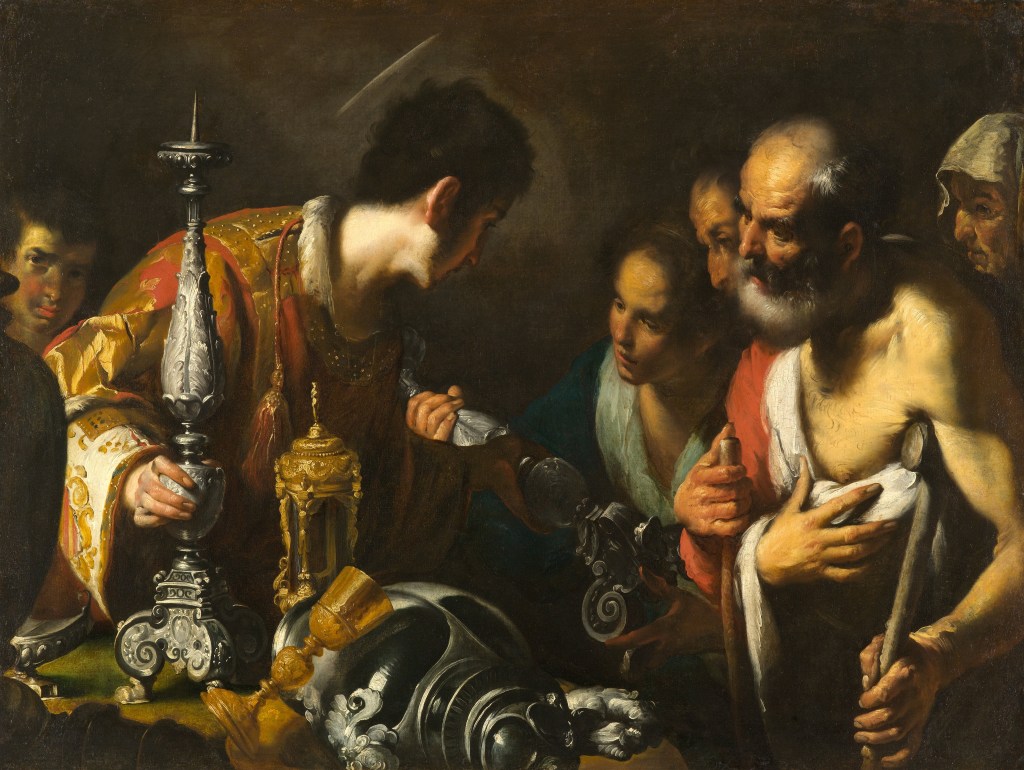
Painting by Bernardo Strozzi of St Lawrence, the third-century deacon and martyr. Lawrence was asked by the Roman prefect to bring the wealth of the church to help maintain the Roman army. Three days later, Lawrence returned with the blind and lame, lepers, orphans, and widows and said to the prefect, “These are the treasure of the Church.” St Lawrence on this your feast day, pray for us!

Link for the Mass readings for Saturday, August, 10, 2024

Aligned with God’s will, there are no limits.

“Where did this man get such wisdom and mighty deeds? Is he not the carpenter’s son?” (Mt 13:54-55).

Many people wonder what Jesus did from the age of twelve until he began his ministry around the age of thirty. Today’s reading gives us some insight into that question. Most likely, Jesus did nothing extraordinary, he was just as ordinary as any other first-century Palestinian Jew living in the small town of Nazareth, with a population of about 250 to 500 people.

Jesus most likely worked as a carpenter. This was rough, menial work, and as a day laborer, a position that was looked down upon. We can even see evidence of this in the Gospel accounts. Mark describes Jesus as the carpenter, the son of Mary, Matthew in today’s account portrays Jesus as the carpenter’s son, and Luke and John just refer to Jesus as Joseph’s son, leaving out any reference to carpenter altogether. Most scripture scholars believe Mark was written first, so we can see a progression in the biblical tradition moving quickly away from identifying Jesus as a carpenter.

Jesus’ return to his hometown and his teaching was first met with wonder. The question arose, “Where did he get such wisdom and how did he work such mighty deeds?” But wonder soon turned to judgment. Who is he? Isn’t he just the carpenter of Nazareth, no better than any of us. In effect, “Who does he think he is?” Not only does this show that Jesus probably lived a very simple peasant life, but that Jesus’ social status was set in stone.

The people’s hearts and minds were closed to Jesus. THEY KNEW who he was and there was no way someone like him could do what they had heard, so they “took offense at him… And he did not work many mighty deeds there because of their lack of faith” (Mt 13:57-58).

How many times have we judged someone? Have we said to ourselves, “I know who he or she is.” We box them in, not as they are, but as WE see them, as we define or label them. We look at another individual not as a person with dignity, but as a two-dimensional caricature to satisfy our own prejudgments and lack of vision. We also do this to ourselves when we resist God’s invitation to grow and follow his plan for us.

Maybe we have had a similar experience as Jesus did in returning to his hometown, in that we have sought or are seeking to move beyond our particular social status, or follow a dream or career out of the norm of familial or community expectations. No matter our age, through no fault of our own, by pursuing this path some or many may feel threatened.

One day Bruce Lee challenged Stirling Silliphant to run five instead of his usual three miles. Into their fourth mile, Stirling said, “if I run any more, I’m liable to have a heart attack and die.” Bruce then said, “die.” And ran off. Sterling was so mad he finished the five miles, approached Bruce and asked him why he said that.

Bruce replied, “Because you might as well be dead. Seriously, if you always put limits on what you can do, physical or anything else, it’ll spread over into the rest of your life. It’ll spread into your work, your morality, into your entire being. There are no limits. There are plateaus, but you must not stay there, you must go beyond them. If it kills you, it kills you. A man must constantly exceed his level” (p. 23).

Jesus rebukes limiting attitudes and perspectives. God the Father has a plan for all of our lives and invites each one of us to resist limiting ourselves and each other. Jesus, the carpenter, invites everyone to embrace the infinite possibilities that will arise when we participate in his life and the Holy Spirit seeks to free us from the shackles, those limitations imposed from within and without, that bind all of us so that we may be free to receive the fullness of and share the Father’s love.
———————————————————————–
Photo: Paused during Rosary walk to look off into the horizon, Riomar Beach, Vero Beach.

Link for the Mass readings for Friday, August 2, 2024

Stirling Silliphant story accessed from Bruce Lee: The Art of Expressing the Human Body, compiled and edited by John Little.

Parallel Gospel accounts: Mark 6:3, Matthew 13:55, Luke 4:22, and John 6:42

“Drawn to the Path”, will we go our own way or follow?

Jesus said to the disciples: “The Kingdom of heaven is like a net thrown into the sea, which collects fish of every kind.” (Mt 13:47).

The invitation of God is universal, and we are all lured by his invitation of love and intimacy. We long to belong, our very substance and essence as human beings is the reality that our ultimate fulfillment can only be reached in communion with the God who created us. Yet, though drawn, we resist being caught.

St Augustine (354-430), bishop of Hippo, came to a point in his life when he realized that the flame of his desire for wealth, fame, and pleasure was dimming. He felt moved toward “one reality that cannot decay, from which all other realities are derived.” Though he was caught in God’s net and being pulled in, Augustine still sought to wriggle free, for: “Though drawn to the Path, who is my savior, I shied from its hard traveling” (Augustine 2008, 161).

How many of us could echo Augustine’s dilemma? We have experienced God in our lives and feel the invitation to go deeper, and yet, we still seek to wriggle free. We are attracted to God while at the same time there are other things that have a stronger pull. We may also buy into the thought that God’s path is too hard. It is. Anything that has been worthwhile in our lives, haven’t we found that we have needed to be disciplined to obtain or even maintain it? Also, when we allow ourselves to be yoked to Christ, our load is lighter.

Mixed metaphors aside, it is harder and takes more effort to work against God’s will, just read the Book of Jonah! May we instead surrender to the current of the Father’s Love and allow ourselves to be caught in the net of his Grace. At first, anxiety and fear may arise, because the pull may appear too strong, his love too pure. Yet, when we align our discipline and effort with his will, the anxiety will wane, we will begin to feel safe, and we will indeed be free to swim again. This time with more exhilaration and joy than we had ever experienced before.

———————————————————————–

Photo: Following Mary’s lead, Rosary walk through Vero Beach.

Link for the Mass readings for Thursday, August 1, 2024

St Augustine. Confessions. Translated by Gary Wills. NY: Penguin Books, 2008.


There is a treasure of great value hidden and yet in our midst.

Jesus said to his disciples: “The Kingdom of heaven is like a treasure buried in a field, which a person finds and hides again, and out of joy goes and sells all that he has and buys that field” (Mt 13:44).

God is hiding in plain sight. God is in our midst, present to all of us, a wonderful treasure just waiting to be found. God’s eternal love and grace is ever reaching out to us. Our soul hungers, yearns, and seeks for that love, whether we know it or not. It is when we seek satisfaction, filling this deepest of our desires in material and finite pursuits alone, that we miss the true treasure. When we sin, create idols, seek the allure of apparent goods, we block our access to the very union we seek, we are not satisfied, and our desire increases all the more because we are seeking to fill that deepest void with everything but the one who wants to fill us to overflowing.

The saints and the mystics are those who have found the treasure of God’s will in their lives, they have experienced his love and mercy, and they have given themselves fully to God. They have encountered the living God in the mundane events of their lives and given all to be immersed in his communion. They “are amplifiers of every person’s more hidden life of faith, hope, and love. Their lives help us to hear the interior whispers and see the faint flickers of divine truth and love in ourselves and others. The Christian mystics point the way to fully authentic human life by illustrating what it means to be a human being, what life means: eternal union (which begins here) with the God of love” (Egan 1996, ix-xx).

God speaks in the silence of our hearts. Setting aside regular time to be still will help us to hear his whisperings. Opening our hearts and minds to God and seeking him in all things will help us to recognize those faint flickers and God-incidences present in our daily experiences. We can also experience Christ by reading and meditating on his Word, as well as reading the lives of the mystics and the saints, those who have found the treasure of Jesus’ presence and want to share it: St Francis of Assisi, St Teresa of Avila, St John of the Cross, St Therese of Lisieux, St Mother Teresa, and so many others are leading and urging us on to experience the rich encounter of the loving God of Jesus Christ.

Another who found this great treasure was St. Ignatius of Loyola (1491-1556), whose memorial we celebrate today. “While reading the life of Christ our Lord or the lives of the saints, he would reflect and reason with himself: ‘What if I should do what St. Francis or St. Dominic did?'” (Luis Gonzalez, The Liturgy of the Hours, vol III, 1975, 1566).  Might we ask this same question and so find the great treasure in our midst which is to experience the love of God in the depths of our souls, to love as Jesus loves us, as we continue our journey to become saints.

St. Ignatius, Pray for us!
———————————————————————–

Photo: Rosary walk Riomar Beach, Vero Beach.

Egan, Harvey D. An Anthology of Christian Mysticism, Second Edition. Collegeville, MN: Liturgical Press, 1996.

Link for the Mass readings for Wednesday, July 31, 2024

No darkness will overcome the love of the Holy Spirit.

“Explain to us the parable of the weeds in the field.” He said in reply, “He who sows good seed is the Son of Man, the field is the world, the good seed the children of the Kingdom. The weeds are the children of the Evil One, and the enemy who sows them is the Devil.” (Mt 13:36-39).

In this parable of the wheat and the weeds, Jesus is addressing the ancient question of why God allows evil and how are we to deal with it. Why do bad things happen to good people? As a starting point, we need to recognize that God is God, and we are not; meaning that we are not capable of reading the mind of God. Any answer to explain how and why God allows suffering will be insufficient. A second reality is that the Devil exists, though he is a created being. An angelic being, yes, but not equal in any way to God.

God is not a being. At best we can say he is Infinite Act of Existence, he is, or as God told Moses, “I am who am” (Exodus 3:14). God did not create evil, he only created good. “God looked at everything he had made, and found it very good” (Genesis 1:31). The Devil, Satan, the one who opposes, was created good also, as a high archangel, Lucifer, yet he chose to turn away from the will of God, and those angels who followed him are demons. God is greater than the Devil and his demons, and his good is greater than the evil they sow.

Evil is not so much a created thing, but a deprivation, or distortion of the good. God does not create evil, but he does allow it, and even though we cannot understand the reasons why God allows or permits evil or suffering, it is not a sufficient reason to say that God does not exist. This is especially true if we are seeking to grasp spiritual realities and truths from purely physical and rational means alone. We are indeed rational beings, who seek to know and to understand that which is good, but we are so much more. As human beings, we are physical AND spiritual, so need not limit ourselves to the merely sensate and empirical realm alone.

To better be guided by God, to hear his voice in the silence of our soul, to be fulfilled, our hearts and minds need to be open to the will of the Holy Spirit working in our lives. We are called to be people of prayer. As we mature spiritually and deepen our relationship with God, we will come to experience God as did Job: “I know that you can do all things, and that no purpose of yours can be hindered. I have dealt with great things that I do not understand; things too wonderful to me, which I cannot know” (Job 42: 2-3). In essence, Job acknowledged and accepted that God was in control, and he was not, and though he could not grasp everything, he trusted in the will of God for his ultimate good.

How do we deal with evil then? We need to surrender our pride and control over to God and acknowledge that he is in charge and knows what is best for us. We need to choose to put God first above ourselves and everything and everyone else. Our fundamental option, our telos, our end goal, is to embrace the reality that we are striving to be in a relationship with God. From the moment of our conception, we are a living, craving, hunger, and desire to be one with God and one another. This is true of the atheist and the mystic alike, whether we believe it or not. As we embrace this reality, put God first and focus on him, no matter what arises, we will begin to experience his presence in not only our everyday lives but begin to feel his presence with us in the midst of our suffering. We will come to know that he is stronger than any pain or evil, his grace is greater than any of our sins, and he will guide us through and give us what we need to endure.

Our loving God and Father has given us the means to understand suffering and evil especially in sending his Son to enter into our humanity, to suffer with us, even suffering his own unjust death on the cross. Our deepest prayer is when we willingly offer up our suffering and enter into the Mystery of the Passion of Jesus. Jesus, the pure and innocent one, beaten and crucified, understands our pain and agony, our cry for the horrors of injustice, and he understands the presence of evil. Jesus himself, asked not to be crucified, though he relinquished in saying, “Not my will but yours be done” (Lk 22:42).

In that acknowledgment, Jesus faced the utter evil, horror, betrayal, and injustice of humanity, his crucifixion. In taking upon himself the sin of the world on the Cross, he even felt his separation from his and our Father. Through his complete surrender into God forsakenness, into his death, and descent into hell, Jesus made the Resurrection possible. He conquered suffering, evil, and death forever, he brought about a greater good, through the evil of the crucifixion. No matter what trials we face, our Father has the last word over sin, suffering, and even our death.

We may not receive a sufficient answer or justification to suffering but we can experience the challenges we face with our hope intact by trusting that God hears our prayers and is present in our trials and tribulations. We receive help best when honest in our prayer, even when we are angry, afraid, doubtful, or frustrated. We will not find Jesus when we deny or run from our challenges. We will find him with his arms wide open and waiting for us when we are willing to ask and accept his help, and then enter into, face our suffering and pain.

We are not alone in our suffering. When we resist running from our pain, denying, or trying to distract or divert ourselves, and bring what we are going through to Jesus, he will provide a way and accompany us through every twist and turn. He understands what we are going through because he experienced the worst of human sin; he was betrayed, beaten, crucified, and died. We experience hope because Jesus has already won the battle and he sends us the Holy Spirit to give us the strength to endure.

No darkness can or will overcome the love of the Holy Spirit. Aligned with God we will be victorious even in the face of the greatest evil that confronts us. Let us trust in Jesus and each other, face whatever storm that arises with confidence and courage as did Jesus when he set his face toward Jerusalem. Empowered by the Holy Spirit we shall overcome.
———————————————————————–

Photo: Prayer connects us to the Light that shines in the darkness and is not overcome by it. Rosary walk North Hutchinson Island looking back at the mainland, Vero Beach, FL.

Link for the Mass readings for Tuesday, July 30, 2024

Are we weeds or wheat?

“’Master, did you not sow good seed in your field? Where have the weeds come from?’ He answered, ‘An enemy has done this.’ His slaves said to him, ‘Do you want us to go and pull them up?’ He replied, ‘No, if you pull up the weeds you might uproot the wheat along with them. Let them grow together until harvest” (Mt 13:27-30).

The master warned his servants to let the wheat and weeds grow together until they were more mature at the time of the harvest, so as not to pull up the wheat with the weeds. Weeds in this verse is translated from the original “Greek [as] zizanion [which] refers to a noxious weed that in its early stages closely resembles wheat and cannot be readily distinguished from it” (Harrington 2007, 204). Both, in their immature state, were indistinguishable.

Jesus is helping his disciples and to resist the temptation of condemning one another. Even when there are those who commit heinous acts of evil, and we may feel justified, Jesus says no. We are to convict another of their actions, and we are certainly to hold each other accountable, but condemn, no. The Father is the ultimate arbiter and judge. The Father sent his Son, not to condemn, but to save. There is always hope for repentance and a change of heart.

All of humanity has been created in the image and likeness of God, each of us are a unique gift to this world. We have been created good, yet all of us fall short of the glory and grace of God and because of our fallen nature our image and likeness to God has dimmed. God the Father will judge at the end of time between the wheat and the weeds and only he knows the time or the hour. Let us leave the judgment to God. Our invitation is to repent and align ourselves to the will of God, to encourage each other in the maturation process which can include, convicting others when needed, yes, but above all with love, willing each other’s good.

We are to resist the temptation the poisonous practices of gossip, prejudice, and self righteousness that create division and separation. Instead let us welcome, nurture and care for one another, promote unity while respecting the diversity of each person and their thought. We can disagree and have a good argument when we keep it at the level of an exchange of ideas while refraining from dehumanizing one another, and in the end accompany and be there for one another through thick and thin.

Not an easy path. What will help us, is to recognize that we are all in need of healing and transformation. Let us pray for patience, understanding, seek forgiveness, as well as be willing to forgive each other. Life, even when going well, is hard. We need the encouragement and support of each other if we are to mature and actualize the fullness of who God calls us to be as we strive through God’s grace to restore our image and likeness to God. “Encourage each other while it is still today” (Hebrews 3:13)!
—————————————

Photo: No wheat on Rosary walk but did find some sea oats. Riomar Beach, Vero Beach, FL.

Link for the Mass readings for Saturday, July 27, 2024.

Harrington SJ, Daniel J. “The Gospel of Matthew”. In vol. 1, Sacra Pagina Series, edited by Daniel J. Harrington. Minnesota, Liturgical Press, 2007.

Focus on God who alone matters now.

“But the seed sown on rich soil is the one who hears the word and understands it, who indeed bears and yields a hundred or sixty or thirtyfold” (Mt 13:23).

God loves us. All of creation and each one of us have been created out of an outpouring of his love. God wants to be in relationship with us and like a good Father wants the best for us. He has sent his Son to be one with us in our humanity so that we can become one with him in his divinity. Time and again, generation after generation, since Adam and Eve, there are those who have rejected the Father’s love, rejected his Son, and the stirrings of the Holy Spirit.

In Jesus explaining the Parable of the Sower to his disciples, he is expressing why people may turn away from the generosity of God’s love. In a modern context we can experience hearing a word that touches our heart in Mass during one of the readings, prayers, homily, or verse from one of the hymns, or while in our own personal time of prayer. We are moved or even challenged. The devil can then threaten to take it away, we can meditate upon it for a time and then move onto other things forgetting this graced moment, we may even bring it back to mind for a time, but not apply it or put what we have learned into practice. Instead of taking firm root, maturing, sprouting and bearing fruit we remain spiritually immature.

Those who have “rich soil” to receive Jesus are those who hear his word, ponder it, return to it often, and put it into practice. The discipline of putting into practice what we have received from Jesus is the key for it taking firm root and transforming our lives. We are so focused too many times on completing and moving on to the next thing that, even when moved, touched, or challenged by his word, we can set the wondrous experience aside to move onto the next task.

I have been inspired and challenged recently by the words of Romano Guardini: “This restless being wants to pray. Can he do it? Only if he steps out of the stream of restlessness and composes himself. This means discarding roaming desires and concentrating on that thing alone which, for the time being, is the only one that matters… to become still; to free oneself of everything which is irrelevant, and to hold oneself at the disposal of God, who alone matters now” (Guardini, 12).

The message imparted by these words is not new, and this is a practice that I have been engaged in for years. Yet, these words engaged me, especially, “hold oneself at the disposal of God, who alone matters now.” They have been like rich compost that has been nourishing my prayer life and daily experiences for the past week. When my mind starts to wander, I bring it back, “God alone matters now.” and then a calming breath follows and I continue.

This is a good practice to begin to prepare rich soil, to return to, and go deeper with! All the invitations, temptations, apparent goods and glitter, pale in comparison to the hunger and desire that we all experience which is for a deeper intimacy with God. No one or nothing else fulfills. When we put all else aside and focus on God alone, he satisfies. Grounded in his infinite love, our relationships improve because we no longer cling out of a fear of losing them. We enjoy the material more because we no longer project onto them what they could never provide. Anxieties and fears lessen because we feel more safe and secure.


Photo: Enjoying a Rosary walk and the oaks of the neighborhood of Vero Beach, FL.

Link for the Mass readings for Friday, July 26, 2024

Guardini, Romano. The Art of Praying: The Principles and Methods of Christian Prayer.Manchester, NH: Sophia Institute Press, 1985.

Following the will of God helps us to grow closer to Jesus and each other.

What Jesus proposes is not an either/or statement, but is meant to be a both/and statement. The end goal of our life is to be in communion with God. To attain that goal, we need to not only acknowledge that God exists but also come to know and follow God’s will. As Jesus said, “For whoever does the will of my heavenly Father is my brother, and sister, and mother.” (Mt 12:50). The challenge is that there is so much that pulls at us for our attention, so much that reaches out to divert us. People, activities, material pursuits are all vying for first place for our minds, hearts, and souls.

Then there are the challenges, demands, joy and wonders of family life. We often read, hear, and experience ourselves, how much the family is being challenged in our modern age from without and within. Many of us strive to put family first in our lives. That ought to and needs to be a priority as healthy relationships require commitment, love, sacrifice, and persistence. What Jesus offers then seems to be counter-intuitive to that reality.

Jesus is interrupted while he is teaching, and told that his mother and brothers were there wanting to see him. We would think he would say, “Great! Bring them right in, I have a place reserved for them here, front and center!” Yet, I am sure that his comment, “Who is my mother? Who are my brothers” (Mt 12:49), raised a few eyebrows and hackles.

Jesus was not choosing his disciples over his family, he was clarifying that the primacy of place of God his Father is to be first and foremost. “For whoever does the will of my heavenly Father is my brother, and sister, and mother” (Mt 12:50). Families come in many different shapes and sizes, one size indeed does not fit all. Building our relationship with our heavenly Father is the foundation toward striving toward healthier relationships.

As our ego and self-centeredness become less of a focus, we slowly come to realized we are not the center of the universe. This is no overnight or easy process, but as we surrender a little more each day to the truth that God is our Father and Jesus is our Lord, we will begin to experience the love of the Holy Spirit a little more. As the relationship of God becomes foremost in our life, we will begin to change. We will become more patient, understanding, less reactive, and more present to one another.

As we continue to mature in our spiritual life, we will also begin to experience the fruit of the Holy Spirit: love, joy, peace, patience, kindness, goodness, gentleness, and self-control (cf. Galatians 5:22-23). In sharing what we have received, we will be more available to others and better able to foster deeper relationships with our own family members, while at the same time experience a larger extended family, with those beyond blood. Let us surrender ourselves and all of our relationships to and entrust them into Jesus’ care.

Who was the closest relationship Jesus had? Mary. Not because she gave birth to him, but because who better than Mary followed the will of his Father? If life with some family members is a little bumpy right now or you just want to deepen your familial bonds, begin your day with Mary and say often, “May it be done to me according to your word” (Lk 1:38) and let God happen.


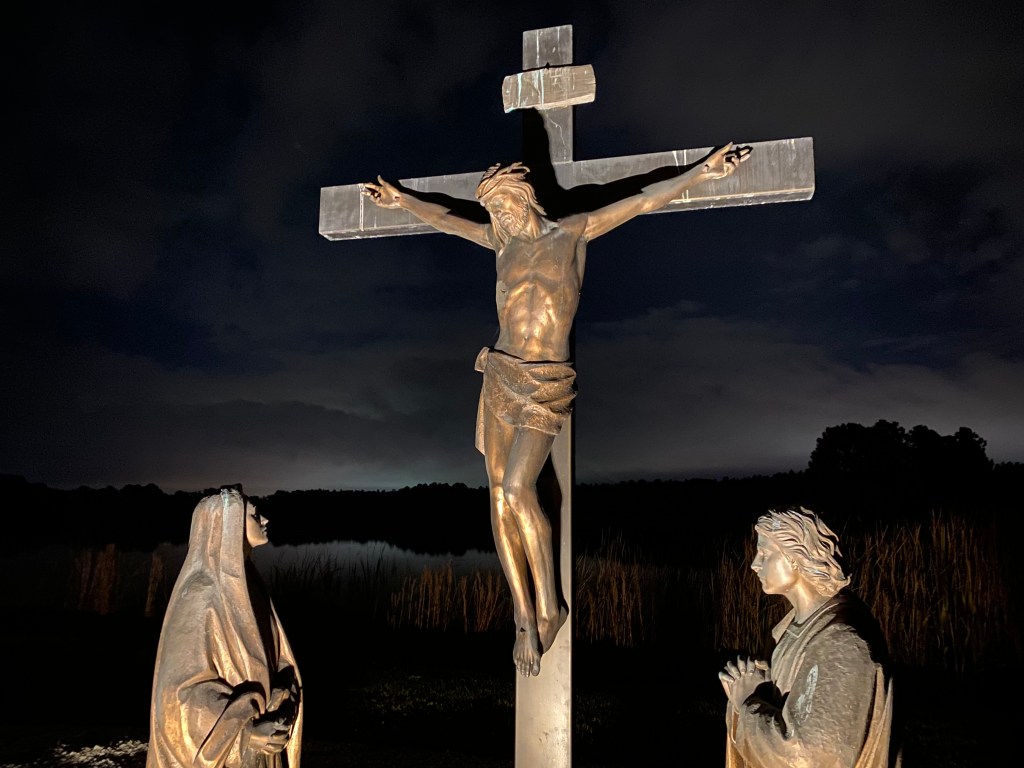
Photo: Mary and John followed Jesus all the way to the Cross. While on canonical retreat last December at Bethany Center, Lutz, FL.

Link for the Mass readings for Tuesday, July 23, 2024

Jesus will help us to discern when to walk away and when to stand firm.

In today’s Gospel from Matthew, Jesus realized that: “The Pharisees went out and took counsel against Jesus to put him to death” (Mt 12:14). Jesus did not then start to plan how he would defend himself against their plot, he did not arm his supporters, nor is there any indication that Jesus let the fact that he was a marked man bother him. What did Jesus do with this bit of news?

“He withdrew from that place” (Mt. 12:15) and cured those who followed him. Was Jesus being a coward by withdrawing? No. Jesus refused to engage or give any of his time or energy to their negativity or threat. He focused on what he was about and that was continuing the mission that God had sent him to achieve, which was to help bring about the salvation of humanity and the world and to call those who would work with him to continue his mission.

Many of us will hopefully not receive death threats, but many of us have and may witness and/or receive critical, negative, belittling, or dehumanizing looks, words, and outright actions to cause physical, mental, emotional or spiritual harm. For those of us who choose to practice publicly the teachings of Jesus, we may receive even more!

Our common response to the many forms of perceived or actual animosity directed toward us is to react. Our reactions generally are based on learned defense mechanisms we have adopted. Often when we react, we slip into survival mode, experience increased anxiety, defensiveness, anger as well as a myriad of other emotions. Hopefully, as we mature in our faith we will resist reacting, remember to breath, and call upon God’s guidance to direct us such that we can be less reactive and more attentive to how to act as advocates of God’s grace.

Life is short, let us not take a day or moment for granted, nor give away our precious time by engaging in unneeded drama or negativity. There are times that we do need to stand and speak up. Other times, as Jesus did today, we need to walk away and direct our energies elsewhere. With each challenge, may we call on Jesus for his discernment on how best to act in each situation.

The words of Teresa of Avila, Spanish saint and doctor of the Church, (1514-1582) are good ones to repeat and meditate upon: “Let nothing disturb you, Let nothing frighten you, All things are passing away: God never changes. Patience obtains all things. Whoever has God lacks nothing; God alone suffices.”


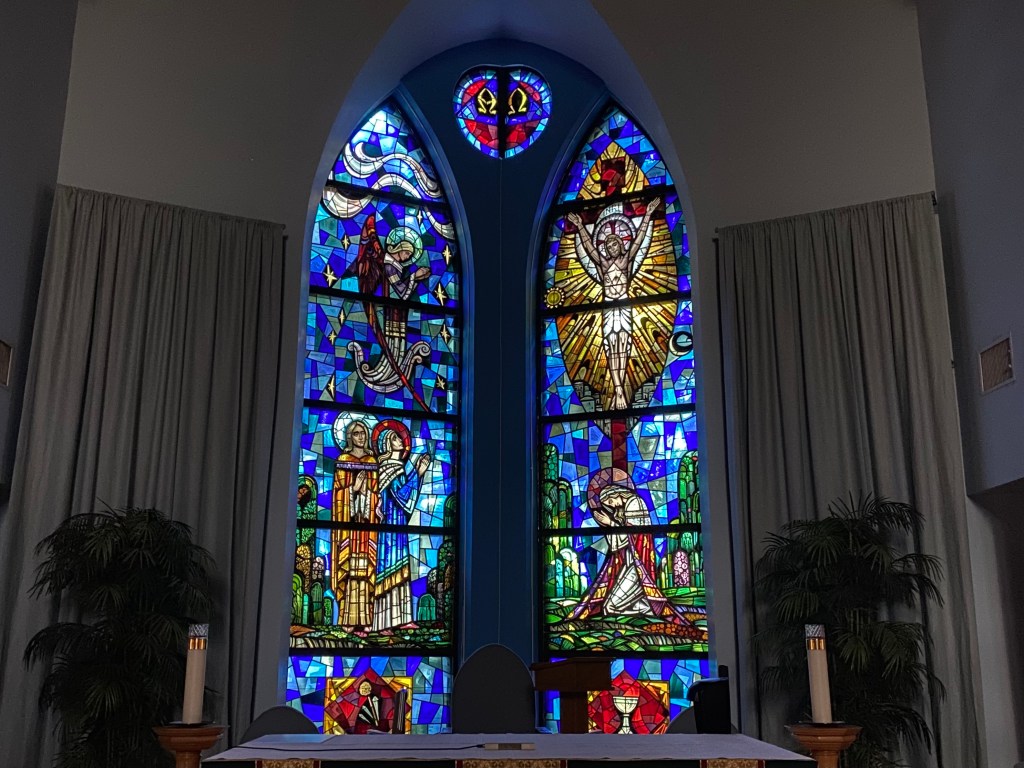
Photo: Jesus walked away from today’s threat but was willing to endure the greatest suffering of all when his appointed time had come to save and restore us to the Father. Praying in the sanctuary of Holy Cross, Vero Beach.

Link for the Mass readings for Saturday, July, 20, 2024

In Jesus, we are grounded and renewed.

“At that time Jesus exclaimed: ‘I give praise to you, Father, Lord of heaven and earth, for although you have hidden these things from the wise and the learned you have revealed them to the childlike’” (Mt 11:25).

Why did the wise and the learned, referring to some of the Sadducees, Pharisees and scribes, reject Jesus? One possibility is that Jesus challenged their idol of tradition. Even though Jesus did not come to abolish the law but to fulfill it (cf. Mt 5:17), the invitation to go deeper was and continues to be challenging. This is certainly highlighted in the six antitheses that Jesus shared during his Sermon on the Mount. Here is one such example: “You have heard that it was said, ‘An eye for an eye and a tooth for a tooth.’ But I say to you, offer no resistance to one who is evil” (Mt 5: 28). Offer no resistance to one who is evil? Not only hard to swallow for people of Jesus’ time, but for us today as well.

Jesus offered then and continues to offer us today a share in the intimacy of the Trinitarian Love of God shared between Father, Son, and Holy Spirit. To be fully alive, to share in his Love, we need to resist being governed by holding blindly on to tradition for its own sake. Instead, we need to be open to growth, change, and renewal. Gerhard Lohfink, in his book, No Irrelevant Jesus, quotes the Polish philosopher Leszak Kolakowski: “A society in which tradition becomes a cult is condemned to stagnation; a society that tries to live entirely through revolt against tradition condemns itself to destruction” (Lohfink 2014, 2).

Many have left the Church because they feel we are too steeped in tradition, rules, and laws, and yet in doing so, they have left behind the secure ground or foundation, with no anchor in their life. On the other extreme are those who remain hunkered down, entrenched in a bunker of tradition fearing the secular tide, grasping, white knuckled, to tradition, but this stifles their growth.

Both tendencies are insufficient because at root there is not a trust in Jesus. Jesus helps balance the tension between these two. He invites us to remain anchored in the Truth of the deposit of faith that he has given to us while encouraging us to go deeper in our understanding, practice of our faith and relationship with our God. If we are not moving forward in our spiritual lives, we are moving backward.

We are better when we resist the extremes of rejecting tradition altogether or idolizing tradition alone, and instead build on the foundation of Jesus Christ: “The Way, the Truth and the Life” (cf. Jn 14:6). Within the life of the Church, “we must not do away with its traditions, but at the same time, it must continually clarify, renew, and deepen them” (Lohfink 2014, 2).

—————————————

Photo: Rosary walk last night – Riomar Beach, Vero Beach FL. Just like the ebb and flow of the tides we must allow for a rhythm of expansion and contraction in our faith journeys. We are called to be grounded in Jesus and stretched beyond our comfort zones as well!

Lohfink, Gerhard. No Irrelevant Jesus: On Jesus and the Church Today. Minnesota: Liturgical Press, 2014

Link for the Mass readings for Wednesday, July 17, 2024