The guidance of the Holy Spirit offers us more wonder, beauty, good, and truth than we can imagine.

Benjamin Franklin is quoted as saying, “Wise men don’t need advice. Fools won’t take it.” Most of us fall somewhere in the middle. Hopefully, we are less foolish and moving more along to path of gaining wisdom. Jesus continues his best efforts in today’s Gospel to offer guidance and assurance to his disciples that the Holy Spirit will continue to be their guide after his departure. “I have much more to tell you, but you cannot bear it now. But when he comes, the Spirit of truth, he will guide you to all truth” (Jn 16:12-13a).

Surely, Jesus could see the dimming lamps in the eyes of his disciples. As discussed yesterday, comprehending the death of the Messiah, his Resurrection, and return to the Father was a bit much to understand, let alone digest. Also, there was only so much that they could grasp with their finite intellect. Until they experienced the infused contemplative insights given to them by the Holy Spirit, there was only so much the apostles were able to be able to receive regarding the inner life of the Trinity, the divine communion of love between he Father, and the Son, and the Holy Spirit.

Yet, Jesus, sowed the seeds that his Father gave him to share. His disciples took in what they could and would come to reflect later with more experience. Jesus’ death and Ascension were not to put an end to their learning, deepening of their understanding, healing or further developing their relationship with Jesus and his Father. The Holy Spirit would continue what Jesus started, and would to lead them to all truth, the fullness of the foundational relationship that is the source of all that exists, the Holy Trinity.

Anyone involved in teaching anyone anything or learning something for one self knows, that just telling someone something does not mean that learning has happened. There is a process of introduction, integration, practice, review, mistakes, corrections, and adjustments until some proficiency is achieved. With the disciples, this is the same. Jesus did not just present things once and move on to the next order of business. That is why John declared at the end of his Gospel that: “There are also many other things that Jesus did, but if these were to be described individually, I do not think the whole world would contain the books that would be written” (Jn 21:25).

I am sure a part of what John was talking about here were the lessons, corrections, and guidance Jesus offered. Just as Joseph modeled for and guided Jesus in his trade in carpentry, so Jesus learned from him through observation, practice, mistakes, adjustments, and corrections. Jesus guided his disciples in the same way, as a mentor with apprentices. He was now assuring them that even though he would be leaving them, the guidance and leading would continue with the support of the Holy Spirit.

The lessons about the immanence of God, God within himself as a Trinitarian communion, that Jesus taught were not as concrete as sawing, hammering, and planing wooden beams though. God is not a being, not even a supreme being, meaning that he transcends our ability to comprehend the fullness of his reality. We will never fully comprehend God or exhaust the richness and the depth of our relationship with God. What the apostles and the saints to follow and we can still experience today is God’s grace building on our nature. When we read, pray, and meditate with these sacred texts, the Holy Spirit will communicate with us and grant us insights beyond any intellectual endeavor. Context and study is important, but the understanding and transformation is gained through the guidance of the Holy Spirit.

On the human level, we are guilty of malpractice in our relationships when we assume that we know everything there is to know about someone else. The gift of the person, the human being, is that we are ever-developing and growing in the mystery and wonder of who we are and who we are called to be. We can always surprise each other. If this is true for us in our relationships with each other, it is much more true in our relationship with God. Once we get to one level of understanding, we plateau for a time, but that is not the end of the journey. That is only a time to savor, to ponder, and contemplate until we are ready to go ever deeper into the truth that the Holy Spirit will reveal to us.

Our tradition teaches us that the fullness of God has been revealed in Jesus Christ, which is true, yet to comprehend that revelation will take a lifetime and continue on into eternity just to scratch the surface. St Thomas Aquinas (1225-1274), a Dominican Friar, who is considered the Angelic Doctor of the Church, was one of the top theological influences during the Scholastic Period, yet close to the end of his life he had a deep and intimate encounter with God in which he came to realize that all of his intellectual achievement, all that he had written, mattered no more than a pile of straw compared to that which God had revealed to him in a single moment of infused contemplation!

Arguably one of the wisest persons of his time, and some would say one of the most brilliant minds ever, was also one who was steeped in daily prayer and continued to be open to the majestic wonder of the glory of God. May we too continue to embrace the gift of wonder, the gift of learning, and never settle, rest and savor yes, but continue to learn and grow, to seek and hunger for the Good, the True, and the Beautiful, to continually allow our hearts and minds to be open to the Holy Spirit that he may guide us “to all truth”!


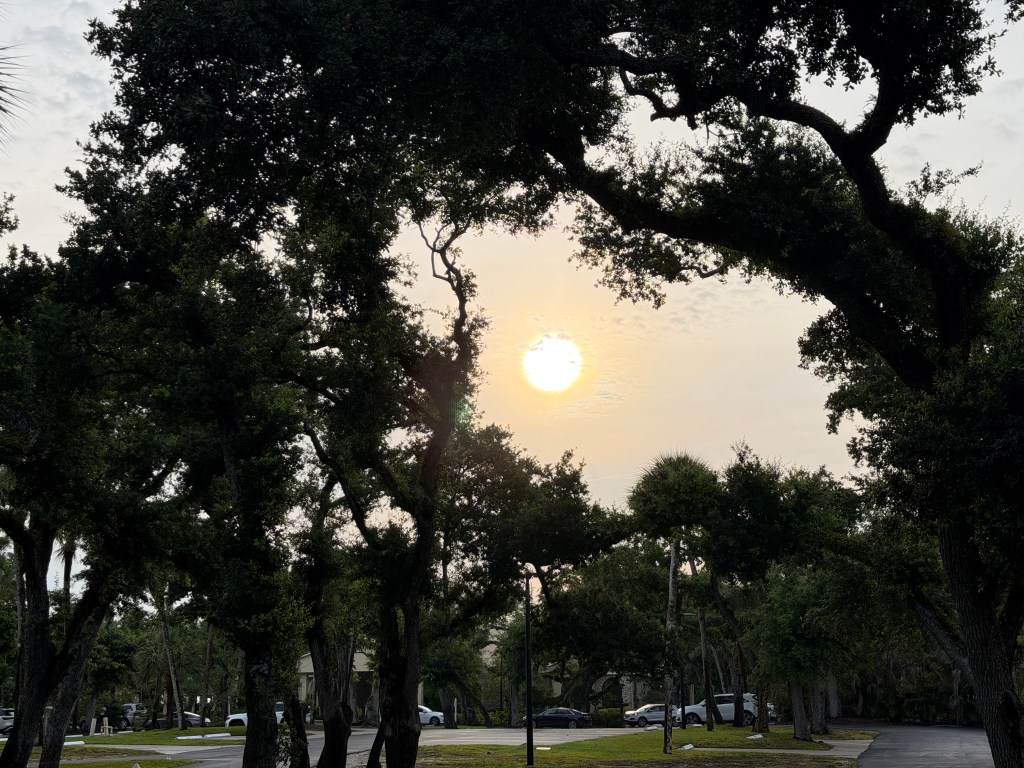
Photo: Experienced a nudge of the Holy Spirit to take a longer walk before Mass yesterday morning. A wonderful moment of joy from a simple activity that then heightened as I celebrated Mass.

Link for the Mass readings for Wednesday, May 13, 2026

Pausing and praying with God will help us to decide what is truly good.

“Here I am living in a house of cedar, while the ark of God dwells in a tent” (2 Samuel 7:2)!

David felt moved to build a magnificent dwelling for the LORD. Nathan the prophet endorsed the idea with the stamp of approval coming from God. The thought sounded like a good one on the surface, the problem that was pointed out by the LORD himself was that although the intention may have appeared to be good, it was not coming from God.

What interested God more than a dwelling place for himself, was establishing an eternal kingdom which he sought to establish through one of David’s heirs. At the proper time and place, God would act and send his Son to be born and come from the line of David: “I will be a father to him, and he shall be a son to me. Your house and your Kingdom shall endure forever before me; your throne shall stand firm forever’” (2 Samuel 7:16).

We can often find ourselves in the same situation as David and Nathan. We may be moving to act on an insight that we think is coming from God, when in fact it is not. We can be seeking to follow through on something good, that is in reality only an apparent good. This is where a pregnant and prayerful pause is helpful. It is important to resist the temptation to get ahead of our skis, and move ahead of God. This can be difficult in a world that is satiated in instant gratification.

What is helpful when we have what appears to be a good idea is to continue to bring it to God in prayer. To wait a period of time and seek the guidance of the Holy Spirit during times of regular silence. As St. Mother Teresa of Calcutta taught, “God speaks in the silence of the heart.” Spending time in the Bible daily and listening to the word proclaimed during the Mass as well as seeking guidance from people who we trust, especially in spiritual matters, are also ways to discern well.

Looking back on experiences where God’s guidance was evidenced helps too. Consistently seeking God’s guidance with each, thought, word, and action really helps us to grow in knowing God and his will.  The more often we do so, the more we will recognize God’s direction and guidance and each time thereafter his voice will become more distinguishable. God will let us know his will and lead the course we are to proceed. Often there is a peace that accompanies clarity, and sometimes, that clarity and peace may appear instantly. Although, more often than not, the clarity we seek comes with time.


Photo: A few more Advent colors as we prepare to enter the Christmas Season. Walking and looking up helps to clear the cobwebs and see God’s will more clearly.

Link for the Mass readings for Wednesday, December 24, 2025